


Erhalten Sie Zugang zu diesem und mehr als 300000 Büchern ab EUR 5,99 monatlich.
- Herausgeber: Books on Demand
- Kategorie: Sachliteratur, Reportagen, Biografien
- Sprache: Englisch
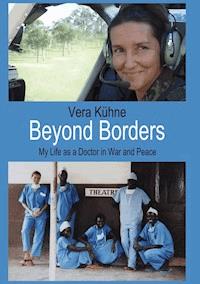
"I want to be alert and feel life." At the beginning of her career, the young surgeon Vera Kühne courageously decides against the bureaucratic medicine business in Germany and becomes involved with Doctors Without Borders and other aid organisations which take her to crisis areas around the world. Without fear, she treats the victims of civil wars and natural disasters in Sudan, Colombia, Haiti and Macedonia. Until the Federal Armed Forces send her to Afghanistan as a doctor. Beyond Borders is the story of a self-confident and strong woman and her fight for a small piece of justice in this world.
Sie lesen das E-Book in den Legimi-Apps auf:
Seitenzahl: 368
Veröffentlichungsjahr: 2017
Das E-Book (TTS) können Sie hören im Abo „Legimi Premium” in Legimi-Apps auf:
Ähnliche

















For Malith and the Dinka of Rumbek
‘The main thing is that we are awake now.
Hopefully we remain so for a long time to come.’
Alice in Stanley Kubrick's 'Eyes wide shut' –
after Arthur Schnitzler, ‘Dream Story’
TABLE OF CONTENT
WAKE-UP CALL
SUDAN – White Dinka, On My Own In The Bush
GERMANY – In Transit
PAPUA NEW GUINEA – Community in Paradise
TAIZÉ – God, what do you want from me?
AFGHANISTAN – An Assignment Over Christmas
BAMBERG – Home Base in Germany
HAITI – State of Emergency
WAKE-UP CALL
I saw him in the middle of the crowd: He was a head taller than everybody else and he was smiling, his big white teeth shining in his deep black face. I noticed the typical gap between the upper incisors and scarred embellishments on his forehead.
He was a Dinka, without any doubt.
And there he stood, in the middle of a flea market in a parking lot in Nuremberg, Germany, in 2012. He was wearing jeans and runners and a sports jacket over a chequered shirt. His clothes were European but the way he moved and laughed all over his face was completely different.
All of a sudden, my mind was back in Rumbek in South Sudan. I saw the men dance in a meeting place, watched how they moved their slim bodies powerfully and yet gracefully in the rhythm. And I saw Bol, our security guard, standing in front of his tukul at lunch time and trying to tell me a Dinka joke. He laughed loudly and threw his head back so that I had to laugh too, although I didn’t understand a word.
I walked towards the unknown young man on the parking lot. How on earth did he get to Nuremberg? Seeing him reminded me of a promise which I had not kept. At the time in South Sudan I had promised the Dinka to write their story, to make it known to everyone. I was to bear witness so the world would not forget them.
This was years ago and in the meantime, I had experienced so much more. However, this first long assignment was decisive for me. I was only 30 years old and rather inexperienced as a doctor when I applied for a job with Malteser Foreign Aid Department.
I wanted to see the world, wanted to find out how far I could get and how far I could go. I wanted to experience boundaries, external as well as internal borders – and find my own limits.
I succeeded in this. In Sudan in particular I had clearly encountered my limits – and exceeded them more than once.
My work there was just a drop in the ocean. Nobody knows whether the Dinka will survive. However, our small bush hospital was a signal, a sign of solidarity and humanity in a country completely devastated by war and famine. A sign of the fact that the world will not leave the people there to their own devices.
For me, the experiences with the Dinka of Rumbek were twofold: fascinating in their rough beauty and intensity, but often also disturbing and shocking in their harshness and brutality. In any case, the months in Rumbek shaped and changed me forever.
‘My Dinka’ – proud, wild, fearless, vivid. They have taught me several important lessons: that life has its own laws and paths, that it catches you unexpectedly, that it surprises and thrills you. That it is exhausting, cruel and yet full of miracles time and time again, even amidst a civil war.
In the years after this assignment I worked as a doctor for many different organisations on all continents: in Kosovo, Papua New Guinea, Columbia, Uganda, Ghana and Haiti; I crossed the South Pacific on a ship and was on a foreign assignment with the German Armed Forces. But also in Germany I experienced a great deal in accident and emergency departments and operating theatres of various hospitals as well as being an emergency doctor on the road.
In order to process my experiences, I have been keeping a diary for many years; I started writing at the age of 13. To put my thoughts into words is the best way for me to sort, analyse and, so to speak, ‘capture’ my experiences on paper. Feeling reassured, I can close the book and move on.
However, I am also writing because I would like to find an explanation for the reason why I have to set off again and again and what it is that incites me in the whole scheme of things. I am not a Mother Teresa; I have only ever done what I wanted, I have not sacrificed myself. To the contrary: I often think that it is me who would have to thank all those people who allowed me to help them.
Albert Schweitzer writes: ‘Our civilisation is burdened with a great debt. In fact, we are not free to help other people or not as we please; it is our duty.’ This is exactly what I feel, too: We have a responsibility – for what we do and also for what we do not do. We, the people in the rich countries, may not take more than we give. I have always felt obliged to give something back to somebody, to not lock myself in here in my comfortable life in Europe.
Apart from this, I freely confess that chaos has always greatly appealed to me. Be it in the hospital, on my assignments or in my garden, I like diversity, I love life with all its power, with its beautiful and its ugly facets, the soft and the harsh ones. I like how life evolves, how it always takes its own course, how it develops freely and in an unimpeded manner. This is probably another reason why I decided to go for emergency medicine. I am the type of person suited to a state of emergency. In any such moments, I feel wide awake. I see clearly, my senses are sharp and I experience everything very intensely; I am living in the moment.
For this reason, it is sometimes also more difficult to come home into ‘normality’, into an every-day life, than to leave – many people do not understand this. In the past, it has often made me sad; feeling left alone with my concept of life and I thought that my dream would probably not be compatible with a partnership. These days I am fortunate to have found a man who is there for me when I need him but still allows me the freedom to leave again – it is a wonderful feeling to have finally arrived.
I know that every person is different, that everybody has to find his or her individual way and that not all people are seeking to push the limits like me. But I want to set off, feel life and discover the essence of living. Death is a part of it, as well as violence. Even if I am frightened: I want to be right in the middle of it, I want to look beyond the borders. Otherwise I do not feel alive.
SUDAN
White Dinka – On My Own In The Bush
Nairobi, 10 July 1999. Ines and I were sitting in the breakfast room of a modest guesthouse run by nuns in Nairobi and were eating. Or rather: She was eating and I watched her in a state of fascination because she was just polishing off the third portion of fruit salad without even looking at me. She was all skin and bone and it seemed as if she had just managed to flee from a famine. I was starting to seriously doubt whether my plan had been such a great idea after all. Ines was a nurse and had just returned from an aid project in Rumbek where I would travel to in the next few days. Provided it would ever be possible to obtain an entry permit into South Sudan. But did I actually still want to go there? Ines didn’t look good at all…
I was thinking about how I was hired by the Malteser two weeks ago. It happened really quickly after a friend of mine had to step back from her assignment and suggested that I go in her place. I drove to Cologne, survived several interviews, in which I was considered to be suitable, and before I even realised, I had been hired as a medical coordinator and doctor for Rumbek. I was to manage – or set up, that wasn’t quite clear – a bush hospital in the south of Sudan which had been shaken by many years of civil war.
I had more concerns myself than the Malteser. I was 30 years of age, up until now my training, apart from having studied medicine, included an illustrious two and a half years of surgery, three months of anaesthetics as well as a diploma course in tropical medicine. Not very much to play hospital manager. Apart from that I had never been to Africa ‘properly’, not taking into account two weeks of holiday in Egypt. “Don’t worry, it’ll be fine. You’ve got the right attitude. We have taken care of finding a second surgeon.”, the employee in the Malteser office said happily. At the moment I was worried nevertheless because the second surgeon had cancelled in the last minute.
But first things first: From June to December 1999 the MAD (Malteser Foreign Aid Department) sent me to South Sudan as a medical coordinator and managing doctor. The MAD, a division of the German Malteser Hilfsdienst (‘Malteser Aid Service’), is a church-operated non-governmental organisation (NGO) which conducts aid projects in several countries of the south (formerly called ‘third world countries’).
Until 2005 one of the longest and bloodiest civil wars of Africa was ongoing in Sudan. It was one of the most severe conflicts on the continent from 1956 to 1972, and has been again since 1983. In 2011 the country was divided. The north of the massive country, which is more than seven times bigger than the Federal Republic of Germany, is of the Arabic-Muslim belief whereas, in addition to the old nature religions, Christianity has become established in the Black African south. The different religions have been considered the cause for the conflicts for a long time. Meanwhile, however, it is obvious that the conflict is mainly due to vast oil reserves which are mainly located in the middle of the country.
The financial and strategic interests of other countries also play an important role, which is why the war has been fuelled anew again and again. Occasionally there are horror reports in the media about periods of drought, famine, slave trade and a never-ending flow of refugees.
However, the reality is a far cry from these reports. The war has been going on for too long to still make breaking news. The people’s interest in obviously unsolvable problems dissipates after a while and then fresh news needs to be discovered.
The purpose of the Malteser’s project was to alleviate the extreme state of medical emergency in the Bahr-el-Ghazal region, in which about 1.5 million people live, and to set up basic medical care by indigenous people as far as possible. To achieve this, the former district capital, Rumbek, was chosen which was considered to have been relatively stable at the time of my assignment.
Rumbek had a population of more than 30,000 inhabitants before the war. However, everything has now been destroyed, there were no schools, no infrastructure anymore. Just like in former times, people moved from one place to another as nomads with their cattle herds, always on the run and between the frontlines of the Sudanese People’s Liberation Army (SPLA) and the soldiers of the official government from the north. Yet most people did not die of direct war actions but as a result of the indirect causes such as hunger and lack of medical care. This state has not changed much to date although the troops of the north withdrew from the south in October 2005 and South Sudan declared its political autonomy in 2011. It will take many, many years to restore what was destroyed in this country – and in its people.
I should have flown to Sudan on 6 July 1999 together with Robert, a technician from Uganda, but things turned out differently. The ‘President’ of the Office of the Sudanese Relief and Rehabilitation Association (SRRA), which considered itself as the government of South Sudan at the time, and was thus also responsible for entry and work permits, first made us wait for ages in front of his office on two pathetic little benches as if we were in the dock and then declared in many long-winded, flowery words that we were not welcome in South Sudan.
Only the bishop of Nairobi, Cesare Mazzolari, an old, rather sick Italian, was able to help us. We visited him in his house. I liked him immediately. He was a true shepherd. It was obvious that he really cared for his flock of sheep. He showed us photos of the first church service in Rumbek, during which he had blessed the hospital, which had been in the process of being built at the time, as well as the people there. This was very important to him; with gleaming eyes and a lot of enthusiasm he told us about the progress that had been made there since the start of the building works three months ago. These were the first positive images I saw and the first positive stories I heard about Rumbek.
We told him about the incident at the governmental office. He was sad and worried but not without hope. I had the impression that he was able to assess the situation much better than us, he knew the connections and the manner in which the people here were thinking. He was a wise old man; I was very impressed.
Indeed, he managed to get the documents for us. Three days later we finally received our entry permit. My mood was subdued as a result of a phone call from the Malteser from Cologne: the second surgeon had cancelled. They asked me in a chirpy mood whether I was able to operate in addition to my coordination job. At the end of the phone call they warned me about the fact that the situation in South Sudan was very dangerous. In fact, however, I was a lot more shocked about not having a second surgeon in the hospital now. This was just how I had not imagined things to be! Having two and a half years of experience in surgery I had categorically declined such missions. But what was the alternative: to watch? My concerns were increasing day by day, but now that we were finally allowed to enter the country after all those efforts, I just couldn’t refuse anymore.
At 6.30 a.m. on 14 July, Robert, a technician from Uganda, and I were finally able to set off. First, we took an aircraft from Nairobi to Loki, short for Lokichoggio, a place at the Kenyan-Sudanese border which had moved from formerly being a water place to a hub of several aid organisations. During the uncomfortable flight I thought: “Are you crazy? What the hell are you doing here? You could now be sitting in Bamberg at the Spezi-Keller bier garden, enjoying the summer with a cool beer…”
After several hours of waiting in Loki we got on board a second aircraft, accompanied by Cesare Mazzolari, the bishop of Nairobi, as well as by half a dozen nuns and several Brothers and Fathers. Against the background of such cumulative trust in God I thought it rather unlikely that we would crash despite our means of transport being in a doubtful state. We were crammed into a space where you would normally expect passenger seats to be, wedged in between suitcases, boxes, bananas, pineapples and a bicycle. Through the non-existent cockpit door, the pilot was in full view, throwing a Coke tin towards me as refreshment. Alternatively, he said he could also walk ‘through the aisle’ in his capacity as a ‘real flight attendant’ and switch on the autopilot in the meantime. I preferred having my drink thrown to me after all. As a sign of special honour, I was seated next to the bishop, who immediately started to explain the function of his camera to me, obviously his favourite toy. This went into full detail and three quarters of an hour later he had still not explained all the buttons and switches. By now I was feeling terribly sick. I don’t feel sick easily, but the constant up and down with as much mobility and heat as in an oven in addition to my effort to concentrate, soon resulted in me having double vision of the camera. Thank God we had a stopover in a place called Marial where the nuns were unloaded.
I was overwhelmed. A real culture shock. All of a sudden, I was right in the middle of it: all around me were very natural-looking blacks in casual nakedness and without the slightest fear of contact. There were kids, laughter, noise and a totally indescribable smell all over the place! You couldn’t miss seeing the poverty. At short notice, a patient was loaded onto the aircraft. He was suffering from abdominal discomfort and was to be offloaded in Loki on the way back.
First, though, we continued flying to Agangrial where the bishop said goodbye. I got two Italian pecks on the cheeks and his blessing – both of which I really needed by now. At least the majority of our luggage had arrived at our flight destination, and even the driver along with a pickup truck from Rumbek was waiting. After all the chaos, I had not expected this. We embarked on a multi-hour drive through potholes and little pools. I was so busy holding on that I only perceived the flat bush landscape as indefinite brown and green impressions. We did not pass bigger settlements; we only saw the occasional bamboo huts with thatched roofs, so-called tukuls, which are typical for Sudan, between bushes and individual trees.
After two hours of driving we suddenly reached the end: Waters of considerable size were flowing right across the ‘road’, and in the middle of it were a Jeep and a small truck, both stuck for obviously quite a while, since people were camping along both banks. They jumped towards us instantly, excited, but it didn’t help: After six unsuccessful attempts to at least drag the Jeep out of the mud our tow rope was torn to pieces. We had to leave the men, women and babies as well as their load behind at the river.
Driving on, we passed several huts built on pillars, the landscape became greener and in many places children came running towards us, enticed by the sound of the engine, and waved at us. We were quite some attraction.
Everything appeared very surreal to me and if it hadn’t been for the smells, I would have thought myself in the cinema. Yes, this really was Africa now!
At some stage we finally arrived. Before the war Rumbek was the district capital with a rather well-known school and a hospital with 300 beds.
I don’t know what I had imagined but certainly not what I now got to see: ruins, ruins, ruins, in between a few hidden tukuls, cows which had lost their way, in one corner there was a tank shot to pieces and a broken aircraft. Nothing was left of the formerly thriving town. The bush had reconquered the land. After several unsuccessful attempts at reconstruction, the people in Rumbek were living in the same way as before the colonialization by the British, in small round huts which were barely visible from above during airstrikes.
The tribe, which is native to this area, is called Dinka. Originally, they were nomads and moved from one place to another with their herds of cows. Several fields with sorghum, a native crop species, were still visible, but the attempt to make them settle down had failed at least since the war.
The Dinka are very tall, with long, slim limbs. I was among average size as a woman here, being 1.81 metres tall. Many men were well over two metres tall, but in contrast to tall northern Europeans, they seemed neither massive nor harsh but incredibly harmonious, even elegant in their movements. Maybe it was because of their proud posture – instantly something fearless and demanding could be sensed in their look. Their skin was deep black, a lot more black than the Kenyans’ skin, their facial features were finer, the noses more slender, the cranium more elongated. I was fascinated and found them very attractive.
Our camp, meaning the premises on which we would live and work, was rather big and contained the ruins of the former seminary of Rumbek. Two rooms were more or less restored already with corrugated tin, otherwise we lived in tukuls just like the indigenous people.
I inspected my empire: a round bamboo grass hut of about three metres in diameter. Inside there was a bamboo bed with a mosquito net, a table and a chair and under the table was a metal box for my clothes. I liked the simplicity and the African character of this abode. Then I noticed the chink between the roof and the wall. It might be good for ventilation but thinking about the upcoming night I felt a bit uncomfortable. Apart from being aware of the fact that I was a young white woman in the depth of the bush, having only an insufficiently working radio device, I wasn’t comfortable with the unfamiliar environment. Already in the few hours since my arrival I had seen massive centipedes as well as spiders, rats, scorpions, a snake and – the most worrying of all – many mosquitoes. I would have felt totally unprotected without the mosquito net and the army tarpaulin which was stretched across it. I thought about the imminent wet season. How long would such a grass roof last?
After a while my predecessor turned up, Friederike. She was the hospital manager up until now, about 50 years old, very energetic, not unlikeable but my gut feeling told me that there was something not quite right about her. She welcomed me in a friendly manner and showed me around. First, we walked along a clay path covered in puddles to a second area where the ‘hospital’ was located. The white tents (laboratory, operating theatre, outpatient department) and the big, elongated tukul, in which the patients were accommodated, gave a better impression than I had expected after all the difficulties that had been reported.
On the one hand, I was curious to have a look into the tents, on the other hand I was totally exhausted from all those new impressions. Especially the smells knackered me. My senses were overwhelmed and weren’t able to take everything in.
Luckily it was dinner time soon. We met in the middle of the camp in a kind of open tukul. We had rice, tomatoes and eggs which we had brought with us on the aircraft. (What will we have when they will be eaten up?) At seven o’clock it was already pitch dark, we chatted for a little while, then everybody went to bed.
Before going to sleep though, I had to overcome a test of courage: brushing my teeth and having a shower in the open air. With the torch, I looked for a route through the muddy territory while trying to avoid crawling creatures early enough without losing my towel and toiletries at the same time. It was a long way and the creatures were numerous. I particularly liked the massive centipedes. In the dark their shadows seemed to be as big as cats. Maybe I could find a corresponding container and place one of them in formalin. Finally, I reached the shower, a little wall with a shower head, connected to a water barrel on a base. Twice a day a group of young Sudanese fetched the water from an Oxfam bore well, not too far away. I had a shower al fresco: The clouds had disappeared and I was looking into a clear night full of stars. It was wonderful! Thousands of stars were visible, many more than at home, since there was no disturbing electrical light. Even the loudly squeaking toad, which had a shower together with me, couldn’t change the romantic atmosphere.
What followed after that could though: I met the first of our two long drop loos. Maybe it was good that I could only see parts of the hustle and bustle in the hot hut in the light of my torch. The numerous green shimmering flies (calliphora – thanks to the tropical medicine course I knew all about them), which were crawling over me as soon as I lowered onto the hole, were absolutely disgusting.
The next morning, just before 7 a.m., Friederike showed me how to establish radio contact with Kampala. Theoretically, somebody should be sitting in the Malteser office in Uganda at this time of day who could then forward the radio message to Nairobi to the head office. Theoretically, because if the equipment there was in a similar state as the equipment here, there would be no hope. The so-called ‘radio’ was in one of the two ruined rooms covered in corrugated iron and was connected to a solar panel via two car batteries. The construction was somewhat touching and looked quite ingenious, particularly the solar panel which was set up in the middle of the ‘courtyard’ and had to be turned depending on the sun angle. What would happen in the wet season?
It should start soon… At the fourth attempt radio contact was established. The messages were sent through letter by letter, which meant that in five minutes of sending time you didn’t get all that far. It was just enough to say hello. But there was something about it: “Victor Delta (that was me) calls Kilo Alpha (Kampala)” – I liked this.
At 7.30 a.m. we set off on the first ward round with Adam, a medical officer from Kenya – a traineeship in between nurse and doctor which was introduced in some African countries, as nobody can afford the long period of study for medicine. Adam was not quite as tall as me, about 50 years old and mostly smiling widely. He made a confident impression although he was constantly complaining about the lack of hospital equipment, the basic accommodation and – mainly – the food.
On the way to the hospital loads of children ran towards us, meaning most of them approached us until they saw us and then ran away again, in order to hide behind the low bushes, giggling and squealing. “Tschibak! Tschibak!” they called from a safe distance:
“Hello, hello.” At this stage the fear still beat the curiosity.
At the moment, it was still quiet around the tents. Adam told me that other than an emergency caesarean, no operation had been carried out as yet; moreover, the instruments and the operating table had not been set up yet. Pardon? I didn’t think I had understood correctly and asked again. But Adam only shook his big head. I thought about what they had said in Cologne: Everything was in place and only waiting for me. They said there was a local surgeon and we could get started straight away… Now, though, we neither had an operating theatre nor a surgeon – I was in too much of a shock to be able to say anything.
We entered an elongated tukul with ten metal beds, in which the patients were accommodated. They were lying around in a chaotic way: two young girls who had been gored by cow horns during milking, a child with a severe kidney disease, another one with febrile convulsions, a malnourished baby, a man with abdominal discomfort, a woman having had a caesarean along with her baby, a young man with rheumatism and another one with a thick bandage covering his right eye. When I changed the compress, I saw that the whole eye was hanging out from the socket, only held by a thin, cable-like strand. Adam and the patient were looking at me with three eyes full of expectation, but I had to pass: eye surgeries were not included in my repertoire.
I was waiting for Friederike to finally introduce me to my coordination job. Instead she drove me to a distant neighbouring camp. On the way back, we suddenly stopped under a group of dense trees. In the background I saw a derelict abode and in front of it something was crawling along the ground. At first I thought it was a dog. But no, we were in a leprosy village and what was crawling along the ground was a human being without feet and fingers. Now I noticed others, also hobbling and limping, who were slowly approaching us. These were scenes as if in a documentary film of the 1920s. A man crawled on his knees and elbows and held out a hand without fingers to me. I took it and have rarely been so shocked in my life. Nobody knew whether the people here regularly received medication. Probably not. Who would come to this remote place amidst a war?
Did Friederike want to shock me so much that I would go home on the next plane, crying? That’s not how I work though, on the contrary! As a result of this experience, it became even more clear to me how urgently people needed help here.
Indeed, after our return late in the evening, Friederike wanted to do the handover which I had been requesting for several days! I was exhausted, simply said “no!” and left her standing there. The next morning Friederike was gone – she had left without another word. On the one hand I was glad about this, on the other hand I was really scared. The task evolved in front of me like a mountain, seemingly impossible. At night, I dreamed of massive dark waves which rolled over me and dragged me into the depths. I sat in my tukul and stared at the wall with a mixture of tears, rage and despair. What the hell should I do… Where should I start this mammoth project? Should I start it at all or would it be better to throw in the towel straight away?
It was a Sunday, my first Sunday in Sudan. Without looking I grabbed my trousers and put them on. I double checked because I had seen something strange when closing my trousers. There! A scorpion was sitting just on the fly! And I was already wearing the trousers! The scorpion was in the process of curling up its tail, a grown-up and magnificent animal. I somehow managed to get hold of my shoe, remove the scorpion with it, push it onto the floor and kill it.
After I had recovered from the shock, I was on my way to Sunday mass. Absolutely everyone was flocking to the big mango tree in the middle of our camp. The priest, Father Benjamin, used the bombed church as a vestry. He welcomed Robert and me and we had to stand up so everyone could see us. “I think we’ll have lots of visitors in the hospital tomorrow”, I whispered to Robert.
What a mass! The Dinka women were dressed up in colourful cloths and had plaited their hair into tiny braids, the men were proudly standing next to them, naked children and chickens, more or less covered in clay, were running all over the place. Everyone was singing with all their hearts. I was instantly taken by the powerful rhythmic songs but the most fascinating thing was when the singers stopped, suddenly and in completely unexpected places within the song. I don’t have a clue how they did this. Then it was absolutely quiet, as if somebody had pressed an off-button on a CD player.
Despite the considerable differences to Europe, visiting the mass calmed me down. It was something familiar and stable within the chaos. I didn’t have to do anything, I was allowed to just be there and listen. The fact that I didn’t understand anything did not bother me in the slightest. I watched, enjoyed the young girls’ dance with colourful umbrellas before the Holy Communion.
All of a sudden, we heard engine noises in the sky. An aircraft! I remembered the young patient whose eye was hanging out. If the aircraft was landing, maybe it could pick him up. It was not possible to help him here. So Adam and I dashed to the hospital, hastily loaded him into the Jeep and rushed to the runway. I am sure, the poor guy didn’t know what was going on. The aircraft landed indeed, it belonged to an American NGO. The pilot did not hesitate to give the patient a lift which surprised me. Hitchhiking by aircraft – I wouldn’t have expected this to work!
However, the patient was not quite as enthusiastic as I was. With increasing horror, he became aware of the fact that we expected him to enter this infernal machine. His intact eye got bigger and bigger, a vivid discussion resulted as half of Rumbek’s population gathered at the runway of course. After a lot of persuasive action and some intense pushing and shoving, the man disappeared inside the aircraft through the cockpit door; only his screams could be heard until the aircraft took off.
In the afternoon, I started to have a look through the medical boxes and to unpack them – a Sisyphean task. The termites had already eaten large parts of the boxes, and even the plastic packaging of the infusion solutions didn’t seem to stop them. I lifted a box which looked intact but as soon as I tightened my grip, everything fell apart and a sticky pulp ran across my fingers.
All of a sudden there was some turmoil: “Antonov! Antonov!” I looked up into the blue-grey sky. It was hazy, the wet season. The Antonovs, former Russian turboprop aircraft, flew at high altitude; I was told you would never see them. But there was a quiet, barely audible hum which increased subtly. This happened so slowly and gently that I only became aware of the danger as it was already hovering above me.
Suddenly, one of the Americans’ Jeeps rushed into our camp: “They are bombing Akot! Rumbek is next. Drive into the bush!” We ran without looking back, everybody to their tukul. I grabbed my little backpack with the passport, pocket knife, lamp and malaria tablets, chucked in the trekking shoes and, in the last second, the camera. Then I ran on to fetch the Jeep keys from the office.
“Hurry! Hurry up!” I started the Jeep, turned it around and hit the horn like mad. Habib, the young Sudanese laboratory technician, arrived first, shivering from fear and out of breath, holding an open sports bag in his hand which contained the strangest of objects: a tooth brush, a single leather shoe and – the microscope. Robert appeared, dragging Adam behind him who was laughingly resisting: “What’s going on?”
We rushed off in the direction into which the Jeep had disappeared. We caught up with it and continued racing through the potholes, leaving the settlement behind, and lost Habib’s leather shoe on the way. Then the vehicle in front of us slowed down, took a turnoff directly into the bush and stopped under a tree. We hid our Jeep too and walked over to the others. Nobody knew what to do. Should we continue driving? But where to? None of us had a map or a compass, let alone petrol or drinking water. In fact, weren’t the white Jeeps on the so-called road the best target? We decided to hide in the bush and wait. We scattered, cautiously walking into different directions while scrutinising the ground in front of us because nobody knew whether there were any mines here.
Habib and I were sitting under a bush in silence, staring up into the empty sky. How much time had passed? I had lost any sense of time. The quiet, subtle hum was still hovering above us. It was so monotonous that I could barely hear it now. Why couldn’t you see anything? I wanted to run out there and call: “Show up, you coward!” I thought this might be a similar feeling to radioactive radiation: “You feel the threat but you cannot see it. You are powerless, condemned to be passive.”
Habib and I were rabbits. We were sitting in the bush, eyes wide open, ears alert. One black one and one white one. “Do you know what to do if a python attacks you?”, he asked. I didn’t know. “The most important thing is to raise your hands, high above the head. And then you have to stand still. It starts to wind itself around you, from bottom to top. But it does it in a way that its head stays at your feet and its body wraps around yours slowly. You must stay completely calm and leave your hands up.” Habib’s eyes were wide open, they were gleamingly white in his pitch black face. I was imagining them, Habib and the python, Habib with rolling eyes, hands raised. “It wraps itself around you, higher and higher... And then, at the very moment when the tail is in front of your mouth, you very quickly grab it with your hands and bite into it! The snake is in such a state of shock that it shoots away from you, for a hundred metres or more. And then you run, as fast as you can”, he showed me. I was thinking aloud as to how it might feel when the python has finished with its wrapping. “And you see its tail, ready to grab it and all of a sudden you realise that you have forgotten to raise your hands”, I laughed. I saw Habib’s rolling eyes. Habibi is Arabic and means ‘darling’. He was laughing, too. We laughed until we were crying with laughter.
Then it was completely silent. A different silence. The hum had disappeared. The Antonovs were gone again. We got up, held each other’s hands and both looked up into the empty sky.
At 7 a.m. I radioed the latest news to Kampala, or rather I tried. All of a sudden the connection was gone, just after having spelled ‘bombing Rumbek’. I first believed in a technical defect but the reaction of the others, who were standing there quietly and burying their toes in the ground, showed me again how naïve I was.
Later on during the day, the staff told me that the Sudanese temporary government from the north had the whole radio communications wiretapped and ‘corrected’ as the case may be. ‘But of course’ we were allowed to report the bombing, but this was translated into ‘We had a headache’. Dead and injured people were to be coded into ‘salt and pepper’ accordingly. I tried to draft a message just in case, but somehow I couldn’t get my head around headaches and spices: ‘Yesterday we had a bad headache with some salt and pepper.’ Aspirin and throat tablets would have been more suitable.
Later Adam called me to come to the hospital. A woman had had a miscarriage and was bleeding heavily. A curettage was required. No problem with the right instruments, but where were they? As a result of all the disturbances, I still did not have a complete overview; most of the boxes with instruments and dressing material were still unopened.
The three of us, Adam, Mathew (the indigenous theatre nurse) and I searched the boxes until we found the necessary basics for the surgery. Much was missing but we improvised. We put up a table in the tent which we covered with a bed sheet. Several old t-shirts were used as scrubs, the brightest torch served as a surgical light. The missing supports for the legs were replaced by human holders – and as such the equipment was ready.
Adam took care of the spinal anaesthesia during which the patient was able to breathe independently. Habib held the torch and Mathew and I were able to conduct the curettage without any problems. Several minutes later the patient woke up, she got up from the table slightly confused and went home. Our first surgery was successful!
In the evening, I heard whispers in front of my tukul. It was dark already, in the light of the torch I recognised Robert and Adam who were grinning mysteriously and were winking at each other. “Doctor Vera! Come out, doctor!” They wanted to take me along but would not tell me where. I found the whole thing scary, I preferred to stay in my ‘safe’ hut. But they grabbed my arm and dragged me to the Jeep. Alright, I gave in and drove towards downtown Rumbek with them both. In the dark this world seemed even more exotic to me. The moon and a thousand stars were shining from the black sky, there were chirps and crackles in the bushes. It had rained a lot in the afternoon and the puddles in the potholes were reflecting. We slowly drove along the empty track – nobody was out during the night. In front of a small shack with a pulled down grass roof Adam signalled me to stop. He led us into a small inner courtyard, lit by candles and paraffin lamps. Slowly my eyes got accustomed to the low light and in the corners I recognised several groups of people, sitting on bamboo chairs, drinking something and talking quietly. Incredible, there was a bar here in the depths of the bush!
A young black man welcomed us warmly and led us into a vacant niche. Prior to that he pointed towards a deep pit in the middle of the courtyard. Due to the lack of a fridge, the drinks were stored there. I saw Coke, Fanta and beer cans – that was all, but better than nothing. It was two US dollars per can, a reasonable price if you consider the difficulty of the delivery: Coming cross-country by truck from Uganda or Kenya, it often took the drivers several weeks on the flooded or bombed tracks, if they ever arrived at all. Adam and Robert managed to get drunk on two beers each while I was happily sipping my Coke. It was a wonderful evening.
“You’ll get reinforcements! We have found a second surgeon!”, I was told by radio from Kampala in the morning. I was relieved. There was a lot to do before his arrival. I had decided to set up an outpatient department in the third tent, which had not been used so far. We needed a place where we could examine new patients and carry out minor surgeries as well as apply bandages. So far all of this took place under the big mango tree; although this was very picturesque, it was not practical in the long term.
Meanwhile, word must have spread that progress was being made in the hospital, because four new patients arrived. The first one was an elderly man, having arrived on a small donkey, and was received with much respect by everybody. He was accompanied by two women: one very young one, who was leading the donkey, and an older one, who gave the orders. The respect for a Dinka man can be seen from the number of his wives and the size of his herd of cattle. Most men only have one wife, explained Mathew, he himself had two and the man on the donkey had three or four. Mathew said the man was a very famous singer and known far beyond the Bahr-el-Ghazal region.
I asked whether the women were not jealous of one another but Mathew laughed: “No, this way they can share the work.” Also, Matthew continued, it was not the man who would pick the second or third wife but the oldest woman. Since there are more women than men as a result of the war and hunting accidents, this was a good solution. Mathew said: “When a man dies, one of his brothers accommodates the woman and the children alike.” The children were often ‘shared’ or exchanged anyway, Mathew continued, adding that when a couple is not able to have children, somebody would give them one. Or if it doesn’t work with her husband, the woman has sex with the brother of the husband, and when she gets pregnant, the child is deemed their own.” I was stunned how archaic, and at the same time enlightened, this social system was. Probably it was just pragmatic and the best for the survival of the tribe. Later on I realised that many women were relieved indeed to share their husband – this way the chances were higher that she didn’t have to give birth to a child every year. Many wives used the same fabric for their clothes and walked around hand in hand; they didn’t seem to be unhappy from what I saw.
The singer was lacking various fingers and toes and a lower leg had been amputated as well – leprosy. However, this was not the reason for his visit; it was because of a hernia. A festering wound had been dressed crudely with plant leaves and as soon as I had removed those, a swarm of flies pitched into the wound.




