


11,99 €
Mehr erfahren.
- Herausgeber: Birlinn
- Kategorie: Sachliteratur, Reportagen, Biografien
- Sprache: Englisch
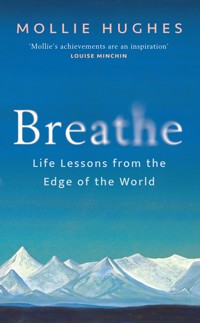
Shortlisted for the Boardman Tasker Award for Mountain Literature. Mollie Hughes has explored some of the wildest environments on earth, from the top of Mount Everest to the vast frozen continent of Antarctica, where at the age of 29 she skied solo from Hercules Inlet to the South Pole in a journey of over 700 miles through storm-force winds, eight-day whiteouts and temperatures as low as minus 45 degrees Celsius. With reference to her all-extreme experiences, and backed with psychological research, Breathe encompasses tales of bravery, risk and pressure on an epic scale and expertly turns them into valuable lessons that can be applied to more everyday challenges. In doing so, Mollie shows how we can unlock our potential, regulate emotion, overcome fear, cope with psychological pressure and understand the importance of silence and headspace in our mental wellbeing.
Das E-Book können Sie in Legimi-Apps oder einer beliebigen App lesen, die das folgende Format unterstützen:
Veröffentlichungsjahr: 2025
Ähnliche

















BREATHE
This edition first published in Great Britain in 2025 by
Birlinn Ltd
West Newington House
10 Newington Road
Edinburgh
EH9 1QS
www.birlinn.co.uk
Copyright© Mollie Hughes 2025
The moral right of Mollie Hughes to be recognised as the author of this work has been asserted in accordance with the Copyright, Designs and Patents Act 1988.
All rights reserved. No part of this publication may be reproduced, stored or transmitted in any form without the express written permission of the publisher.
ISBN 978 1 78885 673 7
eBook ISBN 978 1 78885 673 7
Typeset by Initial Typesetting Services, Edinburgh
Papers used by Birlinn Ltd are from well-managed forests and other responsible sources
Printed and bound by Clays Ltd, Elcograf S.p.A.
‘Technique and ability alone do not get you to the top; it is the willpower that is the most important. This willpower rises from your heart.’
— Junko Tabei, mountaineer, and the firstwoman to climb Mount Everest
Contents
Introduction
1. Control FearCrossing the Void: Everest, 2012
The Deep End: Ayo Akinwolere
2. Find Self-BeliefThe Valley of Silence: Everest, 2012
A Perfect Case Study: Jasmine Harrison
3. Balance Psychological PressureSeven Weeks in Tibet: Everest, 2017
The Jump:Tim Howell
4. Address TraumaThe Frozen Man: Everest, 2017
When the Mountains Shook: Jo Bradshaw 129
5. Grow ResilienceThe Battle: Antarctica, 2019
The Wisdom of Resilience: Ann Daniels
6. Discover Power in PositivityBehind My Eyes: Antarctica, 2019
Choose Positivity: Andrew Donaldson
7. Seek HeadspaceSilence: Antarctica, 2019
The Ultimate Headspace: Cal Major
Afterword
Sources
Acknowledgements
Introduction
Our lives sit between our first breath and our last. We fill this time however we choose, but one constant is our breath. Breathing, for the most part, is an unconscious motion. We don’t think about it, we don’t control it; it happens, and it keeps us alive. But when our body is under physical stress, experiencing fear or heightened emotions, we become aware of our breath, the rapid inhale and exhale, the elevation of our rib cage, the dry throat.
Our breath is a powerful tool, an in-built switch for maintaining composure. It has a profound impact on both our psychology and physiology. By controlling our breath – slowing down our inhales and exhales – we can become more present, manage our emotions and see situations with greater clarity. The power of breath extends to bodily processes. Techniques like diaphragmatic breathing, or ‘belly breathing’, stimulate the vagus nerve, which links the gut and brain. When practised regularly, this type of breathing can significantly reduce stress levels and improve gut health. Our breath is a resource available to all of us, helping us navigate life with greater control. However, in extreme environments or stressful situations, maintaining control of our breath can become more challenging.
When climbing at extreme high altitude, above 8,000 metres, in what is known as the death zone, there is two-thirds less available oxygen in the air. Every inhalation becomes conscious. Every exhalation becomes all you think about.
I was twenty-one years old when I first entered the death zone. I was climbing towards the summit of Mount Everest from the southern route via Nepal. It wasn’t yet sunrise, but the early morning light was beginning to illuminate the Himalayas beneath me; mountains were appearing out of the darkness as far as my eyes could see. I would take a step, stop and catch my breath, before taking another step and having to once again stop and catch my breath. The extreme high altitude had its grip on me, pawing at my body. I willed my legs to move faster, to take two steps before needing to stop and breathe. But on this day, high in the death zone, my body was only capable of moving at a snail’s pace.
My body was rapidly weakening the longer I spent at altitude. But my mind was still strong; it was resilient. And it possessed the belief that I could make it to the summit.
My first expedition on Mount Everest taught me so many lessons. The most important was the sheer strength of our mind. On the flight home from Nepal, I came up with a theory: Achievement in extreme adventure expeditions is 75 per cent mental.
Over the next eight years, I went on to test this theory with other expeditions around the world. I returned to Everest at the age of twenty-six to attempt to summit the mountain from the arguably harder, colder and windier northern route from Tibet. Then at the age of twenty-nine I took on my biggest expedition to date, skiing solo from the edge of the Antarctic continent to the Geographic South Pole. After 58 days of solitude, storms and endless skiing, I achieved my goal and realised that the amateur psychological theory I had developed as a twenty-one-year-old was widely inaccurate. It was almost all in my head. My theory now ran: Achievement in extreme adventure expeditions is 95 per cent mental.
Like any good theory, it needed to be investigated, to be tested, and I needed to find evidence out there in the world to support or disprove it. My personal journey and thoughts on the matter would create a good story, but I wanted to dig deeper and truly understand my own experiences. I wanted to study the research and evidence behind this theory, to talk to other adventurers and learn from people who had experience of similar situations. I put pen to paper and began Breathe.
Inhale, exhale and begin . . .
*
The writing of this book has allowed me to reflect on my past life experiences. In these pages, I have come to understand my fears, my trauma, how my resilience has grown, how I have learnt to cope with pressure . . . how deep in an Antarctic storm I learnt how to harness the power of my mind to bring me back from the edge.
Breathe began as an investigation into my own mental battles but quickly became a manifesto for how anyone can harness the power of the mind – to increase achievement and well-being, and to live a happy and fulfilled life.
Each section of Breathe is followed by an interview with an adventurer who has faced extreme challenges, overcome adversity and harnessed the power of their mind to achieve the near-impossible. I wanted this book to go beyond my own psychology – to uncover patterns, insights and lessons we can learn from others. I speak with a base jumper who has mastered the art of balancing pressure before stepping over the edge, a mountaineer who has endured unimaginable trauma and found space to grow on the other side, a paddleboarder who has discovered headspace and calm through adventure, and many more. These diverse perspectives, drawn from people of different backgrounds and life experiences, offer us all a chance to better understand the incredible potential of the human mind.
You may be reading this on a bus as you head through the hustle and bustle of a busy city, or in a sleepy village in the countryside as birds chatter above. It might be in the comfort of your home, as the world keeps moving outside your door. Breathe brings together seven life lessons from my time spent on the edge of the world, but they seamlessly transport themselves into everyday life. They are for everyone. My hope is that you can take strength from them, learn a little about how your mind works by sharing the journey with me, and understand how you might harness your mind to live a positive, accomplished and happy life.
1
Control Fear
Crossing the Void: Everest, 2012
As I approach the edge of the void, I begin to feel the now all-too-familiar response of my body. My heart begins to thud against my rib cage. My legs start to weaken. My hands rapidly warm inside my thick mountaineering gloves.
During the last few weeks on Mount Everest, I had crossed these crevasses so many times. In fact, already that morning as I had made my way through the maze of the Khumbu Icefall in the early dawn light, I had crossed many. Each time, as I drew closer to the edge, I would feel my body react. But this particular crevasse was different. Nothing could have prepared me for what came next.
I clip into the somewhat dubious safety line and reluctantly step on to the first rung of the ladder that spans the gaping chasm. I feel the air beneath my feet as the metal of my crampons clinks on the cold aluminium. I don’t want to look down, don’t want to be so blatantly reminded of what could happen if I slipped. But I have to see where I am placing my feet. As I lower my gaze, my breath catches in my chest – the side of the crevasse is smeared by a long trail of blood from deep within the ice itself. Bright red in the fresh white snow.
I will my legs to be strong, but they feel weak and uncoordinated. I remind myself to breathe. Gripping the thin safety line with my thick gloves, I take the final two rungs of the ladder as one huge step, desperate to be away from this crevasse and the death hanging in the air. I unclip from the line and my legs keep moving, taking me away from the edge and the frozen red pool next to the ladder.
*
During that same season in 2012 when I first climbed Everest, ten climbers died on the mountain. The first, halfway through April, was that of guide Namgya Tshering Sherpa. Early one morning Namgya was travelling between Base Camp and Camp One through the Khumbu Icefall. While crossing one of these crevasses, he slipped on the ladder and fell fifty metres, the equivalent height of a fifteen-storey building. There followed a huge rescue effort by his teammates, but he didn’t survive. His battered body was recovered from the crevasse and flown home to his family to be buried in line with his Buddhist beliefs. As Namgya’s body was extracted from the void, it was pulled up the side of the glacier, leaving a vivid smear of blood. This was the bright red I had seen against the white of the icy environment.
I had to cross this same crevasse en route to Camp One. As I reached the site where Namgya had fallen to his death just hours before, and looked down at the harrowing scene, every one of my senses was alert.
*
I have a fear of heights – a heart-thumping, leg-shaking, clammy hands type of fear. I have always been afraid – since long before that day in the Khumbu Icefall on the south side of Mount Everest. I believe I will always carry this fear with me; it’s just another psychological load to lug up mountains and drag across continents.
The American Psychological Association defines the word fear as ‘a basic, intense emotion, aroused by detection of an immediate threat’. Fear is an alarm reaction; it mobilises us to act through changes in our body: we can stay and fight the threat or run from the danger.We have all experienced a physical response to fear: a subconscious and intense reaction to something that frightens us, be it heights, spiders or a horror film.
An immediate response can be our heart beating harder in our chest. Our legs may feel weak – we might experience ‘jelly legs’ – as blood flow is directed to the large muscles of our legs, preparing us to run. We may also sense fear in our tummy; when this response is triggered, digestion is reduced as blood moves away from the stomach and intestines to more important places. This is what causes the feeling of ‘butterflies’. We might also feel hyperalert; the levels of glucose within our bloodstream can suddenly spike, providing us with a readily available store of energy, if we need it. We might feel ‘goosebumps’ on our arms, as blood moves away from the skin. There is a tightening of the tiny muscles at the end of each hair follicle, making the hairs stand on end. For (most) humans, our small hairs standing on end makes little difference to how scary we look, but for many other mammals this response can make them look larger and much more threatening.
Fear is a defence mechanism. A subliminal and relatively extreme reaction in our bodies to protect us from threat. It is ancient, it is primal, and some psychologists have argued that it is innate. People may think of fear as a negative experience – something to avoid, to shy away from – but fear, this subconscious response, should be celebrated as humankind’s key to success. Throughout human evolution it is this that has led to the success of our species. Any human who did not run or hide from a predator, who did not walk carefully along the edge of a steep cliff, or who didn’t avoid fast-flowing water will not have been added to the human gene pool.
Specific fears that we experience today may well have been inherited from our ancestors. Hunting and being hunted were daily events for our forebears. Maybe not sabre-tooth tigers every day, but there were plenty of creatures in search of a tasty meal. This made our fear of predators a strong generational response, but we also developed phobias of the inanimate to help us avoid certain situations. Take our very human fear of the dark, for example; it is thought that this stems from early humans. When the sun would set, our ancestors’ key senses would be dulled, putting them at a disadvantage against nocturnal predators. Hiding at night, feeling afraid of the dark, was key to our survival and it stays with us to this day.
I have always been afraid of heights. Throughout my life, the feeling has increased and decreased in response to certain experiences, but it has always been there in the back of my mind. My main aim has been to not let this ancient, biological response prevent me from achieving my dreams, however hard this can sometimes feel.
The Allure of Everest
Exactly one year before that terrifying day in the Khumbu Icefall, I was up late at my university house in Bristol, doing last-minute revising for my final ever exam. I was eager to complete my degree, to finally leave education, but most pressingly I was desperate to enjoy the next few weeks, celebrating with my classmates.
I was twenty years old and had spent the last sixteen years in education. I now found myself at a very intimidating and confusing crossroads. I didn’t know what I wanted out of life, and I didn’t know the extent of what life could offer me. There was so much pressure from my university, from my peers, from society to secure a graduate job, to earn a decent income, to pay off student debt . . . and then what? Buy a house and get a mortgage? The idea of this linear, practical and ‘normal’ existence scared me more than anything.
However, I was feeling lucky. The prospects for my immediate post-university life had all very recently changed. I had been inspired.
‘Inspiration’ can be defined as ‘the process of being mentally and emotionally stimulated to a level of high activity’. But, to me, true inspiration is more than that; it is an event which flicks on a switch in your psyche, lights a fire and changes you. It opens up the extent of your previously-thought ability.
I had spent the last three months writing my dissertation, a process that, for me, had lit that fire of possibility. It had encouraged me to wipe away all the barriers I had created to what I thought I could achieve.
When deciding what to write about for my final piece of university work, I had the choice of any subject within the bracket of ‘sports psychology’. It quite quickly occurred to me that if I was going to be able to write 10,000-plus words on a single subject, it would have to be an interesting one or I would never complete the task.
Mountaineering was quickly becoming my passion. There-fore, to me, the only option for my dissertation was to investigate the psychology of mountaineering. But how should I do this? What should be my inclusion and exclusion criteria? All mountains are so very different; people have so many different styles of climbing and so many different experiences while climbing.
As I was pondering these thoughts, I found myself in the mountaineering literature section of a bookshop. I picked up a large hardback, with a beautiful mountain scene on the front – perfect blue sky, bright white snow, wispy clouds. This book was Higher than the Eagle Soars by Stephen Venables. I felt an urge to buy it. I took it to the counter and was served by a cheery chap in his late twenties whose badge told me in capital letters that he went by the name of DAN. Dan turned the book over in his hands and stared at the picture on the front cover for a few seconds too long. I saw the wonder in his eyes; he too felt the allure.
‘Wow,’ he said quietly. ‘Just imagine being able to climb something like this!’
I paid and took my new book from him, walking out of the shop on to the busy high street with those words echoing in my head. But why, Dan? Why do we have to just imagine? I don’t want to just imagine, I want to feel, I want to see, I want to experience.
Over the next few days, I devoured Stephen Venables’ book. He wrote of his life, his childhood, his introduction to mountaineering, his many brilliant expeditions to far-flung mountain ranges across the globe, and then the climax on the slopes of Mount Everest. He described an expedition where he, along with a team of North Americans, attempted the notorious Kangshung Face of Everest. The sheer extent of their adventure was captivating: Venables became the first British man to summit Mount Everest without supplementary oxygen. He then told the story of his heroic decent, tantalisingly close to death, balancing on the tightrope of human physiology and psychology. He took his body to the limits.Turning the last page of this book, I knew I had a subject for my dissertation. I was going to investigate the psychological experience of climbing Mount Everest. From this moment onwards, I felt something brewing inside me. I knew this was the start of something big – 8,848 metres big.
*
I grew up almost as far from the mountains as you can get on mainland Great Britain – on the south coast of Devon in the seaside holiday hub of Torbay. I was relatively happy at this altitude; there was a lot of adventure to be had growing up next to the sea, from exploring the beaches to surfing and kayaking. My fear of heights was barely tested, apart from the odd time I found myself standing on a bridge or looking down from a tall building, or even abseiling on a school trip.
But as I got older, my sunny corner of Devon began to feel smaller and smaller. I knew the rest of the world was out there and travel began to hold a huge allure over me. When I was seventeen, I had the opportunity to join an expedition to East Africa.At the school I went to, there weren’t many opportunities. It was a large, noisy and often chaotic comprehensive with well over two thousand students, many from some of the most deprived areas of South Devon. Africa felt like a million miles away – I could hardly comprehend what it would be like there, but I knew I wanted to go. My friend Cheryl and I spent a year raising the money for this trip: we did bag-packing in supermarkets, we sold all our worldly possessions (and some of our parents’) at car-boot sales, and we wrote letters to celebrities, charities and trusts asking for support. Our hard work paid off. During the summer, between Year 12 and 13, we were on a plane to Nairobi about to have our small-town minds blown away by the vibrancy and vastness of Kenya.
The expedition involved some work in local schools, an incredible safari and the opportunity for my first experience of altitude. We climbed Mount Kenya to Point Lenana at 4,985 metres above sea level, higher than every mountain in Western Europe. As I stood on this lofty summit, the clouds were swirling around me, but periodically gaps would open and I’d catch a glimpse of the incredible view down to the savannah below. In those moments I was hooked – mountains had captured my imagination.
Throughout the rest of school and university, I would save up as much money as possible during the year with part-time jobs and then spend it all on an expedition over the summer months. I travelled to and climbed in the Indian Himalayas, the volcanoes of the Andes, the high Atlas Mountains of North Africa and the Alps, and then went back again to East Africa a couple of years later to climb Kilimanjaro with friends. The more I travelled and the more mountains I climbed, the more I wanted to experience.
I remember the feeling as I held my bound dissertation in my hands. Inside these 54 pages were 294 paragraphs, 12,682 words and 65,292 characters of pure inspiration to me. I had interviewed seven male climbers who had all summited Mount Everest between the years of 2000 and 2010. I had probed their motivation, their self-belief, their experience of fear, of anxiety, of teamwork, and what factors they believed had aided their success. I then analysed the interviews, drew similarities, differences and conclusions. During those months of researching and writing, I had been on a journey. Combined, these were a series of interconnecting, awakening moments. The men I interviewed all had such beautifully intriguing stories to tell. They’d had such different human experiences while completing the same challenge: climbing the highest mountain in the world.
By the time I reached hand-in day, Everest had me well within its grips. I felt its allure. I had to experience it for myself. I wanted to walk through the Western Cwm, to scale the Lhotse Face, to climb the Hillary Step . . . but most of all I wanted to stand on the summit of Everest and look out over the whole of the Himalayan mountain range.
The Tattoo
I set myself a target: twelve months after handing in my dissertation, I would leave the UK for the Himalayas to start my own Everest expedition. I was just twenty years old at the time. I’d just finished my final year of university, achieving mediocre grades. I had no material wealth and a large student debt. The day of the week I always looked forward to was Wednesday; in the afternoon, I played netball for my university team, and in the evening I went out and partied. I enjoyed life, but I was shy and had little self-confidence; I would never be the one to answer questions in lectures for fear of getting it wrong. I cared way too much about what people thought of me. I didn’t know who I was, and I didn’t know what I believed in or what I wanted from life. The highest mountain I had previously climbed stood at 5,895 metres above sea level and was more of a long walk than a climb. But I had been inspired: the fire in me was burning and I was determined that I would climb the highest mountain in the world. I, therefore, had a lot of work to do.
I very soon realised that I had three main challenges to over-come before I would even be considered to take part in an Everest expedition. First, I had to train. I had to become fitter than I had ever been in my whole life. I had to prepare my body for the physical ordeal of climbing Everest. Over the next twelve months I would spend countless hours in the gym, running up and down hills, hiking along steep coastal footpaths and spending as much time as possible in the mountains of the UK.
Second, I had to find a seriously large amount of money. Mount Everest is incredibly expensive to climb. A 70-day expedition on the Nepalese side of the mountain can cost a climber anywhere from £35,000 to £100,000. As a university student who had been living off baked beans for the last three years, this figure was completely incomprehensible to me. I had been told that the only way to secure this money would be to attract corporate sponsorship. I needed to get a company or a few different companies on board who would contribute to my expedition, and in exchange I would take their logo to the top of the world. This was no easy task. It would involve months and months of sending out proposals, meeting with companies, following fruitless leads and coping with constant rejection.
My third challenge to overcome in twelve months was to increase my mountaineering experience. I had been climbing mountains around the world for the last four years, but I had never attempted anything even half as demanding as Everest would be. On my twenty-first birthday, just weeks after finishing university, I flew out to the French Alps and worked with a British mountain guide in these beautiful yet challenging mountains, honing my skills and deepening my understanding of what climbing Everest was going to be like. However, I knew that the Alps wouldn’t quite cut it. I needed to go higher.
I had been to the Himalayas once before, when I was eighteen, on an expedition to Ladakh in India. I remembered how the sheer magnitude of this mountain range was aweinspiring. The Himalayas stretch from Afghanistan to China. That’s almost 2,500 miles of the highest mountains in the world, the deepest valleys and some of the greatest biodiversity on the planet. This would be the best possible place to prepare for climbing Mount Everest. So, at the beginning of November 2011, four months before I was hoping to head to Mount Everest, I wanted to fly to Nepal and join an expedition to climb Ama Dablam, a beautiful and challenging mountain in the Khumbu Valley and brilliant preparation for Everest.
However, at the beginning of October 2011, I was still a million miles away from setting foot on Ama Dablam, let alone Mount Everest. I had sent out a ridiculous number of sponsorship proposals, but my target was still at a grand total of zero. I had to fund my training expedition and I needed a quick £4,000 before the beginning of the following month to enable me to take part.
I decided to hold a fundraising event in my hometown of Torquay. Selling tickets for £10 and inviting 200 people seemed an easy way to make some money. However, I soon realised event planning is tough! The next three weeks saw me in a mad panic to choose a venue, design and print tickets, find some entertainment, and most importantly convince people to attend. If I managed to sell all the tickets, I would earn £2,000, a huge amount of money. However, I needed double that to leave for Nepal.
I decided to hold a fundraising auction during the event. I visited all the local businesses to try and scavenge some prizes. I received a meal at a restaurant, a painting of a stern-looking owl, a flying lesson, and the one that went down very well with my friends – forty Jäger bombs from a local bar. However, these prizes were never going to make me enough money. I had to act.
I needed a crowd-pleasing, money-grabbing, must-have auction prize – and I found it . . . right behind me. From this one auction lot alone, I raised £1,000 and was able to fly to Nepal the following month. But this auction prize is something that I will never be able to forget, as it is now a permanent fixture on my right bum cheek. I decided to auction my bum as tattoo space to a willing buyer. Whoever bought my bum in this auction would be able to have tattooed on it anything they wanted – absolutely anything.
The bidding started. I was petrified. The price quickly rose above £200, £300, £400 . . . Luckily – and unluckily – for me, I had invited a couple of Royal Marines I knew, and it turns out it was pay day and they’d had a couple of drinks. My dad was also at the auction, bidding against these Marines to make sure I didn’t have to get a tattoo, however when the auction hit £500 he was out. I was on my own. £550, £650 . . . There was a bidding battle going on – every auctioneer’s dream. £850, £950 . . . Then the price finally rested on £1,000 and my right bum cheek was the property of Sam and Andrew, two slightly inebriated and now very poor Royal Marines.
They then proceeded to taunt me with what they were going to have inked on my bum – a stamp saying ‘100% British Beef’, a tattoo of their faces . . . but after sobering up and a few days to consolidate their ideas, I think I came off lightly. I am looking forward to the day when I have to explain to my children and grandchildren why I have two kissing chickens tattooed on my right bum cheek!
A matter of weeks later, I left the UK for my first expedition to Nepal and to climb Ama Dablam. I spent three weeks on this beautiful mountain, and I learned some of the hardest and most valuable lessons of my life.
Returning to the UK just before Christmas, the sponsorship pressure was building. I now had just three months to secure all the funding to enable me to join an Everest expedition in the spring of 2012. I persevered. I kept sending out proposals, kept making phone calls, and the money slowly began to trickle in from various companies and organisations. Many people had told me that sponsorship money often comes through at the last minute and that you can’t give up until the day you are meant to be on a plane. For me, this happened just four weeks before I was hoping to leave for Everest. When the final sponsorship money came through, I could book my flights, purchase my kit and celebrate at last the fact that soon I would be climbing the highest mountain in the world.
The Himalayas
On 31 March 2012, I waved goodbye to my family at Heathrow airport and, along with my forty kilos of luggage, I boarded a plane to Nepal. I had the feeling in my stomach of excitement and apprehension all twisted into one; it was a bit like a weight – but it was a feeling I would soon associate with the start of a big adventure.
Arriving in Nepal’s capital city, Kathmandu, I met my team and spent a couple of days shopping for last-minute pieces of kit, getting to know my teammates and drinking far too much coffee in the various cafés and restaurants in the tourist district. Kathmandu is a vibrant city. As one of the oldest continuously inhabited places in the world, the depth of history and culture there is incredible. Today, it is home to one and a half million residents within fifty square kilometres; it is bustling with a mix of religions, cultures and nationalities. I fell in love with this city the first time I visited, with the organised chaos of the road systems, the jumbled buildings, the ancient monuments, and the generosity and openness of the inhabitants.
Far too quickly it was time to leave Kathmandu and head out to the mountains. We boarded a small twin-engine plane from the capital to Lukla, an airport located at 2,845 metres altitude and the starting point for the trek to Everest Base Camp. I have never been good at flying. I feel the same sensations as when I am standing looking out of a window in a multistorey building, but on a plane there is nothing to connect you with the ground and all control has been given over to the pilots and crew. This flight I really did not enjoy. Lukla airport was once rated as the most dangerous in the world. In 2008, a Yeti Airlines flight crashed on its final approach to the runway, killing eighteen passengers and crew. In 2010, an Agni Air flight crashed as it returned to Kathmandu after being unable to land at Lukla due to bad weather. All eleven passengers and three crew died. But after forty-five minutes of eyes closed and nervous sweating, we touched down at Lukla. Stepping off the plane into the thin air of almost 3,000 metres, I felt very relieved not to have aided this airport’s deadly reputation and become another plane crash statistic.
From Lukla, we trekked for nine days up through the beautiful Khumbu Valley. We would spend the nights in teahouses run by Sherpa families, and the days climbing up and down steep hills, over fierce rivers of glacier meltwater on rickety cable bridges, through deep valleys, woodlands and clear plains. We gained almost another 2,500 metres in altitude and finally reached Everest Base Camp on 12 April 2012.
For two months each spring, Base Camp becomes a large, tented community. Teams from across the globe set up home, side by side, at the foot of the mountain. As colourful Buddhist prayer flags flutter in the wind above their heads, they are all united in one common goal: to attempt to reach the top of the world.
Base Camp is surrounded from all angles by humongous, white-peaked mountains. The Khumbu Icefall is sprawled out in front of camp, carving the route to the summit, which hides elusively just out of sight behind the West Ridge. At an altitude of just below 5,500 metres, there is 50 per cent of the level of available oxygen at sea level. By the time you reach the summit of Everest at just below 8,900 metres there is 33.3 per cent. This has a huge effect on every cell in the body; its physical and mental functions are greatly reduced.
We, therefore, must very slowly let our bodies adapt to this lack of oxygen to avoid the adverse effects of altitude sickness, also known as Acute Mountain Sickness (AMS). At its most minor, AMS can include headaches, nausea, dizziness and shortness of breath, symptoms that can usually be resolved by descending to more oxygen-rich air, or a few days of rest. However, at its most serious, and at higher altitudes, AMS can lead to life-threatening conditions that affect the brain and lungs. High Altitude Cerebral Oedema (HACE) is a swelling of the brain caused by a lack of oxygen. High Altitude Pulmonary Oedema (HAPE) is the build-up of fluid on the lungs, again due to the exposure to low oxygen levels at altitude. Both conditions can develop quickly and be fatal if untreated.
Climbing Everest isn’t as simple as most people might think. You can’t just climb from the bottom to the top in one go. We were going to spend the next four to five weeks yoyoing up and down the mountain to acclimatise. My first real footsteps on Everest would involve a short foray into the Khumbu Icefall to gain a little altitude and cross my first crevasse on the mountain.




