


Erhalten Sie Zugang zu diesem und mehr als 300000 Büchern ab EUR 5,99 monatlich.
- Herausgeber: The History Press
- Kategorie: Sachliteratur, Reportagen, Biografien
- Sprache: Englisch
Canterbury Cathedral's medieval Gothic image survived centuries of religious discord, neglect and Georgian 'improvements'. From 1800, a new generation was re-inspired by the prevalent architectural and artistic 'Gothick' vogue. At this time, a passionately ambitious young architect, William Butterfield, created a Gothic missionary college in two years, and the Dean of Canterbury, who wanted the Cathedral to rival St Peter's, Rome, began the rolling repair programme continuing in today's Appeal. Priests, bishops and Gothic enthusiasts carried the style from there to parish churches, industrial cities and the colonies. With more than fifty illustrations, including a striking colour section, this book will delight lovers of Canterbury and of the Gothic style everywhere.
Sie lesen das E-Book in den Legimi-Apps auf:
Seitenzahl: 163
Veröffentlichungsjahr: 2013
Das E-Book (TTS) können Sie hören im Abo „Legimi Premium” in Legimi-Apps auf:
Ähnliche



















For our great-grandchildren,Leela and Oliver, to read one day
Acknowledgements
Many fellow citizens have contributed to our final tribute to the city and Cathedral. Our gratitude goes to: Cressida Williams and Dr Toby Hewitson at the Cathedral Archives; Philip Hadfield and his colleagues at Canterbury Museums and Galleries; the King’s School, Canterbury, and particularly Mary Berg and Peter Henderson, and their librarian at St Augustine’s, for their co-operation; Professor Jackie and Richard Eales, who commented on the historical accuracy of the first two chapters; Andrew Lyle and Pat Butler, who detected inaccuracies in the text; Paul Crampton and Jane Boucher, who provided access to additional information; and Heather Newton and Geoff Downer, for sharing their knowledge of the Cathedral’s fabric.
Our particular admiration and thanks go to our granddaughter, Victoria Lyle, for her picture-research and negotiation worldwide, and to our local photographer, John Kemp. For the second time he devoted uncounted hours to recording and processing his stunning images. Finally, we are grateful to the Dean of Canterbury, Dr Robert Willis, who took the time to read and commend this book.
Our apologies to anyone inadvertently omitted. We acknowledge that any remaining imperfections are our responsibility.
Contents
Title
Dedication
Acknowledgements
List of Illustrations
Introduction
1. Creating the Gothic Image
2. From Decline to Revival – Sixteenth to Nineteenth Centuries
3. The Dawn of the Gothic Revival: Buildings
4. The Dawn of the Gothic Revival: Images
5. Gothic – The National Style
6. The Recovery of St Augustine’s Abbey
7. The Consequences of St Augustine’s College
8. Dean Alford and After
9. Gothic in the Colonies
Last Words
Some Further Reading
Glossary
Plates
About the author
Copyright
List of Illustrations
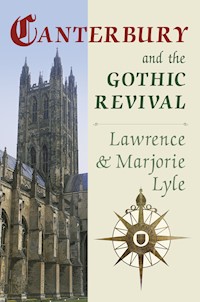
Cover Pictures:
Bell Harry Tower. The Cathedral’s crowning glory was completed in 1504; because its picture is taken by most pilgrims, this image has been spread worldwide.
The Compass Rose. Symbolising the spread of the Anglican communion worldwide, this compass lies above the probable site of St Augustine’s first church, traced by archaeologists in 1993.
Mono Pictures:
St Denis’ interior
The Cathedral Quire, north
The Cathedral Corona
The Cathedral nave
Christchurch Priory ruins
St Augustine’s Abbey ruins
Archbishop William Laud
William Somner
Cathedrall Newes from Canterbury (1644)
The Cathedral’s old west front
Fonthill Abbey
Lee Priory, near Canterbury
The Scott Monument, Edinburgh
Thomas Rickman’s frontispiece
Thomas Rowlandson cartoon: Dr Syntax
T.S. Cooper by John Prescott R.A., 1850
St Augustine’s Monastery (lithograph by T.S. Cooper)
The Cathedral and the railway by L.L. Razé
The throne in the House of Lords
The Grange and St Augustine’s Church, Ramsgate
Cambridge Camden Society seal
Revd Francis Close’s sermon, 1844
The ‘Canterbury Vauxhall’
Library interior of St Augustine’s College
Chapel façade of St Augustine’s College
Students’ range of St Augustine’s College
Realigned monuments in St Augustine’s College, lower chapel
St Augustine’s College exterior by L.L. Razé
William Butterfield
Butterfield’s pulpit in the Cathedral
The Archbishop’s throne in the Cathedral
The font of St Mary’s, Ottery St Mary, Devon
All Saints’, Margaret Street, London
The apse of St Margaret’s Church, Canterbury
The Martyrs’ Memorial, Oxford
The Cathedral’s south-west porch
The Cathedral’s porch, west side
Statue of Dean Alford on the Cathedral’s west front
Tomb of Archbishop Broughton
Tomb of Dean Lyall
The Clergy Orphan School by L.L. Razé
Revd Samuel Marsden landing at the Bay of Islands, 1814
William Broughton and his bishops
St Patrick’s Cathedral, Melbourne
George Selwyn
Old St Paul’s, Wellington
The Provincial Council Chamber, Christchurch
Benjamin Mountfort (1825-1898)
Christ Church Cathedral, Christchurch, New Zealand
John Medley
The Church of the Nativity, Huntsville, Alabama
Colour Plates
1. Eastern Crypt of the Cathedral
2. The Cathedral nave
3. The Great Gallery of Strawberry Hill
4. Horace Walpole
5. A.W.N. Pugin
6. St Giles, Cheadle
7. A.J. Beresford Hope
8. Revd Edward Coleridge
9. The Great Court of St Augustine’s College
10. Spandrel at All Saints’, Margaret Street, London
11. The pulpit at All Saints’, Margaret Street, London
12. St Paul’s Cathedral, Melbourne
13. Christ Church Cathedral, Fredericton, New Brunswick
14. Trinity Chapel, Canterbury Cathedral
Introduction
When you hear ‘Gothic Revival’, what probably springs to mind is Strawberry Hill, the Houses of Parliament or St Pancras Station; so why a book about Canterbury’s place in this mainly nineteenth-century phenomenon? The answer lies in St Augustine’s mission of AD 597; a year later the Cathedral and Abbey were begun, and became the joint power houses of an expanding Church. The bold decision of the monks at the Cathedral five centuries later, in 1174, to rebuild their burnt choir in the new French Gothic style, would have revolutionary consequences. This first major example in England was copied across the country by pilgrims returning from the shrine of St Thomas Becket, where the high vaulting, tall pillars and large windows combined to produce a stunning Gothic space. This shrine, placed at the apex of a series of steps, created a separate raised space at the east end of the church. The appeal of such a layout was strong in the 1840s, as the High Church Cambridge Camden Society planned the restoration of parish churches in what they considered the natural English Gothic style. They wanted to reinstate a separate chancel, an area that had been demoted during the Reformation in the interests of preaching and congregational worship.
Through the troubled Reformation centuries, antiquarians from William Somner onwards would secure the survival of Canterbury’s Gothic image. For the Gothic Quire had in turn spurred later architects to produce fourteenth- and fifteenth-century Gothic examples of great beauty in the nave and Bell Harry Tower. In the early years of the Gothic Revival, the Cathedral’s romantic and ‘picturesque’ appearance made it a favourite subject for topographers, lithographers and artists. Academic studies of the evolution of Gothic cathedrals followed the popularisers.
The 1840s would prove to be a seminal decade in Canterbury, as elsewhere. Robert Willis’s groundbreaking Architectural History of Canterbury Cathedral was adumbrated at lectures here in 1844. This was to prove an important year. The ideas of Pugin, of the Tractarians, and of the High Church Ecclesiological Society had become the talk of the day. Under their influence, three key individuals came together in that year: A.J. Beresford Hope, Revd Edward Coleridge and William Butterfield. Their project was to rescue England’s first Abbey of St Augustine from its fate as a rundown brewery and pleasure garden. Their campaign from 1844 to 1848 to create an Anglican missionary college on the site would have important consequences.
The architect of the college buildings, William Butterfield, would see his career take off; and his influence on secular and ecclesiastical buildings at home and abroad would affect the later spread of the Gothic style. The early advocates and founders of the college, and its missionaries, would go on to do much to make Gothic – whether in wood, stone or brick – as natural a style in the British colonies as it had become in England itself.
Unlike Victorian industrial cities, whose expansion coincided with the Gothic Revival, Canterbury boasts no Gothic civic buildings, hotels or grand mansions; one isolated Gothic bank stands in the High Street. So the host of modern tourists come to visit the three-part Gothic Cathedral and its Precinct in a setting of narrow lanes lined with mainly late medieval buildings encircled by its ancient walls.
While the divided Abbey site shows medieval ruins and glimpses of the Gothic Revival missionary college, the visitor sees a cathedral under active restoration. The present campaign owes much to the initiative of its Victorian deans and architects, under the inspiration of the Gothic Revival.
The Conflagration
On the evening of 5 September 1174, sparks from a minter’s fire smouldered unseen between the leads and the flat roof of the Cathedral Quire.
The monk Gervase takes up the story:
The flames rose to the slope of the roof and the sheets of lead yielded to the increasing heat and began to melt. The raging wind, finding a freer entrance, increased the fury of the fire; and the flames beginning to show themselves, a cry arose in the church-yard: ‘See! See! The church is on fire.’
Then the people and the monks assemble in haste, they draw water, they brandish their hatchets, they run up the stairs, full of eagerness to save the church, already, alas! beyond their help. But when they reach the roof and perceive the black smoke and scorching flames that pervade it throughout, they abandoned the attempt in despair, and thinking only of their own safety, make haste to descend. … The halfburnt timbers fell into the choir below upon the seats of the monks; the seats, consisting of a great mass of woodwork, caught fire, and the mischief grew worse and worse. And it was marvellous, though sad, to behold how that glorious choir itself fed and assisted the fire that was destroying it. …
In this manner, the house of God, hitherto delightful as a paradise of pleasure, was now made a despicable heap of ashes, reduced to a dreary wilderness, and laid open to all the injuries of the weather. The people were astonished that the Almighty should suffer such things, and maddened with excess of grief and perplexity, they tore their hair and beat the walls and pavement of the church with their heads and hands, blaspheming the Lord and and His saints, the patrons of the church. …
Translated from the Latin by Professor Robert Willis (1844)
1
Creating the Gothic Image
On the morning of 6 September 1174, the bewildered monks of Christchurch Priory stood amid the smouldering ruins of their beloved Romanesque Quire, finished only forty-four years before. They were in no state to come to a considered – far less to a united – decision about what should replace it.
This cloistered community had survived four tumultuous years since the notorious murder of their Archbishop, Thomas Becket, in December 1170. After his hurried burial – in the face of his enemy de Broc’s threat to throw his body to the pigs – the cleansing and reconsecration of the Cathedral had followed. The growing flood of pilgrims and miracle stories, and the rapid canonisation of their St Thomas in 1173, had culminated in King Henry II’s spectacular public penance and chastisement the following year. Now, just two months later, sparks from a fire outside their gates had grown unseen above the Quire’s wooden ceiling, which had collapsed on to the wooden stalls below, consuming everything. A plethora of problems, pressures and choices lay before them.
Thanks to Lanfranc, the Conqueror’s Archbishop, Canterbury’s primacy over York and the rest of the English Church had been acknowledged in 1072 by the Accord of Winchester. Meanwhile, from the expanded monastery here, bishops and abbots were promoted – the instigators of a programme which would eventually see all existing cathedrals rebuilt in massive Anglo-Norman Romanesque. Several rural sees were moved to towns, making their new cathedrals even more obtrusive. They became the visible ‘stone jack-boot of conquest’, as Ian Jack describes their impact. Supreme in Church matters, Canterbury was also the natural link between London and France, where many of the kings’ lands and concerns lay. The monks knew that what Canterbury did today, others would follow tomorrow. Their extensive manorial estates would provide resources enough for rebuilding. So what was needed?
Obviously, a magnificent shrine for their new saint, with ambulatory space around it for pilgrims, must be added, east of the monks’ Quire and presbytery. This greatly extended east end would be revolutionary in itself, compared to traditional Romanesque. But already in France, Abbot Suger at St Denis near Paris had rebuilt that pilgrimage church in a revolutionary style. Suger was an unlikely man, at least at first sight, to be the moving spirit behind the adoption of Gothic. As a royal servant he had risen rapidly in the favour of King Louis VI, the Fat, to serve as an ambassador. He was rewarded with the Abbacy of the royal mausoleum and pilgrimage church of St Denis. After five years spent mainly in royal service, in the decade from 1127 to 1137 Suger reformed his monastic family and augmented the revenues of his abbey. Turning his attention to its fabric, by 1140 the west front had been rebuilt in Romanesque style deriving from the Arch of Constantine.
St Denis’ interior. The novel appeal of the Gothic style is perfectly illustrated at St Denis’ east end, completed in 1144. Light and height are achieved by the use of ribbed stone vaults and clustered columns. (© Sylvain Sonnet/Corbis)
It is impossible to tell what impelled Suger to change styles when the choir was reconstructed (between 1140 and 1144). A high, light space, surrounded by the curves of chapels radiating from an ambulatory, was created by employing for the first time five essential elements of Gothic architecture. To the ambulatory and its chapels were added pointed arches, ribbed vaults, flying buttresses and clustered columns, which, fifthly, allowed arches to spring from them in more than one direction.
Suger was so pleased with his creation that he wrote two books about St Denis in which he stressed that aesthetic pleasure was an extra and special way to bring the worshipper to God. Pugin’s writings in the early days of the Gothic Revival nearly 800 years later would draw the same essential conclusion. It is not surprising that St Denis was soon to be copied at two other pilgrimage churches, Laon and Sens, which lay on the important trade route between Burgundy and Flanders.
Such aesthetic and religious qualities promoted revolutionary structural changes, and specialisation began to emerge. Masons had previously travelled from patron to patron, working anonymously to the glory of God. Now the patron, the master mason and the craftsmen were all essential to the result. Anonymity would gradually give way to named masons; William of Sens was among the first. More importantly, through him the Quire of Canterbury Cathedral would be as revolutionary in England as St Denis in France. So how did it come about?
Becket, in fact, had spent most of the six years of his long exile at Sens, in close accord with its bishop whose successor, in turn, was the first and most active champion of Thomas’ canonisation. So, in time, among the masons surveying the job in Canterbury came William of Sens, who for twenty years had worked on Sens Cathedral, a strictly mathematical Gothic construct based on the proportions of height to length and width. While some masons said that the scorched pillars could be consolidated to replicate the old Quire, others said that total demolition was the only answer. William spent several days surveying the Romanesque outer shell which we still see today and talking with the various factions among the monks. Without revealing his gloomiest estimates of the probable costs, he proposed inserting a Gothic cuckoo into the Romanesque nest. This compromise appealed to those among the monks wanting economy and assuaged the fears of the traditionalists. The layout, designed to accommodate the constricting shell, produced the sinuous kink which makes Canterbury’s east end an advance on the severe classicism of Sens.
It was still a huge leap of faith for the monks to go for the ‘shock of the new’ with:
• Pointed, not round, arches
• Six-part stone vaulting instead of a flat wooden ceiling
• Thin, three-storey walls supported by concealed buttresses
• A clerestory row of windows below the vaults
• Clustered columns, some in dark-coloured marble, in place of massive pillars with varied decorative capitals.
After 1170 the Priory produced a stream of biographies, letter-books and miracle stories, but the most remarkable novelty was the monk Gervase’s survey of the Romanesque Cathedral he had known. He then described the fire, William of Sens’ appointment, and what William accomplished year by year until his tragic 50ft fall from the scaffolding while supervising the installation of the final boss of the new Quire.
It had taken eight months to clear the ruins, order materials and enlist French sculptors capable of carving, with the chisel, the uniform capitals of the new piers. Work finally began on 6 September 1175 and we can plot William’s progress from Gervase’s account. Two bays went up in 1175; a third bay, side aisles and a triforium in 1176. By the winter of 1177 the vaults were installed above the alternating plain and octagonal pillars, buttresses supported the increased height of the walls, and a pair of clustered columns were ready for the more intricate vaulting of the new eastern transepts. When William fell in the summer of 1178, eleven pillars 12ft taller than their predecessors supported an elaborate triforium – a mass of round and pointed arches, embellished for the first time with Purbeck marble shafts. New light came from the clerestory windows above and from the enlarged windows of the side aisles. Four-part stone vaulting there and six-part in the Quire stunned the monks: ‘they appeared to us and to all who saw them incomparable and worthy of praise,’ reported Gervase.
Cathedral Quire, north. Here is the junction between the work of William of Sens and his successor. This view takes the eye up to the elaborate triforium and light is thrown on the high stone vaults. (© John Kemp)
Cathedral Corona. Robert Willis’ meticulous drawing shows how far English William had developed the Gothic style at the east end, compared with the Quire.
During the three months in which William of Sens was carried on a stretcher to supervise his successor, English William, we cannot know in what detail he shared his plans for rebuilding the Trinity Chapel, the next part of the work after completing the transepts and presbytery. This was where Becket had celebrated his first Mass after his consecration and would be the site of his splendid shrine. Modern controversy continues over what was constructed eastwards of Pillar XI, but the successive steps, by which the pilgrim rises to this highest point, the Trinity Chapel, must be a legacy of William of Sens. Sens Cathedral had terminated at the east with a nine-part vault and radiating chapels. English William, at the Corona (an extension at the extreme east end), used a similar vault as a canopy over the reliquary containing the crown of Becket’s cloven head, which had won him a martyr’s crown. The Trinity Chapel itself seems to contain the best of both Williams, with its range of tall windows filled with jewel-bright glass telling the miracle stories (see colour plate 14). The light plays on the polished coloured marble of the piers surrounding the shrine.
Those groundbreaking extensions eastward required that the new eastern crypt should incorporate Becket’s original resting place. Between two polished marble pillars the coffin, encased in marble, would lie for fifty years until its translation in 1220 to the Trinity Chapel, where the miracle windows portray the original shrine. The eastern crypt today is where the shock of the new is most clearly felt. You emerge from the dark labyrinth of the Romanesque western crypt into English William’s high, light, vaulted space where pilgrims circulated in the ambulatory around the original tomb (see colour plate 1).
Many went home enthused to modernise their own churches. From Rochester to Chichester to Lincoln, Gothic would spread not only in whole buildings but in parts, as in the use of Purbeck marble at Salisbury. Uniform stiff-leaf capitals, larger pointed windows, and buttresses allowing for taller, thinner walls would follow across the country. After 1220, when at last Becket’s relics were installed in his magnificent shrine in the Trinity Chapel, the French Gothic Quire laid its own imperative on future rebuilders at Canterbury to somehow match its splendour.




