


Erhalten Sie Zugang zu diesem und mehr als 300000 Büchern ab EUR 5,99 monatlich.
- Herausgeber: Books on Demand
- Kategorie: Sachliteratur, Reportagen, Biografien
- Sprache: Englisch
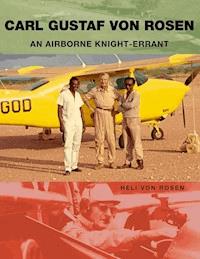
In medieval romance literature, a knight-errant is a traveller of noble birth in search of adventures in which to exhibit military skill, valour and generosity. Count Carl Gustaf von Rosen was all that, although he did not explicitly look for adventures. His forty-year flying career took him to different parts of the world, giving him a bird’s-eye view of the unfair distribution of global wealth. He started as a Red Cross pilot in Ethiopia during the Italian war of 1935-1936, he built an Air Force for Emperor Haile Selassie from 1946 to 1956, and he experienced the painful birth of new African states after the colonial era. He became personally involved in the Nigerian conflict on the side of the breakaway, starving Biafra, creating a tiny air unit of rocket-armed, 100 HP trainer aircraft, to destroy, on the ground, the aggressive Nigerian military jets flown by mercenaries announcing their presence over Biafra with: “This is Genocide calling”, before dropping the bombs. In the early 1970’s when drought hit Ethiopia, von Rosen launched a method of food drops from the air to starving mountain villagers. His son Eric and daughter-in-law Heli worked with him for two years, witnessing the revolution, the Red Terror of the military junta, and the growing conflict between Ethiopia and Somalia; both claiming possession of the semi-desert region of Ogaden. Ultimately, this conflict caused the death of Carl Gustaf von Rosen. He was killed in a Somali attack on Gode in July 1977. Heli von Rosen tells the story.
Sie lesen das E-Book in den Legimi-Apps auf:
Seitenzahl: 590
Veröffentlichungsjahr: 2017
Das E-Book (TTS) können Sie hören im Abo „Legimi Premium” in Legimi-Apps auf:
Ähnliche



















The von Rosen family is descended from German crusader knights who fought, on behalf of the Pope, to baptise the pagan Balts in the 13th century. Otto von Rosen was the progenitor of the family in Livonia. His eldest son Otto, knight and bailiff of the arch-diocese, was killed in battle on the 29th of June 1297. Some four centuries later, part of the Baltic von Rosens became Swedish when Gustaf Fredrik von Rosen joined the army of King Karl XII in his campaign against Russia. When the battle of Poltava was lost, the survivors, among them von Rosen, fled with the King to Turkey. Eventually, he was one of the two officers that accompanied his Majesty on a reckless gallop through Europe, to Sweden, covering 2,152 km in 14 days. After serving the Crown in various offices, Gustaf Fredrik von Rosen was appointed Count, and introduced as member no 85 in the Swedish House of Nobility in 1751. His offspring six generations later: young Carl Gustaf von Rosen in a knight’s armour, 1920.
CONTENT
INTRODUCTION
AIRBORNE KNIGHT-TO-BE
HAILE SELASSIE ASSUMES POWER
MUSSOLINI GOES ON THE ATTACK
SWEDEN SENDS A FIELD HOSPITAL
RED CROSS PILOT IN ABYSSINIA
BOMBING OF THE SWEDISH FIELD HOSPITAL
GASSED ARMY ON THE RUN
THE LAST BATTLE
ABYSSINIAN ADVENTURE PART II
KLM, THE WINTER WAR IN FINLAND AND HANSSIN-JUKKA
ETHIOPIA LIBERATED
THE IMPERIAL ETHIOPIAN AIR FORCE
PALACE COUP AND THE CHRISTMAS CHARTER 1960
HEREDITARY LAND TENURE
THE CONGO CRISIS
GROWING COFFEE IN KAFFA
BIAFRA: WAR, FAMINE AND DEATH
RETIREMENT CUT SHORT
REVOLUTION GAINS MOMENTUM; AIR RELIEF GETS UNDERWAY
THE STUDENTS AND THE LAND REFORM
ERITREA AND THE AFAR COUNTRY
AIR MULA
LAND REFORM AT WOSHO
AIR DROPS IN GEMU GOFFA
NEW RELIEF WORKERS IN AIR MULA
FLOODING IN ILLUBABOR
WHO IS THE WINNER – GOD OR MARX?
STUDENT LEADERS AND THE REVOLUTION
SMALLPOX ERADICATION IN OGADEN
PRINCESSES IN PRISON
MAKALLE – NO SHADE, NO LEE
GOVERNMENT TAKE-OVER OF AIR MULA
COLLISION WITH A VULTURE
KEBELE – URBAN COOPERATIVES
CURRENCY REFORM
THE COUP AT THE OLD GIBBI
CAPTIVITY IN SOMALIA
OPERATION UNDER RRC AIR
THE INCIDENT WITH A WEAPONS LOAD
IN THE NEW HANGAR AT BOLE
CHANGE OF GUARDS IN THE HORN OF AFRICA
THE RED TERROR
FAMINE IN BALE – JUNE 1977
CAMPAIGN AGAINST VON ROSEN
VICTIM OF THE OGADEN WAR
EPILOGUE
Bibliography
INTRODUCTION
Carl Gustaf von Rosen was killed on the night of the 13th of July 1977 in Gode, an Ethiopian army post by the Wabe Shebelle River in Ogaden. The day before, he had flown a Cessna 210 Centurion from Addis Ababa with Ato Shimelis Adugna, head of the Relief and Rehabilitation Commission, and some of his staff, in the 6-seater yellow airplane. They had come to organise an evacuation of relief workers from a nomad settlement run by the RRC in Gode West, after it had been attacked several times by the guerrillas of the Western Somali Liberation Front (WSLF).
When von Rosen and his passengers retired to the building where the local RRC administrator Bellete Ergetie had invited them to spend the night, they had no idea that the Somali president Siad Barre had already begun his long-prepared conquest of Ogaden. Around two a.m. they were abruptly awoken by bursts of artillery from approaching Somali troops. The RRC team got together, anxiously discussing options for escape. Most of them decided to run for shelter to the nearby township under the cover of darkness, but Carl Gustaf von Rosen and two others thought it safer to stay inside the thick stone walls of the building. It was a big mistake. A Soviet-made rocket-propelled grenade came through the roof and exploded inside the room where they were hiding. All three were killed instantly. The Somali soldiers who fired the rockets had no idea who Carl Gustaf von Rosen was. It must have been a huge surprise when they entered the building some time later, to find the badly maimed body of an elderly white man in a large puddle of blood on the floor.
Next morning in Addis Ababa, Eric and I were growing increasingly worried, for not having heard anything from Carl Gustaf on the shortwave radio. He was supposed to have returned from Gode before sunset the day before. All morning people were calling us on the phone asking about rumours of an attack in Gode. We knew nothing. Eventually, at two p.m. a group of Relief Commission officials turned up to express their condolences. A couple of hours later we were, together with Ato Shimelis Adugna (already back from Gode), a number of other RRC staff, Lt. Girma Wolde Giorgis and other friends, standing on the tarmac in front of the Bole Airport Terminal, silently waiting to receive Carl Gustaf von Rosen from his last flight. We watched the Ethiopian Air Force C-47 gently touch down on the runway and taxi towards us. A brightly painted coarse wooden coffin was unloaded from the plane and carried past us to the waiting hearse. We could not stomach to accompany the hearse to the morgue to identify him; an old Swedish friend volunteered to do it for us. Girma W. Giorgis kindly took us home and served each of us a stiff whiskey.
My husband Eric and I had lived in Ethiopia for the past two years, working for Air Mula, a small company specialising in air relief, headed by Carl Gustaf von Rosen, Eric’s father. Our main task was air drops of food to starving people in remote mountain areas, not accessible by roads. Carl Gustaf’s death, the subsequent war with Somalia, and their conquest of Ogaden, brought our work to a sudden halt. Right after the funeral in Addis Ababa on the 19th of July, we flew back to Sweden. The appalling events of Mengistu’s Red Terror in the spring of 1977, accompanied by Carl Gustaf’s demise, remained with us for a long time. Although it had been a relief to leave behind the revolution and the war in Ethiopia, we found Sweden an empty asylum; our minds were still fired up in ’action mode’. We had returned to peaceful and prosperous Sweden from a country recently converted to socialism, struggling with poverty and unrest. Newly-issued laws had banned all possibilities for anyone to become rich on profits gained from capital investment, from land ownership or from housing property. The confiscated properties would be state-owned and the proceeds shared in solidarity by the masses. Yet, the former landowners did not accept the new order and declared a war against the reforms, organising private armies to sabotage the farming of their former lands. The result was starvation in many areas of the country. Air Mula, that had initially come to Ethiopia to help victims of famine after a severe drought in the early 70’s, was now re-directed to drop food into villages cut off by the earlier landlords whose armed militias did all they could to prevent help from getting through to the starving peasants, even firing at our aircraft.
Some time ago, when Eric gave a speech about his father, he told the audience about us, how we had coped with those subversive years in Ethiopia between 1975 and 1977. Afterwards, a listener asked if we had been treated for Post-Traumatic Stress Disorder, PTSD, after coming home. Eric was stunned by the question. In the 1970’s this treatment did not yet exist in Sweden, although it was already used in the U.S. to help traumatised Vietnam veterans. Eric’s father had met a violent death and it had been an emotional shock to us; changed our existence and left us lost and depressed. After coming home, Eric just wanted to put Ethiopia behind him and go on earning his living as a pilot, looking forward to flying bigger airplanes. And that is what he did. For 30 years we lived like any ordinary Swedish family, working and renovating our home, not looking back.
But then again, our Ethiopian experience had left an everlasting imprint on us. When we retired, my thoughts kept coming back to the events of those two years in the seventies. I picked up the copies of my almost daily letters to family and friends from August 1975 to August 1977, arranged them by date, and read. It was a journal, a day-by-day report of our stay in Ethiopia. After thirty years of repressed memories I looked back with astonishment; had all this really taken place? Suddenly I wanted to communicate the circumstances around the death of my father-in-law to others. Few people knew what had happened in Ethiopia in 1977; in Sweden the Ogaden War had hardly been mentioned in the press. Not even our closest family knew, as we never talked about it, and they never asked.
I came to know Carl Gustaf von Rosen at his family’s country estate Rockelstad in 1965, when I arrived from Finland as an au-pair employed to help his elderly mother who had suffered a stroke. My intention was to learn Swedish at the same time. When I came, I knew nothing about the von Rosens. Four years later I married Eric von Rosen, Carl Gustaf von Rosen’s second son, and became interested in learning about the family history. The amazing activities of my father-in-law in Africa gave me an insightful lesson in the colonial history of the continent.
I started to write this story in Swedish in the autumn of 2008. Having covered the two years of my personal experience in Ethiopia, I wanted to learn more about the country where Carl Gustaf von Rosen had spent so many years, and become so attached to, that he even wanted to have his last resting place there: “I want to be buried where I fall”. So I followed his steps back in time through books and newspaper cuttings, starting from the Italian war in 1935 when he first came to Ethiopia as a Red Cross pilot and met Emperor Haile Selassie. It was a relationship that continued for many years to come. In 1945 the Emperor asked him to start the Air Force Flight School in Bishoftu as its first Principal Instructor and Director. After 10 years he left the Imperial Ethiopian Air Force for employment in other countries, but kept coming back to Ethiopia repeatedly over the years. For my research I studied documents at the National Archives of Sweden where his papers are kept. I read a number of books (listed in the bibliography), mainly from the extensive library of my late mother-in-law Gunvor, covering most parts of the colonial history of Ethiopia, Congo, Nigeria and Biafra; all countries where Carl Gustaf von Rosen had been involved, mostly in times of war, always on the side of the underdog. He had always been a controversial person, “an airborne knight-errant” committed to helping the less fortunate, using his pilot-skills in unconventional ways – some people would say in quixotic ways; his windmills being the European colonial powers in Africa.
Heli von Rosen
Eric von Rosen, an ethnographer and big game hunter explored Africa 1911-1912 during an eight month walk from Cape Town to Alexandria on the Mediterranean.
On his return from Africa Eric gave his wife Mary a golden countess-coronet. Today it is used as a wedding crown by brides marrying a Count von Rosen.
AIRBORNE KNIGHT-TO-BE
On a chilly January day in 1905, Mary Fock and Eric von Rosen were married in Stockholm. Mary was the third of the five daughters of Baron Carl Alexander Fock and his wife Huldine, née Beamish, from Cork, Ireland. Eric was the youngest son of Count Carl Gustaf von Rosen and his wife Ella Carlton Moore from Philadelphia. Her family was one of the early Quakers, followers of William Penn, who arrived in New England in the seventeenth century. One of the first settlers in the Moore family married a native Lenape girl.
After the ceremony in the church and a lavish reception in the home of the bride, the newlyweds took the evening train to Sparreholm, a hundred kilometres south of Stockholm. At the railway station they were met by a horse sleigh and driven over the ice of Lake Båven to the country estate of Rockelstad. The servants waiting in the courtyard, were holding brightly burning torches to wish the lady of the house welcome to her new home.
Rockelstad is a small red-brick chateau that Eric von Rosen had bought in 1900 and renovated to a romantic miniature of the royal Gripsholm renaissance palace, with similar turrets and towers. Everything was ready to receive the bride. China, linen, silverware and furniture had been monogrammed with the coat of arms of the Master of the house. The beautiful nineteen-year-old Mary was to be the crown of his creation. Eric was very wealthy. He and his siblings Reinhold, Clarence, Eugene and Maud von Rosen had inherited the vast fortunes of their American grandmother Clara Jessup Moore, widow of Bloomfield Haines Moore, the owner of the world’s largest paper mill, Jessup & Moore Paper Company in Pennsylvania.
Eric, the young proprietor of Rockelstad, used the ample legacy from America to do the things he enjoyed; he financed his own ethnographic expeditions to South America, Africa and Lapland. He went camping in the wilderness and he climbed mountains. Along with ethnographic exploration he hunted wild game in Africa. In the dense forests of Finnish Karelia, he went bear hunting using a spear. He wrote academic books about his expeditions. He entertained the celebrities of his time: artists, authors and explorers. He developed strong political views against Communism after the Bolshevik Revolution in Russia. He took the side of the Whites against the Reds in the Finnish Civil War, by presenting to the White Army Finland’s first aircraft, a Morane-Saulnier Parasol monoplane. Hiring a pilot, he delivered the plane to Vaasa in March 1918, personally handing it over to the Finns. Its wings were marked with his personal emblem, the Swastika, which was henceforth used as the insignia of the Finnish Air Force, until it was banned by law after the Second World War, an emblem forever sullied by the Nazis.
In short, Eric von Rosen lived his life as a “country gentleman of independent means”, until the money ran out. In the economic crisis that hit Europe after the stock market crash in the USA in 1929 and the Kreuger crash in Europe in 1932, Eric lost most of his fortune. He had to start selling off land from his estate. When he died of cancer in 1948 there were only about 700 hectares left.
Eric von Rosen had Rockelstad renovated in the style of the Royal Palace Gripsholm.
The architect was Ivar Tengbom.
Eric and Mary von Rosen had seven children: Björn in 1905, then Mary and Brita in quick succession in the years after. Brita died at only ten months old while her parents were holidaying in Lapland, having left the baby at home with a nurse. Their fourth child, Carl Gustaf Bloomfield Ericsson, was born on the 19th of August 1909, in the blue bedroom of the guest wing of Rockelstad. The delivery was difficult; Mary was ill and drained for a long time afterwards, unable to take care of the baby. Possibly this was the reason for the cool distance mother and son kept for the rest of their lives. After Carl Gustaf there was a pause in childbirths while Eric was gone on a long trek across Africa, exploring the peoples and fauna of the continent. Starting from Cape Town in the south, he traversed great distances on foot, with a trail of natives carrying his luggage and ethnographic findings on their heads. Only during the last part of the expedition, did he travel on board a paddle steamer on the Nile, heading for Alexandria. When he was back home again, Birgitta was born, a few years later Egil, and, finally Anna, in 1926, when Mary was already 40. Amid his siblings Carl Gustaf was an exception, refusing to conform to rules. He had dyslexia. His father, who had also had learning problems at school, had no compassion for the reading and writing difficulties, nor the behaviour of his second son. Carl Gustaf was a creative young man; the wilder his pranks were, the harder the punishments; his father beat him with an African hippo whip. His mother Mary never came to his rescue; her firstborn Björn was a calm, artistic and well-behaved young man. Maybe she thought that wild boys like Carl Gustaf needed to be disciplined. The beatings had a deep impact on his character. From an early age he became a guardian of the weak, always opposed to authority.
The explorer Sven Hedin often visited Rockelstad, here on Midsummer 1913.
From left: Carl Gustaf, Eric and Mary, Sven Hedin, little Mary, and Alma Hedin, Sven’s sister. Mary and her daughter Mary are dressed in traditional local costumes from Vingåker.
Saturday, the 21st of February 1920, was an exceptional winter day that determined the course of young Carl Gustaf von Rosen’s life:
Snow had been falling all morning. Some fifteen minutes past noon he heard the surprising sound of an engine from the snowy whiteness in the sky. The next moment, an aircraft became visible and a few seconds later, it landed softly on the snow-covered lake, taxiing on skis towards the jetty in front of the manor. Out jumped Carl Gustaf’s father, a pilot and a mechanic, who secured the plane after landing. Eric von Rosen had engaged the pilot to fly him home from Stockholm, since the scheduled train had been cancelled due to the blizzard. The pilot, who had dared to risk flying in this weather against a strong headwind, with hardly any visibility through the snow, navigating by the railway line, was a veteran WW1 fighter pilot from Germany, now working for an air charter company in Stockholm. His name was Hermann Göring. As early winter darkness was setting in, it was too late to return to Stockholm and the pilot and his mechanic were invited to stay the night and have dinner with the family.
The first thing that caught Göring’s eye when he entered the hall was a fireplace with flames roaring behind two black andirons forged into swastikas. Gazing at them and warming his cold hands in front of the fire he heard a sound behind him, turned around, and saw a beautiful tall lady descending the stairs to join him. It was Carin von Kantsow, visiting her sister Mary for the weekend. There was an immediate mutual attraction between them; seated by each other during the dinner they fell in love. Eric von Rosen found the young pilot an interesting acquaintance. This dinner was the beginning of a relationship that was to continue for the next twenty years. Göring was concerned about the miserable situation in Germany after the war, and both men agreed that Communism was to blame.
Next morning, the weather had cleared up and Göring wanted to repay the hospitality, inviting the family for a sightseeing tour from the air. The first one to volunteer was Carl Gustaf, ten years old. After the flight his mind was made up; he would become a pilot.
After the fateful encounter at Rockelstad, Hermann Göring and Carin von Kantsow started to have secret meetings in Stockholm. Eventually Carin divorced her officer husband Nils von Kantsow and lost custody of her 10-year-old son Thomas. She and Hermann got married in February 1923. After ten years of nomadic life, from utter misery and ill health in exile, to fame and riches in the Nazi elite, Carin died of heart failure while staying at the Grand Hotel in Stockholm in 1931 for her mother’s funeral. She was buried in the Fock family grave, beside her mother, by the wall of the ancient Lovö church at Drottningholm, on her forty-third birthday. Göring was inconsolable and later moved her body to a mausoleum built on his estate, Karinhall, in Germany. After the war, her remains were moved, once again, back to the family grave at Lovö.
On the 21st of February 1920, Hermann Göring landed on the ice in front of Rockelstad. The next morning he gave Carl Gustaf and his sister Birgitta a sightseeing tour in the air.
Carl Gustaf skiing on a school outing.
He attended the nearby Solbacka School 1919-1920.
Picture by his teacher Anna Nyman.
At primary school, Carl Gustaf struggled with learning to read and write. Later, while attending the exclusive boarding school of Lundsberg situated near the Norwegian border, he always preferred motor sports to studies. When he was found out for having sneaked out from the school dorm on forbidden nightly motorcycle rides with Prince Bertil (for dates with local country girls), the concerned father of Bertil, Crown Prince Gustaf Adolf, telephoned Carl Gustaf’s parents at Rockelstad to tell them that the two boys had a bad influence on each other and had to be separated. This meant that Carl Gustaf had to leave the school in the middle of spring term 1928. His parents were disappointed; they had hoped that he would graduate, eventually. But Carl Gustaf was delighted to be set free from school, to do things he was passionate about; racing motorbikes and speedboats.
Trekking in the mountains of Lapland close to the hunting lodge of the family.
Carl Gustaf at 18 years old with his younger sister, by three years, Birgitta.
But best of all, of the following January he would start his pilot‘s course at the flying school of Albin Ahrenberg, the famous aviator. In late March 1929, he got his pilot‘s license, at nineteen years old. Now he just needed more experience and more flying hours; not an easy task for a young civilian aviator, who was short of money and out of work. In 1930 he was drafted as a conscript mechanic to Roslagen Air Command in Hägernäs, North of Stockholm. During his military service, he met a sweet young girl, Mille Wijkmark, and they fell in love. Soon after, Mille became pregnant. Carl Gustaf told the news to his father who said the only sensible thing would be ”to pay her off”. That is what he did, not once, but twice in his youth, before marrying Mary. He had had two children by an actress in Stockholm (both children died in the Spanish Flu of 1918), and a son, Paavo Rimpi, born in 1899, by a Sàpmi girl at the Great Falls (Stora Sjöfallet) in Lapland, where the Rosen family had a hunting lodge. But Carl Gustaf found his father’s advice unreasonable, and they parted in anger. Carl Gustaf and Mille were married, against the wishes of Eric von Rosen, and their son Nils Gustaf was born on the 12th of August 1932. To support his family, Carl Gustaf got help from his Aunt Lily’s good friend, Gunnar Dellner, Managing Director at NOHAB Power Plant Factories in Trollhättan, who employed him as an apprentice technician, with a promise that he later would be engaged as a factory test pilot. The little family moved into a small apartment in Trollhättan.
Carl Gustaf was racing with motorbikes using the name Eriksson.
Here at ice-racing with his friend Gösta Plahn.
Carl Gustaf’s first wife Mille with their son Nils Gustaf in Trollhättan 1933.
But as soon as he got an opportunity to buy a second-hand Heinkel aircraft, his urge to fly took over. The marriage did not last; as early as 1934 he left Mille, to indulge in aerobatic circus flying in amusement parks, with an air show called: “The Merry Parade”. His performance with the Heinkel HD21 biplane with the registration SE-ACY was the main attraction of the show, with various stunts. He used pyrotechnics to simulate air combat, pretending that his aircraft had been hit by anti-aircraft fire from the ground, caught fire, gone into a spin and finally “crashed” behind a hill. The sudden explosion with a burst of high flames was the dramatic climax of the show; repeated in one amusement park after the other during the summer months of 1934 and 1935.
The flying Circus camp in Malmö with SE-ACY between shows. Carl Gustaf standing between his girlfriend Petra Nymberg and his sister’s stepdaughter Sickan Silfverskiöld.
A poster of the “Ghost pilot – C.G. von Rosen”
Carl Gustaf prepares the magnesium “rockets” for the show.
HAILE SELASSIE ASSUMES POWER
Tafari Makonnen, the only son of Emperor Menelik’s nephew Ras Makonnen, was born on the 23rd of July 1892 in Harar. At his baptism he was given the name Haile Selassie, ‘the patron of Trinity’ in the ancient liturgical language Ge’ez, the name he would use as Emperor of Abyssinia.
When Tafari was four months old, a cousin was born, Imru Haile Selassie. The two boys were brought up together like twins. Before Tafari’s second birthday, his mother died in childbirth, at only 30 years old. Tafari grew up with a loving, yet very strict, demanding and often absent father, Ras Makonnen, whose military name at the battle of Adwa had been ‘Abba Kagnew’ – ‘Father who demands obedience’. In 1906 Ras Makonnen suddenly died. The thirteen-year-old Tafari was sent to the Royal court in Addis Ababa and admitted to a three-year program in the nation’s only secular school, established by Emperor Menelik. Finishing school at eighteen, Tafari was given the title of Dejazmatc by the Emperor, and appointed governor of Harar. In August 1911, just turned nineteen, he married Woizero Menen, who was three years his senior. She had a respectable aristocratic lineage through her mother, but had already been married three times and had four children. The couple had six children together: first-born daughter Tenagnework, Crown Prince Asfaw Wossen, daughters Tsahai and Zenebework, and finally the sons Makonnen and Sahle Selassie.
When the grandson of Menelik, Lij Iyasu, was overthrown in 1916, after only three years as emperor, Tafari was elected Regent and Crown Prince by the country’s chieftains, and given the title of ‘Ras’, meaning Head, Chief, or Duke of a province. The chieftains decided that he, together with Menelik’s daughter Zauditu, would rule the country. Ras Tafari was small in stature, but his dignified manners created respect in the eyes of his peers. With intelligence and diplomacy, he built up a position of power. But he was not without opponents. He was challenged even militarily by some aristocrats who felt they had more right to the crown, but eventually Ras Tafari came out as the winner. Like princes and sons of nobility in ancient Sweden, he travelled abroad to study the ways of foreign countries. His first visit was to Aden in November 1923, where he saw an air show by the British Royal Air Force. He had never seen an aeroplane before, and was thrilled by the plane’s deft manoeuvres in the air. To the great despair of his staff he asked to be taken for a ride in the aircraft ‘because it would be fitting that he, as the Regent of Abyssinia, would also be the first to fly’. On this occasion the seeds for his great interest in aviation were sown. The following year, in 1924, he undertook a tour to Europe together with some of the most important chiefs in the country. Most European countries were visited and studied. In Sweden they were invited to visit schools, hospitals, factories, and churches. Ras Tafari was also invited to Uppsala Cathedral by Archbishop Nathan Söderblom, and in Stockholm he met Crown Prince Gustav Adolf at the palace. The same year, he sought membership for Abyssinia in the newly formed League of Nations, which, after some resistance from Britain, accepted the entry, provided Abyssinia abolished the slave trade, which was still openly practiced in the country. The tour in Europe gave Ras Tafari many ideas about how to modernise his backward country, particularly in terms of the latest technological inventions in communication: telegraph, telephones, automobiles and aircraft. Building roads in the ragged highlands of Abyssinia would be difficult and expensive. Aircraft, he thought, were a better solution demanding only a long enough field without obstacles. When Empress Zauditu suddenly passed away in the spring of 1930, Ras Tafari was elevated to emperor, after a mourning period of six months. He became the sovereign of a large multinational empire with a variety of ethnic groups in areas that previous emperors had conquered. Just before sunrise on the morning of the 2nd of November, he was crowned in the Cathedral of St. George in Addis Ababa, by Archbishop Abuna Kyril, who placed Abyssinia’s heavy three-tier golden crown on his head. Ras Tafari took the name Haile Selassie I and was declared Neguse Negest ze-’Ityopp’ya, ‘the Ethiopian King of Kings’. The coronation was by all accounts a brilliant affair in the presence of royalty, diplomats and dignitaries from all over the world; like Prince Henry, son of King George V of England, Mar- shal Franchet d’Esperey from France and the Prince of Udine, who represented Italy. Diplomats from the United States, Egypt, Turkey, Belgium and Japan were present. The British journalist and author Evelyn Waugh reported from the event with a tone of light sarcasm (which he regretted afterwards). Sweden was represented by a diplomat, Harald Bildt, Sweden’s envoy to Cairo, who attended the ceremonies together with his cousin’s children, Sten and Eric Olof von Rosen. The Emperor’s friend from the trip to Sweden in 1924, Archbishop Nathan Söderblom in Uppsala, had written a letter of introduction for the party of the Bildts and the von Rosens. Harald Bildt was also a cousin of Count Eric von Rosen at Rockelstad. Their American mothers were the sisters Ella and Lilian Moore from Philadelphia, heiresses to huge fortunes, each of whom had married a Swedish nobleman.
Harald Bildt was the Swedish Envoy in Cairo from 1922 to 1936. He lived there until his death in 1947.
Five years after the coronation, Eric von Rosen’s son Carl Gustaf would make his appearance in Addis Ababa. The Emperor, according to all biographers, had an incredible memory for names and faces, and he must have recognised the family name when he, in December 1935, met Carl Gustaf von Rosen in Dessie during the Italian war. The fact that this Count von Rosen also was a pilot must have been a plus in the eyes of the monarch with his interest in aviation. Prince Bertil, Carl Gustaf’s chum from the boarding school of Lundsberg, was another mutual acquaintance after Crown Prince Gustaf Adolf’s visit to Haile Selassie in Addis Ababa in January 1935, together with his wife Louise (née Lady Mountbatten) and two of his children, Ingrid and Bertil.
Haile Selassie bought six Potez 25 A-2 planes from France in 1929 and 1930 – three in each year.
An Air Show during the Coronation above Addis Ababa Railway station, November 1930.
Haile Selassie in his Coronation grandeur together with his chieftains, November 1930.
A feature during the coronation was an air show performed by six French-built Potez 25 A2´s, military biplanes that Ras Tafari had purchased earlier; three with Lorraine-engines had arrived in August 1929; another three with Hispano-Suiza engines arrived in June 1930. Parachute jumps and formation flying were performed over the coronation venue. The six planes were flown by four of the French pilots who had delivered them, and by two Abyssinians: Mischka Babicheff and Asfaw Ali, who had been trained by the French, and received their pilot licenses from the hands of Ras Tafari in October 1930, just in time for the coronation.
From the beginning of his rule, Ras Tafari encouraged foreign missionary societies to set up schools and hospitals in the country. Among the invited guests at the coronation were a Swedish missionary couple Per and Valborg Stjärne, who had worked in Addis Ababa since 1921, and started a school at Entotto. Per and Valborg had become good friends with the royal couple, that still lived in a mud house in the shantytown that Addis Ababa was at the time. Their youngest children played together, and Valborg taught French to Ras Tafari’s oldest daughter Tenagnework. Per and Valborg had learned Amharic very quickly, and Per had made himself useful to Ras Tafari by translating scripts from English, including books about the British parliamentary system and Persian politics. This was important knowledge to the new Emperor in his pursuit to create the country’s first constitution. At the coronation, Per Stjärne delivered a speech in Amharic, which was very much appreciated.
Addis Ababa from the air 1935.
The Guibi with the Menelik Palace on top of the hill. December 1935.
MUSSOLINI GOES ON THE ATTACK
Italy was in chaos after the unification of the kingdom in 1861. Huge unemployment forced people to leave the country to find work elsewhere. Over two million Italians, half of them farmers, emigrated to North and South America. One way to provide employment for Italy’s surplus population would be to expand the colonies in East Africa. In 1896, an attempt was made to annex Abyssinia to the Italian colonies in Eritrea and Somaliland. But the effort failed; at the battle of Adwa the Italians were defeated by Emperor Menelik’s armies. Following the victory, Menelik used the opportunity to seize the Ogaden area, adjacent to Italian Somaliland. Abyssinia continued to retain its independence as the only non-colonised state in Africa.
In the early 1920s, the fascists, led by Mussolini, seized power in Italy, with election promises of territorial expansion that would solve the country’s massive unemployment problem. However, it would take nearly ten years of consolidation of the armed forces before the promises could be fulfilled. Only after the Italian army had secured domination over Libya in the mid-thirties, was an attempt made by Mussolini to gain access to the rich black soil of the highlands of Abyssinia, hoping the area would give double annual harvests to landless Italian peasants.
Although Mussolini’s colonisation plans outraged public opinion in Europe, no official opposition came from European leaders. Both the French and the British politicians were keen to have Italy on their side in a common front against the increasingly aggressive Hitler in Germany. They even saw Abyssinia’s membership in the League of Nations as a problem in itself, especially when Haile Selassie in 1934 filed a protest against a border violation in Ogaden, when Italian troops from Somaliland occupied a waterhole at Wal-Wal, deep inside Abyssinian territory; a provocation which, oddly enough, was used by Italy as an excuse to start preparing for war. In the early 30s, when the Italians started their raids into Ogaden, Haile Selassie reclaimed the area by sending 9,000 troops to safeguard the border. Military settlements were established in Mustahil and other places along the frontier. But it was difficult to keep the army units in good health in the hostile environment; malaria, dysentery, typhoid fever and other diseases killed large numbers. To motivate the soldiers for border duty, Haile Selassie asked a Swedish medical doctor, Gunnar Agge, who was then working at the Mission station in Harar, to take on the health care among the guards, most importantly to treat cases of malaria. For three years Agge worked in Ogaden, leaving the area shortly before the Italians attacked in October 1935.
1935 Ethiopia was surrounded by European colonies. Map by Eric von Rosen Jr.
According to its rules, the League of Nations was obliged to deal with the Abyssinian protest. But behind closed doors an intensive diplomatic game went on in order to delay the issue from being brought forward in the open. The League was powerless to face the conflicts of its member states. There was no joint condemnation of the Italian aggression; instead Italy left the League of Nations to deal with Abyssinia as they pleased. In January 1935 a series of agreements were signed between Benito Mussolini and the French President Pierre Laval, and an Italian-French military cooperation directed against Germany began, on condition that the leaders in Paris give Mussolini a free hand in Abyssinia.
Mass transports of war material and troops were soon on the way from Italy via the Suez Canal to Eritrea. The Red Sea port of Massawa had been expanded to accommodate the arrival of Mussolini’s huge army, and Eritrea was turned into an effective military base for the motorised forces, with paved roads, concrete runways for aircraft, barracks for troops and storage for arms. Poison gas was stored in three separate warehouses in Eritrea.
The young Anthony Eden, who had been appointed British Minister to the League of Nations, saw what was happening and worried about the fate of Abyssinia, but was prevented from acting by his superior, the Secretary for Foreign Affairs, Sir Samuel Hoare. It would have been easy for the British, the most powerful Empire in the world, to stop the war in its infancy. They owned the Suez Canal, and could have closed the passage for the Italian military transports, if they wanted, but did not. The revenue from the Suez was considered important, and many British politicians sympathised with Mussolini, not wanting to offend him. Winston Churchill, who in the mid-30s was politically in the wilderness, did not spare his sarcasm: “The League of Nations proceeded to the rescue of Abyssinia on the basis that nothing must be done to hamper the invading Italian armies”.
At five o’clock in the morning of the 3rd of October 1935, Mussolini attacked Abyssinia on three fronts. It was the beginning of a war that would last for seven months and two days. Haile Selassie had naively believed that Abyssinia’s membership of the League of Nations and the international treaties would prevent Italy from attacking, but at the last moment he had to mobilise, just a few days before Italy, without a declaration of war, crossed the borders into Abyssinia. The Emperor hastily recruited 300,000 barefoot farmers from the provinces, where the governors automatically became commanders of the peasant armies that lacked all modern weapons. The U.S. and the European powers had put an embargo on arms shipments to Ethiopia. The railway line from Djibouti to Addis Ababa was owned and controlled by France. France persuaded Italy not to bomb the railway, their costly investment, by promising it would not be used for arms deliveries to the Abyssinians.
Mule Caravan north of Dessie carrying ammunition to the war front.
Marshal de Bono’s motorised forces on the northern front took a whole month to advance from the border of Eritrea to the city of Makalle, a distance of 120 km. Mussolini was getting increasingly annoyed by de Bono’s lack of success. In late November, de Bono was replaced by Marshal Pietro Badoglio. But the new commander did not achieve much more. Badoglio later wrote in his memoirs: “The untrained Abyssinians made violent attacks with astonishing courage, to a certain death, which unfortunately was completely wasted for lack of military planning and coordination.” Despite Mussolini’s bombastic outbursts in daily telegrams, Badoglio did not advance; for another month his army stood still in Makalle. Only in late December when he began using internationally prohibited poison gas, against which the Abyssinians had no defence, did he manage to advance.
SWEDEN SENDS A FIELD HOSPITAL
The Italian attack on Abyssinia provoked a strong reaction in Sweden. Through missionaries, Sweden had had many contacts with Abyssinia since the 1860s. The newspapers denounced Italy’s actions. The same day the war began, on the 3rd of October, the Swedish Red Cross Committee took the decision to send a field hospital with Swedish medical staff. Fundraisers for the victims of the war started, people donating funds wholeheartedly to Missionary Societies and the Red Cross. Nearly 700,000 Swedish crowns were raised, enough to fund a field hospital for four months.
In October 1935, Carl Gustaf von Rosen was in Gothenburg. The 26-year-old pilot was out of work after his summer tour with the Flying Circus. Listlessly wandering in the streets on a chilly evening at the end of October, he happened to walk by a Public Hall advertising a lecture by Dr Gunnar Agge, a missionary physician, recently returned from Abyssinia. Carl Gustaf was cold, and the lecture was about to begin. He quickly stepped inside and heard Dr Agge’s story of the unprovoked Italian attack and the huge need for aid in Abyssinia. Upset by what he learned, Carl Gustaf did not hesitate; he wrote a letter to Prince Carl, the President of the Swedish Red Cross, and volunteered as an Ambulance pilot. He also put his Heinkel aircraft, SE-ACY, at the disposal of the Red Cross. The Swedish Red Cross had received more than 400 applications from volunteers to serve in the Ambulance. The twelve people who were selected for the final team, all had some kind of Christian outlook, besides being used to primitive field conditions. At least the last requirement applied to Carl Gustaf, who, throughout his childhood had spent some weeks every summer camping with his parents on the sandy shores of Eastern Gotland, an island off mainland Sweden in the Baltic Sea, and during the previous summer the entire Flying Circus Team had camped in the field next to the aircraft. Several other pilots had applied for work in Abyssinia, but it was Carl Gustaf’s offer with his own aircraft that convinced the Red Cross board to decide in his favour. With a contract in his pocket, he carried out an overhaul of the plane in Gothenburg, and had it painted white with red crosses on each side of the fuselage as well as on top and under the wings. Then the wings were disassembled and the plane was hoisted aboard the steamer S/S Burgundia, which would carry Carl Gustaf and his plane from Gothenburg to Antwerp, where a transfer to a cargo vessel bound for Djibouti would take place.
The Heinkel is hoisted aboard the S/S Burgundia in Gothenburg harbour.
Carl Gustaf von Rosen and Tore Boström beside the ambulance plane on deck, on the way to Antwerp to be transferred on to S/S Neuenfels bound for Djibouti. Tore Boström was on his way to Addis Ababa to take up a post as Manager of the new Radio Station.
When the ship cast off from the port of Gothenburg, Carl Gustaf’s parents were waving farewell from the dockside. Unknown to his parents there was a young lady on board the steamer, his girlfriend Petra Nymberg. In order to join Carl Gustaf on his assignment to Abyssinia, she had arranged a freelance job as a journalist, to report on the war to various newspapers in Sweden. During the summer tour a few months earlier, the enterprising young lady had taken a skydiving certificate, just to spend time together with Carl Gustaf on “The Merry Parade”. As the first female parachutist in Sweden, she performed her own stunts during their tour of the Amusement Parks. Now she had taken a new bold initiative and looked forward to more exciting adventures in the company of the handsome young Count von Rosen.
Carl Gustaf’s girlfriend Petra Nymberg was the first female parachutist in Sweden. She took her skydiving certificate in July 1935, to be able to join the Flying Circus Tour on her own merit.
The Swedes were not the only nation to equip an ambulance, but they were the first to arrive on the scene after the outbreak of the war. Motorised ambulance brigades with personnel were sent from the UK, Ireland, Sweden, Holland, Norway, Egypt and Finland. Although the British ambulance led by Dr Melly arrived at the same time as the Swedish one, and brought along 16 trucks, they had to wait almost two months before they were able to travel to the war front in the north, while the road between Dessie and Quoram was being built. A wealthy British couple Mr. and Mrs Lloyd, had also brought to Abyssinia an airplane, a Monospar ST-25, a twin-engine low wing aircraft, built in England. Only after a few days in the country, they crashed, on the 26th of December 1935. The owners on board survived, but sustained serious injuries. The plane was a total loss. The British Red Cross had a two-engine DH.84 Dragon Rapid for ambulance service, flown all the way from England to Abyssinia by Captain Edney-Hayter, that arrived in Addis Ababa in mid-January. Only a month later he crashed after a take-off from Akaki airfield. The accident took place on the 17th of February 1936. Not being able to gain enough altitude he ended up in a grove of trees. Both planes had insufficient engine power for the elevation of the Abyssinian highlands.
The Swedish ambulance brought five 3.5-ton Volvo trucks with equipment for the mobile field hospital, which arrived in Djibouti on the 11th of November and was transported on railway wagons to Addis Ababa. Before the team was ready to leave for the front, a couple of weeks of preparations were needed in Addis Ababa. On the 29th of November they waved goodbye to the Emperor, who saw them off from the porch of the Genetta Leul palace. The Emperor had asked for the Swedish ambulance to be divided into two separate teams. The first consisted of three Swedes; Dr Agge (who spoke several local languages and had many years of medical experience from Harar and Ogaden), Intern Torgny Björk and Paramedic Knut Johansson. Together with ten Abyssinian paramedics they left for the front in Bale, with medical supplies loaded on a newly purchased truck. The second group of nine Swedes was led by Dr Fride Hylander, who had also spent years in Abyssinia and spoke and wrote Amharic fluently. Hylander’s team set off towards the front in the south, where Ras Desta’s troops were trying to resist the Italian offensive. The distance was about 900 km from Addis Ababa to Dolo on the border. About halfway they would pass Negele. Locally employed Abyssinian staff travelled on top of the fully loaded flatbeds. They were mission school boys who had been quickly trained to work as paramedics.
To drive a car through a roadless country was very hard work. The Ambulance Team completed the 900 km journey from Addis Ababa to Dolo in three weeks.
On worse than bad or non-existent roads the trucks advanced slowly, often with chains around the wheels to get through mud holes. River crossings could take a day or more and required hoisting with steel cable and winch. Soldiers from Ras Desta’s army had gone ahead to clear the road for them, placing petrol depots along the entire route to Dolo, using two rickety trucks that were the only mechanical means of transport at the disposal of the southern army. The ambulance was guided by four officers from Ras Desta’s army, led by Balambaras [military title] Seoyum. The five Volvo trucks were new and robust and survived the difficult terrain fairly well, thanks to an attending mechanic, Kurt Allander, and a large supply of spares they had brought along from Sweden.
On the 21st of December, after three weeks on the road, they reached the Genale River. Ras Desta’s closest man Kenyazmatch [title] Bezabeh and his foreign adviser from Belgium, Lieutenant Frère, happened to be in the neighbourhood when the ambulance team arrived, and came to meet them. They told Dr Hylander that this place was called Melka Dida, and it was about 30 km from the front at Dolo. Seven kilometres downstream were the army headquarters, with Fitawrari [commander] Addeme under Ras Desta. The troops were camping in natural shelters, such as caves and rock overhanging rocks. Hylander wanted the field hospital at a good distance from the military camp and he considered seven kilometres to be enough. The place was a good choice with fresh water and shade from the sun in the palm grove near the riverbank. They raised the hospital tents in the soft sand by the river, and put up their personal tents in the palm grove. As the Red Cross Convention decreed, the hospital was marked with large Red Cross flags spread on the ground. They also hung a Red Cross flag with a Swedish and an Ethiopian flag on each side, between two tall palm trunks. Lieutenant Frère, who saw it, suggested that they should remove the Ethiopian flag in order not to provoke the Italians, but the Swedes paid no heed to his warning.
The Genale River was approximately 75 m wide at this point. After the rainy season, it was still so deep that one could not wade across the river, which was teeming with crocodiles. But it did not bother the Swedes; after the long journey, they wanted to freshen up and jumped into the water. When Balambaras Seoyum saw them, he was terrified and shouted warnings about the crocodiles, but after a moment’s hesitation, he joined the others in the cooling water.
Almost before the camp was organised, the clinic work started. Word about the hospital had got around, and from the first day patients were queuing up. Wounded soldiers began to arrive; many had several-week-old infected shrapnel wounds from the battle in late November, but after a few days of cleaning and disinfection most abrasions began to heal. But the majority of the cases were “civilian ailments” such as malaria and dysentery.
Two days before Christmas, the Hospital was discovered by two Italian Fiat fighters which sprayed the camp with machine guns. The pilots seemed to have aimed at the Red Cross flags which were perforated with hundreds of bullet holes, but no people came to any harm. After a quiet Christmas celebration on the 24th of December, the team went to visit Ras Desta, who by now had arrived at his army quarters. Ras Desta approved of their choice of site and agreed that no armed troops would stay in the neighbourhood of the hospital to make it clear to the Italian pilots that this was neutral Red Cross ground.
When the hospital had been operating for nine days and Italian planes had circled around the camp several times without attacking, the staff started to feel confident that the Red Cross flags were indeed giving the intended protection.
RED CROSS PILOT IN ABYSSINIA
While the Swedish Red Cross team was struggling towards its destination, Carl Gustaf von Rosen arrived with his aircraft at the port of Djibouti. The engineer Tore Boström, who had been Carl Gustaf’s and Petra’s travelling companion on board the German steamer S/S Neuenfels, escorted Petra on the train to Addis Ababa. Boström had been hired as director of the new Radio and Telegraph station built the previous year by a Swede, Frank Hammer, in Addis Ababa. The train journey took two days with an overnight stop in Dire Dawa. The wood-burning steam engine was straining to pull the wagons uphill in the volcanic mountains, towards the central highlands where Addis Ababa is located.
In the port, SE-ACY was unloaded from the ship and driven to the airport. Carl Gustaf fixed the wings in place, working outdoors in the fiery sun, in a hurry to get ready. In the afternoon of the 5th of December, he finished, and made a test-flight with four take-offs and landings. The next morning, in order to start the engine, he needed help to pull the propeller. A man, who had closely observed his work, came forward and presented himself as Naust from Holland, offering his help. However, he could not do it properly, so they switched places: Carl Gustaf would pull the propeller while Naust sat in the cockpit. But without having received an order, Naust switched the ignition on, and the engine fired up, taking Carl Gustaf by surprise. A propeller blade struck his thigh muscle and he fainted. When he came to, the Dutchman was gone. At the hospital in Djibouti he was bandaged and given painkillers. But after just one night in the hospital, he left for the airfield, tied his injured leg to the airplane seat and asked a police officer to pull the propeller, which he did without any problem. The take-off was good, but as he flew away from the coast, clouds started to gather in the rising terrain; soon the fog descended almost to the ground. Using the railway as a navigational aid, he flew just a few metres above the track. Two hours and twenty minutes later he landed in Dire Dawa, where he got help to refuel. When he took off again and started the climb to the plateau that rises up to 2,700 meters above sea level, the thin air, in combination with the afternoon sun, was having its effect on the engine and he struggled to keep the plane flying above the ground. It was obvious that the Heinkel with its weak engine would not be a suitable aircraft for ambulance work in Abyssinia. After more than three hours, he finally landed in Addis Ababa. He was met at the airport by Mischka Babicheff and his team of pilots and mechanics.
When Carl Gustaf landed in Addis Ababa, his injured thigh had swollen to double its normal size and he was in severe pain. Babicheff’s people gave him a lift to the Duke Hotel, where Petra was already installed, and she helped him into bed. He had got a fever. Petra found there was a Swedish doctor in town, Dr Knut Hanner, and she sent for him. Hanner came over and looked at the wound: “Did you really fly with this leg? Then you probably are a real pilot after all, and not just a Count.” In the coming months Hanner would develop a true enthusiasm for flying, reporting vividly to the Red Cross in Stockholm about his exciting adventures in Abyssinia, with Carl Gustaf von Rosen at the controls, as his hero.
von Rosen’s Heinkel HD21, SE-ACY parked by the Hangar in Addis Ababa (right). The Red Cross Fokker “Abba Kagnew“ is behind the government Fokker “Abba Dagnew” to the left. Mischka Babicheff (in uniform) walking in the middle.
Mischka Babicheff was a sympathetic person who Carl Gustaf immediately took a liking to. He was head of the Emperor’s air fleet, of some 10 aircraft, and gave him plenty of good advice in the difficult art of flying in Abyssinia. There was also a German aviator, Ludwig Weber, who had been a fighter pilot in World War I. He had been engaged by the Emperor as his personal pilot in 1933. None of the airplanes in the fleet had any armament, and could therefore hardly be called an “air force” and Weber avoided the fronts. Having survived one war, he did not wish to expose himself to another one.
It was a great disappointment that the Heinkel was not suited for the highlands, but Carl Gustaf had not arrived in vain; there was a shortage of pilots in Abyssinia. A few days after his arrival, on the 15th of December, he was asked to fly to Dire Dawa with a Junkers W.33c, to pick up the body of Dr Robert Hackman, head of the Abyssinian Red Cross ambulance no. 1, south of Harar. On the 13th of December, Hackman had lost his life in a foolhardy attempt to defuse an unexploded bomb near his field hospital. On landing from Dire Dawa Carl Gustaf was met at the airfield by people from the Red Cross who had come to collect Hackman’s coffin. Dr Hanner was one of them and he used the opportunity to ask Carl Gustaf whether he would be willing to fly the Fokker VII which the Emperor had put at the disposal of Ethiocross, The Ethiopian Red Cross Society. The plane was large enough to carry ten people or to take several stretchers with wounded. Red crosses were painted on both sides of the fuselage, and on the wings, and the aeroplane was called “Abba Kagnew “ (meaning “stern father”) the traditional warrior name of Ras Makonnen, the Emperor ‘s late father. Carl Gustaf was more than happy to comply. A few days later, on the 18th of December, he was getting instructions in the cockpit of the Fokker from Mischka Babicheff. In his pilot Log Book he has recorded seven take-offs and landings at Addis Ababa airfield. The aircraft was easy to manoeuvre; it had a thick high wing that made it possible to land at low speed without stalling.
Carl Gustaf von Rosen learned to fly the Ethiopian Red Cross Fokker FVII.
It was a big 10-seated plane compared to his small Heinkel.
Captain Mischka Babicheff, the first Abyssinian pilot.
His father was a Russian officer, and his mother was Ethiopian.
BOMBING OF THE SWEDISH FIELD HOSPITAL
At the Swedish field hospital in Melka Dida the day’s clinic was just about to start on the morning of the 30th of December. The director, Fride Hylander, was standing by the surgical tent, preparing for the day’s first surgery, when a loud noise from above made him look up. The next moment, all hell broke loose. The first four planes missed their targets and dropped their bombs on the opposite side of the river, but just behind them came a formation of six, three-engine Caproni Ca.101s, releasing their deadly loads right into the camp. The heavy roar of engines was amplified by the deafening blasts from the explosions. With the noise and the shock waves blocking his hearing, Hylander never heard the rattle of machine guns that perforated the hospital tents with thousands of bullets. Huge clouds of dust obscured the visibility when the bombs exploded in the soft sand. Shrapnel flew in all directions and smashed everything in its path. Three times the planes returned with more bombs. The pilots aimed their machine guns at the hospital tents, where 60 patients were lying in their folding beds. 28 were killed immediately; another 14 died later. Hylander was hit by six pieces of shrapnel. With blood gushing from wounds in his abdomen, he made an effort to reach the palm grove, but did not make it, collapsing unconscious on the open sandy riverbed, while the bombs continued to fall all around him. Paramedic Gunnar Lundström, who had been sitting in the cab of a truck reading his morning prayers, was hit by shrapnel that went through his lower jaw, and tore his throat open. Four Abyssinian paramedics were fatally wounded, and many others injured. A projectile tore off a piece of scalp from the head of Manfred Lundgren, a paramedic. After the attack Hylander was found lying in the sand, bleeding profusely, but alive. The devastation in the camp was indescribable. Dead and mutilated bodies were scattered all over the place. Shredded body parts had been thrown onto the perforated canvas roof of the canteen tent. Moans and screams were heard everywhere: ”abiet, abiet “ (have mercy, help me).
The truck hit by a bomb that fatally wounded paramedic Lundström.
A casualty in his smashed hospital bed.
Dr Fride Hylander who survived the attack.
The Ambulance-team was retrieved from Yirga Alem by von Rosen – from left: paramedic Manfred Lundgren, Dr Åke Holm, Dr Eric Smith, and paramedic Anders Joelsson, in front of the Fokker “Abba Kagnew”.




