


7,49 €
Mehr erfahren.
- Herausgeber: via tolino media
- Kategorie: Lebensstil
- Sprache: Englisch
Because of the great interest in the Wing Chun system of Sifu Lo Man Kam, we decided to provide everyone interested in the second form an overview in written format. Once again, many of our friends worked on this book. Even Sifu Lo Man Kam assisted in words and deeds and was a great help (just as in training). We especially appreciated the help of Gorden Lu, his son. Gorden is not only our Sihing (elder training brother) but has also become a good friend over the years.
Das E-Book können Sie in Legimi-Apps oder einer beliebigen App lesen, die das folgende Format unterstützen:
Veröffentlichungsjahr: 2017
Ähnliche






Inhaltsverzeichnis
Cham Kiu
1. Foreword
2. Cham Kiu: The Second Form of the Wing Chun System
3. The Cham Kiu Form
3.1. Generate arm movement’s power:
3.2. Footwork and mobility:
4. Training the Stance and Turns
5. Experiences from Training the Cham Kiu Form
6. Cham Kiu and the Wing Chun System
7. Cham Kiu - Demonstrated by Gorden Lu
8. Chi Sao Training in Sifu Lo Man Kam’s School
9. Why Martial Arts?
10. Educational and Therapeutic Uses of Wing Chun Kung Fu?
11. Personal Experiences with Wing Chun Kung Fu
12. Technique Series
13. The Lo Man Kam Wing Chun System around the world
14. Greetings
15. Acknowledgements
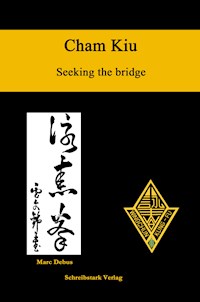
Cham Kiu
Seeking the bridge
The Second Form of Lo Man Kam Wing Chun
Author: Marc Debus et al.
Translated by Tim Bostick
Schreibstark-Verlag
Saalburgstr. 30
61267 Neu-Anspach
“Wing Chun Kuen”
Calligraphy by Sifu Lo Man Kam
1. Foreword
After the publication of our first two books, Siu Lim Tao and The Lo Man Kam Wing Chun System, we are now happy to present the book on the second form Cham Kiu.
We hadn’t expected to achieve such a huge success with the first two books. The book Siu Lim Tao was translated into English and thereby gained a large readership in English-speaking countries. Therefore we decided to offer the second book, The Lo Man Kam Wing Chun System, in English as well.
Because of the great interest in the Wing Chun system of Sifu Lo Man Kam, we decided to provide everyone interested in the second form an overview in written format.
Once again, many of our friends worked on this book. Even Sifu Lo Man Kam assisted in words and deeds and was a great help (just as in training). We especially appreciated the help of Gorden Lu, his son. Gorden is not only our Sihing (elder training brother) but has also become a good friend over the years.
Therefore we were very glad to have convinced Gorden to produce the pictorial for the Cham Kiu form together with Frank Kuhnecke. Gorden took time to visit and was so helpful in publishing this book, despite the fact that he had just opened his school in Virginia Beach. There he teaches Wing Chun from both Sifu Lo Man Kam and Sifu Duncan Leung, whose system he also learned.
We hope all our readers enjoy our new book
Sifu Lo Man Kam and his disciples in Germany
2. Cham Kiu: The Second Form of the Wing Chun System
By Marc Debus
After one has learned the first form of Wing Chun kung fu, Siu Lim Tao (“Little Idea”), and the exercises that go along with it, the second form of the system, Cham Kiu, follows.
The word Cham means ‘seeking’ and kiu means ‘bridge’ or ‘leading arm’. Therefore, one frequently sees the translations ‘seeking the bridge’ or ‘seeking the opponent’s arms’.
The Cham Kiu form of Lo Man Kam Wing Chun is taught in three sections, exactly like the first form. In the second form there are movements already learned in the first. For this reason, the first form is a prerequisite to learning the second one. In Cham Kiu, body movements are added to the arm movements. The students learn to carry out the arm techniques along with the body movements.
The students also learn the first turns. These Cham Kiu turns are done on the heel. The body turns 180 degrees, and the feet are placed at a 45-degree angle from the rest of the body. Weight is distributed evenly on both feet. The students have to learn to execute these turns in a controlled manner. If they turn too far or the feet aren’t set properly, the stance is not stable. The ‘turned’ stance of Cham Kiu (Hor Ma) is also the fighting stance of Wing Chun kung fu.
Furthermore, step techniques also appear in the second form. The students learn to move forward and simultaneously use arm techniques. This simultaneous execution of leg and arm techniques requires a lot of bodily coordination. Extensive training in this form enables the arm and leg movements to become optimally aligned with each other. Correct movements and positions in the form grant the fighter stability.
Cham Kiu also teaches the first kick techniques of the system. The first kick in the form is the front kick, which is also one of the most important ones in Wing Chun. The balance necessary for this technique is the foundation for all other kicks.
The second form is also an important advancement for those training. There are turns, steps, kicks, and movements in the system that improve the coordination, mobility, and stability of the practitioners. At the same time, students learn to coordinate arm and leg movements in order to generate even more power via the combination.
3. The Cham Kiu Form
By Gorden Lu
A few hundred years have passed since the creation of the martial art, Wing Chun. This art leaves behind the wisdom of many important concepts to learn and practice. Unfortunately, there were few written documents detailing this art since Wing Chun was mainly taught through the oral tradition. Since this art was taught from person to person without the benefit of written documentation, the history, movements and theories have had a number of different interpretations, sometimes misinterpretations.
The second form of Wing Chun is called Cham Kiu. The Chinese representation is
The English interpretation literally means ‘seeking the bridge’. In terms of methodology, ‘bridging the gap’ is more in accord with Wing Chun theory.
Other Chinese words are pronounced almost the same as Cham Kiu but the meaning is totally different.
This one means ‘sinking the bridge’. Because of the similarity in pronunciation, sometimes people think this is the meaning of the second form. ‘Sinking the bridge’ can be a movement or technique to use but is not a name of a form.
Like other forms of Wing Chun, there are always key ideas that practitioners need to learn. The first form emphasized the ideas of Wing Chun movements. The second form is more dynamic and emphasized the actual application of Wing Chun. The intent here is to summarize the principles and ideas of the form in order to introduce the philosophy of Sifu Lo Man Kam’s Wing Chun style.
3.1. Generate arm movement’s power:
- Chuen Sao trains the student to generate power by extending the shoulder and pushing the elbow together to shoot the arm towards an opponent’s center. “Chuen” in Chinese means thread or pass through an object. Chuen Sao is the first movement of the second form which pushes the two arms with vertical palms up and to a forward position.
- The power of opposite direction can be seen from the first form at the last two exercises ‘Tue Sao’ and ‘Punch’. This teaches the generation of power by pulling one arm back and pushing another arm forward to create a stronger and better power from the opposite direction. In the second form this same theory is applied but with different moves such as, Jip Sao, Palm strike, Lan Sao and uppercut.




