


Erhalten Sie Zugang zu diesem und mehr als 300000 Büchern ab EUR 5,99 monatlich.
- Herausgeber: The History Press
- Kategorie: Sachliteratur, Reportagen, Biografien
- Sprache: Englisch
Chichester is the archetypal Georgian town, with streets of elegant buildings gathered closely around the ancient cathedral. It usually appears to today's first-time visitor that the city has been largely untouched by the hand of time – particularly the destructive hand that guided the 1960s. However, this is not the case: in the 1960s, Chichester faced the same challenges as all historic towns, and much was lost – but the brakes were applied in good time and it became one of the first conservation areas in the country. This book, the first of its kind, looks at how Chichester fared in that turbulent decade, how it gained its status as a city of culture with a new theatre and museum, and how it expanded to meet the demands of its growing populace. Historical research blends with personal anecdote to produce a heartfelt portrait of the decade.
Sie lesen das E-Book in den Legimi-Apps auf:
Seitenzahl: 394
Veröffentlichungsjahr: 2015
Das E-Book (TTS) können Sie hören im Abo „Legimi Premium” in Legimi-Apps auf:
Ähnliche



















DEDICATED TO THE MEMORY OF:
John Birch (1929–2012), organist of Chichester Cathedral 1958–80
and
Peter Iden (1945–2012), celebrated Chichester artist
Much-missed friends who contributed so much to the artistic life of this city they loved, and also contributed material for this book which, sadly, they were not to see in print.
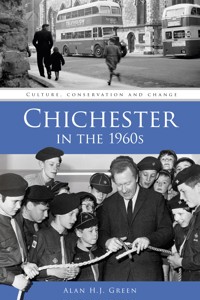
Front Cover
Change: Buses reversing in Tower Street in 1956. At that time buses terminated in West Street and the necessary reversing caused much congestion. By the 1960s this problem had been removed with the opening of a proper bus station in Southgate, which was fortunate as the rapid increase in car ownership in that decade would have meant that West Street would have been gridlocked for most of the day.
Culture: One of the most distinguished Cicestrians in the 1960s, Bernard Price Price was a writer, broadcaster, art connoisseur and antiques expert. Here he is seen opening the new headquarters for the 12th Chichester Scout Group in 1969.
Back Cover
Conservation: Chichester became the subject of a study into conservation in 1968 but, sadly, only after the east side of Somerstown had been unnecessarily destroyed in 1964.
ACKNOWLEDGEMENTS
Researching a work of this size and complexity would not be possible without considerable assistance from a large number of organisations and individuals. Acknowledging that assistance brings with it the risk of omission, and if I have committed this crime I apologise unreservedly and assure the omitee that this was owing to ever-increasing senior moments rather than a cavalier attitude to their contribution.
I must begin with the ever-patient staff of West Sussex Record Office (WSRO), where the bulk of the research was carried out, and who supplied scans of photographs and permission to publish them. I also thank the staff of Chichester Library where I accessed the all-important microfilms of the Chichester Observer. I must thank the town clerk, Rodney Duggua, and Clare Adams of Chichester City Council for granting me access to the council’s archive and permission to reproduce their photographs of civic occasions. Similarly Prof. Clive Behagg, vice chancellor, and Janet Carter, archivist, of the University of Chichester kindly supplied photographs and information about the building of the Chapel of the Ascension of the former Bishop Otter College and gave permission for their reproduction here for which I am most grateful. Martin Hayes, County Local Studies Librarian of West Sussex County Council Library Service, kindly supplied information about the new Chichester Library and the photograph of the much-vaunted computerised ticketing system in use.
Producing this book has made for a pleasurable stroll down memory lane – and not only for me, for it has been my privilege to be able to stir the memories of many other Cicestrians and raid their photograph albums, thus adding contemporary anecdotal and photographic evidence to the story. These include Anne Scicluna, John Templeton, Chris Butler, Garry Long, David Stuckey, Allan and Pat Ware, Linda Wilkinson, Richard Pailthorpe, Martin Philmore, Gerry Adams, Geoffrey Claridge, Eve Willard and the late John Birch and Peter Iden.
It is a local historian’s dream to discover rich seams of previously unpublished photographs to illustrate his tome and I have been particularly fortunate to be given access to two such collections. The first was that of John Iden, who as a young man was a very keen photographer, meticulously cataloguing and dating each negative. When a building was threatened with demolition, off John went to record it. The second collection was that of Rod Funnell who, as an architect practicing in the city in the 1960s (he designed the new library), took progress pictures of the projects with which he was involved. To both these gents I am extremely grateful. Once again John Templeton has kindly granted me permission to reproduce more of his superb – and now famous – 1960s slides, most notably those of the Big Freeze of 1962/63.
I am also grateful to Terry Carlysle who has a nose for sniffing out Chichester snippets and artefacts on the Internet, and making eBay purchases on my behalf via the good offices of her daughter Felicity, who is skilled in the art of virtual auctions, which I am not.
I have attempted to record many of Chichester’s organisations, institutions and businesses of the period and in this have received valuable help from people involved, namely Allan and Pat Ware (St John Ambulance Brigade and Girl Guides), Michael Merritt (12th Chichester Scouts) Mick Bleach (Bleaches Coaches) Gerald Brockhurst (Everymans Coaches), Pam Jones (Granada Cinema), Vera Abraham and Sue Marchant (Jessie Younghusband School) and Rachael Morriarty and Eileen Brown (Bishop Luffa School). In many cases this has resulted in unearthing yet more unpublished photographs as well as forgotten artefacts.
The controversial development of the East Broyle Estate spanned the decade and I am grateful to Ian Creswick for access to the deeds of his East Broyle house and to his son Richard who, when on a work experience placement at WSRO, helped me with the research into this convoluted project; to Graham Brooks and Michael Merritt who provided some early photographs of the development and to Ken Rimell and the Chichester Observer for permission to publish the two aerial photographs.
To all these I express my deep-felt thanks for their time, support and – above all – generosity.
CONTENTS
Title
Dedication
Acknowledgements
List of Illustrations
Introduction
One:
Prelude: The Swinging Sixties
Two:
Round and About the Town Hall
Three:
Planning a City for the Sixties
Four:
Wielding the Besom of Destruction
Five:
City of Culture
Six:
Getting About: Public Transport
Seven:
Schools: Ancient, Modern and Revised
Eight:
City at Play and Prayer
Nine:
The New Architecture
Ten:
Perils and Dangers
Eleven:
From Cradle to Grave: Provision for Healthcare – and Beyond
Envoi
Suggestions for Further Reading
About the Author
Copyright
LIST OF ILLUSTRATIONS
1. Cover of Chichester’s Festival of Britain programme
2. Procession of mayor and Corporation to the cenotaph, 1962
3. Mayor-making ceremony, 1960
4. Mervyn Cutten’s city council election campaign leaflet, 1962
5. Cllr Harry Bell being made mayor, 1965
6. Cllr Alice Eastland with Bishop Bell
7. Dinner menu, Eric Banks’ silver jubilee as town clerk, 1961
8. Eric Banks being presented with silver candlesticks, 1966
9. City council offices at Greyfriars, 1950s
10. Council Chamber, 1961
11. Flyleaf of Chichester City Guidebook
12. Cover of Chichester Paper 31, 1963
13. 500th anniversary of City Cross, 2001
14. Cover of Thomas Sharp’s report
15. Master plan from Sharp’s report
16. Lennards’ shoe shop, 1915
17. Lennards’ shoe shop shored up, 1960
18. Nos 1 & 2 South Street, Barrett’s bookshop, 1963
19. Nos 25–26 North Street, 1964
20. No. 24 North Street with raking shores, 1965
21. T.E. Jay’s ironmonger’s shop, Nos 7–8 East Street, 1958
22. New Tesco store, Nos 7–8 East Street
23. North Street, 1950s
24. Hepworths, East Street, 1964
25. West end of Crane Street, 1966
26. Crane Street looking east, 1966
27. Stride & Son notice of auction of East Broyle Farm, 1959
28. No. 74 Norwich Road when new in 1968
29. No through road! East end of Norwich Road today
30. Aerial view across East Broyle Estate looking west, 1975
31. View across East Broyle Estate looking north, 1975
32. Extract from 1960 Ordnance Survey of St John’s Street
33. South end of St John’s Street, 1966
34. Basin Road looking south, 1962
35. Town map of 1966 showing revised alignments of ring road
36. Nos 32–35 Southgate and Bedford Hotel, 1960
37. Orchard Street seen from North Walls, 1965
38. East end of Franklin Place being demolished, 1967
39. Northgate car park under construction, 1961
40. Demolition of Halsted’s ironfoundry, 1960
41. Cover of Chichester conservation area study report, 1968
42. Nos 48–57 George Street, Somerstown, 1963
43. East side of Broyle Road, Somerstown, 1963
44. Another view of Broyle Road, Somerstown, 1963
45. Demolition of Waggon & Horses, Somerstown, 1964
46. View across Somerstown during demolition, 1964
47. Eastgate Square, 1960
48. Eastgate Square, 1964, with Sharp Garland’s shop being demolished
49. Sharp Garland’s shop being demolished, 1964
50. View of the cathedral from Westgate Fields, 1960
51. Chichester College under construction, 1964
52. Westgate ‘bottleneck’ looking west, 1962
53. Last look at the view of the cathedral from Westgate Fields, 1962
54. Southgate end of the ring road under construction, 1965
55. Buildings on the west side of Southgate awaiting demolition, 1963
56. Westgate in July 1962
57. Nos 16–40 Orchard Street, 1961
58. West Street with demolition of Westgate in background, 1963
59. Another view of Westgate demolition, 1963
60. Old theatre on South Street when it was Lewis’s furniture shop
61. Model of Chichester Festival Theatre
62. Festival Theatre under construction, 1961
63. Festival Theatre, 1967
64. Interior of Festival Theatre, 1962
65. Cover of First Season Festival Theatre programme, 1962
66. Postcard with commemorative postmark for first Festival Theatre season, 1962
67. Theatregoers arriving on the penultimate night of the 1962 season
68. No. 31 Little London, house of Fred Sadler
69. Name plate for Chichester City Museum made by John Skelton
70. John Skelton working on Symbol of Discovery for Chichester City Museum, 1963
71. Completed Symbol of Discovery outside the museum
72. Opening of Chichester City Museum, 1964
73. View along Tower Street, 1964
74. Construction of the new library underway, 1965
75. Another view of the new library under construction, 1965
76. Tower Street with the new library nearing completion, 1966
77. Original computer library ticket, 1967
78. Computerised library ticketing system in use, 1967
79. Prof. Asa Briggs opening the new library, 1967
80. Assembled dignitaries listening to speeches at the opening of the new library
81. Walter Hussey when Dean of Chichester
82. John Birch, organist of Chichester Cathedral
83. Cast list for 1964 Chichester Operatic production of Yeomen of the Guard
84. Cover of 1965 Southern Cathedrals Festival programme, 1965
85. Extract from the programme for the 1965 Southern Cathedrals Festival
86. Yvonne Hudson’s mural of Minerva
87. ‘Street Scene Duian, France’ by R.O. Dunlop, 1963
88. ‘St Martin’s Square, Chichester’ by Peter Iden
89. Advert for David Paul Gallery, 1962
90. Offord & Meynell’s bookshop, No. 50 East Street
91. Coffee bar inside Offord & Meynell’s bookshop
92. Return half of a rail ticket from Chichester to Hayling Island, 1961
93. 2 HAL electric train in the bay at Chichester on a Portsmouth working
94. Electric locomotive 20001 in Chichester yard, 1962
95. Scholar season ticket Arundel to Chichester, 1968
96. Battle of Britain class locomotive leaving Chichester yard on an early morning freight, 1965
97. Extract from 1964 Ordnance Survey showing Chichester station and yard
98. Special train at Lavant, 1967
99. Buses reversing in Tower Street, 1956
100. Aerial view over Chichester Bus Station, 1964
101. Advert in 1961 Southdown timetable for the licensed buffet at Chichester Bus Station
102. Buses in West Street, 1956
103. Bus route map from 1961 Southdown timetable for Chichester
104. Southdown ‘Queen Mary’ in West Street 1962
105. Southdown 1963 advert for coaching services
106. Southdown coach on hire to Chichester High School for Boys, 1961
107. Girls’ Lancastrian School badge
108. Programme for 1962 Girl’s Lancastrian School bicentenary celebrations
109. Central Junior Boys’ School, New Park Road
110. Central Junior Boys’ School blazer badge
111. View of the rear of Central Junior Girls’ School from Tower Street
112. Extract from 1966 Chichester High School for Boys school photograph
113. Cast and stage crew of Chichester High School for Boys school play, 1961
114. Chris Butler in Jessie Younghusband School blazer, c. 1965
115. Jessie Younghusband School blazer badge
116. Jessie Younghusband School sports day, 1965
117. Programme for the official opening of Jessie Younghusband School, 1965
118. Her Majesty the Queen Mother opening Bishop Luffa School, 1965
119. Cover of the official programme for the opening of Bishop Luffa School
120. The new 12th Chichester Scout Headquarters nearing completion in 1969
121. Scouts and Cubs of the 12th Chichester Group watch Bernard Price open the new headquarters, 1969
122. Fanny Silverlock, District Guide Captain, being presented with an award, 1963
123. St John Ambulance Brigade boy cadets, 1964
124. Cover of 1965 Gala Day programme
125. 1965 Soapbox Derby at County Hall
126. Another view of the 1965 Soapbox Derby
127. Pat Silver selling Gala Day cornflowers
128. 1962 Gala Day procession
129. El Bolero coffee bar in South Street
130. Granada Cinema, 1966
131. Granada Cinema kiosk, 1965
132. North Street with new Victor Value and Sainsbury supermarkets
133. Bicycle bell top from Chitty’s cycle shop
134. West Street with Morants department store
135. Garment label for Morants
136. New Co-op department store in North Street, 1966
137. Souvenirs of lost Chichester businesses (bill heads etc.)
138. Mason’s garage in Southgate, 1959
139. F.J. French’s wholesale warehouse, Southgate
140. F.J. French’s after conversion to car showroom for Mason’s garage
141. Advert for Rowe’s garage, 1962
142. St Wilfrid’s church after extension in 1965
143. Notice about 1962 AGM of Swimming Pool Appeal Fund, 1962
144. Ground and first-floor plans of new swimming pool
145. Interior of new swimming pool on opening day, 1967
146. Duke of Richmond opening new swimming pool, 1967
147. Leaflet giving hours of business and charges for new swimming pool, 1967
148. Replacement of Lennards’ shoe shop, 1961
149. New chapel of Bishop Otter College 1962 (Chapel of the Ascension)
150. Interior of the Chapel of the Ascension
151. Festival Theatre from the air, 1962
152. Gillett House, Chichester Theological College
153. The inside staircase of Gillett House
154. Flooding in Green Lane and St Pancras, 1960
155. Snow in St Martin’s Square, December 1962 (the ‘Big Freeze’)
156. Snowbound East Street, December 1962
157. Sewer works in Orchard Street halted by the ‘Big Freeze’
158. Collision between two passenger trains at Drayton, February 1963
159. Drayton collision with breakdown crane clearing the wreckage
160. Firemen tackling the blaze at the Chichester Press, March 1960
161. Jay’s marine shop rebuilt after the fire of 1964
162. Royal West Sussex Hospital in Broyle Road
163. The clinic in Chapel Street
164. Line up of St John Ambulance Brigade vehicles
165. Dr John Gough in his garden in St John’s Street
166. Interior of Bastow’s chemist’s shop, No. 9 North Street
167. Advert for Edward White & Son funeral directors of South Pallant
INTRODUCTION
The 1960s, often lauded as the ‘greatest’ era of the twentieth century, are generally remembered as either a time of welcome liberation from the straight-laced propriety of the first half of the century or an era of great destruction when the hearts were ripped out of our towns and cities in the name of progress. Either way it was a decade of great change – change that was felt right across the land, and even sleepy Chichester was provided with many threats and challenges thereby, as well as gaining some welcome new assets.
It has to be admitted at the outset that Chichester (pronounced by its natives as Chiddester) has always been something of a backwater, never acquiring a fast, direct road or railway link of its own to London and not being en route from London to anywhere more important either. This meant (and still means) lengthy journey times which may be the major reason why it has not undergone the exponential growth of other south coast towns but instead remained pleasantly small. In 1961 its population was 20,118 and it had only risen to 21,170 by 1970; at the time of writing it is some 25,000 but Chichester is now being threatened with unwelcome rapid expansion to satiate the national demand for more housing.
In the 1960s Chichester was still very much a market town. Wednesday was market day, with beast and traders’ markets taking place at the Cattle Market site in Market Road. At this time cattle were still being driven through the streets from the station by colourful drovers. Chichester was also still a garrison town; the large barracks at the top of The Broyle had been home to the Royal Sussex Regiment since 1881, but they relocated to Canterbury in 1960 and, after a gap, the barracks became home to the Royal Military Police (the Recaps) who took up residence in 1964 and entered fully into the life of the city.
Chichester has always been regarded by its younger residents as a dead town where ‘nothing ever happens’, and in the 1960s the young had go to Portsmouth or Brighton (or, even worse, Bognor) for their thrills. Chichester was seen by them to be anything but ‘swinging’. However, the spirit of the 1960s did not entirely pass Chichester by; the city did provide some refuge for the young in its new coffee bars and the jazz club at Fishbourne. Celebrities from the world of rock and roll would appear from time to time, most notably when some of the Rolling Stones were tried here for drugs offences in 1967, an event that emptied out the local girls’ schools whose pupils took the morning off to scream outside the courthouse.
Chichester, as with all cathedral cities, has long had artistic associations, but the opening of Chichester Festival Theatre in 1962 set it on the road of being the city of culture that it is today. That a national theatre could be built – and thrive – in such a one-horse town as Chichester baffled the pundits, but built it was, and it attracted no less a personage than Sir Laurence Olivier as its first director. It remains a popular draw to the city.
Chichester did suffer at the hands of 1960s developers but this was checked sharply by a public backlash over some particularly brutal destruction that took place in 1964 and, three years later, its being adopted by the Minister of Housing and local government as a subject for a conservation study.
Sixties Chichester was a city with tremendous civic pride which engendered great loyalty amongst its citizens, many of whom served it in all sorts of ways. Indeed it was striking how, in the course of the research, the same well-known Chichester names kept cropping up in different connections.
Having been born in 1950, the 1960s were my formative years and I witnessed at first hand how the decade shaped (and, perhaps more importantly, failed to reshape) the City of Chichester. With the eye of an observant schoolboy I watched eagerly all that was going on around me, rejoicing in the constant activity at the railway shunting yard, enjoying the hard winter of 1962/63 and not noticing any particular inconvenience, observing the building of the Festival Theatre and lamenting the running down and final, unnecessary destruction of the east side of Somerstown.
Chichester has been well served by local historians over the years and so some subjects – the building of the Festival Theatre and the fate of Somerstown for example – have already been covered in much detail elsewhere. Where this is the case such subjects have still been included but covered less exhaustively so as to permit more space to be devoted to those that have not; the stories of the creation of the museum, swimming pool and new library, for example, being told here for the first time and in detail.
It is often a moot point as to when a decade actually begins. Technically it should be with the ‘1’ year – i.e. 1961 – and run to 1970, but here I will include all nine of the ‘sixties’ years and, now and again, drift back into the late 1950s and forwards into the early 1970s in order to provide a more complete picture. Consider it to be a long decade, as in ‘the long eighteenth century’.
I did not set out to cover every single aspect of Chichester life in the 1960s, to have done so would have been – for me – an insurmountable task. The choice of what has been included is entirely mine, and naturally (even self-indulgently) I have veered towards those subjects which most interested me or touched me personally in some way during the era in question. To those who have bought the book only to find their pet subject omitted, I apologise.
In this work, documentary research has been backed up by personal memories to produce an account which is primarily evidential, but spiced with memoirs* of the city during the 1960s, hopefully providing some nostalgia along with some long-forgotten facts about Chichester in the Swinging Sixties.
Alan H.J. Green
Chichester, 2015
Note
* Memoirs, especially when recalled in advancing years, can be notoriously unreliable hence the order of priority.
ONE
PRELUDE: THE SWINGING SIXTIES
‘If you can remember the 1960s you weren’t really there’ runs an oft quoted, but seemingly unattributed, maxim about the decade that brought an explosion of youth culture: summers of sex, drugs and rock and roll, long hair, free love, the cult of the hippy and, particularly, liberation. As a result of this the sixties have become almost venerated, ushering in, as they did, some of the most significant social changes of the twentieth century – ‘The old order changeth, yielding place to the new’, as King Arthur lamented from his death-barge in Tennyson’s Morte d’Arthur.
It was an explosion that was waiting to happen. Post-war austerity meant that rationing had continued into the 1950s with ‘make do and mend’ remaining the order of the day. The Festival of Britain had been held in 1951 and was intended to inject a spirit of optimism into a jaded nation. Chichester took part, in its provincial way, staging its own celebrations over the months of May to October 1951 and in the programme the mayor, Russell Purchase, describing the times as ‘difficult days’, urged Cicestrians* to participate in the projects and activities that had been arranged. Unfortunately the hope of a prosperous new age was slow in coming and the 1950s are irretrievably tinged with an air of dowdiness.
Youth rebellion was a theme that ran throughout the 1960s, sometimes reflected in almost tribal warfare. The most significant manifestation of this was in the ‘Mods and Rockers’ skirmishes. ‘Mods’ rode motor-scooters and ‘Rockers’ fast motorbikes and each was wedded to different varieties of popular music and clothing. In the summer of 1964 swarms of Mods and Rockers descended upon south coast seaside resorts and engaged in pitched battles in which knives were used. In Sussex, Brighton was particularly affected in this respect but I remember seeing such swarms gathering on the green at Littlehampton one Sunday afternoon that year. The family beat a hasty retreat to the station before any trouble broke out.
1. The cover of the programme for Chichester’s Festival of Britain celebrations. (Author’s collection)
THE POLITICS
In 1960 Harold Macmillan’s Conservative government were in power, headed by a prime minister well remembered for his famous epithet ‘The British people have never had it so good.’ Not everyone shared this view however and, unbeknown to him at the time, ‘Supermac’s’ days were numbered in the land. Within a few years he was to be brought down by a series of scandals involving his government ministers.
The first part of the M1 – Motorway One – from London to Birmingham had opened in November 1959 under the Minister of Transport, Ernest Marples, whose family construction company – Marples Ridgeway – just happened to have built it. In 1961 Marples commissioned the infamous Beeching Report on the future of British Railways; it was published in March 1963 and set out to prune Britain’s rail network from 21,900 route miles to 16,900 and close 2,363 stations.1 The future of transport was seen by the government as being in roads not railways; car ownership was increasing rapidly, offering freedom from a life dictated by bus and railway timetables, and a powerful road lobby was emerging to influence parliamentary decisions in this direction. The brief post-war golden age of rail and coach travel was rapidly coming to an end.
Whilst the Beeching Report was being got ready for the printers, the whole country was plunged into chaos by sub-arctic conditions that maintained a heavy covering of snow from Boxing Day 1962 until March 1963. Even the sea froze, and all this took place in an era when comparatively few had central heating – especially here in provincial Chichester – so the ‘Winter of 1962/3’ became legendary. The wartime spirit was revived to keep the country going.
In 1963 a notorious scandal broke involving John Profumo, the Secretary of State for War, who was exposed as having a steamy affair with a 19-year-old model, Christine Keeler, whose favours were also being sought by the Assistant Soviet Naval Attaché in London. After lying about the affair in the Commons, Profumo resigned in June 1963. The following September Macmillan resigned as prime minister in the face of personal illness and rising public scorn about scandals, and he was replaced by Sir Alec Douglas-Home, whose tenure was to be short-lived; Labour came into power, but with only a small majority, in October 1964 under Harold Wilson, a man who, apart from sharing the same Christian name, was as different from Old Etonian Harold Macmillan as a grammar-school boy could be. The country had felt a need for change – the old order had to go and the first Labour government for thirteen years was elected.2 Meetings between grandees in exclusive London clubs were replaced by beer and sandwiches at No. 10.
In November 1963 the world was shocked by the assassination of American President John F. Kennedy, one of those events so momentous that everyone remembers where they were at the time – I do; I was in bed, aged 14, with pneumonia. The ease with which Kennedy was able to be picked off by a sniper as he rode in an open car ushered in a new age of security consciousness that was to get steadily more rigorous and invasive as the century wore on.
Another general election was called in 1966 under which Labour increased its majority, something that was necessary to ensure that new legislation could be passed. Harold Wilson won the election with a majority of ninety-seven over the Conservatives, led by Edward Heath, and the Liberals under Joe Grimmond. However, the influence of the trades unions grew and strikes over pay and conditions became commonplace; everyone wanted that bit more out of life and Wilson’s social contract – an unofficial agreement with the unions – failed to curb the unrest.
One major plank of the Labour manifesto was the concept of universal comprehensive (i.e. non-selective) secondary education. A few new comprehensive schools had been opened in London under the previous Conservative government as an experiment in doing away with the stigma of failing the Eleven-plus examination, the examination whose passing was necessary to gain a place at a grammar school. Under Labour’s policy all grammar and secondary modern schools would be converted to comprehensives and much progress was to be made with this in the 1970s, resulting in grammar schools becoming a rarity. In West Sussex all grammar schools were to be completely eliminated, but in neighbouring Kent and Surrey many survived.
The year 1968 was marred by civil rights demonstrations in Befast which marked the restart of ‘the Troubles’ and the infamous ‘rivers of blood’ speech made in Birmingham on 20 April by the right-wing Conservative MP Enoch Powell, who advocated an end to immigration in a speech which polarised the nation.3 The following year, 1969, the politically charged ‘space race’ between the USA and Russia saw the first man land on the moon in July; America won the race.
At home Harold Wilson’s policies, which included devaluing the pound in 1967, failed to get the country back on its feet after what he described as ‘thirteen wasted years’ and he was ousted by Edward Heath’s Conservative government in the 1970 general election. Edward Heath had the task of leading the country into the 1970s, which, as it happened, were to prove no less turbulent.
THE CHANGING FACE OF THE TOWNSCAPE
From the early 1960s, in some parts of the country crooked developers were bribing corrupt councillors into condemning areas of quite serviceable Georgian and Victorian housing, after which said developers were permitted to reap the benefit of the sites. Investigations into such suspected practices eventually resulted in the famous trials of two men, the millionaire developer-architect John Poulson and Councillor T. Dan Smith who was the Labour leader of Newcastle City Council between 1960 and 1964. The trials finally took place in 1973 and both men were detained at Her Majesty’s Pleasure having been convicted of corruption.4 Unfortunately massive redevelopment – whether driven by criminal activity or not – had swept across the country throughout the 1960s, changing the face of many towns and cities; even historic Bath, now a World Heritage Site, was badly affected. In larger cities, under the aegis of slum clearance, poorer families were re-housed in faceless tower blocks whose shiny novelty quickly gave rise to unexpected social problems. The London Borough of Croydon was redeveloped into a business centre with a massing of ugly, high-rise office buildings (several by Mr Poulson himself) irretrievably altering its character.
Much 1960s architecture can best be described as tacky, both in construction and appearance, and the wholesale destruction of older buildings that were in the way can only be described as philistinism. The Town and Country Planning Act had come into force in 1947 and buildings deemed to be of historic and architectural importance had begun to be listed in 1950, but neither of these constraints seemed to be allowed get in the way of this ‘progress’. There were lessons to be learned but, unfortunately, they were not to be learned until it was far too late for many places. Chichester, as we shall see, got off comparatively lightly in this respect.*
It is against this backdrop that the history of Chichester in the Swinging Sixties has to be set.
Notes
* ‘Cicestrian’ is the term for those who were born and brought up in Chichester.
* 1964 was the year when destruction was at its height in Chichester, and the effects were indeed dire but could have been much worse – see Chapter Four.
1The Reshaping of British Railways produced by the British Railways Board under the chairmanship of Dr Richard Beeching – who had come from the chemical industry. (Published by HMSO, 1963.)
2 Burke, J., An illustrated History of England (London, HarperCollins, 1985).
3 Obituary of Enoch Powell, The Daily Telegraph,9 February 1998.
4 Obituary of T. Dan Smith,The Independent,31 July 1993.
TWO
ROUND AND ABOUT THE TOWN HALL
Throughout the 1960s Chichester was administered by a mayor and Corporation, as it had been since medieval times. Known as ‘Chichester City Council’ (but often shortened to ‘the Corporation’) this body displayed all the civic pride which came with such an ancient foundation, and its elected members, many of them Cicestrians, all lived in the city they sought to serve. This was local government at its most local – and none the worse for that.
2. Civic pride: civic duty. The procession to the cenotaph on Remembrance Day, 1962. The two mayor’s constables, carrying staves, precede the macebearer who escorts the mayor, Cllr John Selsby, who is followed by the mayor’s chaplain and then the members of the council. They are seen in St Pancras passing the end of New Park Road. The building in the background is the former Elizabeth Jonston’s Girls School which by this time had undergone a gender change to become an annexe of the Central Junior Boys’ School in New Park Road. It was demolished in 1966 as was the large shed behind it which was Farr’s Depository. (Chichester City Council)
CHICHESTER CITY COUNCIL
Chichester City Council still exists but, as we shall see, now reduced to parish council status. The Chichester City Council of the 1960s was a very different body, it was responsible for providing virtually all public services within the city boundary – planning, highways, sewerage, refuse collection, water supply*, housing, parks, markets – you name it, the city council did it. It also managed Chichester Harbour and owned Dell Quay. Indeed, Chichester City Council was equivalent – but on a much smaller scale – to one of those ‘unitary authorities’ that have recently been created; current perceived wisdom being that it is probably better to have all functions under one large umbrella rather than several smaller ones – what goes around comes around as they say. The rural area outside the city boundary was administered by Chichester Rural District Council whose offices were at Pallant House, the building that is now Pallant House Gallery.
In the 1960s, membership of the council comprised eighteen elected councillors and six aldermen from whose ranks were chosen the mayor and deputy mayor.1 Councillors were elected by the citizens of Chichester to serve a term of three years and a constant stream of endings-of-terms plus the occasional death and resignation meant that at least one municipal election needed to be held every year from 1959 to 1970 to elect new councillors. The main elections were held on the second Thursday of May, but interim ones would be called if necessary.
Before the Second World War those who stood for election as councillors did so on their own ticket and were not put forward or sponsored by a political party, candidates conducted their own campaigns and stood solely because they wanted to serve their town. However, after the war party politics began to enter local government and in the 1950s Chichester City Council became infected, but some candidates still stood on an independent ticket. However, when the one and only Labour councillor lost his seat, the Conservative members dropped their political labels and re-registered as independents. In the May 1957 campaign the Chichester Observer carried the headline ‘IND. RATEPAYERS ON WARPATH AGAIN’and reported that two candidates would be standing on the Independent Ratepayers ticket, who, if elected, would bring their total numbers to five.
In May 1960 there was a particularly high number of candidates – eleven – for the six vacant seats and the candidates, who include some prominent Chichester names, and the votes they polled were as follows:2
(E) William Brookes, civil servant
795
(E) John M Selsby, electrical engineer
707
(E) Robert Owen Stewart, Air Ministry employee
581
(S) William Chiverton, engineer
747
(S) Reginald Dray, company director
344
(S) John Sanctuary, machinist
478
(S) Robert Stephens, tobacconist and confectioner
867
(W) Alfred Brinsmead, manufacturer’s agent
671
(W) John Gilbert, bank clerk
777
(W) Jeremy Goodyer-Pink, soft drink manufacturer
614
(W) Gordon Douglas, licensed victualler
487
Those elected on 12 May 1960 were Messrs Brookes and Selsby to the east ward, Stephens and Chiverton to the south and Gilbert and Brinsmead to the west. It is noticeable that the eleven candidates were all male. J.M. Selsby, the electrical contractor, traded from a shop in Westgate and Robert (Bob) Stephens ran the famous confectionery and tobacconist shop by the entrance to Priory Park, a shop well known to thousands of past Chichester children. Both these men, plus John Gilbert and William Brookes elected at the same time, were to go on to hold the office of Mayor of Chichester, but for John Gilbert this was not to occur until 1971, beyond the era of this account. However, that appointment was to be an historic one as he was the first Roman Catholic Mayor of Chichester since the Reformation*. Until the recommendations of the Second Vatican Council were ratified in 1965, a Catholic mayor would have been impossible since Catholics were forbidden, by their own canon law, from participating in Protestant services; a Catholic mayor would not have been able to attend his own important civic services in the cathedral**.
3. The mayor-making ceremony of 1960 in the Assembly Room with Cllr William Pope receiving the civic insignia. To the left is Eric Banks, the town clerk. The impressive seventeenth-century mace lies on the table. (Chichester City Council)
At this time the city council had reverted to a largely apolitical existence, but that all changed in the election of May 1962.
For the 1962 election the Liberal party put forward a candidate, Mervyn Cutten, a well-respected Cicestrian (and, as it happens, local historian) for the south ward and his campaign leaflet urged voters to ‘put life into local government’ by going Liberal. Cutten topped the polls with 962 votes, the next highest number of votes going to William Pope, whose campaign slogan was ‘Vote for Pope, the Ratepayers’ Hope’, with 674.3 The following year Labour put up a candidate as did the Liberals, and the Liberal was elected. This caused the Chichester Observer to publish its report on the election results under the headline Will Party Politics Come Back Again? :
… for three or four years all has been quiet politically but what will happen now that there are two Liberals? Is there likely to be a revival of the events following election of the first Socialist ten years ago? The Liberals say there will definitely be no party line in the Council Chamber …
… the Chairman of the Conservative Constituency Organisation, Barry Rose, declared that he ‘could not imagine Conservatives standing quietly by and allowing Liberals to obtain control without opposition’.4
At the 1965 municipal election the Liberals held seven seats and the Conservatives again expressed concern, Mr Rose telling the Chichester Observer that the Conservatives would not stand by indefinitely and saying:
4. Mervyn Cutten’s campaign leaflet for the 1962 city council election in which he sets out his party-political stall. (WSRO)
The problem is that the City will shortly have (if we do not enter the fray) a Liberal-controlled council while we believe the majority of Chichester is, in fact, Conservative minded.5
The rest, as they say, is history. From then on party politics returned to the manifestos, although some continued to stand as ‘Independent Ratepayers’, and from 1970 the political allegiances of council candidates began to be recorded in the minute books. With the benefit of hindsight, one has to wonder whether we might have lost something through the politicisation [sic] of local government. Was it not better when there was no voting along party lines because there were no party lines to toe?
There were only three wards then, east, south and west, and of these west was by far the largest, including as it did Parklands and Summersdale. West Ward was getting larger as a result of expansion in both Parklands and Summersdale, and in May 1965 the Corporation, who had been considering the creation of a fourth (north) ward, decided to defer any such decision for a year6 – which they did every year after that, to the end that creation of the North Ward did not happen until after local government reorganisation in 1974.
Although the election of councillors was by the citizens of Chichester, the election of mayor and his deputy was not; these important offices were elected by councillors themselves. Mayoral elections, followed by the mayor-making ceremony, took place in the last week in May, as they had done since 1947. Mayors were elected to serve a term of one year, but at this period it was usual for them to be re-elected at the end of the first year to serve a second term. Once elected, the mayor nominated his deputy. The holders of these offices through the 1960s were:
Mayor
Deputy
1959–61
William Pope,
George Welch
1961–63
John Selsby,
Harry Ball
1963–65
William Brookes,
Alfred Brinsmead
1965–67
Harry Bell,
Samuel Watson
1967–69
Robert Stephens,
David Thomas
1969
Samuel Watson
James Seddon
1970
Thomas Siggs
Arthur Ingram
The mayor’s salary – or ‘remuneration’ as it was called – was £700 per annum in 1964 increasing to £800 in 1967 and £850 in 1970. Some senior councillors were elected from within as aldermen, and there were typically up to six of these, three of whom would be appointed as returning officers. Aldermen could not hold a council seat and so, on such elevation, further municipal elections had to be held to elect a replacement councillor.7 It seems to have been customary for ex mayors to be put forward as aldermen but this was not always the case and, as they were only elected for six years, it was not seen as a life peerage. The elections for aldermen took place at the same time as the mayoral election*, as did the appointment of one councillor to the office of bailiff.
5. Cllr Harry Bell being made Mayor of Chichester in May 1965, here signing the declaration of acceptance under the watchful eye of Eric Banks, the town clerk dressed in his wig and bands. Harry Bell served as mayor for two years at the end of which, in 1967, he was elected an alderman. (Chichester City Council)
As has been mentioned, civic pride in Chichester ran – and indeed still runs – very deep, and many great Chichester families served the city they loved in many ways, including as councillors. One such was Bassil Shippam (the singular spelling of whose name alone commands attention) who in March 1962 was awarded the Freedom of Chichester ‘in recognition of his services to the City’ and he was presented with a pair of Georgian silver candlesticks.
In May 1963 one of the most revered of all members of Chichester City Council died. That man was Alderman Thomas Jesse Eastland. Thomas Eastland, always known by his second name Jesse, kept the Wheatsheaf in Oving Road with his wife, Alice. He had been a railwayman, but serious injuries sustained in a shunting accident had forced a career change and he entered the licensed trade. He was a man of strong socialist principles but when local government became politicised he refused to allow his views to affect his civic life and always stood as an independent.8 The minutes of the council meeting of 22 May contain a lengthy tribute to the man who was first elected to Chichester City Council in 1932, becoming an alderman in November 1939 and mayor in 1947. In addition to his civic duties, Jesse Eastland was a magistrate, the founder of Chichester Trades Council, vice president of Chichester Amateur Athletics Club, vice chairman of Chichester Licensed Victuallers’ Association and chairman of the Chichester and District Allotment Society. He was awarded the MBE for services as vice chairman of the West Sussex Employment Committee and was given the Freedom of the City in 1959.9
On the day of his funeral the full council processed in solemn state to Southgate Methodist Church with the mayoral mace draped in black crepe.10
In an election in July 1963 three candidates were put forward for election as alderman to replace Jesse Eastland, namely William Brookes, Maurice Evans and J.M. Selsby. Selsby was elected to serve until May 1964 (i.e. the next mayoral election) and so in October there was a municipal election to find a new East Ward councillor to replace him, won by William Brookes. Electioneering then was incessant.
ENTER THE FAIR SEX
As we have seen, Chichester City Council was predominantly male in its make up but Alice Eastland, wife of Jesse, managed to buck the trend back in 1925 when she was elected as the first female councillor. Against the odds she went on to become the first female Mayor of Chichester in 1953, progressing – naturally – to become the first female alderman in 1961, from which office she retired in May 1967. She had been joined in the 1930s by Miss Jessie Younghusband but their career paths were not to be followed by other women until the 1960s when, possibly inspired by the equal rights movement, more stood for election. In 1960 Mrs Macadam features in the list and in July 1964 Kathleen Smith was elected in place of William Pope who had been made an alderman. Kathleen Smith would, in due course, go on to became mayor. When Councillor Alfred Brinsmead died in October 1964 his wife Gladys was elected in his place, bringing the number of lady councillors to four. In January 1969 Councillor Richard Butler died and his wife, Elsie, was elected in his place, becoming the fifth female councillor. Interestingly in the role calls of attendees in the minute book the ladies are always designated ‘Cllr Mrs …’.11 In the decades to come women were, of course, to play an increasing role in both local and national government.
6. Cllr Alice Eastland, the first female Mayor of Chichester, seen here presenting Bishop George Bell with a silver inkstand to mark his gaining the freedom of the city on 10 June 1954. She served on Chichester City Council from 1925 to 1967. (Chichester City Council)
THE COMMITTEES
As well as attending all meetings of the full council, the elected members all had to serve on various committees in which they were given a degree of choice. It was at these committee meetings that, as well as mundane day-to-day matters, policies were formulated for ratification by the full council. The list of committees that existed in 1964 gave plenty of scope for members to opt for some truly riveting meetings. These were:
Cemeteries, Parks and Gardens
Highways
Civil Defence
Markets
Establishments
Public Health and Housing
Finance and General Purposes
Sewerage and Waterworks
Harbour
Town Planning and Buildings
The council maintained a separate account for monies obtained from rates, and every March they would calculate the charge to this account for the coming year and the rate, which would be charged against citizens’ dwellings to fund it. This was probably the measure against which most citizens judged the efficacy of their council. Between 1963 and 1967 the rates rose from 9s in the pound to 11s 3d.12 Naturally ways of saving money on services were constantly being examined, but in October 1968 it was resolved that charging for the use of public conveniences (by the famous ‘penny-in-the-slot’) would be dropped within the city, a public-spirited initiative which could actually reduce income!*
THE TOWN CLERK
In any town council the most important officer was the town clerk, around whom the council revolved. It was always his name that appeared on statutory documentation, rather than the mayor’s. In Chichester, as a symbol of his importance, he always wore a Georgian-style wig, gown and bands at civic functions**. For the first half of the 1960s the town clerk was the much-loved Eric Banks who had been appointed to the post in 1936 and remained in office for thirty years. A very dapper man, he was highly efficient at his job and always courteous, even when he had to take a firm line with either a member of the public, a councillor or a member of Corporation staff.
On 28 April 1961 a banquet was held to mark the silver jubilee of Eric Banks’ appointment as town clerk at which he and his wife were presented with gifts. He continued in office for a further five years until he retired in January 1966. That month the full council resolved unanimously that:




