


Erhalten Sie Zugang zu diesem und mehr als 300000 Büchern ab EUR 5,99 monatlich.
- Herausgeber: The History Press
- Kategorie: Sachliteratur, Reportagen, Biografien
- Sprache: Englisch
'One of the best books written about the East End' - Daily Telegraph
Das E-Book Children of Bethnal Green wird angeboten von The History Press und wurde mit folgenden Begriffen kategorisiert:
Sie lesen das E-Book in den Legimi-Apps auf:
Seitenzahl: 429
Veröffentlichungsjahr: 2005
Das E-Book (TTS) können Sie hören im Abo „Legimi Premium” in Legimi-Apps auf:
Ähnliche



















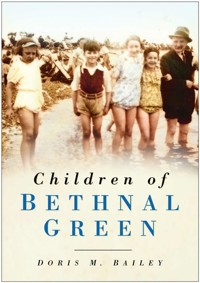
Children ofBethnal Green
Doris with big sister Eva.
Children of
BETHNAL
GREEN
Doris M. Bailey
Part of this text was first published in 1981 under the title Children of the Green by Stepney Books Publications
This revised and expanded edition first published in 2005 by Sutton
Publishing Limited
The History Press
The Mill, Brimscombe Port
Stroud, Gloucestershire, GL5 2QG
www.thehistorypress.co.uk
This ebook edition first published in 2013
All rights reserved
© Doris M. Bailey, 1981, 2005, 2013
The right of Doris M. Bailey to be identified as the Author of this work has been asserted in accordance with the Copyright, Designs and Patents Act 1988.
This ebook is copyright material and must not be copied, reproduced, transferred, distributed, leased, licensed or publicly performed or used in any way except as specifically permitted in writing by the publishers, as allowed under the terms and conditions under which it was purchased or as strictly permitted by applicable copyright law. Any unauthorised distribution or use of this text may be a direct infringement of the author’s and publisher’s rights, and those responsible may be liable in law accordingly.
EPUB ISBN 978 0 7509 5314 6
Original typesetting by The History Press
Life’s Journey
Together the road we’ve travelled,
Holding my hand, you’ve led
I stand in the valley of shadows
Because you have gone ahead.
We met at the foot of life’s mountain
Young then, with courage we went
And all the path glowed then with sunlight
And stumbling blocks seemed heaven sent.
Hand in hand then we travelled together
Through sunshine, or vale of despair
And nothing could daunt us, or harm us
As each knew the other was there.
Sometimes we would pause in the valley,
Or happily tread on life’s way
And each night we’d rest with the sure hope –
Tomorrow, a new climbing day.
And then, we grew older and slower
But still journeyed on, hand in hand
Looking back, life was greyer and dimmer
Than the glow of the bright Promised Land.
And now – you have gone on without me,
Just a few steps alone you’ve trod
But I’m coming, and know you’ll be waiting
As we walk on together – to God.
The book is dedicated to my dear E.B.
Contents
1.
Tilly Goat
2.
Dad
3.
Day to Day
4.
Street Callers
5.
Victoria Park
6.
Rosie
7.
Where Do Babies Come From?
8.
School
9.
Father Christmas and Mr Thorn
10.
The Sanitary Man
11.
Making Knickers All Day
12.
War
13.
Engaged At Last
14.
The Big Day
15.
Miss Green
16.
Ups and Downs
17.
My Daughter is Born
18.
Flying Bombs
19.
VE Day and Peace
Mum.
1
Tilly Goat
Defiantly, I put my arm around Tilly Goat’s thin shoulders as we walked home from Olga Street school together that bright day, catching as I did so the queer smell that always seemed to hang about her, even when, as sometimes happened, she wore a clean dress.
It was a smell that used to pour out of some of the open front doors in our street, and always seemed tied up with children I was not supposed to play with. But today was different. Today, I had got a three. Now I could sit next to Tilly Goat, play with her and walk home with her. She was quite nice too, as long as you didn’t get too near her. None of my other friends could play with me. I was now a three, and although inwardly I was dreadfully upset I could pretend I didn’t care, and I watched Renee and Maudie and May walk past me on the opposite side of the road, put out my tongue at them and shrieked with laughter at something Tilly Goat had said.
Every few weeks, in the early 1920s, Nitty Norah would come into our Bethnal Green school classroom. She was a thin and angular woman, hair scragged tightly into a bun, with a large, round, navy hat firmly pulled on to her head and a starched white nurse’s uniform. Her lips were set in a continuous snarl and her nose twitched as though assailed by a permanent nasty smell. Come to think of it, she had a lousy job anyway. I never tried then to visualise her in her off-duty time, but it couldn’t have been all that pleasant for her. When other women talked about their jobs, she could hardly boast about being a ‘Nitty Norah’. Even school nurse wasn’t exactly glamorous in those days, festering sores and impetigo were too commonly their lot anyway; but the nit nurse, on an everlasting hunt for head lice, had the least enviable job of all. No wonder she was a sour creature. I wonder now whether she was glad or sorry if she didn’t find anything all day. She must have been a forerunner of today’s traffic warden!
We would file out in silence and stand before her while the teacher sat beside her with a book. In one hand, Norah held a metal comb which she dipped into a dish of carbolic. She would lift our hair, peer at our scalps and then utter, one, two or three in a sepulchral tone and the teacher would write it in her book. One, we were clean, two, she suspected nits, and three, dreaded three, we had livestock on our heads!
After she had left the room, the names of the threes were called out, and these luckless ones had to sit alone in a separate block of desks. I had always felt a little pity for these unhappy girls. Some of them, in the dirty block for the first time, would sit and cry, especially as the teacher would warn the class not to play with them again, until they were dealt with. This meant that the nurse would come again shortly and, if they were still unclean, they would be sent to the cleansing station. They would come back from their afternoon trip with clean and shining hair, cut short if it had been long, and the dirty block would be abolished until next time around. Then we would all sit in blocks according to the monthly tests in the good old three ‘R’s, and I would sit smugly in the top place, month after month.
I could not believe my ears that morning, when the teacher called my name with the threes, after tight-lipped Nitty Norah had gone. I knew I had one, I heard her say it; and I looked frantically round the classroom with swimming eyes. Yes, there she sat, another girl with the same surname as mine. She, who was always dirty, was sitting among the clean lambs, while I was to be cast out! I fought back my tears and tried to remonstrate, but the teacher only tutted. After all, in those days no pupil could possibly accuse her teacher of making a mistake. So I sat in the dirty block and shrank from everyone, trying hard not to cry. I was only 7 at the time, but the memory of that morning has stayed with me all my life; for I learnt at that early age the impossibility of trying to reason with authority.
I crossed Grove Road and left Tilly Goat at the top of Hamilton Road. Later, the name was changed to Haverfield Road – the nearest we ever got to moving in my childhood! I took a deep breath, exchanging the smell of poverty for the lovely smell of new bread. On our street corner was a baker’s, with the bakehouse running alongside. The wall was always warm, and stray dogs often sat there warming their thin bodies against it. Gangs of youths sat there too, playing cards, shuffling the greasy packs on the pavement. They had left school, but they were out of work and there was nothing much to do, so they played cards, or football. Our street, being a cul-de-sac, was a favourite place for games, and there were often fights when our own gangs turned on those from neighbouring streets and told them to get back where they belonged. An Englishman’s home may be his castle, but the cockney fellow’s street was his kingdom, and not lightly trampled on by outsiders. Even we small girls felt this bristling pride of belonging. I lived in the ‘court’, a narrow slip of a turning at the bottom of the street, and I can well remember shouting ‘Get out of our court’ whenever children from the main street came down there to play. This was hardly fair on them, and a good job they didn’t return the compliment, since we had to traverse their domain to get out of the street at all.
Past the baker’s, the smell changed again, for next to the baker’s was a dairy. No modern supermarket place this, for it was a real dairy with live cows, poor cockney cows that never saw a field. Often, when we went in with a jug for a penn’orth of milk, we would stand up on the stool by the open window where they served, and see the flanks of the cows and hear them softly mooing and stamping their feet. In the summer there were big sticky flypapers hanging up over the window, and sometimes they were so covered with flies that you couldn’t see the flypaper at all. It was possible to buy new-laid eggs there too, since they kept hens in the back, and when my mother sent me for a large brown egg for Dad’s tea I would carry it home carefully in my hand. We usually bought things as we wanted them, but I suppose eggs would have been difficult by the dozen, without egg boxes. Anyway, the brown new-laid egg cost threeha’pence each then.
Every few mornings the cows were let loose in the street as soon as it got light, while their stalls were scrubbed out. If they made a mess, it didn’t matter in the slightest, because the women would come out of their houses with buckets and take the steaming dung in for their gardens. We didn’t often get cow dung, living in the court at the bottom, but we had the advantage on funeral days, because the lovely black funeral horses always came down to the court to turn round, lifting their feet high into the air and snorting and foaming at the mouth. They were awesome creatures, in their black or purple velvet palls, with feathered plumes on their heads and their coats all shiny. Often, while they were waiting, they would lift their tails and drop horse roses. Mum always had a pail at the ready just inside the door on funeral days, and she, or one of us, would grab the pail and a shovel and scoop up the precious stuff before anyone else could get it. Old Mrs Kay who lived right on the corner had the advantage, but she was a fat woman, and slow with it, whereas my mum was on the skinny side and much quicker. Besides, Mum had an added incentive, because a good load of horse roses would put Dad in a sweet temper for once, and that was always worth while. He would whistle softly as he shovelled it gently around our one and only rose bush, reserving a little for his lilies and carnations.
Dad was a real greenfingers, and this little plot of ours was his pride and joy. The place could not have been more than 25 feet long, and he only had a 4-foot strip of soil along one side, but he grew a profusion of flowers all summer long and knew not only every bud, but every petal he possessed. Every fish head was carefully buried near the rose bush, and when we had no manure he would sometimes send us to walk all the way to Hackney Marshes, about 3½ miles away, armed with a small case and a couple of big hairpins. There we had to fill the case with sheep droppings, picking them up with the hairpins. We didn’t like the job, but we liked the penny we got for the work. No royal garden was cared for so lovingly as ours.
On the day of the ‘three’ episode, I wandered slowly home, carrying my dread news and scratching my head because I had seen Tilly doing it. The front door was open and I yelled into the doorway:
‘Mum, Nitty Norah came this morning and I’ve got a three!’
A sudden crash from the kitchen as Mum dropped what she was doing. ‘Three!’ she shrieked, dashing up the passage and slamming the door. ‘Shut up, all the court’ll hear you!’ Not that they wouldn’t know by now, with three of the girls in my class living in the court.
‘You can’t have a three, you can’t,’ she cried in distress. ‘Your dad’ll kill me.’ Wiping her red hands on her coarse apron, she began searching anxiously in the copper-coloured silk of my short bob. In spite of her negative search, she was taking no chances. The big black kettle was steaming on the hob as always, and she got out the Lysol bottle. Dinner could wait. Soon my head was tingling and my scalp smarting with the fervent wash in piping hot Lysol.
I sat watching her cook the dinner while my hair dried. She was a very goodlooking woman, my mum. Not that I realised it then, but I often heard my aunties say so. Bertha was standing right in the front row when the looks were given out. She had aristocratic features, big brown eyes and black curling hair that escaped from the tight bun at the back in little wispy tendrils. Perhaps her nose looked a big large, but that was because she was thin. Her skin was pink and white, a very good flawless skin, apart from her work-roughened red hands. She was very energetic and moved like lightning, dashing through the chores and working with a will. She was lavish too, lavish with everything, so that our hand-knitted dresses were always on the big side, our dinner plates were piled high and even our toothbrushes well endowed with the camphorated chalk with which we cleaned our teeth. Love and punishment were meted out on the same lavish scale, especially the wallopings! But they were quick hard smacks which she gave, and soon over, whereas Dad would prolong the agony, taking off his trouser belt, or taking the thin hooked cane from the wall and feeling it almost lovingly before giving us a mighty swipe across the legs or the backside. That went on hurting for hours and I went on snivelling for as long as it hurt. My younger sister Gwen was made of sterner stuff: on one occasion, when the thin cane snapped across her bottom, she picked up the broken piece and handed it to Dad with the words, ‘Go on then, hit with two halves at once, you bugger.’ He was so surprised by the retaliation that he threw the broken cane into the fire and walked outside without a word.
I didn’t go back to school that afternoon, one of the very rare occasions when I can recall staying off. Shortly before my father came home from work I got another Lysol wash, just to be on the safe side, and this was repeated daily all week. Even now, the smell of carbolic makes my scalp tingle and the memory of that never-tobe-forgotten episode is as scratch-provoking now as ever.
Next day, Mum came up the school and demanded a recount. Clutching her leather shopping bag in one hand and her worn purse in the other, she bristled at the teacher and cast a few scathing remarks about those dirty old Clarks who spoilt our good name, looking across at Kitty Clark. The teacher looked uncomfortable; it was the first brush she had had with Mum and she had probably realised by this time that it was unusual, to say the least, to see Kitty among the clean children.
Fortunately, Nitty Norah was still on the premises and I was marched into the boys’ school by my angry protesting mum. Norah grudgingly admitted I was clean – now. ‘No nits at all,’ she announced, after a thorough scratchy hunt. I wondered that there was any skin either!
Back in the classroom, I was reinstated in my top place, and next time around saw the hapless Kitty back among the threes where she belonged. My sudden burst of friendship with Tilly Goat ended, but I always had a soft spot for her.
My main friendships were with the girls who lived in our court, Renee, Maud and May. Renee knew everything, except her tables maybe. She was nothing much to look at, being extremely cross-eyed, but she wore steel-rimmed glasses to counteract this, and every few minutes she twitched her nose to push the glasses back where they belonged. She hated helping with the household chores, and once out in the street she would do anything to avoid going back indoors. Out of sight was out of mind, as far as she was concerned. So when she wanted to spend a penny, she would jig and jig and cross her legs and dance about holding herself, rather than go indoors. There was a stale smell about her all the time; unlike Tilly Goat’s poverty smell, but very unpleasant, and probably due to wet knickers most of the time. But she knew all the reasons for the street fights around. She could tell us why Mrs Thatcher had a black eye every week, and why Mr Green threw Maudie’s handbag out of the bedroom window.
Maudie was a little devil. That was my mother’s description. She’d come to no good, that was for sure. I wondered what coming to no good meant, but I shivered at the prospect. She was a beautiful child with bright red hair and when the sun glinted through the court and shone on her, it looked at though her head was afire. She made the most outrageous demands on her poor mum; you could hear her screams throughout the court when she wanted a ha’penny and didn’t get it. Poor Mrs Green would come along and borrow a penny for the gas sometimes, and we all knew it was to give to Maudie, because the screaming would stop as soon as she went back.
After her little brother was born, she was even worse. Then she stood watching the baby feed and would yell, ‘Give us a drop.’ Her foolish mother would take the baby from the breast and hand over to Maudie, who would suck greedily for a few minutes and then spit on the floor. Her father was exactly the opposite. He was always threatening to kill her, and when she grew older, there were the most terrible rows, night after night, as Maud stayed out with the boys and her dad waited for her to come home. He’d throw her bag out of the window, take off his belt and give her a good walloping, but her soft mother would creep downstairs and recover her possessions and next evening give her a sixpence to go out with.
May was quiet and docile, always the peacemaker among us. It was May who would take the end of the skipping rope and turn it, May who was always last in a ball game, and she who would go and ask for our ball back if it bounced down the basement area of the houses at the end of the street. She was a thin, plain girl with straight, lank hair, and it’s strange to me that I can remember her, seeing that there was nothing about her to remember. But perhaps she had lasting solid qualities that I sensed rather than saw, because I liked May, and was never happier than when playing shops or schools with her.
2
Dad
How vividly I remember those Bethnal Green days! There were four children in our family. My sister Eva was six years older than me. Gwen came along just two years after me, and Rosie was three years younger than Gwen.
My mother’s sister Lizzie lived next door, and she and Uncle Will had three children. Will, the eldest, was the same age as our Eva, Steve slightly older than I was and Jean a bit younger than Gwen. There was a gate between our two gardens and we did everything together, so that I looked upon the boys next door more as brothers than cousins.
My sister Eva said we lived in Bow. Indeed, our address was Bow, E3, and it sounded a bit more posh, but whether she liked it or not, we came under Bethnal Green borough council, voted as residents there and had their dustmen and suchlike. But Eva would always strive to be posh. She was a pretty girl, very self-assured and argumentative, a fact which was always landing her in trouble. By the time I was in the main girls’ school at 7, she had left to go to a central school, a sort of half-way house between the elementary and the secondary grammar school. Children went there at eleven plus if they were reckoned to be really bright, but not brilliant enough to get the Junior County, which was the only means of getting to a grammar school without paying.
Eva had been in hospital with scarlet fever at the time of the scholarship, otherwise I expect she’d have made it, but anyway, the central school was something and she learnt French and did algebra and chemistry. This last she really enjoyed and came home full of the experiments she performed. They sounded pretty gruesome to me, but everyone to their taste. I suppose she was a bit vain, but she was a nice-looking girl, with slightly curly brown hair, lovely hazel eyes and petite features. She had nice hands too, and I well remember when she bought herself a bottle of nail varnish. It was colourless of course, but I couldn’t keep my eyes off her shining, wet-look nails. I’d never seen anything like them before. When she was safely out one afternoon, I crept up and took the bottle from the box under her bed and painted my own nails. They looked so nice, but my joy was short-lived. You can’t hide your hands at mealtimes, and Eva suddenly spotted my shining finger ends.
Eva, Gwen and me, 1922.
‘Thief,’ she mouthed at me, ‘thief.’ Even though she was mad at me she didn’t give me away in front of Dad, which shows what a nice nature she really had at heart.
I shot upstairs after tea and scraped and scraped at my nice nails with scissors, finding it harder to take off the polish than to put it on. But scrape and scrape I did, though not without a pause between, while she punched me for stealing.
‘Next time you pinch my stuff, I’ll tell Dad, you bet your life I will, you fat lump of pud.’
So I kept away from her goods after that, except for an occasional shake of her Yardley’s talcum powder down my front, when she grew up a bit and started using such luxuries.
Sometimes, when she wanted to look extra nice, she would put her hair in rag curlers. The long strips of rag were wound round and round the damp hair and firmly knotted. How she slept in them I don’t know, but the end result was a load of frizz to my mind, end being the operative word. I remember she once tried it out on me, but she might just as easily have spent her efforts on steel strands. I can still remember the pulling and tugging of those rags!
I’ve always had a good memory – in fact, I’m sure I can remember being born! The psychiatrists would scoff at that idea, but I suffered badly from nightmares as a child. Whenever I had a cold, or childish upset, tall thin men in white would stand in the corners of the bedroom, and advance on me, swearing loudly and stretching out bony hands to grab me. I would run from them, run and run until I fell head-first down a tiny, tight tunnel. This tunnel was slippery and slimy on all sides, and the slithery walls would press upon me until I felt I should be crushed. Then, just when I could stand no more, I would shoot out from the tunnel of horror into a huge, light open space, cold and echoing. I would start screaming then, loud piercing screams that brought my mother running to me. She would light the candle, give me a drink and sit on the bed awhile, showing me the familiar outlines of the room. But no sooner did she go back to bed than the whole thing would start up again. This nightmare troubled me on and off for years. Every flu episode or bad cold brought the same sensations, until my own first baby was born. In a flash, it came to me that this was what my own nightmare was all about. It was just birth; and it has never once troubled me since. All very far-fetched I suppose, but it’s a thought.
I can even recall sitting on my mother’s lap during an air raid in the First World War, listening to pinging noises interspersed with bangs. Eva was crouched by her side, trembling and hiding her face in Mum’s skirt. ‘It’s all right, it’s only shrapnel on the tin roof opposite,’ comforted Mum, but I sensed her fear and cried bitterly. As I was only 2 when the war ended, my mother was amazed when I told her about this episode, and remembered the occasion clearly.
I was supposed to be the brainy one of the family, but I have long since come to realise that cleverness in those days was merely having a good memory. I could look at a row of dates and know them, I learnt my tables in the same effortless fashion, and it was easy to come out top in every exam when it was only a question of remembering which river flowed into which sea and how many half-crowns there were in a pound.
I learnt poetry in the same parrot fashion, my favourite party piece being ‘Young Lochinvar’. The family would stand me up on the table and I would begin, very soon finding them all convulsed with laughter. It was not a funny poem, but I ploughed my way through, never realising that it was my hopeless lisp which caused the amusement. ‘Through all the wide borders, his steed was the best’ was the line that really got them. My lisp was never so apparent as when I had the misfortune to be in the class of Miss Griffiths: I defy anyone to say that quickly and often, and as all my sentences began ‘Please Mith Griffithth,’ I was always being laughed at.
No one ever suggested speech therapy in those days, and I suppose my lisp was completely ignored because my school reports for those years show 90 per cent or more for ‘Reading’. Yet my present family get all steamed up and suggest sending my three-year-old granddaughter to speech therapy classes, because she says she would like a ‘tup of toffee’ and cannot manage her ‘c’ sound.
When I compare school today with those far-off 1920s, I shudder to think how the bright young lads and lasses of the present generation would fare. Sitting in serried rows of double desks, we never moved out of them except for the fifteen minutes play between 10.30 and 10.45. Then we would queue up in silence and walk sedately to the playground, with a monitor on each landing of the stone staircase to make sure we did no more than breathe on the way down. We ate our sandwich or whatever we had brought, and went mad for about ten minutes in the small concrete yard. Then a quick trip to the outside lavs and into a silent line again for the return journey up the stairs. There was a big timetable on the wall, and we knew exactly what we would do each day. Every morning started with the singing out of the inevitable tables, but we knew them, they were seared for life on the grey matter of all but the most dim. We had never heard of a ‘project’ and in today’s primary school, when I have asked a group of boisterous children milling around the practical area of their school what they are doing, it’s always the same. ‘We are working on a project.’ If they are standing on the upturned tables, or throwing water and paint at each other, then they are ‘doing a play’. No words to learn, nothing to plan and think out, no cues to look for, just ‘doing a play’. Heaven help some of these misguided children when they set foot in the hard competitive world around them, when all they seem to know is projects and plays.
I started out left-handed, but continuous raps on the knuckles soon cured me of that. Or did it? Even now, I’m cack’anded, to use my mother’s expression. If I wind wool, I tend to put the ball round the wool instead of the wool round the ball, and drying dishes, I rub the dish across the cloth instead of the usual way round. But no one in our school was allowed to be left-handed and that was that.
One day, I tried being funny. I put my mill board on my head and pulled a face. (The mill board was a stiff piece of compressed cardboard about one foot square, on which we rested our drawing paper during art lessons). The teacher rounded on me. ‘Do that again,’ she said in a threatening voice. So I did, and how she walloped me! I went home sadder and wiser, having had my first lesson in the duplicity of adults.
Our headmistress was a strange woman. She wore thick stockings with a draughtboard pattern on them in an age when everyone wore lisle for weekdays and silk on Sundays. Her tweed skirts were thick too, and her woollen jumpers tight across a buxom figure. Her hair was a mousy brown and scragged rather than pulled back and her glasses looked as though they had grown into her nose.
She would sweep into morning prayers and say, ‘Good morning girls,’ with a terrific rolling of the ‘r’, to the four hundred or so tightly packed girls assembled before her. ‘Good morning Missawkins,’ we would chant in unison. Without a moment’s hesitation, she would repeat the greeting. And we would reply as before. Sometimes, the whole performance would be repeated time and again, until we got the message and she was satisfied with our reply. ‘Good morning girrrls.’ ‘Good morning Miss . . . Hawkins.’
I wonder now if she was a communist, or whether she belonged to some cranky way-out sect, for even now I remember the words of some of the hymns, of which we sang two every morning.
Hush, the loud cannons roar, the frantic warriors call,
Why should the earth be drenched with gore, are we not brothers all?
This was the one I hated most, it sent shivers down my back. One line, ‘sweet mercy melt the oppressor’s heart, are we not brothers all?’ used to really get me and it was as much as I could do not to howl. Freedom was the keynote in her choice of hymn.
Men whose boast it is that ye come of fathers brave and free,
If there breathe on earth a slave, are ye truly free and brave?
In lighter vein was:
Life is a leaf of paper white, whereon each one of us may write,
His word or two, and then comes night.
She was terribly fond of the brother theme, because we also sang:
Oh brother man, fold to thy heart thy brother.
I wasn’t keen on all these brothers anyway. I didn’t have any and, by jingo, I didn’t want any either. If we had brothers and they grew up to be men, it would be like having more than one father in the house, and we didn’t want that. One was plenty!
My father was a good dad, as dads go. He was a rather short, stocky man, with a little moustache and bushy eyebrows. His hair was thin, carefully brushed to one side to cover a balding patch, but what he missed out on his head grew well enough in other places. His arms were thickly covered and the black hair extended across the backs of his hands, and the thick hair on his chest sprouted even through his vest buttonholes. His fingers were long and sensitive, and he had a hatred of getting sticky. Funny this, because being a french polisher, they were always sticky. But he would never jam his own bread, or peel his own oranges, but hand them to Mum to do. He was powerfully built, and hardly ever used nutcrackers, breaking the nuts in his hands. He cut his finger- and toenails with a big pair of pincers, the same ones that he used to pull 4-inch nails out of wood!
Dad loved his work and many’s the time I’ve watched him doing jobs at home. Spending hour after hour lovingly going over and over the same piece of wood, with little pads of wadding wrapped in linen and soaked in linseed oil. We had some nice pieces of furniture in our house, some of it acquired on a community type basis. My uncle next door was a cabinet maker. His boss would sometimes give him enough wood for three of an article, maybe a sideboard or a cabinet, and he would make up all three in his spare time. Dad would go and polish all three. The boss kept one and Uncle and Dad had one each and all were satisfied with their bargain. A pity folk don’t do this kind of thing more often.
Every bank holiday weekend, particularly at Easter, Dad would go out early to find extra work. Bank jobs were his speciality. What he meant then and what young men mean these days by ‘doing a bank job’ are two very different things. When the banks in the city were closed, there was an opportunity for the long counters to be repolished. Rich mahogany, lovingly tended, not wiped over with a brushful of polyurethane as they are now. Dad took terrific pride in his work, and I still recall the names of some of the big London banks which he ‘did’ at Easter time.
Dad in his youth.
All through the holiday he would work, including the Sunday, and then, when he got paid, he would take us out and buy us good new shoes. He had a mania for good shoes. Both he and Mum had bad feet, with corns and bunions and revolting callouses, and he was determined that we shouldn’t suffer in the same way. So he would take us all up to Dolcis near Liverpool Street, and pay about 12s 11d a pair for our shoes in a day when there were plenty of shoes to be had for 7s 6d.
He had this same spend-and-be-blowed attitude towards food. Sometimes he would stop in the Bethnal Green Road on the way home from work on Saturday afternoons, and buy smoked haddocks, or juicy kippers, or big rump steaks. No matter if Mum had already got the weekend food in. ‘Never a penny is wasted if it goes on your back in the way of good clothes, or into your stomach as good food.’ This was his motto, and we did eat well. A cooked midday dinner, something for tea, and when we were old enough to stay up for supper, there was a rabbit stew, or tripe and onions, or stewed eels. Everything had to be of the best.
It had to be cooked well too and no fault was ever overlooked. If a potato dared to look black after cooking, and they sometimes did towards the end of the winter, then it was Mum’s fault for buying cheap muck. A tomato had to be English and to skin easily, to be neither too firm nor too soft, and if the bloater for his tea happened to look dark inside when he slit it open, then it was entirely Mum’s fault and ought to be rammed down her throat. If he was not in a good mood, I’d watch with bated breath while he ran his knife along the backbone of the bloater and opened it. If mum had been given to prayer, then I think she would have prayed over every steak she cooked him, particularly on Saturday, when he had loitered at the pubs on the way home from work. If it was not tender enough for the knife to slip through like butter, then it might go straight across the room, or into the fire, or at my poor long-suffering mum. I remember her once spending the whole afternoon preparing a crab and making a delicious salad, because we were in the midst of a terrific heat wave and it was too hot to eat. When our lord and master came home, he asked in a very quiet voice what it was supposed to be.
‘Why, your meal,’ answered Mum, equally quiet.
Then he let fly. ‘But where the bloody hell is my dinner?’ he roared. The whole plateful went flying across the room, and the next half hour was given over to a tremendous outburst about a man slaving his guts out to provide money for grub, not bloody rabbit food.
Rows in our house were the most one-sided affairs. I often used to think that if only Mum had answered back and stood up to him occasionally, life might have been a bit different, for he was a real bully. But we didn’t . . . we just let him roar. Many a night, my young sister and I lay in bed petrified, listening to the almighty din downstairs when someone or something had crossed his path and made him angry. Sometimes, Mum came running up the stairs and came in and sat quietly crying, on the end of our bed. We would pretend to be asleep and he would come belting up after her. He would open the bedroom door and point down the stairs. ‘Come down and take your medicine,’ he would say in a queer and level voice, and she would go sobbing down the stairs and the thumping began again.
‘It’s all right, Gwen,’ I would whisper, trying to comfort my sister, ‘it’s only because Mummy has to take some nasty medicine and doesn’t want it.’ But I didn’t believe it, and neither did Gwen.
‘The old man was in a bloody temper last night, wasn’t he?’ Auntie Liz would say over the garden wall, next morning. ‘I wonder you’re so daft as to stay with him. I’ll be damned if I would.’
‘T’aint as easy as all that,’ muttered Mum to her sister, and then they would see me and shoo me away and they’d whisper together.
Of course, it was only the drink that got him like that. I often heard my uncle Will say that it was a pity that Joe didn’t drink a bit more. Something would upset him at work, and instead of coming straight home as he usually did, he would call in at the pub and have a few drinks and brood on everything that had upset him. Then he’d come home and take it out on us, or my mother, if we were already in bed, and if he was late, then she’d make sure we were.
Normally, he came home every evening as the six o’clock hooter went at the nearby factory. He’d whistle a greeting as he came in the door, and we’d know, with absolute certainty, that things were all right. If he didn’t whistle as he came in, you could bet your bottom dollar that there was trouble ahead for someone, and we children learnt to make ourselves scarce if that particular barometer reading was not set fair.
Strange, how our timing was all governed by hooters before the days of radio. Everyone knew the time. There was the five to eight, the eight o’clock, two different sounds, and the same at one o’clock and six. Then there was the school bell. Early bell at twenty to, and late bell at ten to the hour.
Uncle was right about Dad though. Because at Christmas time, when he got really drunk, then he was very funny and he and Uncle would sing all the latest ditties, and put their own words to them too.
You never knew how to take Dad, and it used to puzzle me. When Uncle Will staggered home drunk on a Saturday, my auntie could get anything out of him. If we were around, and we’d always contrive to be, he’d pat us on the head, call us his little cock sparrer and give us pennies for sweets. If he was really drunk, he’d give us a whole sixpence, as like as not. We loved Uncle Will. A kind and generous man, he was so easy-going that he was the easiest man in the world to con. He would buy things for his two sons, things they couldn’t really afford, and his little daughter could wheedle anything out of him. Although I appreciated that drink mellowed my uncle, I grew up nevertheless with a deep-rooted hatred of drunkenness, and vowed that I’d never marry a man who drank, although at that time I honestly didn’t know any man who didn’t. All my friends’ fathers did, and so did my uncles. Drinking and pubs went with manhood and I knew no different.
Between times, my dad was a good father to us, spending hours trying to help with our education, as he put it. This was my particular spot. He set me essays, and while the others were running about and playing games, I’d be sitting writing or looking up long words in the dictionary. He was proud of me and of my glowing school reports, and his aim was to see me ‘go further’ than he had had a chance to do. ‘I left school at eleven,’ he’d say, ‘but I’ll be blowed if you are going to cut short your learning. I never had a chance, but you are going to get the Junior County and have a decent education.’ He taught us all to play draughts, offering us a penny if we beat him. I never realised how good he was at the game then, but since I have hardly ever found anyone to beat me at it, my tuition must have been excellent. Gwen was taught to box and fight. ‘Fists up,’ he would say, and they’d have a lovely scuffle. I sometimes think that she took the opportunity to give him a real hard one. Once she blacked his eye and he thought it was really funny.
It was one of his deepest sorrows that we were all girls. He was upset when Eva was born, annoyed when I turned up, furious that Mum dared do such a thing when Gwen arrived, and when little Rosie came along the aunties had to toss up as to who should tell him. He went out and got drunk and didn’t set eyes on the baby for days. Had he been a duke or King Henry himself, he couldn’t have been madder at these daughters.
I was the plain one among the children. The only one inclined to fat, with straight hair and round red cheeks, big teeth and the hated lisp, I was nothing much to write home about. Dad loved me because I was bright and Mum because I was such a good-tempered baby. She had had a hell of a life with Eva and I wonder if that was why there were six years between us. Eva, although a beauty, had been a real crosspatch of a baby, and poor Mum, trying to undress the screaming bundle, would fumble and fumble until Dad came in. He’d take the baby, cut the clothes off it with a pair of scissors and bump it in the cot, shutting poor Mum outside the room. There were endless rows about it, and I can just imagine how much Mum dreaded my arrival. But I turned up, fat and placid and smiling, sitting happily sucking my toes or fingers and troubling no one.
Gwennie, born just two years after me, was different again. She was a little fivepounder, always small for her age, with a tiny heart-shaped face, black tightly curling hair, and mischievous eyes that went into slits when she laughed. She was a little monkey, always ready for a joke or a dare and up to all sorts of tricks. She took after Mum and moved like quicksilver, and many’s the time I’ve seen poor Mum chase her through the house and up the nearest lamppost. Gwen would shin up and sit cussing away on the crossbar, and no amount of threatening would get her down. She’d bargain with Mum though, and come down if she could miss the punishment she was being chased for in the first place.
Rosie was the baby of the whole family. Everyone loved her, a chubby little golden-haired darling, too good for this world. I can remember her birth but always think of her as a smiler, never hearing the baby yell.
I wonder how today’s mums would cope with the washing and ironing of a baby in the early 1920s. First and foremost of course, was the binder, a tight flannel stitched firmly around the baby’s middle. Then the vests. Flannel one first and a pretty cambric one on top. Then the long undergown, flannel again, coming a good 18 inches below the baby’s feet. This was folded over and pinned up to make a big bag over baby’s feet. Then came the petticoat, gown and coat, followed of course by the big wrapping shawl and head shawl. Taking baby out meant a bigger, more ornate woollen shawl on top of this lot, a bonnet and a veil. When I think that there were no such things as plastic pants either! The whole bundle could and very often did get sopping wet through. This lasted for about three months, until the baby was shortened. This was quite a ceremonial occasion when the long clothes were discarded and short, ankle-length dresses were worn. What a relief this must have been for the poor little flannel-wrapped parcel. Only then could the little dear show a leg to the world. But, boy or girl, it was dressed in petticoats and dresses and not ‘breeched’ until about 2 years, or even 3, if male. Indeed, 2 years was being modern and I have photographs of my uncles standing dressed in dainty dresses at about 4 years old. Boys never wore long trousers until they were nearly 14 and the first pair of ‘long-uns’ was always a great occasion. We were called to the fence to see cousin Will in his first long trousers, and felt him so grown up as to be shy of him.
But none of the delights of fathering sons fell to Dad, and what a blessing that probably was. I can just imagine a grown-up brother dealing with Dad when he started losing his temper, so I reckon the good Lord knew what He was doing when He made us all female.
Dad’s one consolation, apart from his rose bush and lilies, was his pigeon loft. A tall, clean, well-painted structure at the bottom of the little garden, it housed about twenty pigeons. They kept him poor but happy, and kept me with permanently aching arms, since it was my job to get the 7 pounds of pigeon food every week, as soon as I was old enough to go to the shops alone. No pigeon mixture this, as most men bought, but a pound of this and a pound of that, all mixed up in proportion by my father.
Every evening, when he came in from work, he would let the pigeons out for a fly round while he had his tea. Then he would sit on a little box in the garden and watch them, whistling them home when he thought they’d had enough. They were very tame and would perch on his hand or head and take food from him. Sometimes we got mad at them. Perhaps, on a Saturday, we had planned to go out somewhere, and Dad would let those wretched birds out for their fly first. This was all very well, but sometimes there were young birds out for the very first time, and they would be nervous, perch on the roof and refuse to come back to the loft. So Dad would whistle and encourage them, but it might take a couple of hours, while we stood and waited patiently dressed in our best, until all the birds were safely in. Only then would he rise from his box and get ready. Perhaps though, he would say it was too late to go out after all; and even if we were going to tea with relations and were expected, he would refuse to go. He never went out visiting in the rain either, if he could possibly avoid it. On many occasions, with us all dressed up and the aunts expecting us, he’d take off his collar and tie at the slightest hint of rain and refuse to go out. ‘No one will expect us in such weather,’ he’d say. Knowing him, no one ever expected us until they saw us anyway, for such was his contrary nature. I often wonder why my mother didn’t just say, ‘All right, blow you. Stay at home if you want to, but we’re going.’ But she didn’t. She meekly took off her best skirt, put on the everlasting overall and got us out of our best clothes. No wonder we didn’t receive many invitations!
He kept a few fowls too, in our little back. No one called them chickens then, unless they were. But these nice fowls laid eggs, and scratched around in their little bit of dirt and enjoyed themselves. On one occasion though, Dad found that one of them had developed a taste for eggs, and was eating them as fast as they were laid. It didn’t take the others long to realise that they were on to a good thing, and soon we were keeping hens and getting nothing from them. Dad kept watch, found the culprit, and gave her a good walloping with his leather belt. But she was too bird-brained to understand what the hiding was for, and apart from making me cry, it did not a scrap of good. Next, he made up a special egg. He filled a shell with mustard, pepper, pickling spice and peppermint. It made your eyes water to go near that egg. He put it in the nest and after one peck, all the hens were squawking around the run and shoving their beaks in the earth. But next day, they calmly went back to eating their good eggs. So Dad took the main culprit out and sold her, made a nesting box with a sloping false bottom, and all was peace once more.




