


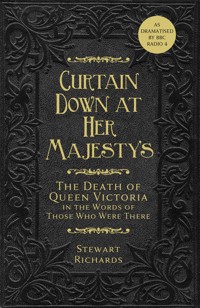
Erhalten Sie Zugang zu diesem und mehr als 300000 Büchern ab EUR 5,99 monatlich.
- Herausgeber: The History Press
- Kategorie: Sachliteratur, Reportagen, Biografien
- Sprache: Englisch
She was the most powerful woman in the world. Victoria had ruled through more than six decades, watching her kingdom spread to become the world's biggest empire and witnessing massive change in society and leaps forward in technology. Many of her people had known no other monarch. It is little surprise, then, that her death resulted in chaos, shock and mass outpourings of grief across the world. Here author and researcher Stewart Richards has delved through the archives to put together the definitive view of Victoria in her drawn-out final days of illness, through the immediate reaction to and aftermath of her death, to the state funeral on 2 February 1901. Based entirely on fascinating first-hand accounts, Curtain Down at Her Majesty's offers a remarkable insight into the events of those tumultuous few days, and a truly unique perspective on the life and impact of one of history's great monarchs.
Sie lesen das E-Book in den Legimi-Apps auf:
Seitenzahl: 318
Veröffentlichungsjahr: 2018
Das E-Book (TTS) können Sie hören im Abo „Legimi Premium” in Legimi-Apps auf:
Ähnliche



















For all my childrenGeorge & PerweenDaisy, Billy & NellyGordon & Alia… wherever you are
First published 2019
The History Press
The Mill, Brimscombe Port
Stroud, Gloucestershire, GL5 2QG
www.thehistorypress.co.uk
© Stewart Richards, 2019
The right of Stewart Richards to be identified as the Author of this work has been asserted in accordance with the Copyright, Designs and Patents Act 1988.
All rights reserved. No part of this book may be reprinted or reproduced or utilised in any form or by any electronic, mechanical or other means, now known or hereafter invented, including photocopying and recording, or in any information storage or retrieval system, without the permission in writing from the Publishers.
British Library Cataloguing in Publication Data.
A catalogue record for this book is available from the British Library.
ISBN 978 0 7509 9101 8
Typesetting and origination by The History Press
Printed and bound in Great Britain by TJ International Ltd
eBook converted by Geethik Technologies
CONTENTS
Prologue
Act I Another Year Begun
Act II The Angel of Death
Act III A Country in Mourning
Act IV Chaos & Confusion
Act V Rest in Peace
Epilogue
The Family of Queen Victoria in January 1901
Sources & Permissions
Acknowledgements
Shortly after 6.30 p.m., the telephones and telegraph wires were suspended as Superintendent Fraser of the Household Police arranged for Osborne House to be surrounded, so as to prevent any servant or messenger from leaving.
A short while later he walked down the long gravel drive to the entrance gate, where a large crowd was waiting, and pinned a small notice on to the bulletin board:
Osborne House, Jan. 22, 6.45 p.m.
Her Majesty the Queen breathed her last at 6.30 p.m.,surrounded by her children and grand-children.
JAMES REID, M.D.R. DOUGLAS POWELL, M.D.THOMAS BARLOW, M.D.
And so it was that the news of the Queen’s passing was announced to the world.
This is the story of the last days of Queen Victoria’s life and the extraordinary events surrounding her funeral, told entirely in the words of those who were there.
PROLOGUE
Victoria was born on 24 May 1819, at Kensington Palace. Her father, the Duke of Kent and Strathearn, died the following year, a few days before his own father, George III.
Following the death of her uncle, William IV, in 1837, Victoria ascended the throne. She was 18 years old. Three years later she married her first cousin, Prince Albert of Saxe-Coburg and Gotha, and between 1841 and 1857 she gave birth to nine children. In 1861, after twenty years of marriage, Prince Albert, then 42, died of suspected typhoid fever.
Throughout her life, Victoria experienced further personal tragedies. In 1866, her grandson Sigismund died, followed by his brother Waldemar in 1879. In 1878, on the anniversary of the death of Prince Albert, her second daughter, Princess Alice, died of diphtheria. John Brown, her loyal servant of more than twenty years, died in 1883. Her youngest son, Prince Leopold, a haemophiliac, died in 1884 at the age of 30, after a fall while on holiday in Cannes. Her grandson, Eddy, the Duke of Clarence and Avondale, and second in line to the throne, died of influenza in 1892. And then in 1899, the 24-year-old ‘Young Affie’, the only son of her fourth child, Prince Alfred, Duke of Saxe-Coburg and Gotha, shot himself after an argument with his parents during their twenty-fifth wedding anniversary celebrations. In the same year, the Queen’s eldest daughter Victoria, the Empress Frederick (Dowager Empress of Germany), was diagnosed with incurable breast cancer and was suffering excruciating pain. She was to die herself only a few months after her mother.
The following year, in July 1900, Victoria’s son, Prince Alfred, was to die from throat cancer at the age of 55. In October, her grandson Christle died on his journey home after serving in South Africa. Then on Christmas Day, her oldest and most trusted friend, Jane, Lady Churchill, was found dead in her bed, while staying with the Queen at Osborne House.
With the Anglo-Boer War still being waged in South Africa, the 81-year-old Queen was visibly fading. Confined to a wheelchair, almost blind and suffering from severe digestive problems, she was often in pain, with lapses of memory and moments of confusion.
All these matters weighed heavily on the ageing Queen as she entered the new century.
1900
BALMORAL
Cosmo Lang, Vicar of Portsea
Honorary Chaplain to the Queen and later Archbishop of Canterbury.
At Dinner I noticed that the Queen was very silent and sleepy – at times she seemed to have some difficulty in keeping awake. And after dinner she was less bright than usual and seemed to be soon tired. But though we did not think it then, there was plainly the shadow of the coming end.
John Campbell, 9th Duke of Argyll
(1845–1914) The Queen’s son-in-law. Age 55. A former Liberal MP, as Marquess of Lorne he had married the Queen’s fourth daughter, Princess Louise. Popular with the Queen, he was to write and publish The Life of Queen Victoria shortly after her death in 1901.
There had been moments of depression during the last stay at Balmoral; the weather had been cold and gray and heavy, and the Queen had not been able to enjoy her stay as usual.
Marie Mallet
As Woman of the Bedchamber, she was part of the inner circle of ladies-in-waiting who served the Queen, to whom she was devoted.
We remain in the same melancholy state here, Ladies’ Dinner every night, gloomy evenings, silence only broken by the receipt of consoling telegrams in divers tongues and by the replies sent to them.
The Queen is quite angelic and does her best to keep up, but the effort is very great and cannot be good for her. The curious thing is that she said to me, ‘After the Prince Consort’s death I wished to die, but now I wish to live and do what I can for my country and those I love.’ Do not repeat this but it is a very remarkable utterance for a woman of eighty-two, and this is not the first time she has made the same remark. I wonder if she dreads the influence of the Prince of Wales?
When she breaks down and draws me close to her and lets me stroke her dear hand I quite forget she is far above me and only realise she is a sorrowing woman who clings to human sympathy and hungers for all that can be given on such occasions. I feel thankful for my unreserved nature and power of showing what I feel, for I believe it is a comfort to her, just a little.
I actually made the Queen laugh at dinner last night by conjuring up a vision of ‘Nunks’1 as a Bishop in full canonicals, I really thought I ought to have a medal.
She was a little brighter yesterday but still ate so little. I could kill the cooks who take no pains whatever to prepare tempting little dishes and would be a disgrace to any kitchen. How I should like to work a sweeping reform, we are abominably served just now. The footmen smell of whisky and are never prompt to answer the bell and although they do not speak rudely, they stare in such a supercilious way. As for the Queen’s dinner it is more like a badly arranged picnic.
The Queen is still far from well but I hope the change to Windsor will do her good. She has so little appetite and yesterday we had a thick fog worthy of London, which made her perfectly miserable.
WINDSOR
John Campbell, 9th Duke of Argyll
She had felt unwell after her return to Windsor, where the very size and stateliness of the Castle appeared to oppress her, and she felt the burden of having to talk to many visitors.
The hours were at last not so punctually observed. There was increasing uncertainty as to whether the Queen would appear at lunch or dinner. She was told by the doctors that she ought to lead the life of an invalid. She must not write so much, she must do nothing to bring on unnecessary fatigue.
It was observed that her eyesight had become very dim, but she heard all that was said. Instead of holding her after-dinner talk with her guests in the corridor outside the Oak Dining-room, she was wheeled in her chair to the White Drawing-room, and sat there near the table to listen to any music played on the piano, or to call up those she desired to speak to.
Almeric Fitzroy
Chief clerk to the Privy Council. The Queen, on meeting him, remarked on how much he resembled Charles II, from whom he was descended. It also prompted Marie Mallet to comment, ‘He was very much at ease, rather too much, I thought.’ Considered to be indiscreet and rather gossipy.
I saw the Queen at three councils after her return to Windsor and cannot say that until the last I was struck with any marked indications of failing vitality.
So little was the Queen’s mental vigour affected by the cumulative losses and anxieties of the year, that at the Council on November 12th when the transfer of seals incidental to the changes in the Cabinet took place, her memory guided us through the mazes of a somewhat intricate transaction whereon official records were dumb, and the recollections of ministers a blank.
It is true that in addition to the somewhat disquieting symptoms of loss of appetite, and an undue tendency to somnolence, periodic attacks of aphasia2 became more frequent, and on the very day I last saw the Queen – December 10th – she was, as I afterwards learnt, unable to speak to the Brazilian ambassador, but whether it was due to the invincible optimism of courts or to a deliberate blindness, no one appears to have anticipated the impending catastrophe.
Marie Mallet
The Queen enjoyed her coffee and egg for breakfast but she still has bouts of pain and Sir James3 is not easy. There is no reason why she should not be herself again if she could be made to take more nourishment.
The servants here are too irritating, the Queen only ordered one small dish – nouilles, for her dinner last night and it was entirely forgotten, so she had nothing. The cooks should be drawn and quartered, and the Clerks of the Kitchen strung from the Curfew Tower; their indifference makes me boil with rage.
The Queen was decidedly better this morning but a large luncheon party and shouting to the Princess of Wales4 exhausted her and she was in pain and very feeble after it.
Of course, we must be anxious but there is no reason why she should not pick up again and regain her appetite, but she resents being treated as an invalid and as soon as she feels a tiny bit better she overtires herself and collapses. She is less meek now and that is a good sign, but Sir James has never been so anxious before in all these years.
Bernard Mallet
Husband of Marie Mallet. Private Secretary to Arthur Balfour, First Lord of the Treasury.
I had not realised that Prince Christian Victor’s5 death had been such a shock to the Queen. That and all the strain of the last year has told terribly on her.
One fears it must be the beginning of the end. But she is strong and has no disease and may probably be nursed back into comparative strength again. One prays indeed that it may be so.
Not a hint of all this appears to have reached the outside world.
Almeric Fitzroy
I had for some weeks been haunted with a fear that all was not right, and before the Duke of Devonshire6 went away for Christmas I got him to go over the precedents connected with the accession ceremonies and mentioned certain points upon which I thought he should refer to the Prime Minister.7 The first result of this move, which events quickly showed to have been anything but premature, was a protest from Lord Salisbury against ‘gruesome proceedings’; but nevertheless I obtained the Duke’s permission to place myself in communication with such of the public departments the advice of which was necessary.
John Campbell, 9th Duke of Argyll
When the day fixed for the departure to Osborne arrived, those who had been told she was ‘failing,’ were glad to see the smile still upon her face as they took leave of her. When she entered her carriage only a few said to themselves they feared it might be the last time.
The journey to the Isle of Wight fatigued her greatly, although, as a rule, railway travelling did not affect her.
For the first time, she did not write herself the good wishes for Christmas and New Year which she was wont to send to each member of her family.
SUNDAY, 23 DECEMBER
OSBORNE HOUSE
Queen Victoria
Had a fairly good night, but again slept till nearly 12, which annoyed me very much. My appetite very indifferent. Had some broth, & later Beatrice8 played to me on the piano. I felt rather exhausted.
Prince Arthur, Duke of Connaught and Strathearn
(1850–1942) The Queen’s seventh child and reportedly her favourite son. Age 50. A committed soldier, rising to the rank of Field Marshal.
To his sister, Louise, Duchess of Argyll
Dearest Louise,9
Many thanks for your dear letter. I find Mama very feeble and unable to do anything she comes to no meals and goes out at odd hours, she is better today and had a good night, but I very much doubt her being able to come to the Christmas tree tomorrow – this throws quite a gloom over our already sad Xmas.
You are very right in what you say about Lenchen10 and Beatrice not reading out any of the sad accounts of poor Vicky’s11 sufferings to Mama, it is very bad for her in her present state; I will do all I can to prevent it.
There is so much that is sad just now that I feel it very difficult to make even a semblance of being cheery at Christmas time.
CHRISTMAS EVE
Queen Victoria
I got up a little earlier, & had in fact slept better, not having laid awake long. Went out with Lenchen & Beatrice. Rested when I came in. At 6 went down, being joined by Arthur, Louischen12 & their children, Lenchen, Christian, Thora,13 Louie,14 & Abby,15 & Beatrice & her children.
We went to the Durbar Room, where the Xmas tree & present tables were arranged. I felt very melancholy as I see so very badly.
I received lovely things, amongst which an enamel of dear Christle, set with little sapphires, given by Lenchen, & a lovely bracelet, in remembrance of dear Affie,16 given by Bertie17 & Alix.
I gave all my personal servants their usual presents, & my children gave those for the Ladies & Gentlemen.
Took a little supper in my room, & then Beatrice came up & played to me.
Princess Beatrice
To her sister, Victoria, Empress Frederick
Dearest Vicky,
I thought so much of you on Xmas Eve, wondering how you would be spending it. I trust in not too much pain!
Dear Mama was able to come down for a short while to the Bescherung,18 but she was very depressed and generally rather weak, her sight is so very bad and she could hardly see all her pretty presents. It was too sad how many presents were mementoes of dear departed ones.
Mama is so afraid that you may be worrying about her and about her inability to write to you, but I assured her you would not, though of course you were very sorry she was so uncomfortable and far from well.
I do think she is a little better and able to take more nourishment, allowing herself to be fed every 2 hours, and she does not attempt to come to any meals, keeping quite quiet in her room, excepting when she goes out for a little,
Ever, dearest Vicky,
Your loving and attached sister,
BEATRICE.
CHRISTMAS DAY
Queen Victoria
Did not have a good night, was very restless, & every remedy that was tried failed in making me sleep. Then when I wished to get up, I fell asleep again, which was too provoking.
Went out with Lenchen & Beatrice about 1 & the former told me Sir J. Reid wished me to know that dear Jane Churchill19 had had one of her bad heart attacks in the night, & that he had telegraphed for her son, as he thought very seriously of her condition.
Sir James Reid
To Princess Louise, Duchess of Argyll
Madam,
I felt that, as one of Lady Churchill’s best friends,20 Your Royal Highness ought to be one of the first to know.
I was called to her at 7.20 this morning. The Housemaid who took in her tea at 7.15 could not rouse her and called her maid, who, seeing that something serious was amiss, called me at once. I found her quite dead, having apparently been so for some time, as she was nearly cold. She looked quite placid, and I have no doubt she passed away in her sleep.
Her maid tells me she had been feeling better than usual since coming here. She was quite bright yesterday, and dined with the Royal party, who all say she was looking well and happy. Personally, it was no surprise to me: but it is most unfortunate it should have happened here and now.
The Queen does not know yet more than that she is ill and that her son has been sent for. I rather dread the effect on Her Majesty when she knows, and it is impossible to conceal it long from her.
The Queen has been eating and sleeping better the last few days and is really better again; and it is all the more sad and unfortunate that she should have this fresh shock to bear.
Queen Victoria
After I had some broth & rested a little, I took a short drive with Louischen & Thora, & we talked a great deal about dear Jane, as I was so distressed at her being so ill.
Directly I returned, I again sent for Sir James, who said ‘I was just coming to tell Your Majesty all was over.’ She had died this morning early, in her sleep, & had just slept peacefully away.
They had not dared tell me for fear of giving me a shock, so had prepared me gradually for the terrible news. I saw Harriet Phipps,21 who told me all about it. I naturally was much upset & very unhappy, as dear Jane was one of my most faithful & intimate friends.
This has indeed been a terribly sad Christmas for us all!
Princess Beatrice
To her sister, Princess Louise, Duchess of Argyll
Mama now knows could [not] be kept from her any longer as she began to suspect it but through gradual preparation has so far borne the shock well though deeply affected her first thought was the grief it will be to you she wishes me to tell you this.
Beatrice.
Queen Victoria
To her daughter, Victoria, Empress Frederick
I must dictate these few lines to you as I am not well able to write myself, I have not been very well, but nothing to cause you alarm and I have not a bad pulse. I have also been able to get out a little most days.
This Christmas has been one of the saddest I ever remember, excepting ’61,22 and you are I am sure as horrified as I am at the loss of my good beloved Jane Churchill, who died in her sleep on Christmas Day. What her loss is to me I cannot describe or even realise yet, and that it should happen here is too sad, but it is I think what she would have wished, excepting for the trouble and sorrow it has caused.
Almeric Fitzroy
Victor Churchill gave me some interesting details about his mother and her last intercourse with the Queen. Contrary to the usual practice, she travelled from Windsor to Osborne in the Queen’s saloon, and these two, who were never again to cross the Solent alive, looked their last upon it together. It appears, for five days after her arrival at Osborne, the Queen was so prostrate that she saw no one, not even Lady Churchill. So impressed was Lady Churchill with the change, when she did see her, that she remarked to her confidential maid that the Queen was a dying woman. It fell to her lot, however, to precede her mistress by exactly four weeks. She went to her bedroom at 11.30 so well that her maid, contrary to custom, left her before she was in bed, having received orders to call her in time for early service on Christmas morning. When the hour came she had trodden the silent way. Truly, Felix opportunitate mortis.
MONDAY, 31 DECEMBER
Wilfrid Scawen Blunt
A poet, writer, social commentator and anti-imperialist. He was a close friend of Oscar Wilde and Winston Churchill.
The old century is very nearly out, and leaves the world in a pretty pass, and the British Empire is playing the devil in it as never an empire before on so large a scale. We may live to see its fall.
All the nations of Europe are making the same hell upon earth in China, massacring and pillaging and raping in the captured cities as outrageously as in the Middle Ages. The Emperor of Germany gives the word for slaughter and the Pope looks on and approves.
In South Africa our troops are burning farms under Kitchener’s command, and the Queen and the two houses of Parliament, and the bench of bishops thank God publicly and vote money for the work.
The Americans are spending fifty millions a year on slaughtering the Filipinos; the King of the Belgians has invested his whole fortune on the Congo, where he is brutalizing the Negroes to fill his pockets. The French and Italians for the moment are playing a less prominent part in the slaughter, but their inactivity grieves them. The whole white race is revelling openly in violence, as though it had never pretended to be Christian. God’s equal curse be on them all!
So ends the famous nineteenth century into which we were so proud to have been born.
I bid good-bye to the old century, may it rest in peace as it has lived in war. Of the new century I prophesy nothing except that it will see the decline of the British Empire. Other worse empires will rise perhaps in its place, but I shall not live to see the day.
And so, poor wicked nineteenth century, farewell!
_________
1 Alick Yorke, the Hon. Alexander Grantham Yorke, Marie’s uncle and groom-in-waiting to the Queen. Described by Marie’s son, Victor Mallet, as an ‘elderly pansy’ and the instigator of the Queen’s most misquoted remark, ‘We are not amused’.
2 Aphasia: damage to the brain, often caused by a stroke and closely associated with dementia.
3 Sir James Reid, resident Physician in Ordinary to the Queen. He was the first physician to remain constantly at her side and to travel with her wherever she went. A shrewd, tactful and discreet courtier with a great sense of humour, he was devoted to her comfort and well-being and became one of her most trusted confidants. He was to stay with the Queen until the moment of her death.
4 Princess Alexandra, Princess of Wales, Alix (1844–1925). Daughter-in-law. Age 56. She was the eldest daughter of King Christian IX of Denmark. Unpretentious and kind, the Queen described her as a ‘dear, lovely being’. She suffered from otosclerosis, which causes hearing loss, and was becoming increasingly deaf.
5 Prince Christian Victor of Schleswig-Holstein, Christle (1867–1900). Grandson. Age 33. He was the son of Princess Helena (Lenchen). Died while serving with the British Army in the Boer War under Lord Roberts.
6 Spencer Compton Cavendish, 8th Duke of Devonshire. Leader of the Liberal Unionist party in the House of Lords and Lord President of the Council.
7 Robert Gascoyne-Cecil, 3rd Marquess of Salisbury. Prime Minister.
8 Beatrice, Princess Henry of Battenberg (1857–1944). Daughter. Age 43. The Queen’s much-loved youngest child and constant companion. Her husband, Prince Henry of Battenberg, Liko (1858–96), had died four years earlier in 1896, at the age of 37, while serving with the British Army during the Anglo-Ashanti War.
9 Louise, Duchess of Argyll (1848–1939). Daughter. Age 52. A beautiful, intelligent and talented sculptor and artist. Described by her sister as ‘… very odd, dreadfully contradictory, very indiscreet, making mischief very frequently’. Married to John Campbell, 9th Duke of Argyll. They had no children.
10 Helena, Princess Christian of Schleswig-Holstein, Lenchen (1846–1923). Daughter. Age 54. A lively, outspoken woman, she had married the impoverished Prince Christian of Schleswig-Holstein (1831–1917), who was fifteen years her senior. They had five children, four of whom survived infancy, including Christle who had died the previous year. With her sister Beatrice, Helena was a constant companion of the Queen.
11 Victoria, Empress Frederick of Germany, Vicky (1840–1901). Eldest daughter. Age 60. Her husband, Emperor Frederick III of Germany (1831–88), had died in 1888 after ruling Germany for only ninety-nine days. He was succeeded by their son, Wilhelm II. She was dying from breast cancer, which had spread to her spine and was causing her considerable pain.
12 Princess Luise, Duchess of Connaught, Louischen (1860–1917). Daughter-in-law. Age 40. Married to Prince Arthur, Duke of Connaught. They lived in Bagshot Park, Surrey, with their three children.
13 Princess Helena Victoria of Schleswig-Holstein, Thora (1870–1948). Granddaughter. Age 30. Unmarried daughter of Princess Helena, she enjoyed a very close relationship with the Queen. Her last public appearance was at the wedding of Queen Elizabeth II in 1947.
14 Princess Marie Louise of Schleswig-Holstein, Louie (1872–1956). Granddaughter. Age 28. Youngest daughter of Princess Helena. Her unhappy marriage to Prince Aribert of Anhalt had just been annulled.
15 Prince Albert of Schleswig-Holstein, Abby (1869–1931). Grandson. Age 31. Second son of Princess Helena. He joined the military, but the Prussian Army rather than the British Army and was excused service during the First World War by his cousin, the Kaiser.
16 Prince Alfred, Duke of Saxe-Coburg and Gotha, Affie (1844–1900). Son. He had died the previous summer at the age of 55.
17 Prince Albert Edward, Prince of Wales, Bertie (1841–1910). Eldest son. Age 59. Heir to the throne.
18 The handing out of presents: this took place on Christmas Eve in the Royal Household.
19 Lady Jane Churchill. Age 74. A very close friend of the Queen, she was made Lady of the Bedchamber in 1854 and was the longest serving member of the Queen’s Household.
20 Princess Louise had known Lady Churchill from childhood. Regardless of the difference in ages, they became close friends and were often seen together. An accomplished sculptor, Louise’s first unaided bust at the age of 18 was of Lady Churchill.
21 Harriet Phipps, Woman of the Bedchamber. She described their role as ladies-in-waiting to the Queen as ‘We are sheets of paper on which H.M. writes with words as less trouble than using her pen and we have to convey her words as a letter would do. What you would feel free to do with a letter you are free to do with her words – no more.’
22 The year Albert, Prince Consort (1819–61) died.
1–21 JANUARY 1901
TUESDAY, 1 JANUARY
The Times
The Twentieth Century begins.
OSBORNE HOUSE
Queen Victoria
Another year begun, I am feeling so weak & unwell, that I enter upon it sadly.
WEDNESDAY, 2 JANUARY
Queen Victoria
Rather a better night, but slept on late into the morning, which is so provoking.
I managed to get out for ½ an hour with Lenchen & went to look at the arch which has been put in honour of Lord Roberts.1 Drove in the afternoon with Louie2 & Mary H,3 getting home just in time before Lord Roberts arrived.
On Lord Roberts arrival here, I received him most warmly shaking hands with him, & he knelt down & kissed my hand.
Lord Roberts spoke with such grief of dear Christle’s death & said he could not say how deeply he mourned him, & how he felt for all of us.4 It had been such a shock, as he had not had the slightest idea there was any danger, during Christle’s whole illness, he had looked so well & been so cheerful.
I then gave Lord Roberts the Garter, which quite overcame him & he said it was too much. I also told him I was going to confer an Earldom on him, with the remainder to his daughter.
I felt a little tired, so rested & slept for a while.
THURSDAY, 3 JANUARY
Queen Victoria
Had a rather better night, though some broken sleep & was not up & dressed till 12. Signed some things & then went out in the garden chair.
Saw Sir A. Bigge5 about some War Office affairs. Had not much appetite. At ½ p.3 took a short drive with Lenchen & Ismay S.6
FRIDAY, 4 JANUARY
Queen Victoria
Had a better night & took less draught, but still unfortunately, I slept longer than I wished.
In the afternoon drove with Harriet P. & Evelyn Moore.7 A fine afternoon, but rather hazy. From not having been well, I see so badly, which is very tiresome.
Had a telegram from Ld Kitchener,8 which was satisfactory. Spent rather an uncomfortable afternoon & felt so weary & tired. Ismay S. read to me after my supper, & Beatrice came later & played to me a little on the piano.
Sir James Reid
To Marie Mallet
Dear Mrs. Mallet,
Just a line to tell you that the Queen is now much better. She has continued to improve ever since she consented to be treated as an invalid; and she now causes me no present anxiety. How far she may still improve it is impossible to say at her age: but I hope she may continue her invalid habits for some time longer, and so give herself every chance.
I have had rather an anxious time and have been very closely tied: so H.M. is to give me a little chance of air and exercise, and Sir F. Laking9 is coming here for a week or so.
Susan10 is in bed with a feverish chill and rheumatism but otherwise she is all right. I have been very little with her since she came, so I am longing for Sir F. Laking’s arrival!
SATURDAY, 5 JANUARY
Queen Victoria
Had a bad & much disturbed night. Felt very exhausted. Beatrice went out with me for a short while late in the morning & in the afternoon I drove with Lenchen & Ismay S. to Newport & back. It was very fine, but cold. I was very drowsy, when I came home.
SUNDAY, 6 JANUARY
Queen Victoria
An improved night, though I wake often. Lenchen came & read letters to me after I got up. The accounts of dear Vicky are not at all satisfactory, which make me so sad.
It blew so hard & was so cold, that I did not go out in the morning. At 3 drove in a closed carriage with Lenchen & Beatrice.
Had my supper of Benger’s food,11 which is very soothing & nourishing. Saw Sir Francis Laking, who is here to relieve Sir James Reid a little.
Lady Susan Reid
To her sister-in-law, Mary Reid
Laking’s visit at Osborne is a great fraud! and does not relieve Jamie of any of his work! and all our beautiful hopes of a rest and Jamie living at May Cottage [while Laking was at Osborne] have been dashed to the ground. The Queen will not see him! at least not about her health, and she can hardly bear Jamie out of her sight!
She is no worse, but has ups and downs and gets very easily over tired, and when so, she gets into a nervous depressed hopeless state. However, she sleeps and eats well and Jamie says that is all one can expect just now, but her family and Miss Phipps will insist (in spite of Jamie’s opinion!!) on thinking her much better than she is and it is all he can do to prevent them overtiring her, by too much talking.
The only difference Laking’s visit has made is that Jamie was able to dine here twice. Last night he was to do so again but the Queen was in a nervous mood, so he gave it up, and she was so pleased and so grateful!! She does depend on him entirely now, and happily he is very well. I am quite pleased with his looks, and he is able to sleep well, now he is not disturbed at night. As things are at present Jamie thinks it is out of the question that the Queen should go abroad, and all the men of the Household are of that opinion. However, the family and Miss Phipps are still in favour of it, but I think gradually they will see for themselves that it is impossible.
MONDAY, 7 JANUARY
Queen Victoria
Had a much better night, but still slept on late. A very cold day with a very high wind. Took a short drive in a closed carriage, at 2.30. Dictated some letters to Lenchen.
TUESDAY, 8 JANUARY
Queen Victoria
Had a restless night & woke very often. The ground was white with snow when I got up & it snowed off & on the whole morning. Got out in a closed carriage for a short while with Harriet P. I was so drowsy that I slept for 2 hours from 6 o’clock. Lenchen & Beatrice came up after their dinner.
WEDNESDAY, 9 JANUARY
Queen Victoria
A bad night, & got up late. Did not go out till the afternoon, when I drove with Harriet P. It was fine & mild & all the snow disappearing fast.
Had some food & rested. Harriet P. read to me & later I dictated to Lenchen & then she & Beatrice wished me good night.
THURSDAY, 10 JANUARY
Queen Victoria
Rather a better night, but I slept on late. Only got out for a short time in the morning, & in the afternoon drove with Lenchen & Beatrice to Newport & back.
Rested when I came in, & had some food, then saw Mr Chamberlain12 for a little while. A good telegram from Ld Kitchener.
FRIDAY, 11 JANUARY
Queen Victoria
A better night, but felt very tired. Out in the garden chair after 1, Lenchen, Beatrice walking with me. Very fine & like spring. Went as far as Barton & back.
Felt so weary that I did not go out again in the afternoon, but slept for more than 2 hours. Afterwards Lenchen & Beatrice played duets to me, very pretty things, the ‘Gondoliers’, Gounod’s Ballet music from ‘Faust’, &c. Then dictated some letters. Harriet read to me after my supper, & then Lenchen & Beatrice came up to say good night.
SATURDAY, 12 JANUARY
Queen Victoria
Had a good night & could take some breakfast better. There was a dense fog & no ships could cross.
Took an hour’s drive at ½ p. 2 with Lenchen. It was very foggy, but the air was pleasant. Had some food when I came in & rested. Afterwards little Leopold13 played charmingly on the violin. Took a ‘lait de poule’, then signed & dictated to Lenchen. Harriet read to me after my supper & Lenchen & Beatrice came up afterwards.
SUNDAY, 13 JANUARY
Queen Victoria
Had a fair night, but was a little wakeful. Got up earlier & had some milk. Lenchen came & read some papers. Out before 1, in the garden chair, Lenchen & Beatrice going with me.
Rested a little, had some food, & took a short drive with Lenchen & Beatrice.
Rested when I came in & at 5.30, went down to the Drawingroom, where a short service was held, it was a great comfort to me. Rested again afterwards, then did some signing & dictated to Lenchen.
This was the Queen’s final entry in the journal she had kept for more than sixty-nine years.
MONDAY, 14 JANUARY
Court Circular
Field-Marshal Earl Roberts, K.G., Commander-in-Chief, arrived at Osborne, and had an audience of Her Majesty before dinner.
Randall Davidson, Bishop of Winchester
A favourite of the Queen. An enormously influential cleric described by the Queen as ‘… singularly pleasing both in appearance and manner, very sympathetic and evidently very intelligent’. Not a view shared by all. He married Edith, daughter of Archibald Tait, the former Archbishop of Canterbury – a position he was to fill himself in 1903.
When she saw Lord Roberts the Princesses told her she must not have too long & fatiguing a talk & that they send & interrupt by a message after twenty minutes.
She answered ‘Do nothing of the kind. I have a great deal to say to him which I must say & a great deal to hear from him. I shall want plenty of time.’ And she did have quite a long interview & was not a bit sleepy or confused.
Baron Eckardstein
A German diplomat serving as the German First Secretary in their London embassy. In 1898, he married Grace, the wealthy heiress of Sir John Maple of Maple’s Furniture, an establishment much admired by the Queen.
While I was on a few days holiday at Cowes, rumours were current as to the serious illness of the old Queen who, as usual, had been spending Christmas at Osborne. I accordingly called there one day to enquire; and although her physician, Sir James Reid, told me her illness was by no means alarming, I learnt from various Court officials that her condition was extremely serious.
TUESDAY, 15 JANUARY
Court Circular
Earl Roberts left Osborne this morning.




