


Erhalten Sie Zugang zu diesem und mehr als 300000 Büchern ab EUR 5,99 monatlich.
- Herausgeber: Mercier Press
- Kategorie: Sachliteratur, Reportagen, Biografien
- Serie: Irish Revolutionary Series
- Sprache: Englisch
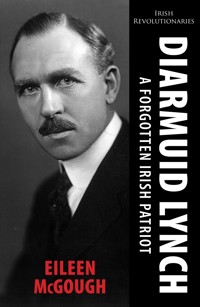
On Saturday night 22 April 1916, a tense meeting in Dublin went on into the small hours to decide whether or not the Easter Rising would go ahead. Present at that meeting were Pádraig Pearse, Tomás MacDonagh, Joseph Plunkett and Seán MacDiarmada. The fifth man present at the all-night session, Diarmuid Lynch, was the only one still alive a month later. It is difficult to understand how Lynch, a member of the Supreme Council of the IRB, has been forgotten so completely. Lynch was at the heart of plans for the Rising and was aide-de-camp to James Connolly in the GPO. Initially sentenced to death, his sentence was commuted to ten years penal servitude because he was an American citizen. However, he was released on 16 June 1917. Immediately following his release, Lynch became active again, and along with Michael Collins and Thomas Ashe, participated in the reorganisation of the IRB. After the 1917 Sinn Féin Ard Fheis, Lynch, like Collins, held three senior posts: in the IRB, Sinn Féin and in the Irish Volunteers. He was again arrested and deported to America in 1918. Lynch was elected, although still in the US, as a TD for the constituency of Cork South-East in the 1918 elections. In America he was working frenetically as the national secretary of the FOIF (Friends of Irish Freedom) organisation, but later sharp differences arose between De Valera and the FOIF about how funds raised in America should be spent. Lynch did not take part in the Civil War, but made several unsuccessful attempts to stop it.
Sie lesen das E-Book in den Legimi-Apps auf:
Seitenzahl: 329
Veröffentlichungsjahr: 2013
Das E-Book (TTS) können Sie hören im Abo „Legimi Premium” in Legimi-Apps auf:
Ähnliche



















MERCIER PRESS
3B Oak House, Bessboro Rd
Blackrock, Cork, Ireland.
www.mercierpress.ie
http://twitter.com/IrishPublisher
http://www.facebook.com/mercier.press
© Eileen McGough, 2013
ISBN: 978 1 78117 137 0
Epub ISBN: 978 1 78117 210 0
Mobi ISBN: 978 1 78117 211 7
This eBook is copyright material and must not be copied, reproduced, transferred, distributed, leased, licensed or publicly performed or used in any way except as specifically permitted in writing by the publishers, as allowed under the terms and conditions under which it was purchased or as strictly permitted by applicable copyright law. Any unauthorised distribution or use of this text may be a direct infringement of the author’s and publisher’s rights and those responsible may be liable in law accordingly.
Contents
Acknowledgements
Introduction
1 ‘The Child is Father of the Man’
2 Ireland, 1907–1915
3 1916
4 Court-Martial and Imprisonment
5 The Most Senior IRB Leader
6 America, Setting the Scene
7 The Slide towards Destruction
8 The Fall-Out Continues
9 The National Secretary Soliders On
10 ‘We’re Home for Good’
11 Cork - the Final Decade
12 Lynch’s Contribution to Historical Records
Conclusion
Appendix I Witness statements by Diarmuid Lynch
Appendix II Sources of materials relating to the life of Diarmuid Lynch
Notes
Manuscript Sources and Official Publications
Newspapers, Periodicals and Journals
Bibliography
‘It seemed to me that the men and women of 1916 were not merely rebels but people of vision. What they desired was not simply a government in Dublin, a green flag over Dublin Castle, and a harp on the coinage. These men and women were calling for a cultural revolution, for a transformation of both public and personal reality.’
From Robert Ballagh, ‘1916 and All That – a Personal Memoir’, paper presented at a conference in Trinity College Dublin, 21–22 April 2006, organised by The Ireland Institute and Dublin University Historical Society.
Acknowledgements
Though I have lived in the Tracton area since 1971, it was only in recent times that I became aware that the grand-uncle of those Lynch boys, whom I had taught in the local Knocknamanagh National School, was a man of national significance. A cutting from The Cork Examiner was given to me. It was the column written by Pádraig Ó Maidín, County Cork Librarian, to mark the ninety-ninth anniversary of the birth of Diarmuid Lynch. It appeared on 7 January 1977 and gave a brief account of the life of Lynch.
Intrigued, I asked the Lynch family members still resident in the farmhouse where Diarmuid was born for further information, which they readily provided. Since 2007 I have been fully committed to the purpose of making Diarmuid Lynch’s work for Ireland better known.
I thank Mary Lynch, who has been the custodian of Diarmuid Lynch’s papers for over half a century; Mary’s son Ruairí organised the papers in a user-friendly archive. I thank them both for their constant support and steady belief that I would do justice to his remarkable life. Both Diarmuid’s niece and grand-niece, Bríd Duggan and Duibhne Daly, generously loaned relevant and precious documents they had in their possession. Another niece, Dolores Lynch, holds the unique distinction of being the only family member who personally knew Diarmuid and she was a source of everyday information on her uncle’s life in his later years.
I was encouraged and supported at all times by the following persons whom I thank most sincerely: my husband, Michael Collins, and our extended family; my daughter, Emma, who proof-read; other meticulous proof-readers were neighbours and friends, Niall and Susan Marron and Lynda O’Flaherty; Doctor Michael Doorley, who, having produced a history of the FOIF in 2005, was in the position of knowing precisely what I should research and concentrate on and who generously gave all the help in his power; Gabriel Doherty, my tutor on the MA degree course at UCC, was ever a cheerful and most encouraging reference. I thank Daniel Breen at the Cork Museum and the museum photographer, Dara McGrath; Brian McGee and staff at the Cork City and County Archives; James Harte and other staff members at the National Library; personnel at the Boole Library at UCC; and Michael Mahoney, who obligingly carried out some research for me at the British National Archives at Kew, Richmond, Surrey.
I am grateful for the friendly enthusiasm of Mary Feehan of Mercier Press who, from the start, showed great heart for the project of bringing Diarmuid Lynch to public notice. Mary’s late father, Captain Seán Feehan produced the only book which incorporates some of Lynch’s reports, The I.R.B. and the 1916 Insurrection (1957).
I thank the staff of the American-Irish Historical Society headquarters in New York, who were cheerfully obliging in providing ready access to the crucial documents archived there. I pay tribute to John Fitzpatrick of Fitzpatrick’s Hotel, Lexington Avenue, New York, who provided affordable, handsome and friendly lodgings for my week of research in 2011. I thank our New York-based friend, Frank Thompson, who undertook several successful researches in American archives; in one example of that research, Frank tracked down the sailing records of Diarmuid Lynch’s many voyages to and from the USA.
Introduction
At a meeting of the Cork City branch of Cumann na nGaedheal on 31 August 1927, those present were considering potential candidates for the forthcoming by-election. An enquiry as to the possibility of inviting Diarmuid Lynch home from New York to contest the seat was met with the query, ‘Who is Diarmuid Lynch?’ This incurred a wrathful reply from Máire Bean Mhic Giolla Phóil, a sister of the late Michael Collins: ‘1916 is of course forgotten and so are all those who ever did anything in the fighting days.’1
Lynch was a native of Cork county, a member of the Supreme Council of the Irish Republican Brotherhood (IRB) at the time of the Easter Rising, a captain under the command of James Connolly in the GPO for the duration of Easter Week 1916, an elected member of the Dáil in 1918 and a dynamic activist in Ireland and in America after his release from prison in June 1917. Michael Collins was the only other nationalist apart from Lynch to hold power simultaneously in the three groups, the IRB, the Volunteers and Sinn Féin – but who has heard of Diarmuid Lynch?2 How did he become an unknown in the heart of Cork just ten years after his release from Lewes Prison?
Lynch remains unknown today, despite much published material and media coverage about the IRB, the Easter Rising and the establishment of the Free State. The point was made by Dermot Keogh and Gabriel Doherty: ‘Beyond Mick and Dev, what was known about other nationalist leaders … of the revolutionary generation? What was known, for example, about Harry Boland’s political ideas and his political formation? The same question may be asked about scores of other leading revolutionaries of the time.’3 Regarding his obliteration from the popular history of 1916, a relative of Lynch concluded wryly, ‘Diarmuid’s problem was that he lived, he was not executed.’4
Only the briefest autobiographical sketch of Lynch exists, in the book The I.R.B. and the 1916 Insurrection.5 This book will show that Lynch was an unrepentant IRB man for life, an ardent and effective Gaelic League worker and an idealistic and leading nationalist. Adopting many roles successfully, he was envoy, courier, operative, strategist, IRB recruiter, fund-raiser, communicator, editor, researcher, secretary and drillmaster. In meeting the demands of his many roles, he was intelligent, cool, adaptable, dedicated and courageous. He deserves recognition as one of the main architects of the Rising of 1916 and as a crucial link between Ireland and Irish America in the lead-up to the Rising. He had lived in America for eleven years before 1916, thus holding a unique position as a delegate and communicator between the Irish Americans and the IRB in Ireland. There would not have been a Rising but for the monies secreted by Lynch and other couriers as they crossed and re-crossed the Atlantic, bringing the next instalment of cash from the hands of John Devoy and Clan na Gael to equip the Irish Volunteers.
James McGurrin, President-General of the American-Irish Historical Society (AIHS), on hearing of Lynch’s death in November 1950, predicted that he would be favourably remembered: ‘When the true story of the last forty years of Ireland’s struggle for complete national independence is written, few names will shine with as bright a lustre as that of brave, honest, incorruptible Diarmuid Lynch.’6 His prediction was incorrect. Of those who were in the inner circle of the IRB for the planning and execution of the Easter Rising, none are quite as forgotten as Lynch.
I intend to introduce Diarmuid Lynch to a new generation, to present the life and work of the man who was the last to leave the burning GPO in Easter Week 1916 – a man of integrity who was dedicated to Ireland, who sacrificed his health, career, comfort and financial security to further one cause: the independence of Ireland from Great Britain. I will also consider why he was so swiftly and completely forgotten.
1 ‘The Child is Father of the Man’1
Jeremiah Christopher (Diarmuid) Lynch was born on 10 January 1878 to a comfortable tenant farmer who leased lands overlooking the site where the medieval Cistercian foundation of Tracton Abbey once stood. The Lynchs have been members of the local farming community in south County Cork for generations. Their ancestor Jeremiah was a tenant of the Anglo-Norman landlord of Tracton Abbey, Achilles Daunt.2 Jeremiah farmed almost 200 acres around his farmhouse in the townland of Granig. As an adult, Jeremiah’s grandson and namesake (who used the Irish version, Diarmuid, of his name from early adulthood) took an interest in the ancestral graves in the churchyard of Tracton Abbey, and the record he compiled in 1902 of the several tombs and graves dating back to 1750 is still preserved by the Lynch family.
Tragedy struck early in Diarmuid’s life as his mother, Hannah Dunlea of Carrignavar, County Cork, died from bronchial pneumonia on 20 July when he was an infant of six months. His father, Timothy Lynch, was then thirty-five years old and soon married for a second time. His new wife was Margaret Murphy of Ovens, County Cork, who bore him one daughter and four sons.
When writing a biographical essay in 1947 at the behest of Florence (Florrie) O’Donoghue, Lynch was warm in praise of his happy childhood, recalling:
Our hard-fought hurling matches … Our camans varied from the factory-made to those cut, ‘seasoned’ and shaped by a few among us, and even to furze ‘crooks.’ … What competitions we had in running, jumping in all its phases; weight-throwing (nothing less than 28 lb. for us ‘men’ of 10–12 years!) when we locals adjourned in summer evenings down by Coveney’s woollen mills … in spearing the other fellow’s peg-top … Marble-playing of our type also called for a high degree of expertness …3
He wrote that he was most proud of successfully sewing a handmade sliotar (hurling ball) when he was around ten years old.4
His initial political education was from his father, who read aloud the speeches of prominent nationalist members of parliament, such as John Dillon and John Redmond. He recalled going with his father to hear Charles Stewart Parnell speak at the Imperial Hotel in Cork city on 21 January 1885, when those stirring words were uttered by Parnell: ‘But no man has the right to fix the boundary to the march of a nation. No man has a right to say to his country: “Thus far shalt thou go and no further”.’ Another political event he attended with his father was a monster Land League meeting in the nearby village of Minane Bridge which was addressed by ‘those fiery orators William O’Brien and Dr. Charles Tanner’.5
Timothy Lynch died aged forty-five in 1890, leaving his very capable widow with six children to rear and a large farm and its farm labourers to manage. Lynch, as the eldest and a stepson in this bereaved family, felt his responsibility: ‘On my father’s death when I was 13 years old, the “sling” and the catapult, the “crib” and the snipe snare were discarded, his shot-gun … took their place.’6 Lynch left school to assist on the home front. He paid tribute to the education he had received while a pupil at Knocknamanagh National School from headmaster Michael McCarthy, an ardent nationalist who shaped the mind of this receptive youth.
Though no official textbook on Irish history then existed, Michael McCarthy taught his pupils about Ireland’s past, from early Celtic myths to the era of the Anglo-Normans, who supplanted the Cistercians as lords of Tracton Abbey. Lynch claimed that ‘deeper national feelings’ were stirred in him by the rendition of patriotic ballads such as ‘The Rising of the Moon’ at the nearby home of his Ahern cousins. A portrait of Robert Emmet hung in his Granig home with the immortal words Emmet spoke from the dock inscribed thereon: ‘When my country takes her place among the nations of the earth then and not ’til then let my epitaph be written.’7 Apart from night classes in clerical training in Skerry’s College in Cork city, Lynch had no further formal education. It was due to his remarkable intellect and self-education that he became a highly effective and accomplished communicator for the organisations of which he was later a member.
At the age of eighteen he passed the state examination for Britain’s civil service and was packed off to London to earn his living. He worked as a boy clerk in the Mount Pleasant sorting office of the postal service at a salary of 14 shillings a week. The Mount Pleasant depot employed other fledgling nationalists, including Sam Maguire. Lynch shared lodgings at Duncan Terrace in Islington with another Cork man, Frank Burke, who got Lynch involved in the ‘London Gaels’ hurling team.8
Items from his earliest scrapbook reflect his homesickness. There are copies of poems exhorting the youth of Ireland to stay at home ‘in dear old Ireland’. Lynch’s copperplate writing of several long poems and ballads pay tribute to the excellent penmanship he was taught at national school. A letter from Michael McCarthy, sent to him at Christmas 1895, declared:
After such a long silence since I received your last letter I would not be surprised if you thought I had forgotten about you altogether. But no! My dear pupil, I will never forget you, for although I had experience of Ballingarry, Myrtleville and the pupils educated therein in those schools, I must say that you, as a pupil, gave me the most utmost satisfaction.9
McCarthy congratulated Lynch on his ongoing study in London of the Irish language ‘under a good man’.10
Lynch showed his continued political awareness during his exile as he archived and annotated newspaper columns, one of which reported anti-jubilee demonstrations that took place in Dublin in June 1897, protesting against Queen Victoria’s Diamond Jubilee. This practice of assembling scrapbooks of newspaper reports, which were often decorated with acerbic comments, became a lifelong habit. On this occasion Lynch wrote, with incredulity, ‘Is it possible?’ after a sentence in the article claimed that ‘The Jubilee was celebrated in almost all parts of Ireland with enthusiasm.’11
After some months in London, in 1896 Lynch seized the opportunity to emigrate to America. His maternal uncle and godfather, Cornelius Dunlea, who had emigrated from Carrignavar, County Cork, and was managing director and a partner in the American company of Farquhar & Company, organised this career move for him.
From rural and humble beginnings, Arthur Farquhar had built up a large and very successful company that manufactured agricultural machinery, exporting it to all parts of America and to many overseas markets. Its head office was in York, Pennsylvania, but the shipping office where Cornelius Dunlea worked was in the Cotton Exchange Building, Lower Manhattan, New York. According to Dun’s International Review, ‘The foreign business of A. B. Farquhar & Co. was built up mainly by the late Mr. Cornelius Dunlea, who travelled extensively throughout South America, South Africa, Russia, Cuba, Mexico, etc.’12
Correspondence in 1950 between Lynch and Maurice Fitzmahony of Midleton, County Cork, revealed that Maurice’s father, Gerald Fitzmahony, ‘a good friend of Uncle Corney’s’, had purchased Lynch’s ticket and organised his passage from Queenstown at the behest of Cornelius Dunlea. Lynch spent his last night before sailing at the home of the Fitzmahony family in Midleton and was escorted to the quayside by them.13 He arrived at Ellis Island in early March 1896.
Life in America delighted Lynch. He acquired a bicycle to save on tram fares and in later years wrote, ‘I venture to say I knew the city [New York] better than most native born citizens.’ During his first year in Manhattan he ‘visited every spot of historical or other interest’.14 He acquainted himself with the course of American history through a determined study of Bryce’s TheAmerican Commonwealth.15 He was employed alongside his uncle at the Cotton Exchange Building as a bookkeeper and shipping clerk at a salary of $18 a week. He lodged with a multinational group of tenants at an address in Lennox Avenue, and the first friendships he made in his early days in New York were with German Americans, who celebrated his twenty-first birthday with him in early 1899.16 His relatives, the Dunleas, lived nearby in West Seventy-Seventh Street, Manhattan, and were supportive as he adapted to living in New York city.
As young Lynch found his way in New York, he searched out organisations that promoted Irish-American interests. He was anxious to continue with the Irish language classes begun in London, but feared that on his meagre salary both texts and fees would be beyond his reach. In the summer of 1897 he attended at the rooms of the Philo-Celtic Society with trepidation, but was relieved to be provided with an Irish language primer which cost a trifling 10 cents.17
The Philo-Celtic Society was founded in Boston, Massachusetts, in 1873, and by the 1890s there were several branches of the society in New York city. The society claims that Douglas Hyde founded the Gaelic League in Ireland following a visit to the Philo-Celtic branches in America in 1891, and, as the Gaelic League’s revival work in Ireland flourished, it encouraged the Philo-Celtic Society in America, leading to increased membership.
Lynch became an enthusiastic and industrious member, rising to the position of secretary of a branch within a year. Lifelong friendships were forged between Lynch and two other members of the Philo-Celtic Society in New York: Joe McGuinness from County Longford and Richard (Dick) Dalton, a native of County Tipperary, who were dedicated activists for Irish culture and nationalism. On 4 March 1897, he and Dalton travelled to Washington, DC, to witness the inauguration of President William McKinley. He later recalled the deep impression which that day’s events made on him, the singing of ‘The Star-Spangled Banner’, the immense mass of people and the solemn ceremony fronting the magnificent Capitol building.18
In 1899, when writing home to ‘the boys’ (his four half-brothers Dan, Tim, Denis and Michael), Lynch exhibited a new confidence and was campaigning enthusiastically to promote the study and use of the Irish language:
How are you progressing with the Irish language? As I have said before, you can learn Irish without it in any way interfering with your other lessons. Are you not proud to be Irishmen? This is the time to put the shoulder to the wheel. Are you going to be among those who stand idly by and not lend a helping hand to preserve our beautiful inheritance?19
He informed them that he had sent papers about the language revival to Fr Patrick O’Neill, the parish priest of Tracton, who ‘evidently did not think the matter worth worrying about’.20 Lynch informed his brothers that he had circularised several other acquaintances in Ireland with the same promotional material concerning the revival under way in America.21
The enthusiasm of young Philo-Celtic Society members such as Lynch led to the society taking an official part for the first time in the St Patrick’s Day Parade in 1901. Lynch had been promoted to the vice-presidency of the society, and he and Dalton manufactured large banners for the parade, which proclaimed nationalistic aspirations using the words of popular Gaelic ballads such as, ‘Beid Éire Fós ag Cáit Ni Dubuidir [sic]’ and ‘Múscail do Misneach, A Banba’.22
The New York branch of the Philo-Celtic Society became politicised when in 1901 it began to oppose any stage production that smacked of the ‘Stage Irish’. One protest was against the production of McFadden’s Row of Flats, which ran at the Fourteenth Street Theatre in the winter of 1901. The play included an Irish male character who sported green whiskers and had a donkey and cart on stage. Lynch and Dalton were at the forefront of the protest, which, at first, consisted of a tame hissing at the actors. Lynch earned a ‘black eye’ as they were forcibly ejected from the theatre.23 Further protests in New York, Philadelphia, Buffalo and Boston gained momentum, with TheNew York Times reporting, ‘The actors and actresses were pelted with bad vegetables and worse eggs.’24
Lynch was proud to acquire American citizenship in 1902 and acknowledged, ‘I can say that on first sight of the Statue of Liberty I felt myself to be a good American.’25
When Lynch returned to County Cork for a prolonged holiday in 1902, he gave a scrapbook to his childhood friend, Liam De Róiste of nearby Fountainstown, which contained newspaper cuttings describing the protests of the Philo-Celtic Society and other nationalist groups, such as the Ancient Order of Hibernians and Clan na Gael members. He also used his prized camera to take hundreds of photographs which are in the Lynch family archives in the farmhouse in Granig. Representing the Gaelic League in New York, Lynch attended the Ard-Fheis in the Assembly Rooms of the Rotunda in Dublin on Tuesday 20 May and made himself known to the activists in the language revival movement, including several future IRB fellow officers and Irish Volunteers, such as Bulmer Hobson, Eoin MacNeill and Douglas Hyde.
Lynch, with De Róiste, organised an aeríocht (outdoor concert) in the village of Minane Bridge in Tracton parish, County Cork, on Sunday 24 August. Lynch had arranged for the Fenian Edward O’Mahony, known as ‘The Great American Basso’, to perform. Four days later, Lynch and De Róiste attended the Munster Feis in Dunmanway, County Cork.26 His ability to motivate and to organise, and the whirlwind of activities he undertook that summer, when he was only twenty-four years old, were indications of Lynch’s capacity and stamina for work.
On his return to New York, Lynch was elected to the presidency of both the New York State Gaelic League and the Philo-Celtic Society, and he addressed successive meetings of both bodies on the topic of the Irish language revival during 1902 and 1903.
During his presidency, Fr Eugene O’Growney, author of many texts for the teaching of Irish, died in Los Angeles, California, and a decision was made to repatriate his body to Ireland. As president of the League, Lynch was responsible for the reception of the body when the cortège reached New York, en route to embarkation on the SS Campania for the final leg of the journey to Ireland. He brashly pestered (he admitted, years later) Daniel F. Cohalan, a high-profile New York lawyer and member of the American-Irish nationalist organisation Clan na Gael, to organise the Clan’s Volunteers to provide a guard of honour for the coffin: ‘… the Guard of Honour materialised [and stood guard during the night in St Patrick’s Cathedral]. Not alone that but the I.V. officers had the Regiment under orders to accompany the remains [on the following day] to the SS “Campania”.’27
Lynch correctly recognised that Cohalan was a political power driver. The oldest child of Timothy Cohalan of Courtmacsherry, County Cork, and Ellen Leary, a native of the nearby village of Lislevane, Cohalan was involved with the Clan na Gael organisation from the 1890s and was district officer for the New York area. He was elected chairman in successive elections in 1902, 1904, 1906 and onwards. He was a member of the board of directors of the Irish-American Athletic Club from 1903 and was also listed as president of the board of directors of TheGaelic American newspaper, founded by John Devoy in 1903. Cohalan and his brothers ran a successful law firm in New York. Daniel was known to be chief confidential adviser of Charles F. Murphy, leader of the Tammany Society, a significant political force in New York city.
Cohalan purchased Glandore House in West Cork from Dean Reeves of Rosscarbery as a holiday home, and the Cohalan family stayed there annually. In the extensive gardens surrounding the property there is a ‘Pearse Walk’, and locals claim that Patrick Pearse stayed here as a guest of the Cohalans.28
Lynch’s esteem for and loyalty to Cohalan was unwavering. In later years, he wrote of him, ‘It is universally acknowledged that in every phase of human endeavour, certain individuals, because of devotion to principle, distinguished service, force of character, ability, experience and general equipment to advance a cause, always attain a commanding influence with their fellow men.’29
Lynch recruited Cohalan in 1903 to his cherished cause, the promotion of Irish culture and the revival of the Irish language. Cohalan was guest speaker at a meeting of the Greenpoint Gaelic Society in Brooklyn. Lynch also attended, and the two men shared a cab back to Manhattan.30 Lynch strove to persuade Cohalan to support the efforts to revive the language, arguing that the revival could and would bolster the work of Clan na Gael. Lynch continued his recruitment campaign another day at the Lawyers’ Club in Manhattan when the two men had lunch together. Not long afterwards Cohalan joined the Philo-Celtic Society and a lifelong friendship was forged between the two men.31
Around this time, the Philo-Celtic Society established an independent dance organisation, Cumann na Rinncí, to promote jigs, reels and hornpipes. A detailed, handwritten instruction sheet for the four-hand Irish reel is archived in Lynch’s papers.
On 9 June 1904, Lynch and Joe McGuinness appeared on stage at the Lexington Opera House in the first Irish-language play ever staged in America, Ar Son Cáit, a Chéad Grádh. The play, produced by the Philo-Celtic Society, was based on a Lady Gregory short story and adapted for the stage by Andrew O’Boyle, a member of the society. Lynch also delivered a recitation, ‘An Rúaig as Éirinn’, and he was one of the four dancers of a reel. The play was a success and received favourable reviews from an American press which was frequently critical of Irish immigrants in the US. It went on to have a Broadway run, playing at the Amsterdam Opera House and the Mendelssohn Hall.
Following the sudden death of his uncle, Cornelius Dunlea, in 1900, Lynch had been working as travelling manager for the Farquhar company in his place. Homesickness caused him to apply for leave in the summer of 1904, which the owner of the Farquhar business reluctantly granted, sensing that the young man’s mind was increasingly dwelling on returning to live and work in Ireland. The projected three-week holiday became a lengthy six-week stay because Lynch fell ill on the voyage and was bedbound at the farm in Granig for ten days. According to Lynch, the illness was caused by the ‘late hours and continuous rush’ involved in issuing a necessary catalogue for Farquhar before his departure.32 The illness prevented his exploring a business opportunity that might have enabled him to return to live in Ireland.33 He did attend the public reception in Dublin for a friend, the Irish-American athlete Martin Sheridan, who had competed in the Olympic Games in St Louis, Missouri, that year.
Lynch also spent time with Liam De Róiste. An entry in De Róiste’s diary relates, ‘Christy Lynch, home from New York, addressed the Celtic Literary Society meeting. Had a walk with him afterwards, ’til midnight.’34 De Róiste invariably used the familiar ‘Christy’ when referring to Lynch.
Back in New York, Lynch resumed his work with both the Gaelic League and the Philo-Celtic Society, in particular preparing for the visit of Douglas Hyde, president of the Gaelic League in Ireland, who hoped to raise funds in a tour of America. There was a succession of letters between Lynch and Hyde from March 1905. Hyde wrote in May from Frenchpark, County Roscommon, ‘If I go out in October, how do you think I might go, as a private visitor or as a delegate from our own Coiste Gnótha at home? Who should notify the AOH [Ancient Order of Hibernians] etc., of my intended visit?’35 Relying on Lynch to smooth the way in New York, he sympathised with him on his recurring ill health.36 Lynch’s physician, Gertrude Kelly (a labour radical and feminist who also espoused Irish independence as a cause) was perturbed by Lynch ‘looking so tired, worn and white’ at a meeting on 16 May.37
A ‘splendid and enthusiastic audience in Carnegie Hall’ welcomed Hyde on 26 November 1905. Lynch presented him with a colourful scroll designed to mark the occasion. In February 1906, Lynch wrote to all branches of the League requesting financial donations to suitably mark the end of Hyde’s tour. The Philo-Celtic Society presented Hyde’s play An Pósadh at the Lexington Opera House on 28 April, with Lynch playing the part of Antoine Ó Raifteirí, the poet, and Dick Dalton taking the role of the farmer.38 One of Douglas Hyde’s final public appearances, which Diarmuid Lynch helped to organise, was at Madison Square Garden on Friday 11 May.
Lynch and Dalton were back on the offensive in January 1907 at the Hammerstein’s Victoria Theatre. The Russell Brothers, who were dramatic directors and actors in the USA, were staging one of their ‘Irish Servant Girls’ sketches, with the predictable sequence of drunkenness, ribald sayings and simple-minded characters whacking each other with brooms, drinking their employer’s booze, breaking china, etc. The show ran to full houses for almost a week before the night of 21 January, when over 300 protestors took over the theatre, pelted the actors with rotten fruit and hurled insults. The show was abandoned.39 The anti-‘Stage Irish’ campaign continued vigorously, and in July 1907 Lynch and Dalton protested against another Russell Brothers production which featured Irish burlesque actors at the Opera House and the Orpheum Theatre in Brooklyn. One of their co-protestors was Tom Clarke, who was employed by John Devoy as general manager of TheGaelic American weekly newspaper.
By this time, Lynch’s homesickness had grown considerably. He later wrote, ‘From my earliest connection with the Irish language revival the desire to return permanently to Ireland had grown stronger. By March 1907 I decided that for its fulfilment some drastic step was essential.’40 Lynch gave formal notice to his employer on 12 March 1907. Farquhar replied immediately, and his regret at losing a most valued employee is evident:
… my experience, extended over some fifty years of observation, is that very few who do return [to Ireland] are satisfied. They find the field so much broader in this country that they come back again, and I fancy it may be the same with you. I honestly believe as your friend, that you would have a better chance of material prosperity, and in the long run, happiness, where you are now and believing this, would it not be well for you to merely take a vacation of a few months?41
Lynch sailed for Ireland in July 1907. He later reflected on his reasons for leaving America and the people with whom he had forged strong friendships, people such as Diarmuid O’Donovan Rossa, Dr Thomas Addis Emmet (descended from the family of patriot Robert Emmet) and John Devoy, founder and proprietor of The Gaelic American newspaper: ‘What an honour and inspiration it was for a young Irishman to have known such living links with Ireland’s fight for freedom over the previous century!’ In relation to the life he had known in America, he concluded it had been, ‘All told, a full life and a happy one – from which I was now about to divorce myself. Well, “the savage loves his native shore.” The rest of the answer is that Ireland was the place where “Irish-Ireland” activities were all-important.’42
A resolution was unanimously passed at a meeting of the Executive Committee of the Gaelic League, New York, which appeared in TheCork Examiner: ‘While we regret the loss which this organisation sustains in Mr Lynch’s departure, we must congratulate our fellow workers in Ireland on the accession to their ranks of such an exemplary, brilliant and patriotic Gaelic Leaguer.’43 A friend on the staff of the New York Herald wrote:
You did great work here for the Gaelic League, noble work in fact, and what is more you did it modestly. Your part in introducing the Irish drama in New York constitutes in itself an achievement to be proud of. You are bound to meet Douglas Hyde, and won’t he welcome you home. There is no fear that he will forget or be unmindful of the part you played in contributing to the success of his great mission two years ago.44
A.B. Farquhar Co. Ltd was the company for which Diarmuid Lynch worked from 1896 to 1907. This is part of the letter written to him by Arthur Farquhar attempting to discourage him from returning to Ireland. Courtesy of Lynch Family Archives
2 Ireland, 1907–1915
A friend and fellow activist of Diarmuid Lynch, Tom Clarke was also determined to return to Ireland. Clarke was an IRB man and a member of Clan na Gael in New York. His widow Kathleen Clarke later wrote, ‘By 1907 Tom was hinting that he would like to go back to Ireland and get things moving’ as ‘some of the well-informed American journals began to talk of the inevitability of war between England and Germany. The tragedy it would be if Ireland failed to avail herself of such an opportunity to make a bid for freedom.’1
Both Clarke and John Devoy, a leading member of Clan na Gael, were aware that the IRB in Ireland was undergoing a shake-up and a renewal, with younger men such as Bulmer Hobson and Denis McCullough coming to the fore of the organisation. McCullough had sworn Hobson into the IRB in 1904. Seán MacDiarmada, Cathal Brugha and Éamonn Ceannt were all sworn in during 1908. The perennial aspiration of the IRB, to win Irish freedom by force of arms, had been resurrected.
Before Clarke left for Ireland in November 1907, Devoy ‘promised him all the help in his power, a promise he kept faithfully’, according to Kathleen Clarke.2 He also gave Clarke letters of introduction to the IRB in Ireland, as Tom intended to start his campaign to take advantage of the coming war between England and Germany and ‘strike a blow for freedom through the IRB’.3
Clan na Gael had signalled its willingness to fund an amalgamation of three existing Irish nationalist groups: the Dungannon Clubs, Arthur Griffith’s Sinn Féin party and the Gaelic League. Clarke and Lynch were both aware of this Clan objective, which was achieved in the autumn of 1907. The new entity took the name of one of its component parts, the Sinn Féin party.4
As a friend of both Devoy and Clarke, and imbued with the same ambition for Ireland’s independence from Britain, when Lynch returned to Ireland in July 1907 he was soon canvassing with Seán MacDiarmada in the North Leitrim by-election on behalf of the Sinn Féin candidate, Charlie Dolan. Not long after his return from America, Fred Allen and P. T. Daly approached him for a ‘chat’ about the overall situation in America. He claimed that it was later that he learned these men were part of the Supreme Council of the IRB.
Whether Lynch was a member of the IRB, that very secret society, when he first returned to Ireland, is a matter for conjecture. He was always a strong advocate of and adherent to the secrecy practised by the IRB. In his autobiography, he asserted that he was officially approached by Seán T. O’Kelly to join the IRB in 1908 and was then initiated into the Bartholomew Teeling Circle.5 From 1908 to 1910 Lynch was active in Dublin, attending to both Gaelic League work and IRB clandestine meetings. Men like Hobson, Brugha, MacDiarmada and Ceannt, who were also involved in the Gaelic League or the Sinn Féin party, were now the colleagues and co-activists of Lynch.
Six months after returning to Ireland in 1907 Lynch was still unemployed and Dick Dalton wrote to him from America:
It’s very plain to see that you have been up against it in your efforts to make things go as you wanted them to. Let me now presume on our friendship, and tell you something which perhaps few else can. Don’t go ahead and wreck your life. It’s too valuable. If Ireland is not ready for you, do not sacrifice yourself for an idea; be a bigger man than you ever were before, and that is saying something, be a bigger man than most of us could be, and come back.6
His former employer, A. B. Farquhar, also heard of his fruitless search for employment and wrote to him, ‘Sooner or later you will want to come back, and whenever you do you may rest assured you will find the latch string out.’ He then offered Lynch re-employment in New York or the option of forging new business for the company in Argentina.7
It took almost a year for Lynch to find employment in Dublin. He wrote in his autobiography:
Eventually, in March 1908 I was glad to accept a rather minor post with Thomas McKenzie & Sons, Dublin, – in charge of Feeding Stuffs, Artificial Manure and the Fittings Department … my salary was about one-eighth of that relinquished by me in New York. Even so, I was quite content, busy as I was endeavouring to get a thorough grasp of this retail trade …8
In 1910 Lynch relocated to Cork, in a move that was probably planned by the IRB as he immediately became a member of the Cork Circle. He must have impressed, because a year later Seán O’Hegarty (head of the IRB in Cork) notified Lynch that he was ‘selected as Divisional Centre for Munster on the Supreme Council’.9 Lynch wrote in 1947: ‘The Circle at Cork City – to which I was transferred about 1910 – was then in its infancy with a small membership which included: Sean O’Hegarty (Centre), Thomas Barry, Tomas MacCurtain, Sean Murphy, Domnall Og O’Callaghan, Diarmaid [sic] Fawsitt, Bob Langford, Tadgh Barry, Tommy O’Riordan, Tommy O’Mahony, Sean O’Sullivan, Billy O’Shea.’ He added, ‘Elsewhere in the County the only Circles I recollect were at Cobh and Millstreet. There were groups at Kinsale, Fermoy, Glanworth, Mitchelstown, Skibbereen and Tracton. I swore in men in some of these places.’10




