


Erhalten Sie Zugang zu diesem und mehr als 300000 Büchern ab EUR 5,99 monatlich.
- Herausgeber: THP Ireland
- Kategorie: Sachliteratur, Reportagen, Biografien
- Sprache: Englisch
Much has been written and reported on the broad canvas of the history of County Wexford over the centuries, but Famous Wexfordians seeks to revitalise interest in some of the principal players that have almost faded into obscurity. This book tells the story of maritime adventurers, sports personalities, artists, musicians, soldiers, political eladers and princes of the Church, who have all left an indelible mark on the south-east corner of Ireland. Author Liam Gaul offers a thorough and absorbing account of Wexford's lesser-known history through these who have lived in and visited the county.
Sie lesen das E-Book in den Legimi-Apps auf:
Seitenzahl: 266
Veröffentlichungsjahr: 2019
Das E-Book (TTS) können Sie hören im Abo „Legimi Premium” in Legimi-Apps auf:
Ähnliche

















FAMOUSWEXFORDIANS
FAMOUSWEXFORDIANS
Liam Gaul
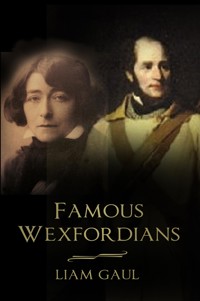
Cover illustrations: front: Sir Robert John Le Mesurier McClure & Eileen Gray in later years, back: Jem Roche, Irish Heavyweight Champion in fighting pose (Courtesy of the Roche family) & Anita Lett, founder of the ICA.
First published 2019
The History Press
The Mill, Brimscombe Port
Stroud, Gloucestershire, GL5 2QG
www.thehistorypress.co.uk
© Liam Gaul, 2019
The right of Liam Gaul to be identified as the Author of this work has been asserted in accordance with the Copyright, Designs and Patents Act 1988.
All rights reserved. No part of this book may be reprinted or reproduced or utilised in any form or by any electronic, mechanical or other means, now known or hereafter invented, including photocopying and recording, or in any information storage or retrieval system, without the permission in writing from the Publishers.
British Library Cataloguing in Publication Data.
A catalogue record for this book is available from the British Library.
ISBN 978 0 7509 9163 6
Typesetting and origination by The History Press
Printed and bound in Great Britain by TJ International Ltd
CONTENTS
About the Author
Acknowledgements
Introduction
1 Father of the American Navy: Commodore John Barry
2 Yola, an Ancient Language: Jacob Poole
3 Poet with Wexford Connections: Thomas Moore
4 The Men of ’98 (Fr John Murphy; John Kelly; Miles Byrne; Bagenal Harvey)
5 Folklorist and Author: Patrick Kennedy
6 Wexford Church Builder: Fr James Roche
7 Arctic Explorer: Sir Robert John Le Mesurier McClure
8 The Ironmasters: James Pierce and Sons
9 A Piping Dynasty: The Rowsome Family
10 The Gentry in County Wexford: Lord and Lady Fitzgerald
11 Politicians and a Soldier: The Redmond Brothers
12 Master Musician: Dr William Henry Grattan Flood
13 The Irish Countrywomen’s Association: Anita Lett
14 Irish Champion Pugilist: Jem Roche
15 Artist, Designer and Author: Eileen Gray
16 Richard Corish and the Corish Family
17 Songs of the Wexford Coast: Fr Joseph Ranson (1906–1964)
18 Wexford Festival Opera: Dr T.J. Walsh
19 A Hurling Hero: Nickey Rackard
Bibliography
Endnotes
To all Wexfordians over the centuries who brought notoriety to their native county, whether at home or abroad, in the activities that brought success and satisfaction, whether in pursuits on land, sea, sport or in entrepreneurial endeavours, in an effort to find a better and more rewarding life.
ABOUT THE AUTHOR
A native of Wexford town, Liam Gaul has a lifelong interest in history and is a regular contributor to various journals and newspapers. His lectures to historical societies, schools and other groups, together with his summer radio series on South East Radio, are an important part of his activities. He is currently researching a further book of historical and musical interest. Liam is president of the Wexford Historical Society, and a member of the Wexford Gramophone Society. He is a graduate of the University of Limerick, the National University of Ireland (Maynooth) and the Open University.
ACKNOWLEDGEMENTS
I wish to thank the following: Breda Banville, ICA; Gloria Hurley-Binions; Jane Cantwell; Brian Cleare; Philip Corish, Michael Dempsey and the staff at Local Studies, Wexford Library; Gráinne Doran, archivist, Wexford County Archive; Marion Doyle, SIPTU; Danny Forde; James Gaul, Cobh; Jarlath Glynn; Brendan Howlin, T.D.; Ken Hemmingway; Susan Kelly, Library Headquarters; Angela Laffan, district manager, Wexford Borough District; Denise O’Connor-Murphy; David McLoughlin, CEO Wexford Festival Opera; Aidan Quirke; Padge Reck; Billy Roche; Nicky Rossiter; Aidan Ryan, Brownswood, Enniscorthy; Eithne Scallan; Seamus Seery; Mary Somers, ICA; Catherine Walsh, SIPTU; David Williams; Dominic Williams; Helen Corish-Wylde, the Friday Historians. To my publisher, The History Press Ireland. Finally, my sincere thanks to my wife and family for their interest, support and patience.
Photographic credits: Denise O’Connor-Murphy; Pat Sheridan; Aidan Ryan; Aidan Quirke, Helen Corish-Wylde, National Gallery of Ireland, Matt Wheeler, Irish Agricultural Museum Archive, Johnstown Castle, Paddy Berry, Tesco, Wexford, Enniscorthy Museum, Brian Cleare.
INTRODUCTION
Many of County Wexford’s sons and daughters have brought fame and glory on themselves and their native place over the past decades. I have included profiles of some of them in Famous Wexfordians. Three of them, although not born in the county – namely our national poet Thomas Moore, through his mother; master musician, composer and organist William Henry Grattan Flood, who lived the greater part of his life in Enniscorthy; and Anita Lett, founder of a national women’s organisation – we claim as Wexfordians. The United States recognised Commodore John Barry as Father of the American Navy, and the man who discovered the Northwest Passage, Sir Robert McClure, was born on Wexford’s Main Street. In the struggle for freedom, Wexfordians took up arms during the Insurrection of 1798, and again during the First World War in answer to John Redmond’s call for Irishmen to fight in Belgium and France, all with great loss of life. Known as the Model County for its rich and productive land, a far-seeing James Pierce gained world renown for his manufacture of agricultural machinery. Remnants of an ancient language spoken in the south-east of the county were collected by Jacob Poole, and from the coastal areas Fr Joseph Ranson preserved songs in print of wreck and rescue. It was folklorist Patrick Kennedy who recounted the many legends and stories in his excellent publications. Art and music, both traditional and operatic, came to the fore with the uilleann piping of the Rowsomes, and the internationally proclaimed festival of opera founded by Dr Tom Walsh and the artistic work of the multitalented artist, designer and author, Eileen Gray from Brownswood, Enniscorthy are profiled here. County Wexford was well represented in sporting activities such as hurling and boxing, with such heroes as hurler supreme, Nickey Rackard, and blacksmith pugilist, Jem Roche. In the past, many castles and fine manor houses, occupied by the landed gentry, were dotted across the county, with only one castle occupied today and Johnstown Castle in a stage of refurbishment. Religion and politics are covered with the story of Fr James Roche, builder of the twin churches in the county town, and the Corish family who served the people in local and national politics for eighty-four years. I trust Famous Wexfordians will give an insight into the lives of some of those men and women included in my book. Enjoy.
Liam Gaul
2019
1
FATHER OF THE AMERICAN NAVY
Commodore John Barry
Commodore John Barry lived an exciting life as a sailor and soldier during the American Revolution and in the formative years of the United States of America, which afforded him some signal honours in its naval service. John Frost (1800–59) writes of John Barry:
The career of this distinguished officer commences with the infancy of our navy, and is marked by many brilliant services. His name occurs in connection with not a few of the more remarkable events in the history of the revolutionary war, and always with credit to himself, and honour to the flag under which he sailed. Few commanders in the navy were employed in a greater variety of service, or met the enemy under greater disadvantages. Yet, in no one of the numerous actions in which he was engaged, did Commodore Barry ever fail to acquit himself of his duty in a manner becoming a skilful seaman and an able warrior.1
John Barry was born in 1745 at Ballysampson in the Parish of Tacumshin.2 His father was a tenant farmer evicted by his English landlord, forcing the family to relocate to Rosslare. It was here that young Barry got his love of the sea from his father’s brother, Nicholas Barry, who was captain of a fishing skiff. John was determined at an early age to follow his uncle to sea. From a ship’s cabin boy he graduated from seaman to able-seaman and, eventually, achieved a mate’s rating. Barry grew to be an imposing man of almost 6ft 4in, of muscular build and a well-respected seaman. His height was determined by Rear Admiral G.H. Preble (1816–85), naval historian, who examined John Barry’s Federal Navy uniform which dated from the 1790s.3
John Barry was held in very high esteem in the services of his adopted country in a bid for her freedom. The young Barry went to Spanishtown in Jamaica, and from there sailed to Philadelphia. Besides Philadelphia’s growing population, the city was also emerging as a great maritime trade centre. It was from Philadelphia that Barry gained his early skills of command at the helm of several merchant ships plying back and forth between his home port and the West Indies. ‘Big John’, as he was popularly known to Philadelphians, was noted for his reliability and personable nature.
He soon became much sought after in the merchant shipping business. He was just 21 years of age when he took command of the 60-ton schooner Barbados leaving Philadelphia on 2 October 1766. The schooner was owned by Edward Denny of Philadelphia and was built at Liverpool, Nova Scotia. John Barry was registered as its captain. Barry served as captain on several vessels, taking charge of the brig Patty and Polly in May 1771, sailing from St Croix to Philadelphia, and in August of that year captained the schooner Industry, a 45-tonner sailing to and from Virginia with trips to New York and to Halifax, Nova Scotia. Later, in October 1772, he took command of the Peggy sailing to and from St Eustatia and Montserrat. It was John Nixon, owner of the Black Prince, whose grandfather, Richard, had settled in Philadelphia in 1686 from Wexford, who issued a register to John Barry to act as the ship’s master.
By 1772, Barry’s abilities as a ship’s master had come to the attention of Meredith and Clymer, one of Philadelphia’s premier mercantile houses, who offered him command of the vessel Peg. Later, Barry transferred to the shipping firm of Willing, Morris and Cadwaladar, who gave Barry command of the 200-ton ship Black Prince. It was on this vessel that John Barry made the amazing and unparalleled record of travelling 237 miles by dead-reckoning in a twenty-four-hour period, giving Barry the fastest day of sailing recorded in the eighteenth century. This recorded distance happened during a voyage from England back home to America.4
Postage stamps issued by An Post.
On the outbreak of war between the colonies and England, Barry was given the very important task of outfitting the first Continental Navy ships which put to sea from Philadelphia. He was responsible for overseeing the rigging, piercing gun-ports, strengthening bulwarks, procuring gunpowder and canvas for the new warships, and loading provisions. Barry received a captain’s commission in the Continental Navy, dated 7 December 1775 and signed by the President of Congress, John Hancock. With this commission went command of John Barry’s first warship, the frigate Lexington. The young Wexford man was just 31 years of age.
The Lexington was 86ft in length with a 24ft beam, and was armed with fourteen 4-pounders, two 6-pounders and twelve swivel guns. Barry had a crew of 110 officers and men and was the first commander appointed under the direct authority of the Continental Congress. The Lexington cruised off the coast of Virginia, where Barry’s ship had a successful encounter and shattered the British ship Edward, with several of her crew killed and wounded. Barry lost two men killed and two wounded. The battered Edward was brought to Philadelphia by Captain Barry with her commander, Lieutenant Richard Boger, and the crew of twenty-five prisoners. This was the first armed vessel taken under the authority of the Continental Marine Committee, proving that the colonies had the ability to contest the sea against Great Britain. The Edward was deemed by the Court of Admiralty as a prize of war. Her ammunition, furniture and tackle went to public auction, with the government and Captain Barry and his crew sharing the proceeds.
Following the encounter with the Edward, the Lexington was in need of a refit. Captain Barry sailed in the sloop Hornet down the Delaware River to help in the defence of the pass at Fort Island, in a bid to prevent the British coming to Philadelphia. The Lexington was sent down the bay to Barry to join the rest of the fleet at Cape May. With the building of thirteen ships by the Marine Committee, the thirty-two-gun frigate Effingham was assigned to Barry.
On 2 July 1776, the Resolution announced that the colonies were free and independent. John Hancock, President of the Congress, notified Captain Barry:
… the frigate you are to command is not yet launched, her guns and anchors not yet ready, a piece of justice due to your merit to allow you to make a cruise in the Lexington for one or two months, in hopes that fortune may favour your industry and reward it with some good prizes.
Fortune smiled on Captain Barry, for on 2 August he captured the Lady Susan, followed by the Betsy, bringing a share of the value to the captain and his crew. Barry commanded the Lexington until 18 October 1776.
As the war progressed, John Barry turned from sailor to soldier, awaiting completion of his thirty-two-gun frigate, the Effingham. In December 1776, Captain John Barry recruited a company of volunteers for land service and the marines cooperating with them were highly commended by General Washington. Later, Barry served as aide-de-camp to militia commander General John Cadwaladar.5 He fought at the Battle of Trenton6 and led a spirited defence during the Battle of Princeton.7 He was chosen by General Washington to convey wounded prisoners through British lines, and to carry a dispatch under a flag of truce to General Cornwallis.8 It was the same Cornwallis who later became Lord Lieutenant of Ireland, arriving in Wexford in June during the Insurrection of 1798. Barry returned to Philadelphia and assisted in the defence of the city. When the British took possession of Philadelphia in September 1777, Barry was ordered to sail the uncompleted Effingham up the Delaware River for safety. On 25 October, General George Washington requested for the crew of the Effingham to become part of the fleet, and two days later Barry’s ship was either to be sunk or burned to avoid her falling into the hands of the British. The Effingham was scuttled on 2 November near Bordentown, New Jersey, and was later burned at the water’s edge by British forces heading northwards from Philadelphia.
The destruction of the Effingham left Barry without a command. On 30 May 1778, the Marine Committee appointed him to the command of the thirty-two-gun frigate Raleigh, which was in Boston Harbour. Barry proceeded to Boston and had the Raleigh refitted for service and put to sea. The vessel proved unfit for cruising and proceeded to Portsmouth, Virginia, for further refurbishment. On Sunday, 27 September, the Raleigh was chased by two British frigates, Unicorn and the ship-of-the-line Experiment, from nine in the morning to five in the afternoon, and as they neared each other Barry’s ship hoisted her colours and one of the frigates hoisted the St George ensign. A broadside from the British ship carried away the foretopmast and mizzentop gallant mast, causing Captain Barry to lose control of the Raleigh, much to his grief. The enemy raked the American ship and Barry saw no way of escaping, and with the advice of his officers Barry decided to run his ship ashore on the uninhabited Wooden Ball Island in the rocky Maine inlets.
Commodore John Barry statue on Crescent Quay, Wexford. (Gaul Collection)
On landing, Captain Barry ordered the men to set fire to his ship. An American Midshipman of English origin, one of Barry’s crew, quenched the fire, preventing the destruction of the ship. Barry successfully guided eighty-eight of his men to safety, in rowboats to Boston. The entire episode reflected on Barry’s concern for the welfare of his crew and his stubborn refusal to surrender. Once again, John Barry was without a ship, although the loss did not lessen his reputation as a skilful commander or mar the character he had won for his bravery.
As his country had no ship to give him, Barry entered the service of his adopted state, Pennsylvania, becoming a privateer and commander of the Letter-of-Marque Delaware, a brig owned by Irwin and Company of Philadelphia. He took up this command on 15 February 1779. The Delaware was a new brig of 200 tons with ten guns and a crew of forty-five men, which Barry increased to twelve guns and sixty men. On arriving back home from two cruises to Port-au-Prince, Captain Barry was sent immediately to Portsmouth, New Hampshire, where the frigate America was on the stocks in the process of building, and where he was to hasten the completion and fitting of the frigate. Barry was replaced by Captain John Paul Jones in overseeing the completion of the America, as Barry was doing service at sea in command of the Alliance.
Early on the morning of 28 May 1781, an armed ship and a brig were about a league distant from the Alliance. At sunup, the ships hoisted the British colours and beat drums. Around eleven o’clock, Captain Barry hailed the ship and was answered that she was a ship-of-war, Atalanta, and belonged to His Britannic Majesty. She was under the command of Captain Sampson Edwards. Barry replied that he was commander of the Continental frigate Alliance, and advised Edwards to haul down the English colours. Captain Edwards declined, wishing to engage the American ship in battle. Due to lack of wind, the heavier Alliance could not manoeuvre quick enough to avoid the gunfire from the Atalanta and the Trepassy.
Wounded in the left shoulder by canister shot (broken nails, metal fragments and ball shot) while in command of the Alliance, Barry remained on deck, bleeding from his many wounds for twenty minutes, until he lost consciousness from loss of blood. He was finally taken below decks for medical care by the ship’s surgeon, Mr Kendall. The colours of the Alliance were shot, leading the British to think that the American vessel had struck its colours and surrendered. The Alliance run up again, and with a rising breeze it was in position to give the Atalanta a broadside, and another to the Trepassy. Both British ships struck their colours to the Alliance. Captain Smith of the Trepassy was killed and the captain of the Atalanta was brought on board and taken before the wounded Captain Barry in his cabin. The defeated British Captain Edwards advanced and presented his sword to Captain Barry, who returned it to Edwards, saying: ‘I return it to you, Sir. You have merited it. Your King ought to give you a better ship. Here is my cabin at your service. Use it as your own.’ The crews were taken prisoner and put on board the disarmed Trepassy, while the British officers were held as hostages on board the Alliance. Barry’s ship made sail for Boston with the wounded John Barry.
The last battle of the Revolution took place on 10 March 1783, when the Alliance encountered the British frigate Sybille, a French vessel captured by the British Hussar and now under the command of Captain Vashon. Following his escape from capture, Captain Vashon reported that he had never received such a drubbing as he had from the Alliance. On 11 April 1783, Congress ordered by proclamation the cessation of arms by sea and land. On 19 April 1783, Washington announced the end of the war and the disbandment of the army.
France and England engaged in war in 1793, seizing each other’s ships on the American coast and sometimes in American waters. A naval force was necessary, and when Congress assembled in December 1793 the main topic for discussion was the building of frigates for the protection of commerce, and from the aggressions of France and from the violation of neutrality by England. Captain John Barry immediately offered his services to his country, and wrote to President Washington on 19 March 1794.9 A week later, Washington signed an Act declaring that the United States deemed it necessary to form a naval force for its protection. The Act was the foundation for the United States Navy.
Three forty-four-gun frigates and three of lesser tonnage were commissioned. John Barry was appointed captain of one of the ships by the president, which he accepted at once. The commission was not signed or issued by President Washington until 22 February 1797, when the frigate United States was ready for launching at Philadelphia. The frigate was built under the supervision of Captain Barry. The County Wexford Irish Catholic boy had become the commander-in-chief of the navy of the new Constitutional United States of America. Barry was appointed by President Washington, ‘the Father of his Country’ making Barry ‘the Father of the American Navy’. His commission reads: ‘to take rank from the fourth day of June, one thousand seven hundred and ninety-four’.
In his private life, John Barry married Mary Clary (Cleary) at Old St Joseph’s Chapel on 31 October 1767. However, tragedy struck with her premature death at the age of 29 years on 9 February 1774. By this time, Barry’s other brothers had made their way across the Atlantic. Patrick was already an experienced mariner, while Thomas embarked on a quieter career as a clerk. Mary died while John was at sea in February 1774, and it was Patrick who was rowed out to his brother’s approaching vessel to break the news. Only 29, John Barry found himself a widower.
This sad event was followed some years later by the loss at sea of his brother and fellow mariner, Patrick Barry, in August 1778. His ship, the Union, a Letter-of-Marque vessel, sailed from Bordeaux, France, and was never heard from again. Barry married Sarah Keen Austin, Sally to her friends, in July 1777. Sally was an Episcopalian, who eventually converted to Barry’s Roman Catholic faith. They had no children of their own but happily reared two boys from John’s deceased sister Eleanor’s household back in Wexford.
It was a spring day in 1787 when John Barry received word that the Rising Sun was very soon to dock in Philadelphia. The ship, under Captain John Rossiter, a friend of Barry’s, was returning from a voyage to Wexford. Captain Rossiter, like Barry, was also a Wexford emigrant. Standing on the quay wall awaiting the lowering of the gangplank and the disembarking of the ship’s passengers, John Barry and his wife glimpsed Captain Rossiter with two teenage boys. The boys received welcoming embraces from their uncle and a tearful aunt. Michael Hayes, at 18 years of age, was the elder of the two brothers, and the younger brother Patrick was 16 years old. Their sister Eleanor had recently married and remained at home in Ireland. Following a meal in the town, the Barrys brought Michael and Patrick to their new home at Strawberry Hill. The commodore had ‘swallowed the anchor’ (a seafaring phrase meaning retirement from sailing), but he encouraged the careers of his nephews. Michael remained with Captain Rossiter on the Rising Sun while Patrick set out on a series of voyages free from his uncle’s eagle eye.10
When the War for Independence ended and the Continental Navy was dissolved, Barry re-entered the maritime trade once more. He sailed to the Orient, bringing back many porcelain and ivory treasures which were eagerly bought by the citizens of Philadelphia. On 22 February 1797, President George Washington gave John Barry Commission Number One in the new Federal Navy. Barry outfitted the first frigates under the Naval Act of 27 March 1794, including his own forty-four-gun USS United States, which served as his flagship. He held the courtesy title of commodore. The title ‘Father of the Navy’ first appeared with the publication of a biographical sketch in Nicholas Biddle’s literary journal, Port Folio, in 1813. Of the many ships that Barry commanded, the Alliance was his favourite and carried his own personal flag, which was of yellow silk with a pine tree and rattlesnake emblazoned on it bearing the motto ‘Don’t tread on me’. The US Navy has had a battleship named the USS Barry in remembrance of this wonderful seaman since those formative years, and it always carries John Barry’s flag and motto.
Barry’s last day of active service came on 6 March 1801, when he brought the USS United States into port. He remained head of the navy until his death on 12 September 1803 from the complications of asthma brought on by the rigours of life at sea. He was buried on 14 September in Old St Mary’s Churchyard with full military honours. He was just 58 years of age.
2
YOLA, AN ANCIENT LANGUAGE
Jacob Poole
Jacob Poole (1774–1827), antiquary, son of Josiah Poole and his wife Sarah (daughter of Jacob Martin of Aghfad, Co. Wexford) was born at Growtown, Taghmon, Co. Wexford, 11 February 1774. He was seventh in descent from Thomas and Catherine Poole of Dortrope, Northamptonshire. Their son, Richard Poole, came to Ireland with the parliamentary army in 1649, turned Quaker, was imprisoned for his religion at Wexford and Waterford, and died in Wexford jail, to which he was committed for refusing to pay tithe in 1665.11
Jacob’s elder brother, Joseph, was born in 1769 and died in 1785. In 1824, Jacob inherited the family estate with extensive land holdings at Growtown and Killianne, where he had lived on family property for some years. Killianne is 4 miles from Wexford town on the Rosslare road. Jacob never lost contact with that area of Wexford and its people, manners, customs and the strange dialect of the Baronies of Forth and Bargy. The inhabitants used to speak an old English dialect, dating from the earliest invasion of the country, and Jacob Poole collected the words and phrases of this expiring language from his tenants and labourers.12 This collection was edited by the Rev. William Barnes from the original manuscript, and published in 1867 by J. Russell Smith, 36 Soho Square, London as A Glossary, with some pieces of verse, of the old Dialect of the English Colony in the Baronies of Forth and Bargy.13 The glossary contains a total of 1,278 words, noted with great exactitude. The dialect is now extinct, and this glossary also has some fragments of verse. Poole completed the glossary and a further vocabulary or gazetteer of the local proper names in the last five years of his life. It is interesting to note that the glossary has no words beginning with the letter X.
Jacob Poole married Mary, daughter of Thomas and Deborah Sparrow of Holmstown, Co. Wexford, on 13 May 1813, and they had three sons and three daughters.14 Wherever Jacob went he endeared himself to friends and neighbours because of his unassuming charitable disposition, as the following oft-quoted incident exemplifies. An example of Mr Poole’s kindness to his fellow man happened following a visit to William Berry, a respectable Protestant neighbour who resided at Ballykelly, one of Poole’s townlands. Berry’s wife was a Roman Catholic, whose places of worship were scarce in the Barony Forth. The Roman Catholic community attended a small boxlike shed of mud and timber by the side of the road near the Cross of Killiane known as Amen Cross. It was there, on Sundays and holy days, that a priest celebrated the Holy Sacrifice of the Mass. On a stormy winter day in 1795, while on his return to Growtown to attend on the following day, Sunday, at his own Quaker Meeting House at Forest, Taghmon, he observed a crowd of bare-headed men and kneeling women enduring a strong wind and a clinging mist on the wet and muddy ground. In their midst was his esteemed friend, Mrs Berry. He stopped his horse and returned to his house in Killiane, and next morning visited Fr O’Toole, the local priest. He expressed his concern that his Catholic countrymen were in such a destitute condition to practise their faith, and offered a plot of ground as a gift, free for ever, to use for Catholic worship. By way of a subscription towards the provision of a Catholic chapel, he handed Fr O’Toole ten guinea coins. The Chapel of Kilmachree came into existence soon afterwards in the townland of Ballykelly.15
This strange dialect of Forth and Bargy became known as Yola, meaning ‘old’, and included words and phrases which were a mixture of Irish, Manx and Flemish. Jacob Poole collected and noted these words over a period of time and had hoped to publish this glossary. Richard Stanyhurst (1541–1610), a noted historian, commented on Yola as follows:
Yola only preserved the dregs of ancient Chaucerian English. Yola speakers have so acquainted themselves with the Irish, that they have made a ‘gallimaufrere’ or ‘mingle-mangle’ of both languages, so that the natives of Forth and Bargy speak neither good English, nor good Irish.16
The leaves of the manuscript are numbered in ink on the recto only as follows: 1, 3, 5, and so on to page 133. The barely legible glossary is written in faded black ink. Poole made various additions and corrections, resulting in a number of very cramped passages. The manuscript was bound by an amateur bookbinder and encased between soft covers. The spine is covered with maroon book cloth, which was trimmed in an uneven manner. There is a title page which contains a list of contents. It is not in Poole’s handwriting, and below this, also in a different script, is written:
Jacob Poole’s Glossary of Forth and Bargy Dialect, the only medium through which an effective record of that ancient speech, which died out about 1890, had been preserved. Through my father’s medium (his signature below) it was printed in 1867. My father was deeply attached to his uncle Jacob Poole. Overleaf I copy a poem written by my father in 1836, principally referring to this uncle.
This inscription is followed by the name of its writer, A. Webb, and the date 12-7-1908. At the bottom of the title page are the date, 27 August 1866, and the signature and address of Richard D. Webb, 176 Great Brunswick Street, Dublin.17
Poole also notes a list of forty-seven surnames common among the inhabitants of the two baronies at that time. The names are written in the Yola spelling and then the English spelling is shown, for example:
Cuz=zeen - Cousins; Cug=ley - Cogley; Hier=een - Hearn; Preeng=aas - Prendergast; Shoord=aane - Jourdan; Vatte=ean - Fortune; Vur=laune - Furlong; De=roos - Devereux.18
Cover drawing from a history of Kilmachree Church.
A selection of Yola words in alphabetical order from over 1,278 listed in Poole’s Glossary follows:
Armeen
the side-lace of a car
Baakoozee
to bake bread in an oven
Clugercheen
a flock, clutch or a crowd
Die oaskean
Ash Wednesday
Enteete
a siesta or sleep at noon
Falsakeen
an unprincipled character, a false person
Gendrize
Gentry
Harr
the shank of a button
Joude
a crowd, e.g. Joude an moude or Joude and maude, Crowds and throngs
Khuingoke
a churn
Leeigheen
laughing
Muskawn
a large lump or heap e.g. Muskawn of buthther - a large lump of butter
Nizterels, Niztrols
the nostrils
Oananooree
one another
Paugh-meale
the harvest-home. Paugh-meale seems to be a playful name for the harvest-home, as the kissing time or feast
Quile laaune
a smart lively fellow
Risheen
an afternoon luncheon, a snack in the evening
Sneesheen, Snisheen
snuff
Tharvizeen
scolding
Unket
shy, strange
Vizeen
struggling, contending
Whithel
a sheet e.g. Mucha whithel, a winnowing sheet
Yalpeen
spewing, vomiting
Zin-zetteen
sunset
A short piece of dialogue as recited by Tobias Butler 1823:
Forth dialogue:
A–
Aar’s a dole o’ sneow apa greound to die. Caules will na get to wullaw to-die.
B–
Aar’s neer a year o aam to be drine-vold.
English translation:
A–
There is a deal of snow upon the ground to-day. Horses will not get to wallow (roll) to-day.
B–
There is no fear of them to fall into a dry furrow or trench.19
‘The Bride’s Portion’, in Forth dialect and an English translation:




