


Erhalten Sie Zugang zu diesem und mehr als 300000 Büchern ab EUR 5,99 monatlich.
- Herausgeber: Tracey McDonald Publishers
- Kategorie: Sachliteratur, Reportagen, Biografien
- Sprache: Englisch
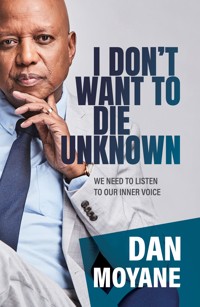
Dan Moyane was 10 years old when he lay on his back on a patch of grass at his parents' home in White City Jabavu, Soweto, looking at the moon and thinking, 'I don't want to die unknown.' The year was 1969, and Neil Armstrong and his team had recently achieved immortality by completing the first moon landing. It was the knowledge that the astronauts would be remembered as long as the world turned that made Dan realise that he, too, would like to be remembered by people outside of his immediate community, just as he would like to find out more about what lay beyond his horizon. Dan's insatiable curiosity and love of learning have ensured that his name has, indeed, become known throughout South Africa. This is the story of how he achieved his goal – from his days as a student at the apex of South Africa's political turmoil, to his years in exile in Mozambique and his first job in media, and the trajectory of a career that would see him become one of South Africa's most highly regarded and influential broadcasters. It is a career that led Dan to interview prominent leaders in Mozambique and South Africa and become acquainted with the likes of Nelson Mandela and Graça Machel, and saw him cover the country's birth into democracy, and help shape South Africans' understanding of the changed world around them. I Don't Want to Die Unknown delves into these experiences, giving a glimpse into the inquisitiveness and desire to know more, do more and be more that has driven Dan Moyane. It offers a rare insight into the man behind the microphone – his ambitions, trials, and motivations. Part memoir, part legacy, this book bears testimony to the fact that far from dying unknown, Dan is one of South Africa's most important, high profile media players and his story provides the framework for his next significant question: How best to use his public profile to benefit his countrymen.
Sie lesen das E-Book in den Legimi-Apps auf:
Seitenzahl: 366
Veröffentlichungsjahr: 2021
Das E-Book (TTS) können Sie hören im Abo „Legimi Premium” in Legimi-Apps auf:
Ähnliche


















First published by Tracey McDonald Publishers, 2021
Suite No. 53, Private Bag X903, Bryanston, South Africa, 2021
www.traceymcdonaldpublishers.com
Copyright © Dan Moyane, 2021
All rights reserved.
No part of this book may be reproduced, stored in a retrieval system, or transmitted in any form or by any means, electronic, mechanical, photocopying, recording, or otherwise, without the prior written permission from the publisher.
ISBN 978-1-920707-25-5
e-ISBN 978-1-920707-26-2
Text design and typesetting by Patricia Crain, Empressa
Narrative compilation by Lisa Witepski, Creative Copy
Cover design by Tomangopawpadilla
Front cover photograph courtesy of eNCA
Digital conversion by Wouter Reinders
‘This book is a memoir. Many events described are in the public domain in one form or another. I have made every effort to ensure factual accuracy in my recollections but should there be errors, I apologise. Of course, the dialogue I quote as verbatim, in some narration, could not have transpired exactly as I have written it down. But I have done my best to ensure this book represents the truth as I know it. All photographs are from my personal collection and are used by permission.’
– Dan Moyane
In loving memory of my parents,
Guwela Moyana and Sina Michaels.
CONTENTS
PREFACE
‘Until the lions have their own historians, the history of the hunt will always glorify the hunter.’
– Chinua Achebe
These words by Nigerian writer Chinua Achebe, expressed to me during an interview I conducted in December 2020, convinced me that it was time for me to write this book.
However, the true genesis of this book lies in my deeply held desire not to die unknown; a desire that I was aware of from when I was a boy. It lies in the quest to make a difference, no matter how small, in the world. It lies in the desire to leave behind a footmark that will memorialise my roots. It lies in the desire that the children of my children (if we are blessed one day), and their children, must know that their identity is rooted in my father’s Moyana* lineage, which goes back to an ancestor who was in the army of Ngungunyane Nxumalo, the last King of the Gaza Empire, who resisted the Portuguese colonial settlers in Mozambique. It is rooted in my mother’s family; the Michaels of the Cape, who are descendants of the Cape Malay slaves, their Dutch colonial masters and the indigenous Khoisan of our land.
I know all of this because my father and mother told me as much as they could about their origins from memory, but a lot of detail has been lost along the way through our oral history. Memory has a funny way of fading; hence the importance of recording it in written form – and hence my decision to commit, in writing, some of my memories.
I have thought about writing a book for quite some years now, but I was not sure about the topic. Around me fellow journalists have written books about events that have shaped our country’s march to freedom in 1994, and our post-democracy developments. I must confess I was tempted to go in a similar direction.
But, towards the end of 2020, Brand Africa founder Thebe Ikalafeng mentioned Chinua Achebe’s words during an interview for my #ConnectAfricaMoyane YouTube channel. Thebe was explaining why it is important for Africans to tell their own stories – and that insight helped to crystallise the topic of my book.
This book is not about the history of the battles of my Moyana ancestors against Portuguese colonialism in Mozambique, or my Michaels ancestors’ tribulations under Dutch domination in the Cape. Even if I wanted to document their history, it would be a near impossible task for me to undertake and do justice to. This book is simply the story of my personal and professional journey, starting with early childhood memories of my upbringing in Soweto, to my 12 years in Mozambique and my entry onto the airwaves of radio and television news stations and corporate boardrooms in Mozambique and South Africa. It is part memoir and part legacy. I am writing it so that, in future, the children of my children, and their children, will have a written account of my lived experiences, which are a product of a richly diverse region of Southern Africa, of which I am proud.
In writing, I had to go back into the recesses of my memory and assemble some recollections. This exercise has helped to enrich my awareness of where I come from, and therefore who the future progeny of my line will come to know as their ancestors, whose roots are richly entrenched in Southern Africa. Like me, I hope that they will be proud of their multiracial ethnic roots in whose blood flows Bantu (Tsonga and Ndau), Khoisan, Dutch and South-East Asian paternal DNA from my side, as well as Bantu (Gitonga) and Goan (Indo-Portuguese) maternal DNA from my wife, Odete Sousa.
I believe that nothing can be as uplifting as knowing your roots, understanding who you are, appreciating the journey you have travelled and ensuring that those who are yet to walk this earth after you will access your memory in written form. And with that consciousness they will continue to drive for more change, as did my Moyana and Michaels ancestors.
I hope that readers will be enriched and inspired by the accounts contained in this book. If even one reader resonates with something they have read here, I will have achieved the goal of ten-year-old Dan Tsakani Moyana, lying on his back and watching the moon from his home in White City Jabavu, dreaming that one day, he would not be unknown.
Nankhensa swinene – thank you very much.
*Moyana is our actual family surname, but when my father went to register me in the Native Affairs Department in 1959, the white Afrikaner official who took down my name spelt it incorrectly as Daniel Tsakani Moyane. Later, in the 1970s, when my father insisted that I must get my dompas, also known as a reference book (an ID document for blacks under apartheid), the officials refused to correct the spelling. My father didn’t fight them. He told me, ‘You know you are a Moyana. We are Moyanas. That’s what matters. We know who we are, no matter what is written in your pass.’
Moyana! Mazole!
Tshuma!
Atshuma ayiheli, ihela hikufa!
Moyana! The one of the morning dew!
The one who prospers!
Your wealth does not end, it ends only with death!
INTRODUCTION
‘To expand my horizons, from an early age I devoured books, asked questions and fed my curiosity.’
The moon is peeking through the fruit trees in our small yard in White City Jabavu, Soweto. I’m lying on my back, underneath the fig tree where we sometimes sit on hot days, and I’m looking at that moon shining down. The small transistor radio (the successor of umsakazo, which used to be pinned in the top corner of the wall in the dining room), is on, as it always is in my house – my father loved listening to Springbok Radio, Radio Zulu and the SABC’s English service – and had told me earlier that America’s astronauts had just landed on that very same moon.
On the one hand, I can’t believe there are men up there, especially since I can’t see them. On the other hand, all I can think is that right now, these men are the main topic of conversation for people around the world, and that they will be remembered for as long as there are people on earth. Even here in Soweto, the ten-year-old son of a labourer and a domestic worker can’t stop thinking about them. And that’s when it dawns on me: how tragic it would be to die without leaving a legacy, so that only your family members, friends and neighbours remember you. This is followed swiftly by another thought: I don’t want to die unknown.
Just how I would come to make sure people knew my name was a point that escaped me at that moment. I was like any other Soweto schoolboy back then: preoccupied with my schoolwork and playing in the streets when class was over. We lived in a small house, but thanks to my father’s great skill with his hands, it had a wonderful small garden, with flowers, as well as a peach tree, an apricot tree and a fig tree, and because my mother was extremely house-proud it was always neat and clean.
As I got a little older, I decided that the way to accomplish the kind of renown I craved was by making a difference, and so my childhood dream started taking shape. I would become a paediatrician, striding down Baragwanath’s corridors in a white coat with a clipboard in my hand, urgent voices calling Dr Moyana to report to the office.
That feeling, that desire, to be more, grew as I did, morphing into a wish to know more about the world. That was when I realised that if I wanted to expand my horizons, I had to become a reader – and so I signed up at the small house in White City which the local council had turned into a library, managed by a wonderful man we called Bra Joe. Bra Joe encouraged us to read and sometimes he would choose a book for me. He also warned me to look after the books and when I returned a book, he would check if it was still in good shape. I used to walk to that library whenever I could, devouring everything I could lay my hands on. I can still remember the smell of those old pages, turning in my hands.
I read magazines, too, passed on to me by the senior primary school teacher who headed my debate team, and these also fuelled my curiosity. I never stopped questioning; I wanted to know the ‘what’ and ‘why’ of everything around me.
This inquisitiveness came back to me years later, when I started asking myself why I do what I do. I remembered, too, the fascination with radio that had started back when I was a child. I spent my Saturday mornings listening to the DJs playing the hits, taping the songs, and then doing my own voiceovers: ‘This is Daniel Tsakani Moyana, and you were listening to the biggest song this week …’ In some ways, that was the precursor to my broadcasting career.
What would the Dan of those days think of what I have achieved since then? He would tell me that I am, indeed, far better known than I was as a ten-year-old. I can even, perhaps, claim to have achieved some degree of renown – certainly, during my days reporting for the BBC’s Focus on Africa from Mozambique, my fellow African reporters recognised my name. And, from the time I returned to South Africa from my Mozambican exile, I have worked hard to develop and maintain my profile in the media.
But I think that what my ten-year-old self would be most likely to say is this: So, a few more people are now familiar with your name. Then he would tell me that there is probably still more I could achieve.
I, in turn, would ask him: What’s the point of being well known? Back then, I believed that renown was the vehicle that would help me make a difference to those around me. I still believe that – and so I must ask myself: Have you made a difference, really? And, once your name is known in South Africa, or even the region, what happens next? In fact, is there ever a point when you can be happy with your achievements? I don’t think so – which is why I will keep asking myself, ‘What is my next step?’
CHAPTER 1
‘The praises for Guwela.’
Guwela waNyarhi! (Guwela the Buffalo)
Makwimbinini! (The one who stands his ground)
Mafela kothluma! (The one who dies in the thicket)
Xihalata uputsu (The one who spills traditional beer)
Masiya ribilile (And leaves it fermented)
These are the praises for Guwela, the name my father was given by his parents. These praises back up stories that the buffalo has killed more hunters in Africa than any other animal. Buffaloes become aggressive and angry when they’ve been wounded. It is said that they would seek revenge on the hunter and even remember the encounter the following day. The moral of the story is that the hunter should not pursue a wounded buffalo because he might end up dead, and traditional beer will be spilled in his memory. The boys in my father’s village had a saying: ‘Guwela will get you.’ It was a threat made to any boy asked to prove his innocence: if he was in the wrong, he would have to face my father’s wrath.
My father’s reputation was backed up by the meaning of his name, Guwela, which in Xitsonga is ‘old male buffalo’. You don’t mess with one. The praises for Guwela demonstrate the power of his name.
In truth, my father was far from a violent man, which may be why he did nothing more than chuckle every time I asked him about the story when I was a child. He was tough, a disciplinarian, determined and tackled problems head on – just like a buffalo – but although I bore the brunt of his temper on several occasions, my strongest memories show his gentle side. I remember how he would burst into song at any given moment, and how we loved listening to his beautiful voice. I remember him humming as he worked in the garden he was so proud of; painstakingly watering every part of it with a bucket because, for a long time, we didn’t have a hosepipe. I remember him hard at work; he was always busy, and although he took everything he did very seriously, he always wore a beautiful smile when he did it. And I remember the bouquet of white and yellow flowers I found when I returned home from a shift at 702 one day; a gift for my wife, Odete. It was so typical of him – he had a special way of showing people that he cared. I remember him sitting behind his sewing machine all night so that he could deliver outfits to the people who admitted that they had left it very late, but they really needed him, a self-taught tailor, to make them something special for a wedding they needed to attend on the weekend.
My father was a giant in many ways. He was a pioneer among his community; someone who was looked up to and respected; someone with deep-seated values who wasn’t afraid to buck tradition when he saw that it no longer served a purpose.
That’s no small thing for a man who grew up as a hunter and shepherd in rural Mozambique. Guwela was born in the central Mozambique province of Manica, in a small village called Sambasoka near the Save River. My grandfather, Kokwani Watch (Mzamani Tshikato) died when my father was about 11 or so – but, before he passed on, he trained my father in the art of traditional healing and taught him how to throw and read the bones. It’s hard to imagine my father, who became a committed Christian, carrying bags full of bones, herbs and medicines when he accompanied his father on visits to treat people, or even assisting him during consultations – but that’s exactly what he did. It’s harder still to imagine a man who prided himself on dressing immaculately hunting down animals – but, again, that’s how he spent his time once his days as a shepherd had passed. What’s more, he was very good at it; his younger brother, my late uncle Nyamayabo Titos, once told me that my father was the strongest in the village – hence the boys’ fear that Guwela would ‘get them’ if they were discovered to have been up to no good. My father simply laughed off his reputation, saying that it was greatly exaggerated – although he once admitted that, until Jesus saved him, his habitual way of sorting out problems was to use his physical prowess, and more than once when I was growing up, I felt the house shake when he lost his temper. Neighbours never messed with my father.
Guwela was the oldest of three children; a fourth had passed away during childhood. Like most young men in this position at the time, it was expected that he would leave Mozambique to work in South Africa’s mines (back then, in 1929, the country, like most of Southern Africa, was a significant supplier of cheap migrant labour) so that he could earn a living and, eventually, come back to Mozambique to pay lobola for a good wife.
He was only 16 when he left his village to make the journey to the mines, and although most teenagers today would feel daunted by what lay ahead, he must have seen it as something of an adventure. In any event, almost every young man from his village had left to search for better prospects, so it was simply something that had to be done if he were to fulfil his duty as the eldest son of looking after his mother, Kokwani Nwa-Mvuthuza Makhanani. I suppose his ignorance about the conditions on the mines, and the kind of life he would live when he reached Johannesburg, served in his favour.
Guwela left with a group of men, ready to walk all the way to the Northern Transvaal; lighting fires as soon as the sun set to keep away hungry lions (the greatest danger they faced) and sleeping in bushes when the need arose.
Finally, the group reached Sibasa in the Northern Transvaal. Here, Guwela had to register with the local chief to pay the unpopular poll tax before he could be granted the permit that would allow him to travel to Johannesburg – and then it was on to the City of Gold.
I know very little about what his life was like after that because he gave me only a few details. I know that he was quickly integrated into a community; some of whom also came from Mozambique, some of whom welcomed him simply because he had the same surname. This is typical of African culture; we believe that sharing a surname makes us family. In fact, I am named after one of the Moyanas that my father met shortly after coming to Johannesburg; Daniel Makohoma, a cousin who, like Guwela’s father, was also a traditional healer.
It was through this ecosystem of solidarity and support that Guwela found his first job on the mines. I’m not quite sure where this was, although I know that he later spent some time at the State Mines in Brakpan: I remember once mentioning that I had gone there to play golf, and he told me that he had worked there. It was a moment that truly highlighted the differences between our lives, and the greater opportunities I have been able to enjoy.
What I do know about my father’s early years on the mines is that he found them extremely difficult. In one way, he was more fortunate than most: at the time, the Portuguese colonial government (which was then in power in Mozambique) had an agreement with the South African government, so that the larger part of any miner’s salary was paid over to them in gold, leaving the miners themselves with a mere pittance. Guwela was lucky to be registered as a resident of Sibasa, so he earned his salary in its entirety – but, even so, it wasn’t very much to live on. And, when World War Two struck, this slender margin of privilege grew even slimmer: the country’s privations meant that there was no more white maize meal, which formed the basis of every miner’s diet. Instead, they had to make do with the yellow maize, which was of such inferior quality that it was usually used only to feed livestock.
That wasn’t the only hardship, according to Guwela. Fearing an air attack from the enemy, Hitler’s Germany, he told me that the South African government ordered a complete blackout at night. The mines were in total darkness; it was forbidden even to light a candle.
Guwela had found life on the mines difficult even before these additional challenges were put in place. As a small man, he battled with the physical demands of life underground, and was greatly relieved when his employers decided that he could serve better above ground.
It was around this time in the mid to late 1930s that my father met the man who would change his life: James Dexter Taylor. Reverend Taylor was one of the leaders of American Board missionaries who were working hard to spread Christianity around South Africa, and while I am not sure if he set my father on the path to Jesus, or if Guwela had already embraced religion and his encounter with the missionaries cemented his conviction that this was the life for him, there’s no denying that they had a massive influence on his life. In fact, when Guwela registered for an identity document and was told he had to have a European name, he chose to be called James.
I always found it interesting that a man who had been raised by a traditional healer could have chosen such a very different path. The truth was that Guwela had been troubled by some of the practices he had seen as a child: the fact that preparations for remedies weren’t documented or carefully measured, for example, which meant that a patient might be consuming too much or too little of a certain ingredient. He never once criticised traditional medicine, but it was clear that he had no interest in becoming a healer.
He was, however, interested in helping people in another way: through preaching. He accompanied the missionaries who crossed South Africa preaching at all the mines, so that by the time he was 30, he was an accomplished preacher himself, able to hold a sermon in any of the major Nguni languages.
Guwela didn’t only spread ‘The Word’ in South Africa, though; he took his message back to his home village, too. As expected, he had returned to Sambasoka, married one of the local women and had a daughter, my late sister Kezina, born in 1947. Back in Johannesburg, around that time, he met and fell in love with my mother, Sina Michaels, who would also give birth to a girl in 1950. So, for a few years in the 1950s, my father had two wives. After Kezina’s mother died, he remained married only to Sina, my mother. Unlike the other men who came back to their villages, Guwela wasn’t content to leave the comforts and trappings of urban life behind in South Africa. He was the first person in the village to ride a bicycle, for example, and the story of his riding into Sambasoka has become the stuff of local legends: when he came wheeling into the fields that surrounded the village, one of the women who was sitting nearby sprang up and ran to hide in the safety of the huts. Having never seen a bicycle before, she couldn’t make sense of the apparition that had materialised. Witnessing what she thought was a man without legs floating through the air, she was convinced she had seen a ghost, Guwela would recount, laughing until tears streamed down his face.
Incidents like this cemented the idea that Guwela was a pioneer and a leader; a reputation he had enjoyed since adolescence. He was able to wield some influence as a result and used it for good wherever he could. I remember the son of a local chief of the Chauke clan telling me that my father had changed his life when he convinced the chief to allow him to go to school; an option that would usually be off-limits to the oldest child, who would be expected to remain at home to look after their parents. It was thanks to my father, this man told me, that he was able to finish primary school and travel to Maputo – then Lourenço Marques – and get his first job.
My father also persuaded the people of Sambasoka to build their own church. And so it wasn’t surprising that he became a man of standing in the village, someone they looked up to. Several families named their children after him, and even today, when I meet some old relatives, I am greeted as ‘the son of Guwela’ and shown the respect they believe is accordingly due to me.
What is particularly interesting about the esteem afforded Guwela is that he wasn’t someone who followed the rules. While the kitchen was very much a woman’s domain at the time, he cooked often, especially after my mother started working. In fact, my father also taught me to cook, as did my mother. He also rejected the custom of seating women on the floor while men sat on chairs; the idea being that women shouldn’t look men in the eye. And, at mealtimes, he insisted on making sure that children had enough to eat before he served himself; challenging the tradition which made sure that men and elders were given meat first, before anyone else could eat (especially the women who prepared the meal who’d be last). And after I got married, he never hesitated to give my wife a hug – something which was seriously taboo in terms of our family’s traditions. He simply had a different approach to life, and although it raised eyebrows amongst men of his generation, the way he treated women ensured he earned their respect.
That’s not to say he was perfect – of course not. In my eyes, one of his greatest flaws was his stinginess. It’s not that he wasn’t generous. Far from it, he was always open-handed and open-hearted when it came to helping people in need. Giving money was a different story, however. In fact, one of our biggest fights ever was over money in 1975, and it marked the end of my churchgoing. This was no small thing for the son of a preacher, especially since by then my father was playing an extremely active role in the church and had even been appointed treasurer of his church. I had also become active in the youth programmes of our church, the United Congregational Church of Southern Africa (UCCSA). This was one of the pillars of my argument, in fact: I asked him how he could give to the church so freely, when he didn’t give to his family. The clash had been sparked when he refused to replace my worn-out school shoes. Since my mother couldn’t afford to buy a new pair, I decided to help myself to his leather ones – which, of course, made him furious. We exchanged angry words, and I told him I would never again go to church; a promise I kept until my return to South Africa from exile in Mozambique in 1991, when he begged me to go with him so that he could give thanks for my safety and homecoming.
There was one positive outcome from the 1975 incident, though: the knowledge that there wasn’t an open hand at home pushed me to become an informal trader – but more about that later.
CHAPTER 2
‘No matter how much you’ve been hurt, you can still be kind and generous.’
If my father was a pillar of his community, my mother was the pillar of our home – carrying the load when he and I fought, and simply making sure that everything was spick and span. Soft-spoken and loving, she was the real strength of the family. True to the meaning of her name, Sina, whose origins in Ireland and the Middle East mean ‘treasure; God is gracious’, my mother was a true blessing.
The story of Guwela Moyana and Sina Michaels started in 1949, by which time my father had left the mines and found work as a cleaner at a hotel in Melville, selling clothes on trains and in the township to supplement his income. Their meeting took place shortly before my father’s first wife, back in Sambasoka in Mozambique, passed away. At the time, Sina was just 19, and was living in Orlando East in Soweto.
Neither of them was living a particularly easy life. Guwela may have had a job, but he still struggled to make ends meet, and so he bought and made clothes and sold them after his day’s work on the trains criss-crossing Johannesburg at night, walking from one coach to the other with his offerings in hand. Guwela loved clothes so much he had bought a sewing machine and taught himself how to sew; he even set up a shop in Cleveland, in the eastern part of Johannesburg, but in 1956 it caught fire and he lost everything. He didn’t even have a home. At the time he met Sina, he was staying in people’s backrooms; even when I was born, in 1959, the couple were staying with one of my father’s closest cousins, Uncle Wilson Sithole, at 126B White City Jabavu. My mother told me that my umbilical cord was buried in the backyard of this house. It was only in 1963 that the local department of Bantu Affairs assigned us our house, 193A White City Jabavu.
Things were even tougher for my mother. Sina Michaels used to describe herself as ‘a real mixed masala’ – and if she was an exotic mix, with her Cape Malay father, Jannie Michaels, and a mother, Ellen, who had been half Dutch and half Khoisan, then her children, who had a Tsonga father, were even more of a blend.
My mother had been born in a very poor part of Knysna, but the family moved to Jeffreys Bay and finally settled in Port Elizabeth. At some point, the family lived near a farm. She was the second of four siblings, including her sister Rachel, with whom she shared a special bond after their mother died.
The family’s life changed dramatically after Jannie Michaels, my grandfather, was deployed to the military barracks in Johannesburg as a member of the Cape Coloured Corps in the 1940s. He decided that Sina and her younger brother (also called Jannie) would accompany him – and so the family was split up.
More trauma was in store, however. Jannie Senior had been living in Johannesburg for a while when he met and fell in love with MaNdhlela, a woman from Zululand. It’s perhaps telling that my mother never knew her stepmother’s first name. Nonetheless, she was brought to live with MaNdhlela and her family in their house in Orlando East. This was probably difficult enough before Jannie decided to return to Port Elizabeth after an illness. He took his son with him but left his daughter with MaNdhlela as an assurance that he would return.
My mother always said that, from this point, her life became a living hell. Like a modern-day Cinderella, MaNdhlela forbade Sina to attend school. She was treated like a domestic worker, expected to clean the house while her ‘sisters’ continued their learning.
Worse was still to come, though. MaNdhlela decided to spirit my mother away to her rural home village, near Volksrust, a town in Mpumalanga near the KwaZulu-Natal provincial border, without telling anyone in her family. So, when Jannie passed away, no one in Port Elizabeth knew how to get in touch with my mother, and she eventually lost all contact with her family in PE.
It was my father who came to her rescue. He had first noticed the girl with the green eyes and flowing hair when she was still living with her brother. They had been selling all kinds of goods in the street to earn a living when she first met him. When he realised that she had gone ‘missing’, he made a plan to track her down – I think he convinced one of the members of the Ndhlela family to tell him where she was. He travelled to Volksrust, and forcibly removed her from the Ndhlela household, taking her back to Soweto.
Unsurprisingly, this chain of events led to a big squabble between my father and my mother’s Ndhlela foster family. When they decided to marry in 1958, Guwela refused to pay lobola; he said that they didn’t deserve it, because they had treated Sina like a slave rather than a daughter. It remained a sore point for the family for many years, but Guwela put his foot down. They got officially married one year after the death of their first daughter, Barbara Thoko, who died aged six after a short illness in May 1957. The only memory I have of my older sister, who was born in 1950, is captured in a couple of black and white photographs that my mother gave to me when she shared her sadness of losing a six-year-old child.
My mother would cry every time she told me the story. Her upbringing affected her very badly – as did the fact that because of MaNdhlela’s actions, she lost all contact with the Michaels family and had never gone to school. It would be 1966 before she saw her beloved siblings again, after my father managed to locate the Michaels family in Port Elizabeth through his church contacts.
I remember the day of the reunion very well. We had made the long journey from Soweto to Port Elizabeth by train. It was my first long distance journey. Sina’s brother, ‘Ouboet’, met us at the station and took us to Aunt Rachel’s house – he had planned the whole event without Rachel knowing anything about it. When we arrived, he opened the door and shouted out, ‘Hi, suster.’ Aunt Rachel was busy in the kitchen, kneading dough for the bread she was baking. Completely unsuspecting, she turned around and gave my mother a quick once-over before making a comment about Ouboet bringing home yet another girl. He told her to take another look at their visitor, this time slowly and carefully – and when she finally recognised her long lost sister, she burst into tears. ‘My G-d, it’s Sina,’ she cried. I remember that there was flour flying everywhere in that moment, but no one cared. Rachel had thought that Sina was dead; even the army had been unable to trace her.
That was a very happy moment, but there were many other moments that weren’t so happy. I have many memories of my mother sitting in her chair at the kitchen or dining room table, almost totally unable to galvanise herself to do anything. Sometimes, she used alcohol to self-medicate. I didn’t realise it at the time, but looking back, I can see that she was very, very depressed. It was only when she was treated for the illness in her old age that I came to see her condition for what it was, and it was from her that I learnt that depression is very real and very serious. I think that her tendency to bottle everything up contributed to her demise.
She had a particularly hard time in apartheid South Africa, where being coloured seemed to make her a target. Some of our neighbours in White City would insult her because of those green eyes – but she always ignored them. They were also envious of her naturally silky, flowing dark-brown hair that she was endowed with, thanks to her beautiful multiracial ethnicity. I once asked her why she didn’t retaliate, and her answer was simple: ‘Is it written on my forehead that someone has insulted me?’ she asked. She told me that she’d been called names her whole life, and that she had come to realise that it meant nothing. She knew how to pick her battles.
My mother wasn’t always sad and inert. Most of the time, she was full of energy, doing everything quickly but with care. She was a true homebody: she took enormous pride in her house, she loved cooking, and always made sure everything was clean and looked just right. She was particularly aware of her appearance: I remember her smoothing Pond’s night cream onto her skin before bedtime and checking herself in the mirror every time she left the house. I used to tease her, but she always replied that she didn’t know who she might run into. She was kind and generous, always willing to help a neighbour: if someone asked to borrow something, she would give them her very best. Her home was always open. And she was forgiving – as badly as she had been treated by her foster family, she still visited them, taking me along sometimes, and even attended MaNdhlela’s funeral when she died.
From my father, I learnt many things, especially not to be an island. But it was from my mother that I learnt the importance of being kind and generous.
CHAPTER 3
‘Early childhood was unhappy. With hardworking parents, I had no choice but to also hustle.’
My earliest memory: It’s cold and rainy. I am crouched behind a coal stove in a room in the house in Jabulani where my family is staying temporarily, because we don’t have our own home. Although the stove isn’t on, this is the warmest corner of the house. It’s been hours since I’ve eaten. Despite my discomfort, I fall asleep … When I wake up, I’m in my father’s arms and he’s trying to make a fire. Although he’s trying to warm me, I don’t know where my mother is, and I feel neglected.
That scene was rather typical of my early childhood. I am struck, often, by the fact that my first memory is of being cold and hungry. It’s not a happy memory – but then, my parents didn’t have the easiest start to married life. On the day of their white wedding, my father’s adopted cousin, Daniel (my namesake) passed away – and so their wedding feast became a wake instead. Unsurprisingly, there is very little joy in my parents’ wedding photo.
Things didn’t get easier after they married. As I’ve said, it would be some time before they were allocated our house in White City, and so they drifted from one friend or relative’s house to another.
When I was born, they were struggling financially and were staying in the house of one my father’s closest cousins, Uncle Wilson Sithole, sleeping in the dining-cum-sitting room of his three-roomed house in White City Jabavu.
Growing up, I ate pap every single day because, often, that’s all there was in the house. Rice was a luxury for Sundays or special occasions. Sometimes, my mother would mix pap with sugar and water, sometimes she’d make gravy from drippings and on a good day, she’d serve our pap with tomatoes and onion. The worst were the nights I went to sleep without a meal. Often, I’d fall asleep cold. We didn’t have money for coal, so my mother would fill the Primus stove with paraffin and cover me with a jersey.
In spite of this, my childhood wasn’t a sad one. One of the things that strike me most about it is that it was very different to the way my father grew up. He had already embraced Christianity by the time I was born, so although traditional healing tends to run in families, I wasn’t brought up with the full-on traditions and customs of my Tsonga and Ndau forebears. In fact, one of the first memories I have is of seeing him get up early to go to church, so it’s not surprising that the church was a very strong influence in the life of my family. I became a churchgoer again from 2013, although never as regularly as my dad.
My father was a person who simply didn’t pay too much attention to differences and he brought me up to be the same. This was a lesson he imparted one day after I had been playing with the son of the family that my mother started working for in 1970, two years after my sister was born. Kobus had called me a kaffir, I told my father, although I didn’t know what that meant. My father told me that it was a term used to denigrate black people and told me that it was bad to call people names or discriminate. He was proud of his heritage, but he enjoyed making friends with people of other backgrounds. He treated everyone he met with respect, and he expected me to do the same, because he said that was the secret to living well with people: respect others, and they’ll respect you back.
That said, no one took advantage of my father. He was tough and firm, and at home, this meant that he was a stern disciplinarian. He did not accept mediocrity.
But he was also fair and supportive. I hated handiwork, one of the school subjects which encapsulated the ethos of Bantu Education, which was structured to equip black people for a life of servitude. My father, on the other hand, was very good with his hands, so he made sure to help me with whatever project I was struggling with.




