


8,39 €
Mehr erfahren.
- Herausgeber: The Collins Press
- Kategorie: Sachliteratur, Reportagen, Biografien
- Sprache: Englisch
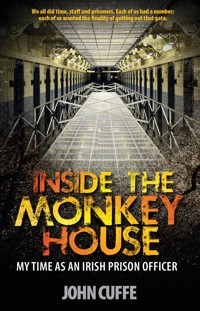
We all did time, staff and prisoners. Each of us had a number; each of us wanted the finality of getting out that gate.When John Cuffe entered Mountjoy as a young prison officer in May 1978, he stepped back into Victorian times. He knew nothing about jails, apart from what he had seen in black-and-white films on RTE: 'good' sheriffs and 'bad' hombres. He quickly learned that behind bars there is no black and white: the 'bad' guy often comes in the guise of officialdom. Here, he reveals the raw truth of thirty tough years on the inside. Starting out in Portlaoise, then Europe's top-security prison, he also served in the drug-infested prisoners' Training Unit and witnessed the Spike Island riot. He counted among his charges the IRA kidnappers of Dutchman Tiede Herrema, the gangsters implicated in Veronica Guerin's murder and Dean Lyons, wrongly accused of the 1997 Grangegorman killings.Join him on a vivid, eye-opening journey through the belly of an archaic and chaotic beast. He exposes the secrets behind the prison walls where, forgotten and neglected, the accused and their keepers wrestle for air.
Das E-Book können Sie in Legimi-Apps oder einer beliebigen App lesen, die das folgende Format unterstützen:
Veröffentlichungsjahr: 2017
Ähnliche



















JOHN CUFFE served as a prison officer from 1978 to 2007. Originally from Blacksod Bay in the Mayo Gaeltacht, he now lives in County Meath. He holds postgraduate degrees in crime-related and social issues, and has lectured in Dublin City University. A regular guest in the media as an expert on the criminal psyche and penal system, he has written for The Irish Times and appeared on Morning Ireland, The Ray D’Arcy Show and The Right Hook, among others.
Stay up to date with the author at:
@cuffejohn
To Seamus Carney, Padraig Loftus and Padraig Kavanagh: three teachers who gave me a love for language and history. They brightened many grey days.
And to my wife, Kathleen, for her support and belief.
Contents
Prologue
Introduction
1. Off to Dublin for the Blue
2. The Bog
3. Shanganagh Castle
4. Promotion Premonition
5. Spiked
6. Out of the Fire
7. Sledgehammer
8. Clear Water
9. Break on Through to the Other Side
10. Goodbye to the Hill
11. Tipping Point
12. Knocking on Heaven’s Door
Prologue
It is said that no one truly knows a nation until one has been inside its jails. A nation should not be judged by how it treats its highest citizens, but its lowest ones.
NELSON MANDELA (1918–2013)
A perception exists of the Irish criminal justice system as an unbroken chain, where all the participants work together to ensure its strength and safety. That is risible. The fact is that the Irish criminal justice system is the perfect example of a hierarchy. Sitting atop are bewigged and black-gowned judges and their retinue of tipstaffs, snuff and brandy, and old-world etiquette. Each layer beneath them tries to replicate their status: barristers, solicitors, experts of all hues, including Gardaí and court clerks. At the bottom, vying for air, wrestle the accused and their keepers.
I was one of those keepers for thirty years and this is my story. It is intended neither to slant nor to skew. I tell it as the cards fell: I favour neither prisoner nor employer, workmate nor inmate.
This is the story of John F. Cuffe 02318C.
Introduction
Stone walls do not a prison make, nor iron bars a cage.
RICHARD LOVELACE (1618–58)
No one grows up wanting to be a prison officer. As a kid I wanted to be a fireman, train driver, marine, sailor, submariner or cowboy. Indeed, my years in national school were lived out Moone Boy style: I pretended I was in the US cavalry. In first class I was a private, second class a corporal, third class a sergeant, fourth class a lieutenant, fifth a captain and sixth a general. Then reality and a grey boarding school knocked me for six as the real world intruded.
My exposure to prisons was non-existent. Coming from a west-of-Ireland seaside village, my habitat was lighthouses and fishing boats, sand, sea and rocks. That and emigration. Scenery and beautiful wilderness do not fill the belly or sate the soul. The bit I saw of prisons was via the American cowboy genre shown on RTÉ television, jails with sheriffs, deputies and bad hombres. Occasionally, black-and-white Jimmy Cagney movies showed mean-street stubble and talk from the side of the mouth. All framed within steel bars and sombre wardens.
Even the lightweight Elvis film Jailhouse Rock depicted the warder as cold and uncaring as Elvis at his meanest uttered, ‘Hey, Screw … fill me a can of water,’ proffering his tin mug in the hot jail. I knew a score from my village who joined the lighthouse service, myself included. I knew nobody who joined the prison service. Around 1970 I saw an advertisement in the Irish Press looking for twelve prison warders for Mountjoy. I was neither interested nor motivated.
Note I have used the words prison officer, warder, warden, guard and ‘screw’ to title the job. Prison staff are described by one or other of those titles in the media. Indeed, I have seen articles that used three of those names within the one story. The Evening Herald in March 1988 ran the headline ‘Prison Wardens Threaten Strike’, with the piece continuing, ‘Prison Officers today decided blah-de-blah’ and ending ‘Warders will, however, meet the minister …’ The place of work is itself called everything from prison, jail, nick, slammer, can and gaol to place of detention.
As you travel on my journey you will see me use all those descriptions as the need and context arise. You won’t see me use ‘screw’ because I find it repulsive, and in my thirty years’ service very few prisoners referred to us directly using that title. However, those in the outside world who should have known better have. It’s akin to describing a Garda as a ‘pig’. You wouldn’t do it.
Around 1994 staff from Arbour Hill did a cycle around Ireland to raise funds for a charity. They sought some publicity and sponsorship. The Evening Herald duly obliged with a banner headline ‘Arbour Hill Screws Cycle for Charity’. I rang the editor; he seemed perplexed. ‘Would you describe a guard as a pig?’ I asked. ‘No,’ he replied, and then silence … until finally the penny dropped … oops. You see, people know very little about prisons.
Perceptions are formed often by hearsay or knowledge of a criminal, warder or film. Perceptions are confirmed by the media. A one-time lifer released from Arbour Hill after serving around eight years once surfaced on a number of radio shows. Describing himself as a former armed robber – sexy title and Jesse James connotations – cleverly he left out that he had, in fact, been locked up for murder, as they botched an armed robbery, killing the owner of the would-be robbed store. He then started going around the schools lecturing secondary kids. He regaled them with tales of how he ‘ran the gauntlet’ in Arbour Hill. A younger brother of a colleague of mine arrived home and asked my workmate about the ‘gauntlet’ that the Hill had. Perplexed, my colleague asked the younger brother more.
Apparently the ‘guest armed robber’ told them that the officers in the Hill formed two lines, batons drawn, and the prisoners had to run through the lines as the blows rained down. I did see this once, in an American film where Apaches ran captured US cavalrymen in such a fashion. No officers carried batons in Arbour Hill; there was never a ‘gauntlet’. In the main, the inmates were just compliant sex offenders, many too old and unfit to take two stair steps at a time. What he didn’t tell those kids was that he was involved in the murder of a hard-working storekeeper and that the man was killed in cold blood. Why ruin a good story?
My own kids came home from school in early 2007 with a more fanciful spin from another ex-prisoner doing the school circuit. This ex-prisoner filled them full of multi-channel American Super Max jail rubbish; my son gave me a knowing look, a grin along with a ‘you kept that a secret for a long time, Dad’ kinda thing. I elicited from him a fairy tale of fairly damaging and libellous rubbish, full of fanciful imagery. Yes, you’ve guessed it: another Jesse James.
Where I live there are many prison staff who contribute greatly to the local institutions, be they sporting, housing or charitable committees. Their children attended the same school as mine. I rang the Vice Principal and pointed out the danger of allowing someone into a class like that where those being tarred have neither opportunity nor recourse to defend their good name. After I explained where I was coming from, the Vice Principal agreed with my point of view.
So how does one wind up working in a jail (or gaol) or prison? It’s mostly via a circuitous route. I envy the youth of today in many ways – their style, clothes, modern technology – but I don’t envy the rat race for the jobs, the treadmill that chews them up and spews them out. When I left school around 1970, those that had a moderate education could aspire to a job with the old Posts and Telegraphs as either a clerk or postman; some got jobs in the civil service, where those with brains became Higher Executive Officers (HEOs). The ESB was an outlet especially if you were a good footballer; the Gardaí, the army and the banks took many more.
For those less educationally gifted there were the county council, factories, CIÉ and, of course, the prison service. I myself trained to be a chef and did a City & Guilds catering course in London. A single summer toiling in a sweaty kitchen with a manic chef exorcised the Jamie Oliver in me. A clout across the cheek from the fraught cook belittled and ironically emboldened me to ensure nobody would ever do that to me again. That kitchen literally became too hot to stand. I hated the kitchens, a good cook yes, but a chef, no. My past as a chef would catch up with me in the prison service but more of that anon.
After my cuisine career I applied for many jobs. Despite having honours in English, Irish, History and Geography, failure to pass Maths meant I didn’t have a Leaving Certificate (nor, for the same reason, an Inter Cert). Boldly, I entered mainstream life with the old Primary Certificate. As door after door closed, a clear sense of entrapment entered my life. Blacksod, my home village and the fountain of my youth, became my prison. I started to hate it, with no money, no prospects and no escape.
I had applied for the lighthouse service but got no reply. My mother, in that gentle but steely way of hers, told me that it was time to move on … anywhere. Some lads home from England for Christmas kindly took me back to the English Midlands with them in early January 1973. I still recall getting on the ferry in Dublin port and the dark bay as the ship headed across the channel on that freezing January night. I still remember Liverpool as dawn broke across that city. On the motorway towards the Birmingham area I recall Paddy John Sibby’s Ford Escort from home with its IZ Mayo registration number passing us. It was at that point that I got homesick.
My first job was for a small building firm. I nearly died. In freezing-cold weather, a canal bank too narrow for a digger needed a trench cut in it. We had to light fires to soften the ground. My uncle’s old boots cut the feet off me and I was perpetually hungry and homesick. This was not how it was supposed to be. I ditched the labouring but quickly ran out of money. My mother, my old reliable, wired £20 to me. I applied for a job in a pie factory. The manager, a Northern Irish man, was more interested in my religion. When I said Catholic, a sinking feeling told me I wouldn’t be making pies.
Eventually I got good work. Lockheed AP in Leamington Spa were hiring. I got a job on a line making high-class engine parts. This was a three-man team and the work, though tough, was financially rewarding. Losing an empty wallet with, of all things, just an old grey Irish Provisional Drivers’ licence in it brought me to a police station to enquire whether it had been handed in. It had, and the constable and I got talking. I decided after that I would apply to the various forces in the UK.
Eventually I was accepted by the Heathrow Airport Police, then run by the Hounslow and Middlesex Authority. Later it was subsumed into the London Met. Having signed up and been measured up, I came home for a two-week break before heading to Ryton-on-Dunsmore Police Academy to train. It was the one nearest to me in the Warwick area. Back at home in Blacksod was a letter requesting me to appear in Pembroke Street in Dublin for an interview for the lighthouse service. Initially I had no interest: returning to England was the only show in town. But the weather at home that summer was glorious and it was easy to love the old village again. As the time for returning drew closer, my resolve was tested.
Finally and with great misgiving, I wrote asking the police to defer my training. I was interviewed for the lighthouses and was successful. After training in the Baily Lighthouse, I was unleashed around Ireland’s coast for about four years. With a month on the lighthouse and a month off on leave, rotating across the year, and travel by helicopter, my life with my two fellow keepers was a cross between being a hermit and a member of The Eagles. The extremes were too much. Solitary and wind-lashed but beautiful coastal scenes intermingled with wads of money to squander in the downtime. I burned the candle at both ends, returning to the lighthouse to recuperate and top up the tan in summer. The nightly music from the then Red Island Holiday Village in Skerries, across from Rockabill Lighthouse in County Dublin, my station and home of the tern, tipped me over the edge. I had to get out.
Salvation sailed across the sea on a small yacht. May 1977 was a scorcher. John Boland, a future Government minister, owned a small yacht and was of the habit of calling to the lighthouse during the summers, tying up his small yacht and showing his guests around the rock. We permitted him to climb the cold stairs of the lighthouse where the view stretched across the Irish Sea to the mountains of north Wales and south beyond the Wicklow Hills.
Boland was a gentleman and always brought out three fresh loaves for us, sliced ham, three bottles of beer and the best of all, the Sunday newspapers. I devoured the papers as well as the beer and chunky sandwiches. On the appointments page was an advertisement for 400 prison officers. This was my escape from the rocky lighthouse! Once ashore I applied for the job, was called for an exam – an easy one, I have to say – and then an interview. To ensure that I didn’t miss the boat, metaphorically this time, I resigned from my permanent, pensionable forty-year career as a lighthouse keeper. Whilst I was happy to go, it would be remiss of me not to acknowledge them as excellent employers.
Ahead lay thirty years of a career as a warder. In this book I will refer to various actors and players: ‘the Department’ refers to the Department of Justice; the ‘POA’ is the Prison Officers Association, our union; the ‘IPS’ refers to the Irish Prison Service, domiciled nowhere near a prison and situated in Longford. ‘ACO’ refers to the first senior rank of supervisor in the prison service, called Assistant Chief Officer, a rank I held for about twenty-three years. ‘CO’ refers to the Chief Officer, the fulcrum of the jail: a good one ensured the oil was poured smoothly on the jail gears, a poor one crashed them.
‘The governor’ was nominally in charge of the prison. ‘The Welfare’ was the Welfare and Probation Service. Very few prison staff referred to prisoners as ‘lags’, a few did, guys that were best avoided and generally useless. The more extreme body of prison officers, thankfully counted on a single hand, might refer to prisoners as ‘dirt birds’. Their language tells you what you need to know about them. ‘Time’ referred to the length of the sentence. We all did time, staff and prisoners. Each of us had a number, each wanted the finality of getting out that gate. The ‘Gate’ was just that, but with connotations: coming in could be deflating, leaving was always welcome.
The following chapters tell the story of the young man who left a sedentary village in Ireland’s west, and chart his progress as life and the prison service see him emerge thirty years later – wiser or damaged?
1
Off to Dublin for the Blue
‘Anyone who has been to an English Public School will always feel comparatively at home in prison.’
EVELYN WAUGH (1903–1966)
Despite finishing inside the top eighty out of 3,000 plus in the entrance exam for the Prison Service and completing my medical successfully, it was almost a year before I was called to training. I had given up on the call and was actually about to go to Saudi Arabia with my mother’s cousin who was a roustabout on the oilfields. The proposition was attractive: good money, sun guaranteed and, of course, hard work. I loved the first two and the third held no fear for me.
Then, in early May 1978, a brown envelope arrived for me confirming my call-up and giving me a starting date to report to Mountjoy Jail. I was by then working in Killala, County Mayo, in Asahi, a Japanese company which manufactured, amongst other things, synthetic wool. Asahi was a massive plant, possibly running about a mile and a half in length. The ‘wool’ started life at one end as a highly inflammable and toxic liquid and came out as slightly sweet-smelling warm white wool at the other end. My job, along with three others, was to tamp and seal the boxes at the final stage.
As coincidence would have it, the four of us were hoping to join the prison service. Asahi, though good employers, had a Japanese work ethic where everybody wore the same garb consisting of a two-piece grey canvas uniform with a flat cloth cap. In time the process started to numb us and many of our colleagues. It was pitched at a deceptive speed that looked slow but was in fact relentless, on and on, eternal hell on earth. Today you read of something similar afflicting electronics workers in China. That brown envelope saved me from the ultimate institutional machine, the conveyor-belt factory.
Lesen Sie weiter in der vollständigen Ausgabe!
Lesen Sie weiter in der vollständigen Ausgabe!
Lesen Sie weiter in der vollständigen Ausgabe!
Lesen Sie weiter in der vollständigen Ausgabe!
Lesen Sie weiter in der vollständigen Ausgabe!
Lesen Sie weiter in der vollständigen Ausgabe!
Lesen Sie weiter in der vollständigen Ausgabe!
Lesen Sie weiter in der vollständigen Ausgabe!
Lesen Sie weiter in der vollständigen Ausgabe!
Lesen Sie weiter in der vollständigen Ausgabe!
Lesen Sie weiter in der vollständigen Ausgabe!
Lesen Sie weiter in der vollständigen Ausgabe!
Lesen Sie weiter in der vollständigen Ausgabe!




