


Erhalten Sie Zugang zu diesem und mehr als 300000 Büchern ab EUR 5,99 monatlich.
- Herausgeber: The History Press
- Kategorie: Sachliteratur, Reportagen, Biografien
- Sprache: Englisch
This is the first book to the reveal the complex personality behind the public image that is Ivan Mauger, the dedicated and often ruthlessly efficient speedway multi- World Champion. Driven by uncompromising determination and naked ambition he became, to terrace fans and on-track rivals alike, a virtual sporting automaton. His motorcycle racing achievements - 15 world titles on speedway and long track - are testament to his pursuit of excellence. He elevated a minority sport to a new and higher dimension with professionalism that made him at once envied and feared, admired and hated. And it launched him from the obscurity of his small-town New Zealand origins to worldwide acclaim, which continues to enjoy. Here, renowned speedway historian and journalist John Chaplin reveals, through the words of opponents, friends, enemies, business associated, fans, rivals and his own family, the real Ivan Mauger... the man behind the myth.
Sie lesen das E-Book in den Legimi-Apps auf:
Seitenzahl: 351
Veröffentlichungsjahr: 2012
Das E-Book (TTS) können Sie hören im Abo „Legimi Premium” in Legimi-Apps auf:
Ähnliche



















For my dear and fun-loving Tilly, my Aunt Hilda, who is in her 100th year. I only hope I’ve inherited her genes!
“I never set out to be unpopular, but if winning is unpopular I would take winning every time.”
Ivan Mauger, World Speedway Champion1968, 1969, 1970, 1972, 1977, 1979
“Charm is scarcely the prerequisite of champions.”
Ian Wooldridge, award winning sports journalist, Daily Mail
“To be … a World Champion you have to be extremely ruthless and determined. It is a very dangerous, very difficult, very tough job, and that degree of ruthlessness has to be there and sometimes it shows itself.”
Max Mosley, former president of the Fédération Internationale de l’Automobile (FIA), motor sport’s governing body
Acknowledgements
I am grateful to all these people for their assistance and also in obtaining illustrations:
Bob Andrews, Robert Bamford, Jim Blanchard, Neil Burston, Alan Clark, Scott Dalosio, Brian Darby, Jeff Davies, Eddie Garvey, Bert Harkins, Ron Harper, Jim Henry, John Hipkiss, Tracy Holmes, Mike Hunter, Norman Jacobs, Mike Kemp, Bruce Kent, Dave Lanning, Steve Luxton, Tony Macdonald, Debbie Mauger, Bill Meyer, Jarek Pabijan, Mike Patrick, Bruce Penhall Museum, Ian Presslie, Deborah Sigalos, John Somerville, Barry Stephenson, Ray Wilson.
The author also wishes to place on record his appreciation to Michelle Tilling of The History Press for her patience and forbearance during the preparation of this book.
Contents
Title
Dedication
Quotes
Acknowledgements
Introduction
Foreword by Martin Rogers
Richard Bott
John Cook
Pete Smith
Bob Dugard
Chum Taylor
Brian Havelock
Con Migro
Mike Lee
Jason Crump
Phil Crump
Neil Street
Ronnie Moore MBE
Tony ‘Hawkeye’ Hurren
Richard Clark
Ian Belcher
Guy Allott
Barry Briggs
Tony Briggs
Ken Wrench
George Major
Debbie Pritchard (née Mauger)
Armando Castagna
Ray Wilson
Freddie Williams
Norrie Allan
Gordon Stobbs
Margaret Stobbs
Brad Oxley
Jim MacMillan
Peter White
Julie Mauger
Mark and Bernard Robinson
Colin Pratt
Dave Appleton, HMP Stafford
Tony Lethbridge
Ove Fundin
Joe Owen
Leigh Adams
Trevor Mauger
Bob Andrews
Peter Oakes
Pam Oakes
John Berry
Hans Nielsen
Deborah and Dennis Sigalos
John Davis
Bill Walsh
Kelly Moran
Ole Olsen
Peggy Crozier
Scott Autrey
Philip Rising
Len & Andrew Silver
Tony Olsson
Anders Michanek
Jim Hone
Mike Bast
Doug Wyer
Mark Loram
Malcolm Roe
Carl Askew
Reg Fearman
Egon Muller
Jim Lynch
Graham Drury
Gunter Sorber
Bert Harkins
Bill Elliott
Nigel and Cynthia Boocock
Eric Boocock
Malcolm Simmons
Nigel Pearson
Bruce Penhall
Tore Kittilsen
Dave Lanning
Jerzy Szczakiel
Jim Shepherd
‘Sudden’ Sam Ermolenko
Peter Adams
Peter Collins MBE
Peter York
Richard Greer
Rick Miller
Richard Frost
Tony Rickardsson
Rod Colquhoun
Dave Gifford
Bill Gilliham
Iain Potter
Brett Tucker
Nigel Bower
Allen Trump
Alan Brett
Tony Steele
Allan Batt
Ian Hoskins
Dave Jessup
Graham Brodie
Tracy Holmes
Chris Morton MBE
Kelvin Tatum MBE
John Burley
Bengt Jansson
Trevor Hedge
Gareth Rogers
Alan Hunt
Bernie Leigh
Ronnie Allan
Vaclav Verner
Mike Patrick
Wilfried Drygala
Neil Evitts
Mike Hunter
John Davidson
Raye Mauger
The Statistics
Plates
About the Author
By the Same Author
Copyright
Introduction
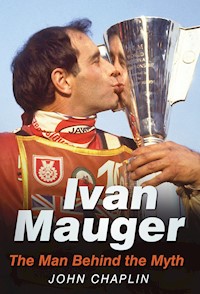
When contemplating writing this book, The Man Behind Myth, I first had to contend with … Ivan Mauger. He wasn’t too keen on the title for a start, because ‘everything I have ever done is out there for everyone to see’. And he had positive ideas about what illustration should appear on the cover.
Because of his reputation – sometimes fearsome – I thought it would be an interesting exercise to try to find a definition of the word Mauger. In Webster’s Unabridged Dictionary there is this:
Mau´ger: In spite of; in opposition to.
… and in the Complete Oxford English Dictionary:
maugre, mauger: ill will; from Old French maugre, literally: bad pleasure
There have also been literary quotations about the name. For instance:
Of which maid anon, maugree hir heed
By very force, he raft hire maydenhed
That is from Chaucer’s The Wife of Bath’s Tale. (It doesn’t bear thinking about, does it? Because it is well known how saucy Chaucer can be). Even Shakespeare was moved to write, ‘This mauger all the world will I keep safe.’
All of which, thinking about it, pretty well covers the contrasting and contradictory personality with which speedway and the rest of the sporting world has had to deal.
That being so, one of the difficult aspects of this project was gathering material and persuading people to tell me things. There were many, many people within the speedway world, and also many without it, who were ready and eager to praise the man who, at his best, like Caesar, emperor-like, bestrode the sport.
There were also many others who came to bury him, not to praise him. As with Shakespeare’s Caesar, the knives came out and some spat venom at the very mention of his name. So … no change there then.
But the really difficult part was selecting what to include and what, regrettably, had to be left on the cutting room floor through a restriction on the number of words. So, my apologies to those who patiently put up with my persistence and answered my requests, only to find that their contribution is not here.
Ivan Mauger is a sporting icon about whom there seems to be nothing equivocal. You love him, respect him, admire him maybe … or you hate him, despise him perhaps. It’s all there in black and white, like his trademark chequered helmet and saddle and the whimsical chequered bow tie he wears on special occasions, betraying that there is, lurking beneath the sometimes dour exterior, an impish and sly sense of humour.
Question: ‘Where did you get that chequered bow tie, Ivan?’
Answer: ‘I had it specially made.’
That is the essential Ivan Mauger. It is perhaps only a minor detail, minuscule even, but he knows what he wants and, by giving his attention to such minuscule details, he not only goes out to get what he wants, he does get what he wants. Mostly by fair means.
The specially made bow tie.
By that I do not mean to imply Ivan Mauger did not adhere meticulously to the highest sporting traditions and the regulations as laid down in the speedway rule book. I can only relate an incident when one well-known and established international speedway star took an interest in the progress being made by my son Christopher, who was at the time in the Hackney junior team.
‘You’ve got to cheat at the gate,’ he told Christopher, who replied, ‘I don’t want to do that.’
‘Why not?’ said the well-known and established international speedway star, ‘everyone else does.’
In this attempt to reveal the man behind the myth there are a myriad examples, such as the bow tie incident, of the dedication, determination and attention to detail that has made Ivan Mauger unique within his chosen sport. There are two that for me really illuminate his true character. The first is a story told by my journalistic friend Richard Bott.
Ivan, said Richard, was a showman with a collection of multi-coloured leathers. But for the Wembley World Final in 1972, the master tactician wore an old pair of jet black leathers bought second-hand from former British Champion Eric Boocock some six years before. Why?
‘When I go to a World Final,’ Ivan explained, ‘I go to score 15 points – not to look spectacular or entertain. Normally, with my brightly coloured leathers, my rivals only have to glance to know where I am. Black leathers are less conspicuous.’
In those black leathers, he said, he ‘looked like a Russian’. Now there were six Russians in the 1972 Final, but none rated as a possible World Champion, so there was a good chance his rivals would not consider another rider in black leathers a threat, and it would then be easy for the ‘other’ man in black to make the most of such a cunning strategy. The disguise appears to have worked – it was Ivan’s fourth title win in five years.
But it didn’t put Ivan off. He was determined to honour his commitment to his trainees and, with a makeshift snow shovel, set about leading a team of volunteers to clear enough snow to get bikes on the track. In less than two hours the track was fit to ride on and training went ahead.
I have to confess that, right from the start of this project, Ivan was extremely co-operative. He supplied a comprehensive list of 92 contacts, not all of whom responded to my requests for contributions which, naturally, was only to be expected.
It was not always a pleasant or straightforward task. In one instance I was even threatened, by a person who knows Ivan well, with action (what sort was not specified) if I so much as mentioned his name in the book. By no stretch of the imagination could he be described as an Ivan Mauger fan – and he knows who he is. There have been many others, of course, from high-powered officials in the Fédération Internationale de Motocyclisme (FIM) to racing rivals, business associates, speedway promoters, team managers, referees, team-mates, mechanics and journalists, right down to the ordinary terrace fans, one of whom wrote to me from one of Her Majesty’s Prisons, who have been only too willing to tell their tales, stories, anecdotes and reveal their memories – not in every case complimentary.
Speedway has held me enraptured since my schooldays in 1946. But I first became aware of the name Ivan Mauger during his ‘second coming’ in the early 1960s which coincided with a period when I was not able to see speedway often because I was on the staff of a national morning paper. It meant working mostly at night when speedway meetings took place and I couldn’t get there.
The sport had gone through one of its periodic attempted suicides but, phoenix-like, had then risen from the ashes of the blazing dispute between the Establishment, the Speedway Control Board (SCB), with its old ‘legitimate’ National League, and the ‘pirate’ Provincial League headed by that speedway buccaneer Mike Parker. The result was the new British League and the name I kept reading about, who seemed to be generating all the headlines and hogging the limelight, was Ivan Mauger.
Throughout my 65-year association with the sport of speedway racing I have always been careful never to become close to any rider. Maybe you have heard the old hackneyed rhyme about newspaper hacks: ‘You cannot hope to bribe or twist, thank God, the British journalist. But seeing what the man will do unbribed, there’s no occasion to.’ Well, I did not wish to be accused of that. I did not want to have my ability to do my job – to report objectively on speedway, and the people in it – compromised.
I was severely tempted when I met Ivan at Coventry in August 2011. I had arranged to give him a special audio tape I’d made of historic speedway moments. I had discovered that his interest in the history of the sport is just as keen as mine. At the same time I wanted to buy a copy of his new autobiography The Will To Win. At first neither Ivan nor his wife Raye wanted to take the £20 note I offered. But I insisted and said, ‘If I don’t buy a copy I’ll be compromised.’
Then I reminded him of the night in 1979 when we were all sitting in the stand at Hackney watching a meeting. My first book on speedway, The Story of the World Championship, had just been published and Ivan said to me, ‘I’ve just bought a copy of your book.’
Flattered, I said, ‘Oh, if I’d known you wanted one I’d have brought one and given it to you.’
‘No.’ he said. ‘You can’t write books and not have people pay you for them.’
I’d turned the tables on Ivan Mauger. So I asked him if he remembered that incident at Hackney. He hesitated momentarily, then said he did. And, as I knew he would, he then accepted my proffered £20 note, immediately handing me the exact one pound and a penny change.
Astute … and organised, that’s Ivan Mauger. But here, I should confess that on one occasion I was a guest of Ivan and Mrs Mauger – Raye – at their waterside home at Runaway Bay on Australia’s Gold Coast. They are extremely kind, generous and entertaining hosts. I have stood beneath the crystal chandeliers, admired the glass cases full of FIM gold medals, touched the Gold Bike and sailed with Cap’n Ivan on his impressive boat – a Monaco-style yacht more like. We spent an evening discussing the sport and he invited me to go through his collection of speedway photographs.
So I think I know ‘Ivan the Terrible’ well enough having experienced him in his Jekyll and Hyde environments – at home, and at speedway tracks in various parts of the world over many years.
The Man in Black … Ivan and Raye, Wembley 1972.
I have seen Ivan Mauger lose his temper only once. It was at one of his training schools on a miserable winter’s day in Scunthorpe. Ivan had told the trainees that no one should go out onto the track until he said so, and one of them, full of youthful enthusiasm, disobeyed him to go roaring off on his own. When the lad returned to the pits he was met with a thunderous reprimand from Ivan, which I’m sure he remembers to this day. It was the only time I have ever heard Ivan raise his voice in anger.
You cannot mention Ivan Mauger without also acknowledging the woman behind the myth, Sarah Raye Mauger, who is English – born in Carlisle. ‘A very clever woman’, according to their great friend and rival, the triple World Champion Ole Olsen. She has always been steadfast in her belief in, and support for, Ivan during even the darkest of their days – and there have been some very dark days.
Raye has been kind enough to contribute to this book, ‘Change grammar, errors and condense it if you so wish. Please let me see how much you will use, etc. before I rubber-stamp it. I wish you all the best in your endeavour with your book, and that it may be a great success.’ I did what she asked and, apart from the odd comma or two, I changed nothing because it was just not necessary.
Raye wrote, ‘Everybody has their own idea about the identity of the “real” Ivan Mauger.’
I am not sure whether Ivan and Raye will unequivocally enjoy reading every one of those ideas reported within these pages. Most they will. And, well, here they are …
John Chaplin, 2012
Foreword
by Martin Rogers
‘Tough, ice-cool, obsessive … Yes, but now he’s let down his guard – the twinkle in his eye is the giveaway.’
Former speedway promoter, international journalist and the co-author of Ivan Mauger’s autobiography, The Will To Win.
Not a lot of people know this, but Ivan Mauger OBE MBE and speedway’s all-time most decorated rider is a funny guy. He has a keen sense of humour, doesn’t take himself half as seriously as his long-time image suggests, loves 1960s and ’70s music, is the identikit type of sports nut for whom cable television might have been invented, and knows his way around a good wine list and a cordon bleu menu.
Rogers: in on the joke.
If a quarter of a century of professional excellence still defines the essence of the man, the past 25 years have coincided with a personality makeover of surprising proportions. During his years of world domination Ivan certainly wasn’t the most approachable character. He could, and routinely did, win almost everything – except popularity contests.
There is something about being outstandingly good at your chosen speciality which can be terribly daunting to mere mortals; and that, of course, was part of his game plan. He never has suffered fools gladly, for a long time was intensely suspicious of the motives of people who sought to get close to him, and he certainly didn’t allow many of his contemporaries a great deal of insight into his inner workings. ‘I didn’t care if people liked me,’ he said. ‘If you want to win races and titles, it’s no bad thing if opponents feel a bit intimidated.’
For all that, like him or not, few speedway folk have given Ivan anything less than the respect his stunning consistency warranted. And, since he packed away his competitive on-track urges for the last time, many have come to view him in a much more sympathetic light, to bathe in the warmth of his company. In numerous unsung instances, folk have had reason to be grateful for the sensitivity with which he and his wife Raye have given their time, support and consideration.
Former rivals fallen upon hard times, in poor health, dire financial straits, or other misfortune have benefited from acts of generosity and understanding, none of which sought or indeed received what would have been entirely justifiable publicity. All the stuff that made the headlines has been faithfully recorded, but what separated Ivan from most of the riders up to and beyond his retirement was an approach which gave new meaning to the term ‘professionalism’.
The Giveaway …
An almost ascetic lifestyle, a tough training regime, attention to dietary details, an ice-cool temperament, a quest for mechanical perfection bordering upon the obsessive – it’s pretty standard stuff for today’s Grand Prix giants but was confrontational and far from the usual back in the 1960s and ’70s.
When he trained with Manchester City Football Club, for example, Ivan wanted to do what the footballers did; when he contested the made-for-television Superstars show he amazed onlookers with the intensity of his physical effort. Borrowing something from the British public school ethos, he prefaced major championship meetings by taking a freezing shower minutes before the tapes went up – to concentrate the mind and sharpen the senses, he said.
To witness him these days in the company of a Barry Briggs, Ove Fundin or Ole Olsen, yarning and finding hidden humour in those super-competitive days of old, is to see a man quietly amused by the memory of how intensely serious it all was way back when. It’s been a different deal since he settled on Queensland’s sun-drenched Gold Coast in 1987, with the water lapping at the back door, the ocean a 5-minute boat or jetski ride away, family members dotted around adjacent suburbs.
In retirement, while rarely inactive, and still in love with speedway and his contacts in the sport, Ivan at last has let down his guard and allowed the lighter side of his personality to shine through. After decades of eating on the run (albeit healthily) he now values the opportunity to sit down and enjoy the simple pleasures of a good meal and a glass or two, an indulgence sporting jetsetters rarely manage to savour. If he can get to watch his beloved All Blacks win, it’s a perfect day, not that Ivan’s interests begin and end with the game closest to the heart of most New Zealanders – he takes a keen interest in cricket and rugby league, as any bona fide resident of Australia must, and is most entertaining when he volunteers his own highly personal analysis of what’s what.
Impressively though, this isn’t an old soldier gone to seed. He still cuts a neat, trim figure and – especially since at last finding the time to have an operation on an ankle he smashed in a long track crash a mere 28 years ago – scurries around with as much sense of purpose and enthusiasm as a man half his age.
Just because he’s Ivan Mauger there remain those in awe of his reputation who won’t ever allow themselves to succumb to a charm offensive. For them he’s still the hard-nosed, steely-eyed superstar who lives in his own personal bubble. To know him, which has been a pleasure and a privilege for many years and especially so since he laid out the welcome mat for my wife Lin and I as new arrivals in Australia in 1988, is to be in on the joke. The twinkle in the eye gives it away.
Richard Bott
‘If he lost a race it was never his fault. He was convinced he was the best.’
Distinguished sports journalist, author and friend of Ivan Mauger
As far as I’m concerned, Ivan is the guv’nor. Maybe not the most exciting rider to watch: that is, not a true racer like PC (Peter Collins) or Peter Craven, but unquestionably the most professional, most committed and ambitious rider I have ever seen.
Bott: Good fortune.
They say ‘Once a World Champion, always a World Champion’ and some of Ivan’s contemporaries were happy with that. Not Ivan.
He wasn’t satisfied until he beat Ove Fundin’s record of five solo world titles and if he had known Tony Rickardsson was going to come along and equal his own record, he would have made sure he won a seventh.
As it was, he won nine solo world titles and six more in team or pairs and rode in a record 52 World Finals. I saw him quoted once as saying, ‘The only title worth winning is the world title’, but he won everything else bar the National Lottery.
We first met back in the mid-1960s when I was doing speedway for the Daily Mail and he was riding for Newcastle. He was working on his bikes in a workshop in Mike Parker’s house in Upper Chorlton Road, Manchester, and I don’t think he stopped working throughout the interview.
The determination he showed in coming to England as a newlywed and virtually penniless 17-year-old, and again after failing to make a go of British speedway the first time, established his strength of character and ambition. Ivan changed the face of world speedway. He helped to get rid of its grease-monkey, Hell’s Angels image because he introduced coloured leathers and because he was smart and articulate. Above all, he was a brilliant motorcyclist and a born winner.
He was a brilliant gater. He knew that whether races were started at the drop of a flag, with an elastic band or whatever, his reflexes were better than most. And he developed his fearless ‘death dive’ into the first turn. For me, Ivan’s greatest strength was his self-belief. If he lost a race or a World Final, it was never his fault. It was either down to a mechanical failure, the track conditions or sheer bad luck. He was convinced he was the best. He knew every trick in the book and a few others besides. He was a master when it came to gamesmanship and kidology. There were times when he was utterly ruthless – another characteristic of a true champion.
Ivan helped develop emerging talents such as Ole Olsen and Peter Collins, but if they got in his way on the track, heaven help them. I never took much notice of the second-half races when I was covering Belle Vue’s home meetings for the Manchester Evening News, but it was Ivan who insisted I forget my interviews in the pits to take a look at the teenage Peter Collins. Ivan knew PC had the makings of a World Champion, even at 16. Just like himself.
The Guv’nor in action for Newcastle.
PC’s greatest day was winning the world title in Katowice in 1976 but his greatest achievement was finishing runner-up in the wet in Gothenburg the following year, a week after having a leg almost severed by hitting a drain cover at Belle Vue. A few weeks earlier, when PC won the Inter-Continental Final at White City and Ivan struggled to qualify for Gothenburg, the guv’nor played a psychological card. He sowed a few seeds of doubt in Peter’s mind when he said, ‘Well done, Peter, but remember we both start equal in the World Final.’ As it happened, they didn’t, because of PC’s injuries, and after Ivan’s victory in Sweden, PC told him he had been lucky because he could have been excluded in his race (the controversial Heat 18) with Ole Olsen.
Ivan said, ‘If you’ve got the time, I’ll tell you about all the titles I would have won if I hadn’t been unlucky – including last year in Poland.’
Ivan’s durability was incredible. He knew he wasn’t top of the pops, but he was top of the charts and he stayed there, continually confounding his critics. His then record-breaking sixth world title in 1979, just ahead of his 40th birthday, was another reward for his skill and dedication. It probably ranked alongside his first world title and his third, when he proved the Poles were not unbeatable on their own tracks. And he turned average teams into championship-winning sides with his attention to detail and leadership.
I had the good fortune to work with him regularly from a journalistic point of view for five years, at Belle Vue, Hull and when he was involved in the indoor meetings at Wembley. I also had the privilege of editing the brochure for his 30-year World Jubilee Series. Our paths have not crossed since I saw him at [Belle Vue boss] Jack Fearnley’s funeral in Southport several years ago and feel guilty I didn’t drop in on him on Australia’s Gold Coast when I was covering the 2008 Rugby League World Cup.
Ivan and his wife Raye came to my wedding 36 years ago and we still exchange Christmas cards. There have been some great World Champions in speedway. And three of them came from the same city in New Zealand. But there is only one Ivan Mauger. The Guv’nor.
John Cook
‘I was left with my panties round my ankles. We were just kids and we weren’t put under Ivan’s wing at Hull’
Master entertainer, American international and World Finalist
As a teenager I looked up to Ivan and the next thing I knew I was on the same team as him at Hull, along with Ian Thomas and Brian Larner. It was probably one of the best things for me because it was a hard time. There was Shawn [Moran] and me in the same team together and he got sold to Sheffield halfway through the season. I was left with my panties round my ankles. I was just a 19- or 20-year-old kid from California.
When Peter Collins won the World Final I was just an average fan of speedway. Not too many people in America know what speedway is even today. If you mention speedway they think you’re an Indycar driver. I got into it in the 1970s.
We did a tour down in New Zealand and I kind of got pretty close to the family. Raye got me my birthday present down there and she’s a little sweetheart of a person. He’s a different person, like we all are when we’ve got our helmets on. He was a real gentleman and a real grandfather.
That first year at Hull was really hard for me. I was surprised that Ian and Brian didn’t put Shawn and me under Ivan’s wing a bit and kind of give us a hand because we were blind. I had some mechanical knowledge. I knew how to work those JAWAs – Shawn knew a little bit – but the weapon of choice was the Weslake push rod. Kelly [Moran] was a different story. Put him on anything … but I wasn’t as talented as those two. Shawn and Kelly were a lot more talented and I just had to work harder.
Cool master entertainer …
… on the gas.
Pete Smith
‘He’s a really, really good ambassador for the sport.’
Former Poole captain and English international
To be honest with you, during the time when I was with Ivan and rode against him he was the most professional bloke I ever met, and he brought to my attention a lot of things in reference to how he prepared his bikes, his set-ups. I’ve seen him run last in a race in a World Championship, he’d come in, sit down, check everything and then go out and win the next four races. Absolutely brilliant.
I think one of the best things I remember about him was when I guested for Belle Vue in about 1972 and I won a couple of rides then my bike blew in my third. He came across to me and said, ‘What’s the problem?’ I said, ‘The rocker’s gone.’ And he said, ‘Right, don’t bother with that, borrow one of mine. Do what you like with it – change the handlebars or whatever. It’s more important for me to make sure Belle Vue win.’ And we did win.
I rode his bike and did very well on it. Come the second half and we got into the final and he says to me, ‘That bike’s going too good. Can we change bikes?’ So we did and we had a race in the final and he beat me by about half a tyre on the line. Fantastic.
The guy’s totally professional and a fantastic ambassador for speedway, in my opinion. A really, really good one. He was never secretive. He would always talk to you. Among the things he told me were 1) whenever you go to a track find out how they do it and ride it in your head. And 2) whenever you go to Poland always take a Mars bar and don’t eat their food.
Bob Dugard
‘His bike was a load of rubbish.’
Wimbledon, West Ham, promoter at Oxford and London White City who inherited the family track at Eastbourne
I can recall very vividly when Ivan came down to Eastbourne. He’d virtually been thrown out of Wimbledon, and my father [Charlie Dugard] took a liking to him. I’m sure Ivan will confirm it – when he arrived his bike was a load of rubbish and my father had to do the timing for him. He only had a pencil on him to measure it but he was very good with engines so he set Ivan’s timing up for him and he was a much improved rider. He progressed enormously from there and went from being totally unknown to being the most outstanding rider in the league [which the magazines of the day called the Junior League].
Self-assured: Ivan at Eastbourne.
Ivan was always very self-assured and incredibly focussed, but also very pleasant with it. I know he had a reputation for being a bit bolshie, but he was never like that with us.
Chum Taylor
‘A World Champion walked in my shoes.’
Australian multi-international and World Finalist
I am 84 now and it’s over 40 years since I gave up speedway, but I still have a few memories of Ivan. It was in the late 1950s, about 1958, that I was riding for Southampton at Wimbledon. I was in the pits early doing a few things to my bike when Ivan walked up and we started to chat. I said to Ivan, ‘How are you going?’ and he replied, ‘Not so good. Ronnie Greene won’t give me enough rides.’ He then asked me how he should ride the track. I told him to watch the top riders. At the time he was cleaning the stadium.
After I came home to Perth I kept riding at Claremont and Bunbury, a country track. By this time Ivan had really got going, winning a World Championship and was one of the greats of speedway. He was booked in for Claremont for the Friday night and Bunbury for Saturday night. I had the same bookings. At Bunbury the lord mayor was putting on a reception for Ivan and some of the riders. I arrived at the town hall and met up with Ivan who was a bit upset. He said he had left his good shoes at home and didn’t know what to do.
I said I had a pair of work shoes in the back of my car, so I got them out and they were a good fit, so after a bit of spit and polish Ivan wore them to the reception. It’s the first time I have had a World Champion walk in my shoes.
I would like to say this about Ivan: he was the most dedicated rider I have ever met and he is a true champion of speedway.
Brian Havelock
‘Ivan wants to be in on the scene.’
Former rider, Redcar team manager and father of 1992 World Champion Gary Havelock
He was secretive as far as the top guys were concerned. But anyone at the bottom end of the team who wanted to learn, such as me who was coming in as a raw rookie, then he would pass on information because he wanted the team to win. I mean, anybody does in their right mind.
Gary didn’t have much to do with him, though Ivan was sniffing around when Gary won the World Championship – but that’s Ivan, he wants to be in on the scene. But he didn’t make us an offer. We never asked him to. We thought that if Gary and me had got that far we could get that bit further. … He just said ‘if you need any help get back to me.’
He’s very much like Briggo [Barry Briggs]. Whatever they can get out of the sport now is an absolute bonus to them.
Con Migro
‘He raced with me for just a handshake, but when the heat was on, Sprouts got serious.’
Known to Australians as Mr Speedway, Perth-based former leading promoter and veteran speedway commentator
I fondly remember he would come to the now-defunct Claremont track to do a media day. Most times it was 100 degrees. When the media stuff was completed for me he would settle down to do serious practice. When I mean serious practice, he would bring to the track at least six rear wheels all fitted with gearing he thought he needed.
He’d bring an extra 50 engine and rear-wheel sprockets and use the lot of them. WOW!
I remember saying to him many times, ‘Sprouts [his nickname], you don’t have to wear yourself out doing all this practice.’ He would turn to me and say, ‘You might be right, Con, but on Friday night when we race I will know every inch of this track. In other words there will be no place that will frighten me if I have to ride or avoid a prang.’
What I loved most about dealing with him: his word was his bond. You know, each time he raced for me I never had a signed contract, only a handshake. Or my word and his over the phone. Can you imagine doing business like that today with the top line racers? No matter what discipline they race in. One in a million! His wife Raye is a wonderful woman.
Mike Lee
‘A totally respected rival.’
Speedway World Champion 1980; Long Track World Champion 1981; World Team Champion 1977, 1980; British Champion 1977, 1978
He was always someone I looked up to when I raced and you base yourself on that to get to the top. A great guy, dedicated to speedway, and this dedication in my opinion was what gave him the achievements. I didn’t have close contact with him as a friend it was more as a rider, but a totally respected rival. He was one of the guys I always struggled to beat, to be honest.
Lee posing for the press at Wembley.
Mike Lee, the World Champion at Gothenburg, 1980.
Jason Crump
‘I’d love to know the real man.’
Speedway World Champion 2004, 2006, 2009; World Team Champion 1999, 2001, 2002; World Under-21 Champion 1995; Australian Champion 1995, 2007
Not thatmany people know the real Ivan Mauger. Raye knows the real Ivan Mauger – I would say about as much as anyone in speedway knows him. But I would love to be able to know the real man because he has such values as far as families are concerned. What he did with family was pretty amazing when you consider all the years ago that it happened. It’s something that my wife and I try to do with our kids. We take our kids everywhere.
Crump conference: Neil Street (left), Jason and Phil.
I can give you an example. At the end of 2006 I was honoured by the Gold Coast City Council; Ivan was a very big part of that whole thing and we were to go out for a dinner with the Mayor of the Gold Coast, Mr Ron Clarke, the former Olympic athlete. They said that the dinner was for adults only: there were no children. And when Ivan told me on the phone I said to him, ‘Well, I’m sorry I can’t make it. I can’t go if there are no children allowed.’
And he said, ‘Bloody right. That’s exactly the same answer I would have given. Bring your kids.’
Phil Crump
Speedway World No. 3, 1976 and father of Jason Crump
I get on with Ivan good. I’ve got a house close to him in Australia. Probably about 5 or 6 kilometres apart, and I see quite a lot of him when we’re in Australia. To be honest I didn’t have very much to do with Ivan when I was racing. I rode in his tours in Australia and he was always very good to me. When I was racing in England I had very, very little to do with him. Every year now, when we go back to Australia, we have a couple of barbies around Christmas and stuff. We’ve found him a very good host. We go out on his boat with him.
Neil Street
Developer of the SR4 (Street Racing Four-Valve) speedway engine, former international rider and Australian World Cup winning team manager, Jason’s grandfather and Phil’s father-in-law. Neil died in October 2011, aged 80.
Don’t talk to me about Ivan Mauger … he is no friend of mine!
Ronnie Moore MBE
‘Ivan saved my life.’
Speedway World Champion 1954, 1959; World Pairs Champion 1970 with Ivan Mauger; New Zealand Champion 1956, 1962, 1968, 1969.
Ivan saved my life when I had the bad crash in Newcastle in 1975. He did a lap back to where I lay, and pushed the track staff out of the way because they were trying to get my helmet off without undoing the strap. He took off my helmet, pulled out my tongue which I had choked on and held my head in his lap till the ambulance arrived.
Ronnie Moore and the man who ‘kept him in this world’.
Champions’ conference: Ronnie (centre) flanked by Barry Briggs (right) and on the left Jack Young.
After the meeting he and Barry [Briggs] rushed to the hospital to be informed I was as good as dead, and there was nothing they could do. Ivan arranged an ambulance and two police escorts and a mad dash to North Shore Hospital in Sydney, where they put a drill through my head, and that started getting things beating again.
Naturally I knew nothing about this as I was in a coma for a long while.
A couple of months later I was flown home to Christchurch and into the hospital there. After two weeks I discharged myself because I had had enough of hospitals. My left ear was shattered and my right ear took two operations to get a little hearing back, but that was my balanced stuffed.
A year later Ivan flew me to Newcastle for the same meeting so I could walk into the centre green and let the people see me moving. By asking a lot of people I found out all that Ivan had done to keep me in this world.
I was flown over to Aussie for the speedway veterans’ dinner in Sydney after Ivan said I had better get up to his place in Surfers Paradise because the Indy cars were going to race through the streets.
A couple of days later he drove me up to Brisbane to catch a plane home, I got out of his car and said thanks, but he got out and gave me one hell of a hug that brought tears to my eyes. Since the crash I have seen the other side of Ivan that most people don’t realise is there.
Tony ‘Hawkeye’ Hurren
‘The name game.’
Prolific and opinionated contributor to the Hackney speedway programmes
I clearly remember one night at Hackney. A group of four or five people were speaking to Ivan in a jocular fashion about Wimbledon promoter Ronnie Greene’s pronunciation of his name. Greene, of course, always referred to him as Ivan ‘Mawger’.
Hackney announcer Terry Ripo was in the office at the time and said to Mauger, ‘How do you pronounce your name?’ Mauger wasn’t too amused and said words to the effect, ‘What business is it of yours?’
Ripo then explained that he was in fact the announcer, and Mauger promptly told him the correct pronunciation.




