


Erhalten Sie Zugang zu diesem und mehr als 300000 Büchern ab EUR 5,99 monatlich.
- Herausgeber: Jonathan Ball
- Kategorie: Sachliteratur, Reportagen, Biografien
- Sprache: Englisch
Jan Smuts: Unafraid of Greatness is a re-examination of the life and thoughts of Jan Smuts. It is intended to remind a contemporary readership of the remarkable achievements of this impressive soldier-statesman. The author, a former editor of The Star, argues that Smut's role in the creation of modern South Africa should never be forgotten, not least because of his lifetime of devoted service to this country. The book draws a parallel between Smuts and President Thabo Mbeki, both architects of a new South Africa, much lionised abroad yet often distrusted at home. This highly readable account of Smut's eventful life blends fact, anecdote and opinion in an examination of his complex character, his relationships with women, spiritual and intellectual life and role as advisor to world leaders. Politics and international affairs receive the most attention, but Smut's unique contributions in a variety of other fields, including botany, conservation and philosophy, also receive attention. Jan Smuts: Unafraid of Greatness does not shy away from the contradictions of its subject. Smuts was one of the architects of the United Nations and a great champion of human rights, yet he could not come to terms with the need to include the African majority in the politics of his own country.
Sie lesen das E-Book in den Legimi-Apps auf:
Seitenzahl: 475
Veröffentlichungsjahr: 2015
Das E-Book (TTS) können Sie hören im Abo „Legimi Premium” in Legimi-Apps auf:
Ähnliche


















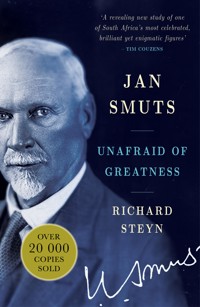
Jan Smuts: portrait by JK de Vries, 1947.Museum Africa, Johannesburg
Jan Smuts
Unafraid of Greatness
Richard Steyn
Jonathan Ball Publishers
Johannesburg & Cape Town
… be not afraid of greatness. Some are born great, some achieve greatness, and some have greatness thrust upon ’em.
Twelfth Night
William Shakespeare
To Elizabeth, and our children, and their children.
Contents
Preface
Author’s Note
Prologue
PART ONE Life and Times
1. ‘Totsiens, Oubaas’
2. A Queer Fellow
3. Bursting with Idealism
4. Boer Strategist
5. Fighting the British
6. Aftermath
7. Nation Builder
8. Rebellion
9. On Britain’s Side
10. ‘On Service for Humanity’
11. Losing the Peace
12. A Reluctant Prime Minister
13. Model of Restraint
14. Achieving the Unthinkable
15. War Leader
16. ‘We, the United Nations’
17. A Year of Sadness
18. Last Climb
PART TWO The Man
19. Forged from Steel
20. ‘A Refuge for Stoics’
21. At Ease with Women
22. Finding Order in Complexity
23. ‘Our Wisest Ecologist’
24. An Uncertain Trumpet
25. Counsellor to Kings
26. Envoi
Notes
Select Bibliography
Acknowledgements
About the Book
About the Author
Copyright
PREFACE
When I let slip to a friend, an academic of renown, that I had always been fascinated by Jan Smuts and was contemplating a new study of him because so few young people seem aware of his influence on the country we live in, he replied that I could bury myself in research for the next few years and produce a thick tome that would gather dust on shelves, or write a shorter and less daunting book that busy people like himself might be tempted to read. I have tried to follow his advice.
For a relatively young nation, remote from the centres of world affairs, South Africa has thrown up a remarkable assortment of exceptional, larger-than-life characters – some admirable, others much less so. They are the products of a turbulent history of some 350 years of wars, both tribal and ethnic, racial confrontations, fights over resources, cultural clashes, ideological arguments, political accommodations and spectacular reconciliations. Two of them – Smuts and Nelson Mandela – added lustre, in the eyes of the world, to the country they led. Two other outstanding figures of the twentieth century – Winston Churchill and Mahatma Gandhi – also left their imprint here.
If I let my imagination run away with me, I sometimes picture these four men gathered together at a celestial dinner-table, looking down on South Africa and discussing their contributions to its history. On the menu, besides ambrosia and nectar – and champagne for Churchill – there would have to be slices of humble pie, for some of their expectations turned out much differently from what they had expected and so confidently predicted. In most cases, the world stubbornly refused to be re-shaped in ways that they had hoped. The dinner would have ended early, no doubt. Churchill might have wished to ramble on into the early hours of next morning but the more self-denying Smuts, Gandhi and Mandela would have been in bed by ten.
In reviewing a recent book by Doris Kearns Goodwin, author ofLincoln, the American critic Nicholas Lemann wrote that Goodwin’s kind of history was different from that produced by most academic scholars. He described it as popular history – ‘a sort of journalism about the past’ in which the story and characters are the key elements and the argument is secondary. That is precisely the kind of book I have tried to write.
So, a work of journalism which recounts and re-examines the life and times of the phenomenally gifted, tenacious and always controversial Jan Christian Smuts. In writing it, I have stood on the shoulders of many people who either knew Smuts personally or wrote books about him. From these many and varied sources, I have attempted to distil, for a new audience, the essence of an extraordinary individual, in his time more famous than his country, whose influence may still be felt for good or ill in modern post-colonial, post-apartheid South Africa. My debt to historians such as Sir Keith Hancock, Kenneth Ingham, FS Crafford, Piet Beukes, Piet Meiring and others is immense, and I have acknowledged their works at the end of the book as fully as I can.
•
What, you may well ask, is the relevance of Jan Smuts’ life and example to South Africans today? First and foremost, I would suggest, is his lifelong – indeed overlong – dedication to public service. Throughout his life, he deployed his talents not to amuse or enrich himself – though he was not poor – but in the service of his countrymen and women. As a politician, he worked harder than anyone else and, unlike many modern leaders, never shied away from taking tough decisions. As a young government official he was prepared to court unpopularity in his drive to combat cronyism and corruption. Unlike some of those before and after him, he let it be understood that public resources were not there to be plundered by politicians or civil servants. In his private life, he was frugal in his habits, faithful to his spiritual beliefs, and always extremely fit. He grew up in, and stood out in, a society much tougher and in many ways more demanding than the one we live in today.
William Hazlitt could have been describing Smuts when he wrote that man is an intellectual animal and an everlasting contradiction to himself: ‘His senses centre in himself, his ideas reach to the ends of the universe; so that he is torn in pieces between the two, without a possibility of its ever being otherwise.’1There were indeed many contradictions in the character of Smuts, most notably his simultaneous belief in racial segregation and human rights, the two most conflicting moral causes in the twentieth century.
This book has been written in two parts. The first is a straightforward account of Smuts’s long and eventful life; the second is an attempt to portray him in all his many dimensions – his personality, his home and family, relationships with women, his spiritual life and the philosophy of holism, his interest in matters ecological, the matter of the black franchise, and his experiences as a world statesman. I have assumed little or no knowledge of Smuts on the part of new readers, and have striven to make his intellectual ideas and philosophising understandable to those who might have been intimidated by some earlier books about him. My hope is to rekindle an awareness of the role played by this remarkable Afrikaner in the history of our and other countries.
Johannesburg, 2015
Author’s Note
As has often been said, South Africa is a terminological minefield. In Smuts’s time, the law and custom distinguished between Europeans (or Whites), Coloureds (mixed race), Asiatics (or Indians) and Natives. The term ‘native’ – as in the South African Native National Congress – did not have the pejorative meaning it has acquired today. In this book, I have used the racial descriptions applicable at the time: so the words ‘native’, ‘black’ and ‘African’ are used interchangeably.
Prologue
In Parliament Square in London, there are eleven statues. Four of them are of non-Britons, and two of those – Jan Smuts and Nelson Mandela – are South African. The third is America’s Abraham Lincoln and the recently added fourth, Mahatma Gandhi. While Mandela, Lincoln and Gandhi have been the subjects of many contemporary articles, books and films, Smuts, by contrast, has been allowed to drift into obscurity. Yet in his time, South Africa’s warrior-leader and international statesman was a figure of comparable stature and renown.
‘In his time’ is the key phrase, because Smuts’s views on empire and race, forged in the nineteenth century and typical of most of his contemporaries, have put him beyond the pale in modern, majority-ruled South Africa. As a founding father and the architect of a new country more than a century ago, his preoccupation was the welding of white Afrikaners and English-speakers into a united nation, under the shelter of an imperial umbrella. Smuts and his fellow whites, settled in precarious isolation at the foot of Africa, were confronted by a ‘native problem’ that seemed insoluble. While insistent that South Africa was a unitary country, full of promise, in which black and white people had no option but to work out their future together, he thought – mistakenly – that the ‘native question’ could be kept separate from politics. Smuts was a firm believer in the inevitability of gradual change in biological, social and political evolution. South Africans, he asserted repeatedly, should resolve their political, economic and cultural differences in an atmosphere of hope rather than fear. Political solutions would come only in the fullness of time.
If there is one trait common to the four figures in Parliament Square which has won them the affection and respect of the British people, it is that highest of political virtues – magnanimity. Lincoln’s generosity of spirit towards his political rivals, and America’s slaves, was the key to his greatness as a human being and president. Gandhi’s humanity is legendary, while Mandela’s great-heartedness in reaching out to his captors and political foes after 27 years of incarceration will forever be held up as an example to mankind. And Smuts too, once a fiery opponent of the British, was so inspired by the generosity of spirit displayed by Henry Campbell-Bannerman in granting self-government to the defeated Boers that he devoted the rest of his life to spreading ‘the contagion of magnanimity’ among South Africans and Britons, Afrikaners and English-speakers, and warring nations the world over.
Jan Smuts was an Afrikaner of extraordinary intellect, versatility and resilience. A scholar, lawyer, guerrilla leader, military commander, philosopher, scientist, politician and international statesman, his uniqueness as a human being lay in his deep spirituality, his physical bravery, his love of nature, the spartan quality of his personal life, and the pleasure he derived from simple things. Above all, he was a seeker: a lifelong searcher after religious truth and those eternal values that could be applied to politics and other spheres of human endeavour. Like Job, his faith was sorely tested throughout a tumultuous, 80-year-long life marred by personal tragedy, inner struggle and despair, and the bitter enmity of many Afrikaners who had once revered him.
In a recent tribute in a British legal journal, Sir Louis Blom-Cooper QC wrote that any proper understanding of Jan Smuts’s approach to the political and human rights of black people has to be contrasted with the position which faced Nelson Mandela in the latter years of the last century.1Smuts chose to sidestep the problem, while Mandela, in different circumstances, confronted it head on and was not distracted by other issues. In his inspiring leadership of the ANC, Mandela ‘focused starkly on the home front’. Smuts, on the other hand, although caught up initially in his country’s politics, found himself drawn ever more deeply into international affairs, where his counsel was sought by kings and commoners alike.
While serving as South Africa’s minister of defence during World War I, Smuts became a member of Britain’s war cabinet and helped found the Royal Air Force; he drafted the outlines of British policy at the Peace Conference at Versailles and played a key part in setting up the League of Nations; he also proposed the establishment of the British Commonwealth and laid the foundation for the Statute of Westminster which brought political emancipation to the Dominions of Canada, Australia, New Zealand and South Africa. During the course of World War II, he paid nine visits to Europe and the Middle East to confer with Allied leaders and military commanders. Winston Churchill, a like-minded warrior, wanted to appoint him as acting prime minister during his (Churchill’s) absence from Britain in 1943, declaring ‘my faith in Smuts is unbreakable’.2He was the only man to attend the Peace Conferences that ended both World Wars, and after World War II he drew up the Preamble to the Charter of the United Nations. As Alan Paton, who understood him better than most, reflected, ‘Even the great thought that he was great.’3
Smuts was not without flaws and weaknesses. He lacked the patience and warmth of his great comrade Louis Botha, and mostly kept aloof from the common man, for whom a contemporary noted he had no deep affection and probably little real sympathy, even though he felt deeply for humanity as a whole.4He also had such confidence in his own judgement that once his brilliant mind had come up with a rational answer to any problem, he could not always understand why others didn’t see matters in the same way. Over time, he allowed too much distance to grow between himself and his fellow Afrikaans-speakers. He had an authoritarian streak, and could be ruthless when he decided that circumstances required it.
But if Smuts lacked the compassion and forbearance of a Lincoln or a Mandela, his other spiritual, intellectual, and moral qualities made him an exceptional human being. As Paton wrote, ‘he had the fearlessness which comes from nature as a rare and splendid gift’.5His courage, together with his intellect and energy, made him one of the pioneering figures of the twentieth century, while his personal dynamism and idealism inspired an uncommon degree of loyalty among those who followed him, or admired him from afar.
This then is the man whom the current generation of South Africans has chosen to ignore or forget. Yet if Ralph Waldo Emerson is correct in saying ‘there is properly no history; only biography’,6it is time to revisit our history through the life and times of one of this country’s finest sons, of whom Churchill said: ‘He did not belong to any single state or nation. Hefoughtfor his own country, hethoughtfor the whole world.’7
PART ONE
Life and Times
Virtue is like a rich stone, best plain set.
Francis Bacon
The gun carriage at Smuts’s funeral. INPRA
CHAPTER 1
‘Totsiens, Oubaas’
A light has gone out in the world of free men.
Clement Atlee
September 11 (or 9/11) is a day of the year etched indelibly into the history of modern times. Back in 1950, it was the day on which General Smuts, the warrior-politician and statesman at the heart of South Africa’s affairs for as long as anyone could remember, died of a heart attack at his home in Irene, near Pretoria. He was 80 years old and his passing was, as one newspaper put it, ‘the toppling of an oak tree under which we have sheltered for generations’.1
Less than 20 kilometres from Irene, Smuts’s political nemesis – South Africa’s prime minister, Dr DF Malan – had come to the end of a 90-minute address to his National Party congress in the Pretoria City Hall. According to theRand Daily Mail’s parliamentary correspondent, after the Prime Minister had read a note handed to him, he sat with his head in his hands for almost a minute. Manifestly upset, he had to be helped to the microphone, where he told his 1 000-strong audience that General Smuts, ‘a great figure of his time’2had just died. He asked delegates to stand in silence as a mark of respect, and then to adjourn. A cabinet minister told the reporter that he had never seen Malan so affected.
As the news flashed around the country, South Africans of all races began, in their own ways, to absorb the knowledge that the ‘Oubaas’, the man who had single-handedly dominated the country’s political life for almost half a century, was no more. Radio programmes were interrupted and in cities and towns across South Africa meetings, public shows and private entertainments were cut short. A day later, leading the country in paying homage to a man with whom he had grown up as a small boy and been friends with as a student, but who had since become a bitter political enemy, Malan went on national radio to deliver an awkwardly worded and carefully nuanced tribute: ‘General Smuts was undoubtedly one of South Africa’s greatest and most renowned sons,’ the Prime Minister intoned. ‘In his own person he combined the most outstanding gifts of intellectual power, capability of expression, strength of will and energy, coupled with a remarkable physical endurance, even in old age – features which in their entirety constituted that strong personality which never failed to impress.’3
‘Both in the public life of our own country and in the wider field of international relations,’ the Prime Minister continued, ‘his departure will leave an emptiness which it will not be possible to fill.’ South Africa’s wealth did not lie in gold and diamonds, he added, but in the production of men and women who by their personal qualities and deeds were able to leave deep footprints in the sands of time, and on their country’s history. One of those was Smuts – a ‘great South African’.
Over in Britain, where Smuts had enjoyed heroic status because of his wartime activities, the praise was more heartfelt. Prime Minister Clement Attlee described him as having the ‘true simplicity of heart which marks great men for what they are’.4A visibly emotional Sir Winston Churchill, leader of the opposition, told Parliament that ‘in all the numerous fields in which he shone – warrior, statesman, philosopher, philanthropist – Jan Smuts commands in his majestic career the admiration of all. There is no personal tragedy,’ Churchill continued, ‘in the close of so long and complete a life as this. But his friends who are left behind to face the unending problems and perils of human existence feel an overpowering sense of impoverishment and irreparable loss. This sense is also the measure of the gratitude with which we and lovers of freedom and civilisation in every land salute his memory.’5
Not all South Africans remembered the ‘Oubaas’ with as much affection.Die Transvaler, a mouthpiece of Afrikaner nationalism, after noting that Smuts’s spirit had been so restless, his energy so consuming, his body so nervously strung with impetuosity that he never knew old age or arrived at the outspan of rest and quiet contemplation, described his life in terms of a tragic failure: ‘The outstanding tragedy was that he stood entirely apart from the struggle and emergence of his own people.’ The newspaper felt obliged to concede, however, that even if their fellow-Afrikaner had not served his own people, he had served the world ‘with distinction’.6
•
As was usual in the racially divided South Africa of the mid-twentieth century, opinions of Smuts differed from race to race and even within racial groups. Spokesmen for the ‘coloured’ and Asian communities paid public tribute to the departed statesman. Many coloured people, especially those who had served in the armed forces, looked upon him with reverence. Yet there were many more who either kept their opinions to themselves or were not asked to express them. Dr JS Moroka, president-general of the African National Congress, said that ‘in South Africa we did not always see eye to eye on those issues which we felt affected our interests and many were the bitter struggles we had. But we have been irresistibly and continuously conscious of the giant stature of his mind and soul.’7In Natal, Pika Zulu, grandson of Shaka’s brother Mpande, rose from a sick-bed to express his regret at the great loss suffered by ‘the white people of South Africa’ in the death of General Smuts, a man ‘our people regarded as a true and honoured friend’.8
None of the leading newspapers invited any African leaders to comment on Smuts’s passing. TheRand Daily Mailcommented editorially that in all the tributes to Smuts on national radio, no one had been invited to speak on behalf of South Africa’s 8 million ‘natives’. The obvious person to have spoken, the newspaper suggested tentatively, would have been a member of the Native Representative Council, such as Mrs Margaret Ballinger.9
•
The Malan government offered the Smuts family a state funeral, but the offer was declined in favour of a military ceremony. On Friday, 15 September – a day of national mourning – crowds stood in respectful silence along the streets of Pretoria as Smuts’s cortege slowly made its way to the Groote Kerk, where Ds Johan Reyneke and the Revd JB Webb conducted the bilingual funeral service. A reporter noted that nearly every other person in the crowd seemed to have a camera with them.
Smuts’s coffin, lashed to an open gun carriage, was followed by a lone charger, draped in black, with riding boots and spurs reversed in the stirrups. Atop the casket was a wreath of Cape heather from an ailing Isie Smuts – not well enough to attend the funeral – which carried the simple inscription ‘Totsiens, Pappa.’
Ds Reyneke used the solemn occasion to plead with the people of ‘our beloved fatherland’ for a new spirit of peacefulness and tolerance among all races. The relationship between white and black is getting worse, he observed, and that between whites becoming bitterer. If we are united in mourning in death, does God not wish us to feel like this in life, he asked. ‘Jan Christiaan Smuts,’ he concluded, ‘you had a place among the greatest of the world; you had a place among the humblest of individuals … We bid you farewell, “Oubaas”.’10
From the Groote Kerk, the funeral procession led by bands of the Defence Force and Air Force passed by the statue of Paul Kruger on its way to the railway station, where a 19-gun salute reverberated from a hillside nearby. As the gunfire and strains of the Last Post died away, eight Air Force Spitfires swooped low over the building and the special funeral train slid slowly out of the station on its way to Johannesburg.
At Irene, hundreds of people had laid blossoms and wildflowers along the station’s platform. As the train stopped briefly, a lone bugler sounded the Last Post once again, and an African choir sang ‘Nkosi Sikelel’ iAfrika’. Along the route to Johannesburg, people of all races stood hatless and silent, some in the open veld, as the train went slowly by; at Olifantsfontein, 2 000 African workers lined the embankment to pay their respects.
In Johannesburg, a crowd of about 400 000 people of all races, spilling over from every conceivable vantage point, bowed their heads as the cortege passed through streets lined with ex-servicemen and soldiers, military and railway policemen, to the Braamfontein Crematorium. It was the biggest procession that Johannesburg had ever witnessed. The behaviour of the huge crowd, according to a senior policeman, was the most exemplary he had seen in his 32-year experience.11The cremation service was restricted to members of the family; a few days later Smuts’s ashes were strewn on the koppie above Doornkloof, his family homestead, where an obelisk in his memory stands today.
Throughout the week, newspapers in South Africa and around the world carried lengthy assessments of Smuts’s life and legacy. In London,The Timeswrote that the old warrior statesman had enjoyed a span of active public life that, for staying power, raised him to the lonely pinnacle scaled only by a few historic figures such as Palmerston, Gladstone and Clemenceau. The paper ascribed his rare vitality to his long and stable marriage and his mental curiosity. It is impossible to believe,The Timesasserted, that Smuts was ever in his life bored, ‘and the absence of boredom, surely makes for perpetual youth’.12
In Johannesburg, theRand Daily Mailwrote of Smuts that he was one of those men whom small countries produce from time to time, but whose proper place is on the stage of world affairs.13However, it wasThe Starwhich encapsulated what made him such an exceptional individual: ‘To say that he was beloved is trite and inadequate. Smuts had the quality of greatness that attracted to itself not only a passionate loyalty from his followers but a kind of awed reverence alike from those who supported him and those who opposed him. It was impossible to be in his company without falling under his spell. Few understood him fully, yet he commanded the devotion of many to whom his philosophy had not even a name. In war and peace, men were prepared to follow him to unseen goals. No other man of comparable stature has appeared on the South African scene for 300 years. Many nations have had to wait much longer.’14
South Africa has been blessed, of course, with at least two men who have left deep footprints on the sands of time, not only in their own country but in the wider world as well. In the age-old argument over whether history is shaped by great men, or whether great men are the products of their social environments, Jan Smuts and Nelson Mandela are powerful examples of the former – though the devout Smuts would probably have agreed with Tolstoy that such men are merely instruments of a Divine Providence. Mandela has rightly been canonised for seizing the opportunity to bring South Africans of all races together for the first time in his country’s history. But Jan Smuts, of an earlier time and in different circumstances, also deserves an honoured place in our pantheon of heroes.
CHAPTER 2
A Queer Fellow
EARLY DAYS
Riebeek West is a pretty village lying below the imposing Kasteelberg in the well-to-do wheat- and wine-growing Swartland region of the Western Cape. It was there that Jan Christiaan1Smuts was born on the family farm Bovenplaats on 24 May 1870. His father, Jacobus Abraham Smuts, a sixth-generation descendant of the first Smuts who came to the Cape from Holland in 1692, was a pillar of the Dutch Reformed Church and a member of the Cape colonial legislature. His mother, Catherina (Cato) Petronella (née De Vries) was a seventh-generation descendant of Jacob Cloete, who had come to the Cape with Jan van Riebeeck in 1652. She hailed from the Worcester area and had studied French and music in Cape Town before she was married.
The world the infant Smuts was born into was one ruled by empires – of Britain, France, Spain, the Netherlands and Belgium, among others. At the time, the colonisation of the globe had been underway for 400 years and colonialism was regarded as natural, legitimate and, by and large, in the interests of both rulers and the ruled. Of the colonial empires, Britain’s was comfortably the largest, most powerful, and – in her own estimation – by far the most benign. As citizens of the Cape Colony, the Smuts family though of Dutch origin were the subjects of Queen Victoria.
Jan was a frail, sickly child who grew up tending cattle and sheep on the farm and was given no formal schooling until he was twelve. His lively, public-spirited father did not know what to make of him, describing him as ‘a queer fellow without much intelligence’.2When Jan was six, the family left Bovenplaats and moved to the farm Klipfontein, some 16 km from Riebeek West. Here, long before he could read or write, Jan’s intense passion for the landscape and its flora and fauna was nurtured. Years later he would recall: ‘Month after month I had spent there in lonely occupation – alone with the cattle, myself and God. The veld had grown part of me, not only in the sense that my bones were part of it, but in that more vital sense which identifies nature with man.’3
When their eldest son, Michiel, destined for the ministry, died from typhoid, Jan’s parents decided that he should be educated in order to become a pastor in the Dutch Reformed Church. He was despatched to the boarding house, Die Ark, at Mr TC Stoffberg’s school at Riebeek Kasteel, where his insatiable thirst for knowledge began immediately to manifest itself. His memory was quite phenomenal and it was not long before he had caught up with, and left behind, fellow pupils who had been at school for several years. Stoffberg would say of Jan that he was among the most brilliant of his pupils and the hardest-working boy he had ever met.4
The youngster was also deeply religious, having been influenced from an early age by his parents, his uncle, thepredikantBoudewyn de Vries, and the local dominee, AJ Louw, whose assistant he became at Sunday school. As his official biographer notes, without his religious beliefs, Jan could well have become an animist, discovering a spirit in every rock and tree; or a pantheist, believing that God is in everything.5At various times throughout his long life, he was apt to lapse into pantheist heresy.
In the Riebeek West farmhouses in which Jan spent his early childhood, Afrikaans was the only language spoken. He encountered English for the first time when he went to school, and mastered the language quickly. At school and at home, he read everything he could lay his hands on in both Dutch and English. Four years later, he was able to write fluently in both, though still conversing most of the time in his home language. A solitary, contemplative soul who much preferred reading his books to playing games with his fellows, when he went home for the holidays, his parents often found him wandering around the farm, lost in contemplation.
ALOOF AND BOOKISH
Having spent only four years at school in Riebeek West instead of the usual seven, Jan passed out second in the Colony’s standard eight examinations. In 1886, at the age of 16, he was sent to nearby Stellenbosch to matriculate and thereafter to study for a degree at the town’s Victoria College. Deeply serious, self-conscious about his physical deficiencies and painfully shy, he kept always from other students who thought him aloof and bookish, and did not like him much.
As an adolescent, Jan must have been an awful prig. Before going to Victoria College, fearful of being led astray by his fellow students, he wrote these remarkable words in a letter to Professor Charles Murray, a Scottish don in the English faculty: ‘I intend coming to Stellenbosch in July next … and I trust you will favour me by keeping your eye upon me and helping me with your kindly advice. Moreover, … I shall be a perfect stranger there, and as you know, such a place, where a large puerile element exists, affords fair scope for moral, and what is more important, religious temptation, which, if yielded to, will eclipse alike the expectations of my parents and the attentions of myself…’.6If the College had had anything as frivolous as a ‘rag’ procession in those days, it goes without saying that Jan would not have been among the float-builders.
During his first year at Stellenbosch, Smuts lived a life ‘altogether exemplary both in diligence and piety’.7While his roots were in the Afrikaanstaaland the language of his church was Dutch, his language of study and debate was predominantly English, which he spoke with the distinctive accent of the Swartland known as a Malmesbury ‘brei’. In his boarding house, he worked hard at mathematics, science, and Latin, besides reading and writing poetry.
One of the subjects he had to pass – as he found out belatedly – was Greek, which he had never come across before. During the six-day holiday before his final term, he locked himself away in his room to master the language and was so successful that he passed out top of the Cape Colony in the subject, a feat of memory he regarded as the most remarkable of his life.8At the end of the year, he matriculated with distinction, coming third in the order of merit. In ninth place was the book-loving young girl he had recently begun courting, and was eventually to marry.
•
Sybella Margaretha Krige (better known as Isie – pronounced ‘Icy’), daughter of a wine farmer of Huguenot descent, was six months younger than Jan and of a similarly serious disposition. The two met while walking along the oak-lined Dorp Street to school each day. She was, by all accounts, a slender, pretty girl, ‘with wide-awake intelligent eyes’, bursting with mental and physical energy.9The teenaged couple were reserved and undemonstrative but their friendship grew as they studied botany and poetry together. Though fluent in Dutch and by now in English, they always spoke to each other in Afrikaans.10Isie was particularly fond of the German poets, Goethe and Schiller, while Jan had discovered Milton, Shakespeare, Shelley and Keats. Shelley’sPrometheus Unboundwas a particular favourite. Even though the poet was an atheist, ‘I have never read a poet who re-echoes so deeply the spirit of the Bible and who infuses such an ethereal spirit in me,’ Jan enthused to Isie.11
Smuts expressed his feelings for Isie in a long, lyrical letter to her on her seventeenth birthday. In part it read:‘Some wishes I have expressed in verse – some aspirations which I know accord with your own. May I add one more? It is that we may be faithful to each other, that our mutual love may be pure and unselfish, that in whatever relation and circumstance we may be, it may grow from more to more and, if possible, never be dissolved; that we may be bound together in soul and spirit by a holy and true love.’12
The cerebral young couple took little part in the social life of the College and neither ever dated anyone else. But Isie gave Jan the confidence to change his mind about studying theology and switch to majoring in physical science and literature instead. Now 5 feet 9 inches (1.75 metres) tall, fair-haired and stronger in stature, with piercing blue eyes, he began also to shed some of his shyness and take more notice of the ‘puerile element’ on the campus, though showing no interest whatsoever in sport. He became a leading light in the student debating society, however, which made him its secretary. In 1889, he brought into the society an admiring former Sunday school pupil of his from Riebeek West, none other than his eventual political foe, DF (‘Danie’) Malan.
He also started to show an interest in politics, and in the cause of Afrikaner unity. At meetings of the Union Debating Society, one of two debating forums on the campus, he would plead for Afrikaans to be given a similar status to the more widely used English. In 1888, when the premier of the Cape, Cecil John Rhodes, visited the College, Smuts was chosen to respond to his address on behalf of the students. He commended himself to Rhodes by echoing the latter’s views on the need for a unified Africa.13
At Christ’s College, Cambridge, 1892.Western Cape Archives and Records Service
At this time, the young Smuts was as fervently nationalistic as his friend from Riebeek West, Danie Malan. Although professing to be an enlightened Cape liberal, his conservative political views were actually much closer to those of the Boers in the Transvaal Republic. ‘Perhaps, at first glance, the Transvaal character may seem crude,’ he wrote, ‘but it does contain the greatest promise and the most excellent potential for all that is good in people and nations.’14
CAMBRIDGE
In his finals, Smuts took a double first in science and literature and was awarded the Ebden scholarship to Cambridge to study law. His absence from Isie for the next four years was the first of many long separations she had to endure. On arriving in Cambridge after a voyage marred by sea-sickness, he entered Christ’s College and settled down to work immediately. Lonely, homesick and short of money, he endured a miserable first year. As at Stellenbosch, he had little time for anything but study, and took his exercise in long, solitary walks in the countryside. His social alienation was compounded by a lack of money, which prevented him from reciprocating the hospitality of the few students who tried to befriend him.15
Shivering through his first English winter because he could not afford warm underwear – the Ebden scholarship being worth only half what he had been led to expect – he was forced to borrow money from his mentor and friend at Stellenbosch, Professor JI Marais of the Theological Faculty. Though disappointed at Smuts’s decision to turn his back on theology in favour of law, which he described as ‘classified humbug’, Marais wrote regularly to his young protégé, reminding him that the Afrikaner owed everything to the providence of God and warning him against the evils of irreligion and ‘Anglomania’. He and Smuts – who was already inclining towards a theoretical synthesis of ‘nature, conduct and religion’16– wrote regularly to each other on subjects ranging from philosophy and literature to science and theology.
Smuts’s second year at Cambridge was much more enjoyable than his first, mainly because a number of other Afrikaners from Victoria College, including NJ (Klaasie) de Wet, a future Chief Justice of South Africa, as well as his later political colleague FS Malan, had arrived at the university. On one occasion he travelled to London with them to watch the Oxford-Cambridge boat race but lost his companions en route. It later transpired that he had found his way to the British Museum, where he had spent the afternoon doing research instead. He also became friendly with a fellow walking enthusiast, Ethel Brown, with whom he carried on a friendly and entirely chaste relationship that was to endure for years. To her, he was always ‘Mr Smuts’ whenever she wrote to him.17
Walking in the hills of Derbyshire with Ethel as his guide, Smuts would pour out his thoughts on philosophy, science and politics; although not really understanding many of his ideas, Ethel would listen attentively and give him moral support and encouragement. It was at her mother’s simple abode in Belper, Derbyshire that he first began to feel at home in England.
A KINDRED SPIRIT
While taking a break in the picture-perfect Lake District in the north of England, Smuts became absorbed by the writings of the American poet, Walt Whitman, whose ideas on religion and the evolution of personality were to free him (Smuts) from some of the constraints imposed by his excessively pious upbringing with its heavy emphasis on sin. He was to write his first book on Whitman, a kindred spirit18in whom he discovered his own passion for synthesis, which later found expression in the philosophy of holism, the idea that the particular only acquired meaning as part of a greater whole.19
While the ultra-serious Smuts found most of the younger Cambridge undergraduates too light-hearted, he became friendly with some older and more mature law tutors and with two dons in particular. One was EW Hobson, a Fellow of Christ’s and Professor of Pure Mathematics and member of a radical Quaker family whose political ideas and moral attitudes were to influence Smuts deeply in later life.20The other was the reclusive HJ Wolstenholme, who had once intended to become a Congregational minister but had subsequently lost his faith. The latter was an unlikely friendship: the younger man so full of idealism and religious zeal; the older sceptical about the meaning and purpose of life in a morally indifferent universe.21The pair continued to correspond regularly from 1892 until Wolstenholme’s lonely death in 1917.
It was probably while at Cambridge that Smuts became inspired by the notion of an Afrikaner-led empire in southern Africa, stretching from Table Bay to the Zambezi.22In an article for the college magazine, he wrote of the common destiny of Englishmen and Afrikaners in his homeland, the only dividing line between them being religion. He looked forward to the future amalgamation of the two white groups, which he believed was profoundly important because of the racial struggle that inevitably lay ahead in Africa.23
The diligent young Smuts’s achievements in his law finals were spectacular. He became the first person at Cambridge to take both parts of the Law Tripos in the same year, and was placed first in each with distinction. He was awarded a special merit prize in Roman law and Jurisprudence and granted an extra year of study under the Ebden scholarship. His tutor FW Maitland, a distinguished scholar himself, regarded him as the best student he had ever taught. After spending a month reading and studying in Germany, Smuts was admitted as a barrister of the Middle Temple and offered a professorship at his Cambridge college. Yet he chose to spend his days in the British Museum, reading everything he could find about Whitman, in order to complete the manuscript of ‘Walt Whitman: A Study in the Evolution of Personality’, for which he was unable to find a publisher.24
Tempting though a career in England must have been, home in South Africa beckoned. In June 1895, Smuts arrived by ship in Cape Town to find a faithful and welcoming Isie on the quayside to meet him. Life had not gone well for her in the intervening four years. Her parents had been unable to pay for medical studies at college, so she had taken a poorly paid job as a country school teacher. It was to be some time before her impecunious husband-to-be was earning enough money to enable them to marry.
CHAPTER 3
Bursting with Idealism
BETRAYED BY RHODES
Settling in Cape Town, a self-assured Smuts set up in practice as a barrister. However, although his stellar academic reputation had preceded him, despite some early successes he found briefs harder and harder to come by. The reason, according to his fellow-Afrikaner biographer, FS Crafford, was his austere personality. Having never really mixed with ordinary people, he found it difficult to rub along with the common man and his aloof tactlessness antagonised colleagues in the Cape’s clubby legal fraternity. His awkwardness was not altogether surprising, for most of his experience up to then had been of ‘a world of books and dreams and unsubstantial things’.1
To bolster his meagre earnings, he took to writing articles on a wide variety of topics for Cape newspapers, in both English and Dutch. He also rekindled his interest in Cape politics and became an enthusiastic member of his father’s party, the Afrikaner Bond, whose guiding spirit was JH Hofmeyr (‘Onze Jan’). Hofmeyr was a staunch ally of the Cape premier, Cecil John Rhodes, who he believed held the key to Afrikaner-English unity. Smuts was inspired by a similar ideal. Confident of his intellectual powers and bursting with idealism, he foresaw a promising future for himself in the unified South Africa propounded by Hofmeyr and Rhodes.2
Though sympathetic to the ideals of the Transvaalers, Smuts regarded their leader Paul Kruger as narrow-minded and inward-looking, and too disposed to employ ‘Hollanders’ instead of Afrikaners. Rhodes, by contrast, offered an inspiring vision of a greater, united nation of Afrikaners and Englishmen in which the former would not have to sacrifice their language and traditions. Sent by Hofmeyr in October 1895 in response to a request by Rhodes, to address a meeting in Kimberley, the home of De Beers Consolidated, Smuts seized the opportunity to defend the mining magnate and enthusiastically endorse his actions and policies. Under the leadership of ‘Mr Rhodes’, he asserted confidently, the Colony’s native policy, as enshrined in the Glen Grey Act, as well as the question of the (deliberately highly qualified) franchise were headed in the right direction. Well received though his speech might have been, not everyone in his audience was convinced. Two prominent Kimberley citizens, Samuel Cronwright and his wife, the author Olive Schreiner, were deeply sceptical about Rhodes’s true intentions. In an article aimed directly at Smuts’s fellow-Afrikaners in the Cape, they warned that Rhodes was not to be trusted: he was an imperialist at heart, who wished to promote British and not Afrikaner interests.3
Great was Smuts’s mortification and anger, therefore, when a few months later the infamous Jameson Raid laid bare Rhodes’s machinations. Having been acclaimed as a rising political talent after his Kimberley speech, the neophyte politician had been made to look utterly foolish by the Cape premier. For some days, Smuts ‘found himself to be in the quicksands’,4not knowing what to say or think. Yet he recovered quickly to join John X Merriman a fortnight later on an anti-Rhodes political platform near Malmesbury, where the pair denounced the Englishman’s duplicity.
For some months thereafter, Smuts remained mired in despair. He had counted on Rhodes to give him a start in Cape politics, but that avenue was now closed. Yet although he felt betrayed and humiliated, he did not join enthusiastically in the general vilification of the Cape’s prime minister. Was it because he recognised what his critics would later claim, that in the Victorian empire-builder he saw a kindred spirit, whose idealism and expansionist ideas matched his own?
After this blow to his self-esteem, Smuts could no longer foresee a role for himself in the British-run Cape Colony. As he was later to write ruefully, ‘In the course of 1896, it became so clear to me that the British connection was harmful to South Africa, that I feared my further position as a Cape politician would be a false one. I therefore left the old colony for good and settled in the Transvaal.’5Renouncing his British citizenship, he turned his back on the Cape – leaving Isie behind – and threw in his lot with his fellow-Afrikaners to the north.
BECOMING A TRANSVAALER
The dusty, unattractive mining camp of Johannesburg, with its lawless, fortune-seeking inhabitants, both white and black, was an unfortunate choice of domicile for the strait-laced Smuts. His law practice, from chambers in Commissioner Street, was no more successful than it had been in the Cape and he felt ill at ease in the get-rich-quick atmosphere that prevailed among other men of his age. He pined for the natural beauty of the Cape – and of course he missed Isie. To supplement his income, he gave lectures in jurisprudence at night and continued to write for newspapers.
In April 1897, he paid a hurried return to the Cape on business, and while there – at a mere day’s notice to their families – he and Isie were married. The nuptials were conducted by his friend Professor JI Marais and the next day the young couple took the train to Johannesburg. Settling in a simple and unpretentious house in Twist Street, they received as their first visitor none other than Danie Malan.6In 1898, Isie gave birth to premature twins, neither of whom survived for longer than a few weeks.
After a difficult few months, at Isie’s urging, Smuts resolved to return to politics. Taken to meet Paul Kruger for the first time, his youthfulness and keen intelligence made an immediate impression on the old Boer leader. For his part, Smuts felt a deep sympathy for Kruger and his difficulties with British. Never one to split his loyalties, when the President dismissed his pro-British Chief Justice, JG Kotze – an act which outraged the legal profession in the Transvaal Republic – the now fervently anti-British lawyer issued a cleverly argued statement of support for the Kruger government. His reward was not long in coming: in 1898, at the tender age of 28 – two years below the minimum prescribed for the post – he was appointed as the Transvaal’s State Attorney, responsible for upholding law and order and advising the government on legal matters. Later that year, he and Isie moved permanently to Pretoria, where less than a year later their son Jacobus ‘Koosie’ was born.
Smuts took to his new role with enthusiasm and the zeal of an avenging angel. The Transvaal administration was notoriously inefficient and corrupt, so he gave priority to purging the police force and bringing an end to illicit trading in liquor and gold. He fired the chief of police, whom he described as ‘a specially smart man, singularly unsuccessful at getting at criminals’7and had legislation passed to put the detective force under the personal control of the State Attorney. Determined to crack down on pimping and prostitution as well, he appointed a Second Public Prosecutor in Johannesburg, reporting to him, whose responsibility it was to implement ‘morals legislation’.8In so doing, he made many enemies. As Crafford writes, he was met with opposition and resentment from officials who disliked and feared ‘the gaunt young man with the coldly staring, steely eyes, inexhaustible working power and amazing efficiency’.9
In his new post, Smuts drew extremely close to Kruger. Writing to his friend Emily Hobhouse after Kruger’s death, he likened their relationship to one between father and son. Until his own death, he was to speak of the late president as ‘the greatest Afrikaner of all’.10Yet the two men could hardly have been more different in character: the elderly patriarch was stolid, dignified and ready to talk patiently to everyone who came to see him; the younger man, by contrast, was quick-thinking, impatient and often rude.11Although Kruger was sometimes irritated by Smuts’s youthful impetuosity, he developed a high regard for his law officer’s intellect and administrative ability, while his knowledge of England made him most useful in dealings with the British High Commissioner, Sir Alfred Milner.
AT KRUGER’S RIGHT HAND
Milner had been sent to South Africa in 1897 in the aftermath of the Jameson Raid. A legal scholar and born administrator, his brief from the Colonial Secretary Joseph Chamberlain, was to reduce tensions between the Transvaal government and theuitlanders(immigrants) who had settled on the Rand to make a living on the mines. Yet Milner was an avowed imperialist at heart, who made no secret of his belief that Afrikanerdom had to be crushed if British rule was to be upheld in South Africa. His detractors at home described him as having the qualities of ‘a natural dictator’,12while even admirers thought ‘his genius was of the autocratic kind’.13
Though obedient to Chamberlain’s instructions at first, Milner became convinced that South Africa was the weakest link in the Imperial chain and did not believe that ‘a mediaeval race oligarchy and a modern industrial state recognising no difference of status between various white races’14could live side by side. He was outspokenly critical of the Transvaal government’s inefficiencies and its unwillingness to grant franchise rights touitlanders. Intent on provoking acasus belli, he wrote to Chamberlain in 1898 to say that the way forward in South Africa should be either ‘reform in the Transvaal or war’.15
Neither Kruger nor Smuts wanted war, but they were under no illusions about Milner’s intentions. At the urging of President Steyn of the Free State, Kruger and Milner met in Bloemfontein to try to settle their differences and avoid armed conflict, the former showing his faith in Smuts by letting him effectively lead the Transvaal delegation. In the determined young State Attorney, the patrician and uncompromising Milner found his match in arrogance.16The personal animosity that grew between the two undoubtedly helped take South Africa to the war that the Englishman so clearly wanted.
The sticking point at the week-long Bloemfontein conference was the franchise. Milner demanded the vote for theuitlanders,a requirement that Kruger deemed quite unreasonable because his ‘burghers’ would be outvoted by two to one. Behind the scenes, Smuts advised Kruger to compromise, but Milner indicated that he was not prepared to negotiate – an attitude that infuriated Smuts, who had to hold himself in check at Milner’s dismissive treatment of the old president.17
Returning to Pretoria after the failure of the conference, Smuts said to Kruger’s secretary, Piet Grobler, ‘It is absolutely clear to me that Milner is planning to make war’.18At Smuts’s urging, Kruger offered the British government a five-year residential franchise foruitlanders, but on Milner’s advice, Chamberlain rejected the proposal. On 2 September, the Colonial Secretary broke off diplomatic relations with the Kruger government. Left with no alternative, Smuts drafted an ultimatum to the British government on Kruger’s behalf which the intransigent Milner rejected.
Smuts made one last-ditch attempt to avert war by quietly offering the British agent in the Transvaal, Conyngham Green, some further concessions on the franchise, but the discussions went nowhere. And so, on 11 October 1899 – to universal astonishment – war broke out between the two Boer Republics and the all-powerful British Empire. The unequal military struggle was to last three years. Though ending in defeat for the Boers, it was to capture the imagination of the watching world and inflict lasting damage on British imperial prestige and self-confidence.
Smuts, Isie and daughter Santa, 1904.Smuts House Museum
CHAPTER 4
Boer Strategist
PREPARING FOR WAR
Both sides in the Anglo-Boer War1were spoiling for a fight. Although public opinion in Britain was against going to war and there were doubts about its desirability in some government circles, Joseph Chamberlain had been persuaded by Milner that the time had come to teach Kruger and the Boers a lesson. Decision-making took time, however, and British military commanders in the field in South Africa were fretting at the delay.2The Brits were confident, however, that if war were eventually to come, it would be no more than a short conflict of a few months before the professionalism of their soldiers overcame any Boer resistance.
In the Volksraad, Kruger had first to face down his colleagues Piet Joubert, Koos de la Rey and Louis Botha, who were wary of taking on the might of the British Empire. After a thunderous clash of wills, the President, with the support of Smuts and State Secretary FW Reitz, won the vote in favour of going to war as soon as the opportunity arose. Kruger had already been persuaded by Smuts that since war was inevitable, the sooner it began the better. The latter hoped that a quick strike by Boer forces before British troops arrived in numbers might be enough to persuade the Imperial government that peace was preferable to a protracted struggle.
At the tender age of 29, Smuts found himself alongside Reitz at the helm of the Transvaal government, responsible for running the administration in Pretoria while the generals readied for war. Despite having had no military training whatsoever, he had drafted – and without being asked – an 18-page memorandum setting out the measures needed to support Boer units in the field: all agricultural and manufacturing production had to be geared towards the war effort; gold output was to be increased, armaments manufactured, and a war tax imposed. As usual, Smuts worked himself to the bone, shouldering the heaviest burden of anyone in government, issuing proclamations and dispatches, and laying the logistical groundwork for war.
His plan called for a surprise assault by Boer forces, as well as simultaneous preparation for a long and costly struggle. Having done his best to ward off conflict, he must have had mixed feelings about the wisdom of going to war. His head would have told him that the fighting could be drawn-out and bloody, and result in untold Boer suffering. His heart led him to believe (wishfully, it must be said) that Boer successes might incite Britain’s many enemies in Europe to mobilise and help bring down the Empire. Moreover, he surmised to himself, if Afrikaners in the Cape were to come to the aid of their compatriots and declare a third Afrikaner republic, Afrikanerdom might inherit Britain’s hegemony over territory from the Cape to the banks of the Zambezi.
To rally support for the war among his fellow Afrikaners – and in the wider world – the impulsive young Smuts took a step he would later regret. He produced an emotive 30 000-word tract,Eene Eeuw van Onrecht(A Century of Wrong),written in Dutch and translated into English by Isie, which excoriated British governments for their behaviour in southern Africa over the preceding century and ended with the stirring cry: ‘We now lay our whole case with full confidence before the world. Whether we conquer or whether we die: freedom shall rise in South Africa as the sun arises from the morning clouds … Then shall it be from the Zambesi to Simon’s Bay: “Africa for the Africander”.’3
FS Crafford observed that there must have been few things in life that Smuts was to regret more than his authorship ofA Century of Wrong:




