


Erhalten Sie Zugang zu diesem und mehr als 300000 Büchern ab EUR 5,99 monatlich.
- Herausgeber: Jonathan Ball
- Kategorie: Sachliteratur, Reportagen, Biografien
- Sprache: Englisch
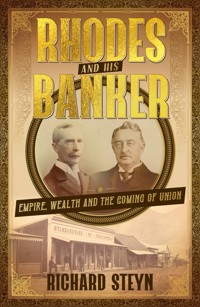
Rhodes and his Banker is an account of the remarkable friendship between a larger-than-life historical figure and a modest, unassuming banker, both of whom were personally involved in all the major political and financial developments in Southern Africa during the closing decades of the 19th century. The financial institution that brought diamond and gold magnate Cecil John Rhodes and Sir Lewis Michell together – the Standard Bank – was at the heart of the country's rapid transformation from an agricultural backwater to an industrial powerhouse thanks to the discovery of diamonds and gold. The book chronicles the activities and growth of the bank under the remarkable stewardship of Michell and recounts his role as the trusted confidant of Rhodes. Michell published the first biography of Rhodes to be written after his death and offers many intriguing insights into the character and motives of one of the most controversial and self-driven of British imperialists. He also did everything he could to fulfil Rhodes's ambition for a united South Africa and played a key role in setting up the world-famous Rhodes Scholarship programme. Intertwining dual narratives of Rhodes as rapacious entrepreneur with the Standard Bank under Michell tiptoeing in his wake to become the biggest bank in Africa, Steyn recounts how colonialism and capitalism took root in South Africa and Rhodesia.
Sie lesen das E-Book in den Legimi-Apps auf:
Seitenzahl: 523
Veröffentlichungsjahr: 2024
Das E-Book (TTS) können Sie hören im Abo „Legimi Premium” in Legimi-Apps auf:
Ähnliche


















Jonathan Ball Publishers
Johannesburg • Cape Town
Also by Richard Steyn
Jan Smuts: Unafraid of Greatness
Churchill and Smuts: The Friendship
Louis Botha: A Man Apart
Seven Votes: How WWII Changed South Africa Forever
Milner: Last of the Empire-Builders
To my dearest Elizabeth, who has supported and looked after me for more than half a century.
The naive insistence on moral purity removes all perspective and critical debate when it comes to history.
Jawad Iqbal, columnist for The Times of London
History contains an ocean of injustice, most of it unremedied and now lying beyond correction in this world.
Nigel Biggar, theologian and ethicist, Oxford University
One of history’s most useful tasks is to bring home to us how keenly, honestly and painfully past generations pursued aims that now seem to us wrong or disgraceful.
John Carey, literary critic
Contents
Preface
Rhodes and his Banker is an account of the remarkable friendship between a larger-than-life historical figure and a modest, unassuming banker, both of whom were personally involved in all the major political and financial developments in southern Africa during the closing decades of the 19th century. The financial institution that brought the pair together – the Standard Bank – was at the heart of South Africa’s rapid transformation during those times from a struggling agrarian economy to the world’s leading producer of gold and diamonds.
The book chronicles the activities and growth of the Bank under the remarkable stewardship of Lewis Michell and recounts his role as the trusted confidant of Cecil John Rhodes, the diamond and gold magnate, and the most controversial and self-driven of British imperialists. It describes Michell’s singular contribution to the cult of Rhodes that grew up during the early 1900s – before being steadily dismantled by revisionist historians and armchair critics over the next century.
No individual has had a greater influence on the early political and economic fortunes of South Africa than Rhodes. To this day, historians continue to argue over his motives in trying simultaneously to advance the British Empire’s interests in Africa, on the one hand, and to unify South Africa’s four diverse and unequal colonies, on the other.
That the Standard Bank became the country’s biggest bank by the turn of the century must be ascribed to the quality of two of the men who had guided its fortunes since 1864. One was a Scot, Robert Stewart, its first General Manager, who ran the Bank for 11 of its earliest years, during which he grasped the opportunity (and took the risk) of opening on the diamond fields, and in so doing made the Standard the leading bank in the country. The other was Lewis Michell, who built upon and expanded Stewart’s legacy.
Michell, an adventurous young Cornishman, had been trained as a bank clerk in London before being sent out to the eastern Cape in the early 1860s at the height of the worldwide wool boom. Resigning after a few years of service from the stuffy institution that had dispatched him to a distant colonial outpost, he joined the Standard Bank and was instrumental in expanding it into southern Africa’s leading financial institution in the years before and during the second Anglo-Boer War (1899–1902). In so doing, his path inevitably crossed that of Rhodes, the most famous (and to many, most notorious) empire-builder of the late Victorian era.
Cecil John Rhodes
Lewis Michell
Keeping his distance at first, Michell eventually fell under the spell of Rhodes, whom he came to regard as ‘a great man, great even in his faults’.1 During his stellar career in banking and for many years after Rhodes’s early death, Michell worked unceasingly to perpetuate his client’s legacy in South Africa and neighbouring Rhodesia. On Rhodes’s death in 1902, the Standard Bank’s head kept a promise he had made, retired from banking and spent the rest of his long life promoting, protecting and defending his late hero’s legacy. He wrote one of the first of many biographies of the man aptly nicknamed ‘the Colossus’, succeeded Rhodes as chairman of De Beers Consolidated Mines, the world’s biggest diamond company, and served for many years as a director of the British South Africa Company (BSAC). As an executor and member of the Rhodes Trust, he also played a key role in setting up its world-famous Rhodes Scholarship programme, which continues more than a century later to attract to Oxford University some of the best and brightest young men and women.
Unusually for a busy banker, for most of his life Michell was a diligent diarist and letter writer, combining notes and reminiscences into a lengthy and at times rambling autobiography that was never fully published. At the Standard Bank, he came into regular contact with every leading South African and imperial politician of his day, faithfully recording his impressions and chronicling his experiences in his adopted country for more than half a century.
Having an interest in South African history of the late 19th and early 20th centuries, I have long been intrigued by how one small island race off the coast of Europe could rule a quarter of the world by remote control, and how men such as Rhodes and Michell were able to impose their imperialist credo upon the people of southern Africa – with consequences both positive and negative. At the British Empire’s zenith, the Standard was the most important of the imperial banks in South Africa; Rhodes the foremost believer in the superiority and mission of the Anglo-Saxon race; and Lewis Michell one of many well-intentioned Englishmen who felt called upon to bring enlightenment and economic development to the backward people of the continent at whose foot they had landed.
Weaving these three themes into a coherent narrative about a seminal period in South African history – brought to life primarily but by no means exclusively by Michell’s ground-breaking manuscript – has presented a series of challenges I hope to have overcome. But that judgement I must leave to those readers who seek a better understanding of the cross-currents that still swirl beneath the surface of our turbulent and perennially underperforming country.
Richard Steyn
Author’s note: The names of many cities and towns across South Africa have changed since 1994. Throughout this book, the place names mentioned in the text are, for the most part, those in use at the time.
Prologue
On 20 September 1890, the oldest and largest of the Cape Colony’s banks, the Cape of Good Hope Bank, was reported to be ‘in difficulties’. That day, the Prime Minister of the Cape, Cecil John Rhodes, a long-standing client of the Good Hope, strode unannounced into the Adderley Street office of the head of Standard Bank, Lewis Michell, ‘with so much vehemence’ that he failed to observe an elderly gentleman already in the room.
‘He burst into a torrent of words urging me not to let the other bank close its doors through lack of support,’ Michell wrote. ‘I had the satisfaction, perhaps malicious,’ he recalled, ‘of introducing my other visitor as the Chairman of the bank in trouble, to whom, I added, I had just made an offer of adequate support to avert a run, [but] which had been declined under legal advice.’
Taken aback, Rhodes observed that there was now sure to be ‘a general panic’ nonetheless and asked if his government could be of assistance. He was surprised to hear that the Standard Bank had been expecting its rival’s failure for some two years and had accumulated sufficient reserves of coin to meet all probable demands from customers.
The collapse of the Good Hope Bank had its lighter moments, wrote Michell. After a two-day run on the banks, the public ‘regained its sanity and returned their money’. One alarmed Standard customer withdrew his cash, hired a cab and went across town to deposit his funds with the Bank of Africa, a smaller and – he thought – much safer institution. While doing so, he met a friend trying to retrieve his funds from the Bank of Africa in order to deposit them with the ‘more stable’ Standard. ‘Both men returned post-haste to their respective institutions, and the story, leaking out, helped to restore confidence all round.’
The Cape’s Attorney-General, Sir Thomas Upington, had an Irish sense of humour. When he showed emotion at the failure of the Good Hope, a friend inquired whether his loss had been a heavy one? ‘No,’ said Upington, ‘but the Bank was very useful to me. It was here I kept my overdraft.’
The significance of the Good Hope Bank’s demise was not lost on Rhodes, who promptly transferred his personal loyalties, and his corporate accounts, to Michell’s Standard. As the Bank’s historian JA Henry observes, were it not for the failure of the Good Hope, where Rhodes had been a customer of long standing, the diamond magnate might never have become a Standard customer. Until then, his relationship with the Standard Bank, if not with Michell personally, had ranged from ‘ambiguous’ to ‘delicate’. Used to getting his own way, the man they called ‘the Colossus’ (not altogether admiringly) had been less than impressed with the Bank’s ‘lukewarm’ responses to his expansionist aims – whether in Kimberley, Bechuanaland or Matabele/Mashonaland.
Conscious of reputational risk, the Standard had managed up to then to steer clear of involvement in the affairs of Rhodes’s British South Africa Company, which had few tangible assets and seemed more of an administrative and policing vehicle than a profit-making venture. The Bank had also declined to lend £500 000 to the new De Beers Mining Corporation, although agreeing to a small personal advance of £12 000 to its powerful chairman. It was to Lewis Michell that Henry ascribes the personal credit for managing to win Rhodes’s confidence and his valuable custom.
As Duncan Campbell-Smith points out in Crossing Continents (2021), his definitive history of Britain’s Standard Chartered Bank, as the Cape’s leading banker, Michell may have had little option but to develop an amicable relationship with the man who controlled the world’s diamond industry, was a significant investor in gold mining on the Rand and had recently stepped up to become premier of the Cape Colony. For almost half of the Colony’s annual revenue was derived from Rhodes’s various business undertakings.
But as Michell’s friendship with Rhodes grew during the 1890s, his ties went well beyond the normal obligations of a bank manager, even towards an illustrious client. He came to believe that Rhodes was the only person in South Africa capable of bringing Britain and the Boers together politically. And Rhodes, for his part, developed a high regard for the Standard banker’s grasp of the broader issues facing the Colony and for his attention to detail. The closeness of their relationship was exemplified by Michell’s and the Standard Bank’s support for Rhodes’s ambitious campaigns to extend the boundaries of empire well beyond the borders of South Africa.
PartI
1
On the Sheep’s Back
1860s
Today’s Standard Bank of South Africa had its origins in the eastern Cape of the mid-19th century – the epicentre of the Cape Colony’s thriving wool trade. In response to a worldwide demand for woollens sparked off by Britain’s industrial revolution, wool-bearing sheep had been introduced into the arid platteland (countryside) around Port Elizabeth in the 1830s, enabling the growing settlement to overtake Cape Town temporarily as the busiest town in the British-ruled Colony. If England’s economy in the 19th century depended largely upon woollen products, the same was true of the economy of the Cape. Between 1862 and 1869, wool accounted for 73 per cent of the value of exports to Britain and the United States (US) through the Colony’s two seaports. As the Standard Bank’s historian JA Henry observes, before the discovery of diamonds and gold, the entire economy of the Cape was carried on the sheep’s back.1
Elsewhere in the future South Africa, local economies were mostly agrarian and poor, with ostrich feathers and ivory ‘providing the only exotic supplements to the conventional agricultural products of the land’. The frequent wars on the eastern Cape frontier – besides being a constant drain on the British taxpayer – kept the Colony in a state of permanent unrest.2
Not that the wool from the eastern Cape was of high quality – far from it. Perennially short of cash and plagued by livestock losses during the Frontier Wars against the Xhosa, sheep farmers were obliged to shear twice a year instead of once, producing wool that was not strong or fine enough to meet the standards required by British and American mills.3 And the marketing of wool, like much business activity in the Colony, was rudimentary and slow. Nonetheless, Port Elizabeth’s warehouses were filled to bursting with wool bales, its streets regularly clogged by heavily laden ox-wagons on their way to the harbour. Wool replaced wine as the Colony’s chief export.
Financing was urgently needed to send the Cape’s wool crop to overseas markets, hence the need for better banking services. Although small banks were scattered around the Colony, most lacked capital and reserves and struggled to withstand the regular droughts and trading downturns that were the bane of a largely single-product economy. Yet every dorp (small town) worthy of its name boasted its own bank, ‘generally owned by one or two leading businessmen and farmers in the community, who extended credit in none-too-vigorous fashion to themselves as well as local tradesmen’.4
It took the initiative and thrust of an enterprising young Scottish immigrant, John Paterson, to raise the quality of banking services in the Colony. The son of an artisan, young Paterson was educated in Aberdeen, graduating in 1840 with an MA to his name. A year later, he took advantage of a sponsored scheme that took schoolteachers out to the Cape Colony. Passing out top of the recruitment process, Paterson was sent to Port Elizabeth to open a senior government school there, which in time became Grey High School. After running the school for six and a half years – during which he made many shrewd investments in land and helped found the Eastern Province Herald – the enterprising Scotsman abandoned teaching as a career in favour of becoming joint-proprietor, publisher and editor of the newspaper still in print today. Paterson’s restless temperament and growing interest in civic affairs led ineluctably to his involvement in politics, in which the Herald campaigned actively for the introduction of municipal government to Port Elizabeth and for greater autonomy for the eastern Cape. In 1849, he married Frances Mary Kemp, daughter of a prominent local businessman, who bore him five children.
During the late 1840s and early 1850s, Paterson helped to buy up Crown land for the town and to set up a hospital, library and wharves for the harbour. His business interests expanded to include retailing, real estate development, importing, ship victualling and insurance, and in 1853 he became chairman of the board of Town Commissioners. A year later, when representative government came to the Cape and Port Elizabeth was granted two representatives in the first colonial parliament, Paterson was a shoo-in as one of them. Before long, he became a member of the Cape’s Legislative Council, where he was noted for his forcefulness (and long-windedness) as a speaker.
* * *
By 1857, Port Elizabeth had two banks of its own, with John Paterson a prominent shareholder in each. This did not deter him, however, from attempting – along with other prominent businessmen – to establish a third, the ‘Standard Bank of Port Elizabeth’, to offer commercial services to the rapidly growing trading centre that the other banks were unable to provide. But when his attempts to raise sufficient capital locally were unsuccessful, and his wife died suddenly, leaving him with five young children, Paterson resigned as a town commissioner and colonial parliamentarian and, in 1858, decamped for London. It was time to take advantage of the mid-Victorian economic boom in Britain, ignited by positive developments in banking legislation and regulation.
John Paterson
Returning ‘home’ as a wealthy and enviably successful businessman from the Empire’s outer reaches, Paterson soon established a presence in the City of London. Besides promoting his own business interests, he produced, within a few short months, the first prospectus for the ‘Standard Bank of British South Africa’, with nominal capital of £1 500 000, not all to be called upon immediately. The new bank would not be confined to the eastern Cape but would aim to attract capital and custom from all quarters of the Colony.5 An inducement to potential British investors was the Companies Act of 1862, which significantly reduced the risk of doing business in distant imperial destinations. As chairman, Paterson also took the crucial decision to set up a reserve fund, so that the Bank did not have to distribute all its profits to shareholders.6
In booming Victorian London, Paterson’s salesmanship had City investors falling over themselves to buy shares in the Standard Bank, among the first to be registered under the new banking legislation. As Campbell-Smith records,7 by 1862 the new Standard’s paid-up capital of £2 million was twice as great as that of the 29 other banks operating in the Cape Colony, excluding the UK-based London & South Africa Bank. The enthusiasm of shareholders was a reflection of Paterson’s energy and persuasiveness. After his election as executive chairman by a board based in the City, Paterson opened his fledgling Standard Bank of British South Africa for business on 20 February 1863.
Port Elizabeth branch, c.1882.
While Paterson was still in London, negotiations for a merger with the Commercial Bank of Port Elizabeth were already under way. The Standard agreed to take over the Commercial’s impressive building in the town, in addition to its chief cashier, James Tudhope, who became the merged bank’s first branch manager. In the meantime, Paterson busied himself transferring capital to the Colony by means of bills of exchange drawn on City banks into which shareholders’ subscriptions had been deposited.
Having persuaded the London board to agree that the business of the Standard Bank would be conducted from Port Elizabeth, now the principal port of the Colony,8 and armed with the authority to establish a network of branches in pro-British parts of South Africa, Paterson sailed for the eastern Cape in February 1863, after shipping off £10 000 in gold coins before departing. Accompanying him was a new wife, an 18-year-old Scottish lass, Marizza Bowie, who would bear him no fewer than eight more children.9
Port Elizabeth branch interior, c.1883.
Within weeks of opening, the new Standard had taken over the Colesberg and British Kaffrarian banks in the eastern Cape, the Fauresmith bank in the Orange Free State and the Beaufort West bank, while negotiations had opened with others in the western Cape. Besides these mergers, several new bank branches were started from scratch. By the end of 1864, the Standard had 19 branches (or agencies) – eight in the eastern Cape (including Port Elizabeth), five in the western Cape, three in the Free State, two in Natal and one in British Kaffraria (outside East London) – and its nominal capital had been increased from £2 million to £3 million. While the overall direction of the Bank came from the main board in London, local boards were established in Port Elizabeth, in Cape Town and in several smaller branches. Capital was sorely needed at this time for infrastructure, bridge-building and particularly railway construction.10
Amalgamating with other banks did not always proceed easily: there was a prejudice against imperial newcomers, and antagonisms surfaced when the Standard’s more modern methods showed up past deficiencies and new accounting systems were imposed upon managements accustomed to a more ‘happy-go-lucky’ style of banking. In a capital-deficient environment, many local bank managers made interest-bearing loans to their friends or even to themselves, cloaked as ‘Advances on Sundry Accounts’, and thought of it as a normal way of doing business. Even more damaging to the Bank was the habit of isolated branches to set their own overdraft rates in order to enhance profitability. The London board, as may be expected, was kept in the dark about these activities.
In 1864, a collapse in the international wool price, a result of the American Civil War, had a damaging impact on the Cape economy, which was already plagued by locusts and a severe drought that had set in two years earlier, causing the loss of thousands of sheep. In the severe recession that ensued, wool farmers and banks – including the Standard, whose shares fell steeply – struggled to survive. Railway construction came to an abrupt halt 70 miles (110 km) outside Cape Town for want of money.11 In London, interest rates shot up and the board decided that expansion in South Africa had gone far enough: no new branches were to be opened until the existing network had been knocked into shape.
Concerned about the amounts of capital they had poured into the Colony, Paterson’s City colleagues were uncertain where final authority for the bank lay: was it with the chairman, no longer in London, or with Tudhope, the manager in Port Elizabeth? They resolved, therefore, to create the new position of General Manager and to send out someone with proven banking credentials ‘to exercise a firm hand in the Cape’.12 The man chosen was another Scot, 34-year-old Robert Stewart, an up-and-coming banker of excellent reputation, who arrived in Port Elizabeth in February 1865 to manage the Standard’s operations in South Africa. His arrival was not met with much enthusiasm by local directors and branch managers, for reasons that soon became apparent.
* * *
Stewart arrived in the eastern Cape to find himself at the head of a bank not only serving an agricultural and commercial community in the midst of a severe and prolonged drought but also in some danger of falling apart because of its independent-minded directors and managers, who ignored the instructions they were given by head office.13 Credit had been extended to borrowers with ‘a shocking recklessness’14 and managers had covered up the loans going into their personal accounts.15 Stewart also concluded that the existing banking capital in South Africa was ‘far beyond the legitimate business requirements of the country’. ‘Unless we have a change of seasons, I tremble to contemplate the future of the Bank here,’ he wrote.16
Robert Stewart
Putting aside his concerns, Stewart set about cleaning out the Augean stables with his customary vigour: local boards were disbanded, inefficient staff weeded out and many managers (including James Tudhope) dismissed. His most important innovation was the introduction of regular branch inspections that were not announced in advance, a system that still survives in the Bank to this day.
In a report to the board in London, Stewart was unsparing in his criticism of the way in which the main branch in Port Elizabeth had been managed: ‘The board here had practically ceased to exist, a fortunate circumstance for the bank for had it done so much longer, the members would have absorbed all the capital of the Branch for themselves and their friends … The Bank has in this respect been shamefully managed. You have a right to know the true state of matters and I should be failing in my duty were I to withhold it from you.’17 When it emerged that the dismissed Tudhope had been acting on his chairman’s direct instructions, there was not much left of John Paterson’s reputation.
Making matters worse for the founder was the collapse of his firm Paterson, Kemp and Co, forced into liquidation in 1865 after Stewart had flatly refused to lend it more money. When the economic crash of 1865 resulted in the Standard’s share price in London plummeting from £100 to £9,18 and the Bank had insufficient reserves to pay a dividend, Paterson resigned as chairman. Two years later, he became insolvent.
The irrepressible Paterson’s return to politics in 1872 – and desire to hit back at Stewart – gave him sufficient confidence to embark on a legal case against the Standard and to initiate another round of banking mergers. In 1873, the Oriental, another City-based imperial bank with a charter to operate ‘East of the Cape of Good Hope’, opened in Port Elizabeth, under Paterson’s direction. Based largely in India and Ceylon, the Oriental accumulated 11 branches in the eastern Cape before mounting debts in Asia forced it to sell out in 1878 to another City-based venture, the Bank of Africa.19
It was Robert Stewart who rescued the Standard Bank from an early closure and set it on course as a going concern by enforcing a restrictive lending policy uncomfortable to pursue and unpopular with customers. His problems were not confined to the Cape Colony, however. In Natal, where the Bank had opened in Pietermaritzburg in 1864, the fledgling sugar industry was struggling, and the Standard found itself managing several large sugar estates until they could be sold.
By this time, old Boer-Brit animosities had resurfaced in the Orange Free State, where the Standard had branches at Bloemfontein, Smithfield and Fauresmith, and was a rival of the Bloemfontein Bank, which was often unable to redeem its own notes. Resentful of competition, directors of the Free State bank petitioned the Volksraad, the republic’s parliament, to ban the Standard, on the grounds that it was a ‘foreign’ bank, with limited liability, whose profits were sent out of the country.20
The Volksraad voted overwhelmingly to support the local institution and debar the Standard, which closed its doors in late 1865 – at great inconvenience to its customers. Another 35 years were to pass before the Bank was allowed back into the Free State.
With wool prices at low levels, drought widespread and locusts rampant, and the new Suez Canal about to divert shipping from Cape ports, the Colony’s economy languished in the mid-1860s, and many of Robert Stewart’s letters to London were tinged with despondency. In one he wrote, in bankerly fashion, ‘I must question … whether the conclusion is not forced upon us that the Cape Colony, as a merely pastoral country, has not struck something of a limit to its further progress until some other resources are discovered.’21
* * *
Luckily, Providence was about to intervene to give both the Colony and the Standard a helping hand. In 1866, a 15-year-old youth, one Erasmus Stephanus Jacobs, picked up the first diamond to be found in South Africa, at Hopetown on the Orange River. Other sporadic finds were also made, but the frantic rush to the area only began in 1869, after the 83.5-carat rough white diamond the Star of Africa (also known as the ‘Dudley Diamond’) was found by a Griqua shepherd on the banks of the Orange. A year later, more alluvial finds were made along the Vaal River near Barkly West and at various ‘dry’ sites on farms surrounding Kimberley. Within weeks, hopeful fortune seekers, white and black, from every nook and cranny in southern Africa and beyond had descended upon the northern Cape and ‘trekked across the sandy veld to scratch for luck in the mud and gravel of the riverbeds’.22 The Standard first felt the effects of the diamond rush when its branch at Colesberg, the closest to the diamond discoveries, began to run out of notes and coins. Stewart, whose glass had begun to rise from half empty to more than half full, sent the Standard’s first parcel of diamonds to London on 13 September 1870, with an accompanying memo saying, ‘I hope this is the first of a series of many other similar transactions which will yield handsome profits to the Bank and open up a remunerative branch of business which was little contemplated when the institution was first established.’23
Stewart barely hesitated before deciding to open a branch of the Standard on the diamond fields – at Klipdrift in the centre of the ‘dry’ diggings. By October 1870, he had transferred a sub-manager to Kimberley and dispatched, by ox-wagon from Port Elizabeth, the necessary equipment to set up new premises. The requirements took five to six weeks to arrive, but not before the Bank’s safe had slipped its moorings along the way and fallen into the Vaal River between Pniel and Klipdrift. The Standard was not only the first bank to open on the diamond fields but for some time it was the only one, having to act as bank, diamond broker and insurance company despite lacking any of the necessary expertise to do so.
The discovery of diamonds turbocharged the Colony’s notoriously sluggish economy, particularly after the British government first ruled that the diamond fields belonged to the Griqua tribe and then, in 1871, declared the Griqualand West area to be a protectorate of the Crown. At last, the lengthy drought had broken, the wool price had recovered and, most important of all, new discoveries of diamonds were being made almost daily. A sign of the times was the arrival of another foreign bank, the Oriental, in South Africa.
Kimberley branch, c.1878.
Thanks largely to Stewart, who laid the foundations of a successful retail bank ‘with only the barest rudiments of modern communications’,24 the Standard emerged from a succession of lean years in fair shape. As General Manager, Stewart had to depend on the regular but slow sea-mail service to London to report to the board, and on horse-drawn post carts to supervise the widely dispersed branch network. He met the latter challenge by relying heavily on the work of travelling inspectors.25 As Terry records, suspect accounts were well monitored, liquidations carefully controlled, business routines remodelled and the staff moulded into a cohesive unit.26
Most importantly, public confidence in the Bank, initially at a low ebb, had begun to rise. Banking historians are agreed that had it not been for Stewart’s firm hand on the tiller, and the wisdom of the board in appointing him, the Standard would probably not have survived the 1870s. As the other great figure in the Standard’s early history, Lewis Michell, acknowledged modestly, ‘the Bank’s foundations were so well and truly laid by Robert Stewart that his successors only had to follow in his footsteps’.27
2
Early Days
1860s & 1870s
Lewis Lloyd Michell, second son of a Cornish solicitor, was born at the naval port of Plymouth in southwest England on 11 August 1842, to devout Anglican parents. Educated in London at Christ’s Hospital, he joined a bank in 1859 in Penzance, Cornwall, where he underwent four years of rigorous training at a low salary. In 1863, he was offered a choice of three clerkships: by the news agency Reuters; by Lynch Bros, a commercial company in Baghdad; and by the newly established London & South Africa Bank. Having recently read The Arabian Nights, he leant towards Baghdad, but his mother ‘scented danger in a place where men slept on flat roofs and indulged in a plurality of wives’.1 Without having much say in the matter, young Lewis bowed to his parents’ wishes and chose South Africa.
The bank to which he was apprenticed, the London & South Africa Bank (L&SAB), was the first of the ‘imperial’ banks to set foot in the Cape Colony. It had opened in 1861, one year before the Standard issued its prospectus in London. Although some of the L&SAB’s directors were Cape Town merchants, within 12 months the new bank had moved its headquarters to the eastern Cape to take advantage of the wool trade.
Michell signed on with the L&SAB in London in August 1863, shortly before his 21st birthday. Six months later, he was on his way to South Africa to join the bank’s complement in Port Elizabeth, embarking on a long and tedious sea voyage which he shared with a handful of hardy passengers. In his memoirs, he ‘draws a veil’ over his first seven days at sea, describing the weather as ‘exceptionally wild’. Yet the merchant ship SS Briton’s 42-day passage to Table Bay ended four days ahead of schedule, which drew a congratulatory gunshot fired from a hill above Sea Point.2
For emigrants from relatively sophisticated mid-Victorian Britain, arriving at the Cape meant taking a few steps backward in time. Not yet a country, underpopulated South Africa was little more than ‘a hotchpotch of races engaged in elbowing each other out of the way’.3 The Cape Colony, the largest region, formally in British hands since 1814, was run by an elected local government under guidance from London.
Before the opening of the Suez Canal in 1869, the Cape’s strategic significance lay in the services it provided for ships from European ports sailing around the foot of Africa on their way to India. To the northeast of the Colony were the Boer-held territories of the Transvaal and Orange Free State, founded after the Great Trek of 1836–1843, when 7 000 ‘Dutch’ stock-farmers and their families, resentful of British rule (and racial attitudes), had ventured into the interior to set up their own rudimentary republics. To the east was Natal, proclaimed as a district of the Cape Colony in 1843, after the British government had annexed the short-lived Boer republic of Natalia.
In the Cape, distances between the scattered towns were long, telegraph links limited and internal transport restricted to horse-drawn carts and stagecoaches or cumbersome ox-wagons. The first railway in the Colony, from Cape Town to Wellington via Eerste Rivier, had opened in the year before Michell’s arrival. One of his first assignments from the L&SAB in Cape Town was to take a consignment of specie (gold coins) out to the Wellington branch, some 45 miles (75 km) away. He went there and back by train in one day, noting that, in doing so, he had traversed the entire railway system of southern Africa.4
From Cape Town, the ‘Mother City’, the young Englishman sailed on to the mailboat terminus at Algoa Bay. ‘I can vividly remember our landing in a surf boat amid what appeared appalling breakers,’ he recalled. ‘Port Elizabeth was singularly unattractive to a newcomer.’ Reflecting ruefully that he was bound by indenture to remain there for at least five years, ‘I little thought I should remain at the Port for twenty-one years and leave it with regret. We never know what fortune has in store for us.’5
* * *
In his unpublished autobiography, much of it compiled later from notes in his diary, Michell recalled the drawbacks of early life in Port Elizabeth, which was ‘in a primitive stage: the landing facilities were archaic, the streets windswept and storms frequent, drinking water scarce, telegraphic facilities not yet available and not a mile of railway even in prospect … but with all its deficiencies it was a cheery spot, with a progressive tone about it which promised well for its future’.6
‘There were of course gradations of society,’ he reflected, ‘but they were not very rigid. Of pretentious entertainments there were none, unless on the infrequent visit of a man of war, or the more infrequent visit of the Governor. But there was much informal hospitality and friendliness and when young men were asked to “drop in of an evening”, the invitation was meant seriously and accepted readily’.7
Michell was impressed by the healthy spirit of discontent of the citizenry, who ‘strenuously’ insisted on improvements to the town and threatened the government in Cape Town with secession if their demands were not met. Under this stimulus, he reflects, ‘the bi-weekly post was accelerated, telegraphic communication was promised, and a few years later engineers arrived to examine the possibilities of a railway’.8
Many tales of early life in Port Elizabeth had to do with its stormy weather, which made arriving by sea so hazardous and often drove ships onto the sandy beaches of Algoa Bay.9 Overcoming his initial concerns, Michell set out to make the best of his new posting and never lost an opportunity to get to know the countryside. Among his greatest pleasures was walking: one long weekend he and a friend walked to St Francis Bay and back, via the Van Stadens River, a round trip ‘of at least 100 miles’.10 Not long after his arrival, he volunteered to take his bank’s gold specie to King William’s Town, via Grahamstown, during a war scare along the border. He travelled in a post cart with a ‘Hottentot’ driver, the gold coin hidden under mailbags. It was an almost non-stop journey, save only for changes of horses along the way: At various unbridged rivers, he records, ‘the specie had to be hauled across by ropes, sometimes at night. But the roads were good, horses were better and the driver hard to beat’.11
In subsequent years, Michell made many other ‘delightful journeys over our mountain passes’ before the routes fell into disuse after the arrival of railways. ‘Visitors who have not seen the Amatolas, the Hogsback, the Zuurberg, the Katberg, Montague Pass, Bains Kloof, Mitchell’s Pass, the Hex River Heights, Sheba Hill and the Valley of Desolation cannot be said to have seen the finest views in South Africa,’ he wrote.12
With horses being relatively cheap, Michell and fellow bachelors spent many weekends in the saddle, visiting neighbouring farms as far away as the Sundays River, Addo Heights and Grahamstown. Uitenhage (now Kariega) was a favourite place because of its ‘pretty girls’, including one 18-year-old Maria Agnes Philpott – daughter of the hospitable resident magistrate and civil commissioner, Edward Philpott and his wife, Sophia – to whom Michell before long became engaged. Whether ‘Mary’ Philpott was blonde, blue-eyed or vivacious we will never know, for her fiancé does not tell us. But of his ardour there can be no doubt: during his courtship, he would often ride 17 miles (28 km) to Uitenhage and back, after a busy day at the office, arriving home ‘a tired man’ around midnight.
After a clerkship of only two years, Michell was promoted by the L&SAB to the posts of accountant and then acting manager. Though junior to other members of staff, he was entrusted by London with a secret power of attorney that enabled him to assert full authority over the branch in case of emergency. He held ‘no illusions’ about his employer, however. The L&SAB’s ultra-cautious and vacillating policies, framed 6 000 miles away, and its resistance to branch expansion, indicated that the bank was unlikely to succeed in South Africa, ‘and I knew it’.13
The L&SAB’s commercial troubles were temporarily alleviated by the economic boom in diamonds, even though the upturn led also to ‘unlimited gambling and heavy losses’. In 1869, Michell travelled to Grahamstown and Queenstown to lend support to two bank managers who wished to deal in diamonds, but in doing so alarmed his risk-averse employer in London, which ordered the staff in South Africa under no circumstances to accept diamonds as security for advances. For Michell, this prohibition was the final straw: he was shortly to be married and had to think seriously about his financial future.14
After his marriage, on 13 June 1871 at St Katharine’s Anglican church in Uitenhage, Michell embarked on a protracted correspondence with his board in London hoping to ‘mitigate their drastic decision’ not to do business in the diamond market. When he failed to carry the board with him, he resigned, having soldiered on at the L&SAB for nine years, the last six as Port Elizabeth branch manager.15
By now, ‘South Africa had begun to exercise that strangle-hold which it maintains on a great majority of those who set foot upon its shores’, he wrote.16 In 1872, the Michells’ first son, John Bentley, was born in Port Elizabeth,17 followed in 1874 by a daughter, Dora, the first and second of the couple’s eight children. After John and Dora came Edward (1876), Francis (1878), Ethel (1881), Lewis Edward Barbary (1883), Sophie (1885) and Rodon (1888). Worried about Mary’s health and his own, Michell dispatched mother and infants to England to consult doctors and meet their grandparents. Following them as soon as his work allowed, Michell brought the family safely back to South Africa on the Windsor Castle, which was shipwrecked shortly thereafter.18
* * *
Resignation was a risky step for a newly married man amid a commercial crisis that was causing heavy bank losses in the Colony, but the Standard – in the person of Robert Stewart – came to Michell’s rescue. Stewart had been impressed by his younger rival and had long suspected that Michell would not put up with his employer’s timid lending policy for ever. Before departing for the UK on home leave, Stewart left behind a written offer of employment for Michell with HC Ross, the Acting General Manager. When, by coincidence, the Standard’s Port Elizabeth branch manager also resigned, Ross called Michell in for an interview. On learning that the younger man was thinking of going to Australia, a broadly smiling Ross handed him an offer in Stewart’s own hand to become manager of the Standard’s Port Elizabeth branch. Michell had little hesitation in accepting.19 Reflecting later that his former employer ‘had consistently mismanaged its affairs to the day of its death’, Michell notes wryly that it was a welcome change ‘to be associated with a real live bank, with a good London board laying down sound general principles but leaving their local representative to apply them’.20
Two innovations that Stewart had introduced into the Standard’s operations made a deep impression on Michell: one was the Bank’s method of avoiding the dominance of any individual on the London board by having no chairman but requiring every director by rotation to be ‘chairman of the week’. This rule required the chairman’s attendance at the office each day of ‘his’ week, which helped to familiarise him with the business. The second unique feature was Stewart’s adoption of the Scottish system of regular inspection. Every branch was visited without warning at least once a year, and ‘overhauled and reported on by a thoroughly competent official’. Michell believed this system ought to be adopted by all colonial banks with head offices in London. Without such regular inspections, the Cape of Good Hope Bank, once the Colony’s premier bank, was to close its doors in September 1890.
After three years at the helm in Port Elizabeth, the Standard’s new manager was described in the following terms by a visiting bank inspector: ‘His conduct is that of a gentleman and of a wide awake, large-minded man of business combined … In point of efficiency, he is remarkably cool and collected, intelligent, watchful, firm and energetic, possessing tact, judgment, promptitude and experience. The Bank is to be congratulated upon having so able and trustworthy representative at its chief branch.’21
* * *
By 1870, the Standard had taken a healthy lead over rival banks in the Colony in note circulation, deposits and discounted bills of exchange. It was also the main provider of cash in the Colony. Like other banks, it had to import coinage (specie) from London but was permitted by the colonial authorities to print its own bills of exchange and banknotes, which had to be backed by sufficient reserves.
The physical difficulties of sending large amounts of gold and silver coin into remote rural areas by slow, irregular transport were considerable, and the expense of doing so forbidding. Most unskilled Africans would only accept gold or silver coins as payment for their labour, and shortages of the currency required by farmers and diamond diggers restricted both the expansion of the Cape economy and the Bank’s business.22 Stewart was able to report, however, that notes issued by the Standard Bank were ‘held in high favour on the diggings and [had] latterly come to be preferred by many even to gold’.23
By 1877, the Standard had doubled the number of its branches to 34.24 The Bank had grown in tandem with the expansion of the railway network to the diamond fields from Cape Town, Port Elizabeth and East London, with new branches opening at temporary railheads along the way. Short of capital to finance its own expansion, the Standard was helped greatly by being appointed as the Cape government’s official banker.
The Bank’s quasi-official status gave it access to substantial cash deposits, particularly during the Frontier Wars, and enabled it, in the absence of a central bank, to effectively control the foreign exchange market in South Africa.25 But the appointment also imposed additional responsibilities. As Campbell-Smith points out, the Bank had to protect its own balance sheet in a feverish trading environment, while taking a stand against excessive volatility; it had to be seen as an institution concerned not just about its own profitability but with the long-term interests of the country; and it had to deal equitably with all the parties contending for control of the diamond fields – ‘challenges with few parallels in the chronicles of capitalism’.26
By now, the Bank had come to be regarded as very much a South African operation.27 In 1875, Stewart wrote to the board saying that while the Standard had become the leading institution of its kind in the country, a constraint on its activities was the perception that it also carried on business in London. If the public could be satisfied by a declaration from the UK that the Bank’s entire capital was employed in South Africa and its position in the City simply that of an agency, ‘I would be able to advise without the slightest qualifications whatsoever that their confidence in the Bank was quite unbounded’.28
Stewart himself was not in the best of health, however, and informed the board that when Francis Searle, the incumbent manager in London, retired, he wished to succeed him in a lowlier post as a way of retreating gradually from the front line. When Searle died suddenly in late 1875, the board offered his position in the City to Stewart, instructing the chairman ‘to express the great satisfaction of the directors with the manner in which he had managed the affairs of the Bank during the past ten years under very difficult circumstances’.29
In 1876, 11 years after arriving at the Cape, Robert Stewart left for home, appointing two of his colleagues, Gilbert Farie and Hugh Cameron Ross, as joint general managers to succeed him. As Campbell-Smith records disapprovingly, Stewart was not offered a seat on the board upon returning to London, despite thoroughly deserving one. Victorian class snobbery still drew a distinction between bank directors and mere bank managers.
One of Stewart’s several accomplishments as ‘Chief Manager’ in London before his death from a cerebral haemorrhage in 1885, at the age of only 55, was to encourage the board to acquire the business of the London & South Africa Bank. Though it had been trounced by its imperial rival, the L&SAB nonetheless provided the Standard with no fewer than three of its future general managers.30
3
Fortune Seekers
1870s
The discovery of diamonds was first felt in the Cape economy in the early 1870s, shortly before Lewis Michell switched banks. While wool sales remained the Colony’s chief revenue earner, the requirements of the diamond fields offered new opportunities to farmers, both white and black, and transformed what had previously been a subsistence economy. Secondary industries emerged to meet the rising demand from Kimberley for food, clothing, consumer goods, footwear and machine tools.1 Government spending on railway, telegraph, road and bridge construction, made possible by the Colony’s improving finances, created new employment opportunities and helped to bring an end to the financial downturn of the 1860s.
On the diamond fields, the frenzy that set in after the promising discoveries at Klipdrift had attracted more than 5 000 diggers to the area by 1870, and 10 000 by 1871.2 While the earliest discoveries were mostly alluvial – along an 80-mile (130 km) stretch of the Vaal River – much richer ‘dry’ discoveries were made 20 miles to the south, in a layer of ‘reddish-yellow’ earth below the surface soil of farms such as Dutoitspan, Bultfontein and especially Vooruitzigt (later ‘New Rush’). On New Rush, a hillock on the farm of the De Beer brothers, known as the ‘Colesberg Kopje’,was on its way to becoming the ‘Big Hole’ of Kimberley, a huge crater whose four volcanic diamond ‘pipes’ were to yield many millions in revenue over the next ten years.
However, as the highly literate English prospector Charles Payton recorded, the early days on the diamond fields were backbreakingly hard for the poor diggers: supplies of everything were scarce, the food was coarse, and there were no luxuries or many of life’s necessities. Temporary shelters were insufficient to counter ‘the inclemency of the weather, the chill blasts of winter, and the terrible heats and nerve-destroying thunderstorms of the summer’.3 Payton’s description of a day on the diggings was vivid:
Bultfontein Mine, 1880s.
There was a strong wind blowing; as usual the whole camp was enveloped in clouds of stifling, penetrating white and red dust; the heat was excessive, and it was very thirsty work … Liquor took the place of water, and so-called canteens were erected on the perimeter of the mines. Filled with customers, they added to the noise that afflicted the diggings, day and night. Donkeys brayed, mules snorted, cattle lowed, dogs snarled, and chickens clucked. The shouting of the cart-drivers competed, as did the noise of the mines themselves. There was camp fever and dysentery, a vast armada of flies, and a celebrated infestation of fleas.4
Most daunting of all was the physical labour required to unearth the ‘dry’ diamonds, buried in deeper ‘blue’ ground below the yellow earth. At the Big Hole, there was constant danger from crumbling roadways, the falling walls of claims and the frequent fires in the makeshift tented city. All supplies for the diggings had to be hauled up from Cape Town or Port Elizabeth (and the Transvaal, in due course), at great expense. Only hard liquor was readily available. For single men, besides their many material discomforts, there were few suitable women to divert or entertain them.
Photo of camp at ‘New Rush’ by GW von Ahlefeldt, 1873.
* * *
The demand from the diamond fields might have been ‘manna from heaven’ to the struggling Cape economy but it also put a severe strain on the Colony’s inadequate transport system. It took until 1875 for the first railway in the eastern Cape to be opened, stretching for 32 miles (50 km) inland from Port Elizabeth harbour, while in the western Cape, the railway line extended from Cape Town only as far the Hottentots-Holland mountains. Until the advent of rail, transport to the diamond fields from the coastal ports was either by cumbersome ox-wagon or horse-drawn post carts travelling at six miles an hour, their journeys often interrupted by ‘impassable roads or bridgeless rivers’.5 Persistent droughts sent fodder prices soaring, helping to make the Cape one of the most expensive colonies in the Empire.
As the old saying goes, it never rains but it pours. Adding to the diggers’ difficulties, a break in Kimberley’s long-lasting drought in the early 1870s inundated mining operations and severely reduced production. To make matters worse, by 1873 – the year in which Michell joined the Standard Bank – the volume of new diamonds flooding the world market had caused a collapse in prices. From 1874 to 1876, the diamond industry was brought to a virtual standstill, forcing many of the 50 000 prospectors and traders to abandon the diggings in droves. For the Standard, it was an anxious period, with many of its diamond-dealing clients driven out of business before the world market could recover. Stewart, Michell and their colleagues had to devote much of their energies to protecting the Bank against the seesawing diamond price.6 Fortunately for the Colony’s economy, wool sales had recovered thanks to renewed demand worldwide for woollen clothing.
Throughout the 1870s, the Standard Bank’s chief kept his eye fixed on the bigger picture. As he wrote to the board in London, diamonds were making ‘localities rich and produced wealth in places where pastoral and agricultural pursuits never flourished’.7 Added to which were promising gold discoveries in the northern Transvaal. For the Standard, Stewart declared, ‘as the Colony progresses, there can be no standing still … in the position now occupied by us. If we cannot fairly meet the business requirements of our customers, some other bank will most assuredly push us to the rear and probably we would never thereafter be able to recover the ground we had lost.’8
Thanks to Stewart’s energy and enthusiasm, the Standard managed not only to consolidate its leading position in the Cape but to extend its network into every corner of the Colony.9 It was also primed to open beyond the borders of British colonies in South Africa as soon as circumstances permitted. The Bank offered overdraft facilities, the discounting of trade bills and the exchange of its own notes for gold at any of its branches, no matter where the paper in question had been issued – services unmatchable by any of its rivals.10
* * *
Not surprisingly, the headlong rush to the alluvial diggings along the Vaal and ‘dry’ discoveries around the newly named Kimberley set off a multitude of claims to ownership of the land on which diamonds were located, long considered a part of the Orange Free State.11 There were heated exchanges between the British, Free State and Transvaal governments over a region recognised unofficially by the British since 1834 as belonging to the Griqua tribe, now led by their chief Nicolaas Waterboer, who appealed to the Cape government for ‘protection’ against the rival claimants. In London, the Colonial Secretary, the Earl of Kimberley, was keen to deny the Boers who had trekked away from the Cape ‘an extended field for their slave-dealing operations’.12 Instead, the Earl favoured the formal annexation of the diamond fields by the British government, to be administered not from Whitehall but by the Cape government, which would have to bear the costs of their acquisition.
In 1871, the autocratic Sir Henry Barkly became the Cape’s new governor.13 He quickly realised that ownership of the diamond fields was more than just a territorial dispute but a matter that might determine the political future of South Africa. He immediately appointed an arbiter, Robert Keate, the Lieutenant-Governor of Natal, to determine the ownership issue. Keate duly ruled in favour of Waterboer, who asked for the territory to be taken over by Britain. Barkly then infuriated the Earl of Kimberley by jumping the gun and annexing the diggings in the name of the British government, rather than the Cape Colony. The Cape’s eastern border with the Free State was carefully readjusted to ensure that all of the diamond fields fell within Britain’s jurisdiction.14Lacking sufficient military power, there was nothing either Boer government could do about it.
In 1872, Griqualand West was formally declared a Crown Colony, and eight years later it was incorporated into the Cape Colony. Needless to say, Britain’s annexation of the diamond fields aroused bitter resentment among the Boers of the Free State and Transvaal, and the subsequent loss of diamond revenues gave the two republics a grievance they would never get over.15 The annexation also angered immigrant diggers, who thought the British administration unduly favoured the interests of local Africans.
Johannes H Brand, the President of the Free State and a London-trained lawyer, had argued strongly that Griqualand fell within the sphere of influence of the old Orange River Sovereignty (1848–1854), and protested year after year to the British government about his republic’s loss of land until the Free State was paid off in 1876 with £90 000 by way of compensation.16 In his memoirs, Michell surmises that the shrewd old president – who later became a good friend – had never really coveted the responsibility of administering the turbulent and troublesome diamond fields. Yet his tactful manner in dealing with the British gained him a knighthood, which raised some eyebrows in Volksraad circles. In due course, the compensation received was used to found the National Bank of the Free State, and a few years later led – against Brand’s wishes – to the expulsion of the Standard Bank from the Boer republic.
Although the diamond discoveries in Griqualand also attracted a steady stream of black migrants from across southern Africa,17 from the 1870s onwards most unskilled workers came from neighbouring Basutoland (now Lesotho). They had one object in mind: to earn enough money to buy arms to ensure their security and then return home. As Roberts observes, ‘inevitably and understandably, there was a brisk trade in illicit diamonds, because for raw tribesmen the temptations of easily acquired wealth were enormous.’18 White diggers, who relied heavily on African labour, complained endlessly about the constant movement of workers from one claim to another in search of better pay, claiming that it led to diamond theft. Loud cries went up for the colonial government to impose tighter methods of labour control.19
* * *
Among the hopeful hordes who flocked to South Africa at the time of the diamond rush was one Cecil John Rhodes, a fair-haired English teenager in poor health, dispatched by his parents to join older brother Herbert on a cotton farm in Natal. In Pietermaritzburg, the youngster from Bishop’s Stortford in Hertfordshire ran into fellow British immigrants returning from Kimberley with tales of the riches to be found on the diamond fields. Not long after Cecil’s arrival, Herbert abruptly abandoned his cotton farm and set off for the diggings on his own.
Having initially thrown himself wholeheartedly into cotton-growing, the 17-year-old Cecil soon gave in to what he described in a letter home as the ‘awful enticement’ of the diamond fields. In October 1871, he loaded his few possessions onto an ox-cart, his precious Classical books among them, mounted a pony and took off across the Tugela, through the Drakensberg via Van Reenen’s Pass and onto the wide-open highveld. The journey of 400 miles (650 km) took him a month, during which his horse died, and he was forced to complete the trip on foot.20
Cecil turned up at the diamond fields not intending to be there long, or to make his fortune: his aim was to earn enough quick money to take him back to England to study law at Oxford. By the time Cecil arrived in Kimberley, Herbert Rhodes already had three claims on the Colesberg Kopje, still a primitive camp of tents and covered wagons. By now, the fast-growing Big Hole was 60 feet deep and was yielding between £40 ٠٠٠ and £50 000 worth of diamonds each week.21
Cecil John Rhodes, age 16




