


Erhalten Sie Zugang zu diesem und mehr als 300000 Büchern ab EUR 5,99 monatlich.
- Herausgeber: Jonathan Ball
- Kategorie: Sachliteratur, Reportagen, Biografien
- Sprache: Englisch
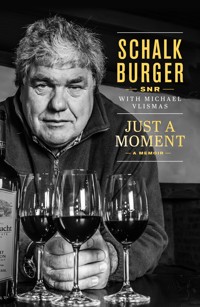
'It was never my dream to become a Springbok rugby player. I wanted to become a designer of Formula 1 racing cars.' In Just a Moment, Schalk Burger Snr, one of the greats of South African rugby, shares the many layers of his colourful and eventful life. Rugby legend and businessman, wine farmer, cultural custodian, musician, father and grandfather, Schalk Burger takes us on an intensely personal and honest journey through the triumphs and hardships that have shaped the life of this much-loved South African. Burger is a storyteller extraordinaire and will have you snorting into your beer as you read about run-ins with officialdom, fisticuffs on the field, how he became the first white Springbok selected from a coloured team, and the day Cheeky Watson asked to wash his feet. This is a glimpse into the life and times of one of the country's most recognised figures, told through the stories of the many lives that have intersected with his. 'Who am I, and how do I live? That is something this story will bring out of me.'
Sie lesen das E-Book in den Legimi-Apps auf:
Seitenzahl: 428
Veröffentlichungsjahr: 2021
Das E-Book (TTS) können Sie hören im Abo „Legimi Premium” in Legimi-Apps auf:
Ähnliche


















JUST A MOMENT
— A MEMOIR —
SCHALK BURGER SNR
AS TOLD TO MICHAEL VLISMAS
Jonathan Ball Publishers
Johannesburg · Cape Town · London
CONTENTS
FOREWORD
PERSONAL CIRCUMSTANCES MADE ME extremely reluctant to accept the invitation to write the foreword to this book.
More so, by choosing me for this role, it may create the entirely incorrect impression that this book is mainly about rugby. Schalk stood firm against my resistance, and the result is here I sit, three-quarters of the way through a bottle of the finest Cape Blend, searching for inspiration to appropriately introduce Just a Moment, or what I would describe as Schalk’s terroir – his Pictures of Life.
Schalk and I have, over the past 50 years, been acquaintances, teammates, adversaries, combatants (physically and verbally) and finally, in our latter years, close family friends. So I start reading Just a Moment with an attitude of, ‘I know this guy so well.’ Very soon, the book introduces a new frame of reference for understanding the complexities that make up this versatile man.
A complex wine doesn’t only have one flavour through it, it starts off one way, then different notes emerge mid-palate and on the finish.
– Margaret Rand
The notes and reflections on his early childhood, his very ‘different’ love for and relationship with his parents and siblings, and his final, lasting pledge to his father to ‘look after the family’ are significant markers in his life and an early introduction to a renewed appreciation of Schalk.
Myra, as is her way, is quietly woven throughout the fabric of their family journey as Schalk shares their joy and the near devastations of parenting their remarkable offspring, Schalk Jnr, Tiaan and René.
Schalk is a pilot, sailor, golfer, cricketer, musician, mountaineer, promoter of the arts, businessman, arbitrator, counsellor, activist and – perhaps his over-riding passion – farmer. I have travelled with Schalk to many parts of the world and have always enjoyed the surprise of new acquaintances as they encounter this giant from Africa with the biggest hands in the world, and experience his sharp intellect, humour, libertarian nature and musical talent.
And, yes, there is some rugby. It is a ringside seat to Schalk’s own career – the triumph, fun and laughter of his playing days, but also the consequences and retrospective sadness of playing rugby (as we of that generation did) in a deeply troubled and divided country. There is also a close-up view of the intrigues, politics and business of rugby, in particular the emergence of professional rugby.
Schalk and I do sometimes differ on the interpretation of some of the events that shaped our rugby and also of the people in and around the game. We will vigorously debate these things, as we always do, and I will also take him on to contend that you can move forward in rugby by passing the ball.
‘Who am I, and how do I live?’ Schalk muses, and hopes to find the answer by writing this memoir. And so, whatever the outcome, I hope he continues to tend lovingly to the soil at Welbedacht, cherish his family, enjoy his friends, laugh and play music.
Thanks, Schalk, for sharing your personal journey and taking us below the surface of what we thought we saw.
The first step that leads to our identity in life is usually not ‘I know who I am’ but rather ‘I know who I’m not’. – Matthew McConaughey
Morné du Plessis
INTRODUCTION
CHARTING THE SOILS
I LOVE A GOOD STORY, and I’m thinking of one now, here on my farm Welbedacht in the wine-growing region just outside the Western Cape town of Wellington.
It’s the story of this piece of land. A story that began 520 million years ago.
How do you even begin to tell a story of time and moments and things unexplained that shifted and moved the earth, and opened up mystical pathways for rivers such as the beautiful Berg, which runs through Wellington?
This place where I stand is the story of Paarlberg, Paardeberg, Groenberg and Kasteelberg. And the ridge of Porseleinberg. I have always loved that name. As a wine farmer, I’ll tell you the name of this story. It’s called terroir. And terroir influences everything around it.
The story told by terroir creates pictures of life at various periods. These pictures drift down into the soils, washed by thousands of years of wind and heat and sun and water and the cool evening breeze that blows here. These pictures, these glimpses of moments in time, are every bit a product of their elements, and the soils are the custodians of these stories. This is why I love farming so much, because the soil tells our stories.
When I came to this farm in the Boland basin, before I could plant my new cultivars to begin making wine, I went through a process called the charting of the soils. People who know more about such things than I do will tell you that this is when the topography of the land that is to be planted (a block of land, as farmers call it) is charted to indicate its various outlines relative to north, and its elevation, and gradient or fall from the highest to the lowest point. A consultant will ask you, the farmer, to dig what are known as profile holes two metres deep. He will then climb into these holes and from there will be able to read the story of the land like a beautiful book. And the stories that lie in those soils will tell you what you can plant, and how.
I remember digging those profile holes with my trusty Massey Ferguson digger. I was told that such an unwieldy machine, with its modern hydraulics, was not suited to such a delicate task. But as a man with unusually large hands, which I have used to play rugby, guitar and even execute a certain amount of finesse on the golf course, I felt my Massey Ferguson was perfectly suited to this task.
Digging your profile hole is one thing. Reading it is, quite literally, another story. If you aren’t attuned to the kind of story you are reading, you won’t see a thing in those soils. And if you climb into that hole expecting to read a particular type of story, you will never see the real heart of what is before you.
And so Paul Feyt came into my life. A quiet-spoken man, he has seen most of the Swartland from below ground level, having climbed into countless profile holes and read many stories of the soil in his lifetime. Paul climbed into the profile hole on my farm, armed with an archaeologist’s pick, a pocket notebook, a pen and a 30-pack of cigarettes. Once at the bottom, he hunched down and began reading the book of the land before him. Every now and then his head would pop up like a meerkat for a look around, and then he’d duck down again to make more notes.
‘God made this,’ he told me. ‘If you don’t read it carefully, as you would read the Bible, you’ll never know what to do with it.’
For Paul, it was an aberration to stand on a piece of land, and simply by looking at it, decide what you will plant. How could you do that when you have no idea what lies beneath? Who could ever judge a piece of land simply by scratching at the surface? Especially when what lies beneath is a story 520 million years old and part of the collective Cape Granite Suite, which is referred to as the ‘parent geology’ of many of South Africa’s vineyards. The arrogance of man, he reasoned, who is but a passing thought on these timeless soils.
I have never forgotten this, and I have used it as the foundation of everything we do as a wine estate at Welbedacht. I am nothing but a custodian of the land here. It’s been here for 250 million years, since the Malmesbury intrusion, which shaped my beloved Groenberg, and which in turn is shaped by soils from 550 million years ago when the supercontinent of Gondwanaland split. What am I but a brief, passing phase in such a great expanse of time? And I am very much like the vine that is planted in this soil. The vine is a factor of the place where it lives and breathes. Its home. Home. Who am I, and how do I live? That is something this story will hopefully bring out of me, as well as the influence on my present-day thinking of mentors such as Dr Danie Craven, who drilled into my head at every training session that you play rugby the same way you live your life.
The French say that the dear Lord provides, and we on Earth can only care for it. On our wine farm, we can only produce this year what the Earth allows us to produce. Through fires and droughts, ours is a product of the elements, and we can only live the elements and not control them.
So how do I tell this story?
Well, maybe we need to start as Paul would tell me to start: by digging below the surface of what you think you see.
I should warn you: what you find may surprise you. Some of it may even offend you. If it does, I apologise.
We’ll start with the obvious. But I guarantee you that what we uncover as we dig deeper will most likely be far from what you expected.
So let’s begin.
––– PART ONE –––
SPRINGBOK
1
FROM RACING CARS TO RUGBY
IT WAS NEVER MY DREAM to become a Springbok rugby player. I wanted to become a designer of Formula 1 racing cars.
In the 1960s, when I was growing up, my childhood heroes were not rugby players. They were racing drivers like Stirling Moss, Jody Scheckter and Jackie Stewart, and motorcyclists like Giacomo Agostini and Jon Ekerold. My younger brother Johann and I would cycle 70 kilometres from our home in Paarl to the Killarney racetrack in Milnerton to see my other racing heroes, John Love and Sam Tingle, take part in single-seater races. We would climb the big bluegum tree on our favourite corner of the track, named Malmesbury, to get a better view of the racing cars.
One day we saw a blue Renault Gordini totally out of control and sliding around into this corner. It belonged to a young driver named Jody Scheckter. We immediately took a liking to him purely because of the way he drove. It always looked as if he was headed for a serious accident, and then at the last moment he’d escape disaster. And with every lap he improved his position in the race.
In our minds, a hero was born through his daring, skill and youth. We spoke endlessly about his races as we pedalled the long road home. I also loved Ekerold because he had won a World Championship as a South African privateer riding a self-modified motorcycle, and beating big brand names such as Kawasaki in the process. That kind of pioneering spirit really resonated with me. I loved that mindset of taking on the big guys and beating them.
I spent most of my childhood years tinkering with engines and opening them up and rebuilding them. I redesigned or rebuilt everything I could get my hands on. My friends who had motorbikes benefited from my curiosity, as I was constantly looking for ways to improve their performance.
I had a really fast Ford Anglia at one stage. It had a problem stopping, though, even after I acquired disc brakes from a scrapyard and ground them into place. And it had a wicked speed wobble that developed at 50 kilometres per hour. This was because the ball joints had once expended themselves in trying to get a poor-handling car full of students to corner as quickly as possible around a roundabout, with two cars in hot pursuit. One was filled with the students we were racing against. The other was a police car chasing us. The extra-big rims and tyres on my Anglia were just too much for those ball joints to handle.
I was a keen sailor growing up, and it’s something that has stayed with me my whole life. Someone who really spoke to my adventurous spirit was the South African, and international, sailing legend Bertie Reed, who caught the world’s attention with his performances in the singlehanded round-the-world yacht races of the 1980s and early 1990s, then known as the ‘Everest of sailing’. His exploits were filled with the kind of daring adventure I loved, such as when he rescued fellow South African sailor John Martin – funnily enough, a man with whom I would cross paths in my early rugby career – whose boat was sinking after it hit an iceberg in the Southern Ocean during the 1990–1991 BOC Challenge. Reed’s exploit earned him the Woltemade Cross for Bravery – then South Africa’s highest civilian award for bravery.
Flying was another great passion of mine. Here it was legendary US Air Force test pilot Chuck Yeager who captured my boyhood imagination. Years later an army friend, Graham Fig, gave me a copy of Yeager’s autobiography, signed by the great man, which he’d purchased at the Oshkosh air show.
It was only much later, as I approached the end of my school career, that rugby started to feature more prominently in my mind. And then it was players such as Frik du Preez, whose autobiography my dad gave me as a birthday present, and Jan Ellis, who I had the privilege of playing against in my second senior provincial rugby match, who inspired me.
I played rugby at school, but even at school sport was not my main priority. I enjoyed the academic and cultural side of school far more, and had a particular love for subjects such as maths, chemistry and accounting.
My love for culture led me to music, and I taught myself to play the guitar. I couldn’t read sheet music to save my life, and still can’t, but I learnt by watching people play and then memorising the chords. Then I would number the chord sequence so I could remember it. In that way I developed my own numbering system for guitar, and it’s served me very well. In fact, during my schooldays I used to make a bit of pocket money giving guitar lessons to my friends. My rudimentary numbering system proved quite lucrative for me.
But my childhood dreams and aspirations were of a largely technical nature. How does an engine work? How can I build a faster motorbike? How do you navigate a yacht around the world?
That was my world, and those were the dreams in the mind of a boy from Paarl. The ultimate dream was to finish school and then raise enough money to travel to England, study at the Birmingham School of Design (later Birmingham Polytechnic) and work for Tyrrell Racing designing racing cars. Tyrrell was the famous Formula 1 team, founded by Ken Tyrrell, that dominated motor racing in the early 1970s with Jackie Stewart as driver, as well as other greats such as Jody Scheckter and Jacky Ickx.
It’s safe to say that Springbok rugby was quite far down my list of priorities when I was growing up.
My brother Johann, who at that stage was impressing as a highly talented provincial cross-country and track athlete, shared this dream with me. So when I completed school, he was adamant that I couldn’t leave for England without him. I still had to complete my compulsory national service, so we agreed that I’d do my time in the army and wait for him to finish school, and then we could leave together. That would also give us enough time to save the money we needed.
And then my life changed direction completely. I was about to embark on a path with as many twists and turns as the racetracks I loved.
It was a phone call in September 1974 from Dr Danie ‘Doc’ Craven, during my army days, that changed my life.
Typically, I had my hands deep in the engine of an army truck that I was repairing when that phone call came through.
Our squad captain came to find me and said I needed to report to the commandant’s office at 10 am. The commandant was on the phone when I arrived. He handed me the receiver and said, ‘Doc Craven wants to talk to you.’
My response was, ‘Who?’
Of course I knew who Doc Craven was, but only by reputation. My rugby had started to move in a direction after school, but in my mind it wasn’t at the point where I should be receiving a phone call from the great Doc Craven. So I was a little confused as to whom the commandant was talking about.
‘But I’m not sick,’ I said. The commandant just shook his head and handed me the phone.
‘Hello,’ I said, and the voice on the other end announced, ‘This is Dr Craven from Maties rugby. Mannetjie, what are your plans next year?’
I told him I planned to travel to England to work for Tyrrell designing racing cars.
‘Resieskarretjies,’ he said. ‘Hoe op aarde is jy so geïnteresseerd in resieskarretjies?’ (How on earth are you so interested in racing cars?)
I explained my dream to him.
‘So you don’t want to play rugby?’ he said. ‘I’ve been told you’re Springbok material, and I know you won’t become a Springbok unless you come and play rugby in Stellenbosch.’
He asked whether I would consider studying at Stellenbosch, and I told him I’d need a bursary to do that. We grew up poor, as I’ll explain later, so whether it was pursuing my dream in England or going to study in Stellenbosch, money was always going to be a problem.
Doc Craven ended the conversation by saying that I should speak to the commandant about bursary options, and leave the rest to him.
When I put down the phone, the commandant said to me, ‘Burger, how many young men get that kind of offer? Doc Craven wants you to come to Stellenbosch.’
I had a real problem at this stage, as I had been tested to study either engineering or medicine at university, and both these academic options were no longer open for entry. The applications had closed in June that year. Economics was another field I had considered.
But Doc’s phone call made me think twice about my plans. The commandant informed me about the South African Railways Bursary, which was one of the best in those days. I decided to apply for the bursary, and to my surprise I got it. And that’s how I ended up going to Stellenbosch to play rugby for Maties under Doc Craven, and studying commerce.
I have a painting in the living room of our home of Doc Craven, painted by the renowned Pierre Volschenk, who was commissioned by the University of Stellenbosch to also produce a commemorative bronze statue of the legendary man. It depicts him from behind, standing with his dog, Bliksem, at his side as they both look out onto a rugby field. I often look at the painting and wonder how different my life would have been had Doc Craven not come into it when he did – had it not been for that phone call.
It also meant that Johann’s and my paths started to split as we embarked on two very different journeys. I was now off to Stellenbosch to take my rugby career to the next level under Danie Craven. I really didn’t know what to say to Johann about the change in plans. I loved my brother dearly and we had handled our difficult family issues together.
We decided that it was perhaps best that he go and study, but this was also easier said than done, because he’d barely scraped by in school. However, we managed to get him into the Wellington Teachers Training College, where he qualified as a teacher.
But then his life took a different turn as he joined the army, where he would go on to become one of South Africa’s most decorated Recces (the renowned Special Forces division of the South African Defence Force). And, in our own ways, we would both be exposed to the power, influence and skulduggery of South African politics.
In my case, politics almost ended my rugby career before it even began. My senior rugby career was a tumultuous, roller-coaster journey. As Doc Craven himself once said to me, ‘Burger, wherever you are, drama seems to be nearby.’
2
‘SKREEBORSIE’
DOLF VISSER WAS ONE of the best coaches I ever had. He had to have been a visionary, especially when it came to me, because nothing about who I was on a rugby field during primary school at Paarl Gimnasium could ever have suggested that I would one day become a Springbok.
I was a gangly young athlete who suffered from asthma. Severe asthma. In Sub B (Grade 2) I spent nearly a year out of school because I had contracted double pneumonia as a complication of my asthma. I spent three months in the Red Cross War Memorial Children’s Hospital in Cape Town. A professor at the hospital told my mother that he thought my condition might improve if I did sport at school. It then happened that my teacher, Mr Visser, intervened and said he thought rugby would be an excellent choice for me. And that’s how I started playing rugby.
My mother taught Mr Visser how to prepare my old-fashioned asthma pump, and he was more than happy to carry it with him and take on this responsibility for me. And so began my rugby career.
But perhaps I should clarify that my career began more with a wheeze than a bang. My nickname on the rugby field was ‘Skreeborsie’ (whistling chest), because I would always play flat out, and then my chest would begin to wheeze because of the asthma. And that’s when Mr Visser would run onto the field with the asthma pump, into which you poured the medication. Years later, he told me that he was surprised how he didn’t do permanent damage to me, because it was always a guessing game as to how much medicine you had to put into the pump; when he was anxious or my chest was wheezing more than normal he would unintentionally put a bit more medicine into the bowl. He was a bit worried that he might have overdosed me at times. At least there was no drug testing taking place.
I started my rugby career playing at prop, believe it or not. It was later in my school career that I moved to lock, and then to eighthman.
Although sport wasn’t my main priority at school, I soon grew to love expressing myself on the sports field. And there was one overriding reason for that. The sports field is the most incredible leveller. It didn’t matter what neighbourhood you grew up in or what size house you lived in. And that meant a lot to a poor boy from the wrong side of Paarl.
Me in Sub A (Grade 1) at Blackheath Primary, where we used to be four classes in one classroom. I sometimes went to school by donkey. The only clothing I knew was a khaki shirt and khaki pants.
I am the eldest child in our family, and my three siblings were all very good in their respective sports. Johann was a Western Province and South African champion in the 800 metres and 1 500 metres. The first cross-country race he ever ran at school was a trial for the Western Province schools team. And he won. But I remember him coming home that day and we asked him where he’d finished overall. He said, ‘I don’t know. We’ll have to see.’ In those days you had to listen to the radio to get the sports results. So we all listened carefully for the results, and there was a report about a Johann Burger who had impressed everybody by winning the Western Province cross-country trials.
My sister, Laura, was also a good runner. But my youngest brother, Paul, was probably the most talented of all of us. He was a provincial athlete and also played tennis, cricket and rugby for his province. Paul was a South African champion in discus and high jump. Paul and André Pollard, the father of Springbok flyhalf Handré, were training partners for many years. Paul beat André for the gold medal in the hammer throw at the South African Championships one year.
Many of my friends, themselves top sportsmen, tell me they think Paul was probably the most prolific school sportsman Paarl has ever produced. In his second-ever South African Under-19 pentathlon he set a South African record that stood for many years. He was also an excellent tennis player. He used to play left-handed against my children and still beat them. I think he was too talented, actually, but we’ll get to that later.
As for me, as I said, sport was never my first priority. But I discovered that I was fairly good at it. Apart from rugby, I was also a provincial athlete in discus, shot put and, would you believe it, high jump. My first sporting love, though, was actually cricket. It still is. The same can be said for Schalk Jnr. I think he could’ve had a successful career as a professional cricketer as well. He was already playing for the first team at Paarl Gimnasium when he was only in Grade 8, and he played provincial first-class cricket while still at school.
I’ve built a cricket oval at Welbedacht, and we’ve hosted some incredible matches where some of the international greats of the game have played when they’ve come to visit. I have an extensive library of cricket books, and I even planted some of the vines on my farm according to the principle of how a cricket pitch must be laid out – from north to south, to make the most effective use of the influence of the sun.
But, unfortunately for my own cricket career, my father banned me from playing the game at school. When I questioned him about this, he simply said, ‘One day I’ll tell you what the English did to our forefathers.’ And that was it. My mother, on the other hand, had plans of her own. It was well known that I had the biggest school bag in my grade at Paarl Gimnasium. My mother bought me a really big one so that she could pack my cricket kit and my books into the same bag without my father noticing. So I played what little cricket I could. My dad obviously found out about it later. He never took it further, but without my father’s encouragement in this area, I naturally didn’t pursue the game as much as I could have. I played first-team cricket as an opening bowler and number-eight batsman. I loved opening the bowling with my friend Lochie Slabber, who was originally from Rhodesia and whose father had built him his own cricket nets.
My rugby career started off at prop. My first match was in 1965 for Paarl Gimnasium Primary versus North End Primary in Paarl, and I played against a guy by the name of Hurter (no joke), who was the biggest boy I’d ever seen in my life. He was easily twice my size. He scrummed me so hard I couldn’t turn my neck the following day. I remember my dad taking a mixture of salt and vinegar in a cloth and winding it around my neck to help it heal, which was a pretty good treatment in those days except that for the next three days at school, I had this salt-and-vinegar smell coming off me, as if I’d been working in a fish-and-chips shop.
However, my aunts were horrified that I was playing rugby. They came to watch a game I played against CBC (Christian Brothers’ College) in Cape Town but left after only 30 minutes. My one aunt wrote me a long letter explaining how she couldn’t believe her nephew was playing this barbaric and gladiatorial game. But, true to both my aunts, there was always an opportunity to pass on a lesson. So in the letter my aunt said that if I really was intent on playing rugby, she wanted to leave me with a thought: she believed that to be a good gladiator, the desire to win must always be greater than the fear of losing. I put that up on the wall of our home for my children in later years, and to this day I believe my aunt knew a heck of a lot more about rugby than she let on.
The night before that CBC game my dad had a few of his friends over to our house, and they decided that I needed something extra so I could ‘bugger up those Englishmen’ the next day. So I was subjected to an impromptu scrumming session in our kitchen against these men. My face was scratched red from the stubble on their chins, and I can clearly recall that distinctive smell of nicotine and brandy that was almost like a cologne for men in those days. To this day I remember that smell and am taken back to that little kitchen of ours.
I’ll never forget our meeting at the church in Paarl – the Toringkerk, as we called it – at 6.45 am and then travelling by bus to the game. My father also drove to the city to watch the match and drive me home afterwards. On the way back it was his routine to stop off at the Klapmuts Hotel bar. It was a routine that would eventually become his undoing. Any boy who grew up as the child of a hotel-bar dad kind of knows this routine. You sit in the car while Dad kuiers.
A school photo of me in 1965, proudly wearing my Paarl Gimnasium uniform.
The owner of the Klapmuts Hotel was Issy Hodes, a cheerful old man who knew how to keep his customers happy when they passed through this sleepy little town. He was a great friend of all the farmers. He owned two Great Danes that were nearly as tall as I was. It was the first time I had ever seen such a massive dog, and I was astounded. Normally, on the piece of grass next to the hotel, the kids whose dads were in the bar would play a little rugby game while we waited. But there was no game on this day, so I sat in the car with my window open, waiting for something to be sent out from the bar. I was starving after my first full rugby match.
My father sent out a pie and Coke for me, and I was busy eating the pie when the one Great Dane casually put his head through my window and took a bite. I was so surprised at how big the dog was that I just froze and watched him take this enormous bite out of my pie. Eventually, my dad came out of the bar and we drove home. Up until this point my father had said nothing about my game. Finally, I plucked up the courage to ask him how he thought I’d played.
‘You did okay for the first 15 minutes,’ he said. ‘But then you went quiet and I don’t know why. You were all over your opponent in the scrum.’
‘But Dad, there was a reason for that,’ I told him. ‘You don’t know who the ref was.’
‘Who was the ref and why does it matter?’ he asked.
‘The other prop I was scrumming against started crying, Dad. The ref asked him why he was crying, and he said, “Brother, this other guy is hurting me in the scrums.” They were brothers, Dad, and I honestly thought the ref was going to moer me for hurting his brother.’
‘Schalk,’ my dad said. ‘At CBC, all of the teachers are called brothers by the pupils.’
3
THE ‘PROFESSIONALS’ OF PAARL GIMNASIUM PRIMARY SCHOOL
MY RUGBY CAREER STARTED to gather a bit of momentum in 1968, during Standard Five (Grade 7), when I was made captain of the Under-12 A rugby team.
That year came a major announcement. Paarl Gimnasium Primary School would be selecting a team to travel to Pretoria to play against the mighty Afrikaanse Hoër Seunskool (Affies). I knew immediately that I wouldn’t be able to go. As a family, we never had the money for extras such as this.
It was an important tour for the school. But on the day of the announcement, as we were collecting our bicycles at the bike shed, I turned to my best friend, Arrie Slabbert, and said, ‘This is a stuff-up. I’m going to have to tell Mr Visser that I can’t tour because my mom doesn’t have the money.’
Arrie said to me, ‘Listen, Schalk, I heard my dad praying for money last night because my sister is at university and he took our last savings to pay for her education. So I can’t go either.’ Arrie’s father was a policeman, and we were both dead scared of him. Arrie said there was no way he was even going to bother asking his dad for the money. I said I was also not going to ask my mom, because it would just make her sad.
So we arranged to go and meet Mr Visser together to break the news to him. Mr Visser heard us out and then said he couldn’t have his captain and star player not go on this tour. ‘Leave it with me,’ he said. Anyway, the next thing we know, Mr Visser tells us we’re going on tour and not to worry, it’s been paid for.
It was a great tour. Arrie actually has a small article from Beeld newspaper about it. There’s a photo of our team with the headline ‘Paarl Gimnasium beats Affies’. And the article mentions tries by Arrie Slabbert and Schalk Burger.
But the real highlight for me was a visit to the Impala aircraft factory in Kempton Park. It blew my mind watching these people build an aircraft, and it fuelled my fascination with engines and mechanics even more.
For years neither of us knew how Mr Visser had arranged for us to go on that tour – until we visited him shortly before he passed away.
In June 2013, I contacted Arrie, who had become very wealthy as a manufacturer of shoes and other leather products, and informed him that Mr Visser was living in Moorreesburg, but that he was very ill. I suggested we go and see him. So Arrie and I travelled out there, and I took some of my wine along. Mr Visser wasn’t in a good way at all. I opened up some wine and we started to lift his spirits a bit. And that’s when Arrie, in all seriousness, said, ‘Sir, this is a good time to clarify something.’ So now Mr Visser and I are wondering what on earth Arrie is on about.
You see, Arrie used to sit to the right and behind me in class, and he would regularly crib from me. On one occasion in Standard Four (Grade 6), Mr Visser heard me saying something to Arrie. I had disrupted his class while he was talking, so he took me outside and gave me a hiding, saying, ‘You’re the class captain and should know better. Why were you talking?’ I didn’t want to split on Arrie, so I never told Mr Visser and just left it at that, apologising for the mistake.
‘Sir,’ Arrie said to Mr Visser during our visit, ‘you remember that day in class when you took Schalk outside and gave him a hiding for talking while you were teaching?’
‘Yes, I do. Very well,’ said Mr Visser.
‘Well, I’d like to tell you that I was to blame.’
‘How?’
‘Well, it was because of me that Schalk was talking. He was actually asking me a question.’
Mr Visser was a bit puzzled by this.
‘What could Schalk have been asking you, Arrie?’
‘Sir, he asked me, “Arrie, have you finished copying? Can I turn my page?”’
To this day, once a year Arrie sends me a nice leather belt or a pair of shoes with a note saying, ‘Thanks for getting me through primary school.’
During our visit, Arrie asked Mr Visser if he had paid for us to go on that tour. Mr Visser said he would’ve loved to have done so, but he also didn’t have the money at the time, and it was someone else who paid. Arrie asked who, but Mr Visser said he had sworn never to tell, because that’s what the donor had requested. Then he thought for a few seconds and said, ‘Well, the man is dead now, so I suppose I can tell you.’
There was a man who used to sell ink to the schools, which we all used to have on our desks. His surname was De Villiers, but his nickname was ‘Ink’ so he was known as Ink de Villiers. He had paid for the two of us to go.
After hearing this, Arrie said to Mr Visser, ‘Sir, does that make Schalk and me the first two professional rugby players in the history of Paarl Gimnasium and South Africa?’
We had such a good laugh about that, and the timing could not have been better, as our dear Mr Visser, who used to give me my asthma medicine on the side of the field, passed away two weeks after our visit.
4
A TWIST OF FATE ON THE TOUWSRIVIER TRAIN
IT TOOK 25 STITCHES to keep me out of the Western Province Craven Week team. The first time, that is. When I was 17 years old.
My rugby career was moving along steadily at school, and in 1973, when I was in matric, I made it through to the final stages of the Western Province Craven Week trials. But in my second-last trial match, I bumped heads with a player from Paul Roos Gimnasium named Harry Erasmus. It opened up a huge gash above my eye, which required 25 stitches. Dr Daantjie Greeff stitched me up and said the only way I could possibly play in the final trial would be if he bandaged my whole eye closed to keep the wound from opening again. Which he did. So I played that final trial game, in the rain at Bishops, with one eye.
Although I was in the A team, I didn’t get selected. The lock who was selected in my place was a Wynberg Boys’ High player by the name of John Martin, who went on to become a Springbok sailor instead. Along with Bertie Reed, he is one of South African sailing’s most decorated yachtsmen.
So, having not made the Western Province Craven Week team, in June of that year I was included in a Paarl Gimnasium team that toured Pretoria for three games, with the main game once more against Affies. We were en route to Pretoria and had reached Touwsrivier when the train suddenly stopped. There was a man running down the platform shouting: ‘Is there a Schalk Burger on the train?’
I was in a compartment with my friends, playing cards, when we heard him. I identified myself to the man, who said I needed to go to the stationmaster’s office because there was a phone call for me. It’s amazing how, throughout my rugby career, there have been some last-minute phone calls that have changed my plans. This was another of them.
When I took the call in the stationmaster’s office, it was our school principal, Mr Gouws. He informed me that John Martin had suffered a bacterial infection and had been withdrawn from the Western Province team, and I had been selected to take his place. I was told to get off the train immediately and return to Paarl as quickly as possible. Mr Gouws would send a teacher to collect me.
Of course I was delighted at my inclusion. But I also felt really bad about dropping my teammates, who were waiting on the train. I don’t like leaving people in the lurch, and I carried this outlook into my senior rugby days as well. As I’ll point out later, it played a major part in my decision whether or not to accept my first Springbok call-up.
So, standing in the stationmaster’s office, I told Mr Gouws that I couldn’t drop my teammates; they were also counting on me. I decided that I would ask them to vote on whether or not I should go to Craven Week. Mr Gouws was astounded, because at that point Paarl Gimnasium had no representation in the Western Province Craven Week team, and I was now the school’s only chance. But he let me go ahead with the vote. I walked back to the train and told my teammates what had transpired, and asked them to vote on the matter. Amazingly, the vote was evenly split. So I made up my mind that I would stay on the train with them. That’s when one of my friends, Kippie Immelman, came out of the toilet and asked what was going on. We told him about the split vote.
‘Well,’ he said, ‘I vote that Schalk goes to play for Western Province. I’ve always wanted to brag about having a mate who played Western Province Craven Week rugby.’
That Western Province Craven Week side was a really talented team, and, playing in the worst conditions, we won all of our games. I made some great friendships there. Those that stand out for me are: Skip Krige, who was our captain; Rob Louw, who I’ll say more about later; Harry Erasmus; Danie van Niekerk, who a year later would make his senior provincial debut for the North Western Cape as fullback while doing his national service; and Peter Kirsten, who was sublime in the tricky conditions. I’ll never forget the 45-metre drop kick he converted on a field that was little more than a mud pit. He became an outstanding cricketer, but I’m sure he would’ve become a Springbok rugby player had he not injured his knee, and if he had played on regular tours.
This was also the first time I was exposed to the politics of rugby. Western Province were the host union and we had made it to the Saturday unbeaten, so everybody naturally thought we would be playing the main game at a packed Coetzenburg Stadium in Stellenbosch. Our coach also used this to motivate us to play better, and we were all well aware that a good performance increased our chances of one day playing senior provincial rugby and then hopefully for the Springboks.
Then suddenly that Thursday we were told that we would not be playing in the final game. I remember Peter Kirsten had a big issue with this. I just wanted to play anyone, to be honest. But sanity prevailed and when the final draw was made, we were down to play the final game of the tournament – against Transvaal. Well, we were pumped up, and with Peter Kirsten leading the charge, we trounced them 36–7.
And that’s how I ended up playing Craven Week rugby for Western Province (WP) – my first provincial-representative rugby. But if you look at the photo of that team, I’m the only one who doesn’t have a WP blazer, because there was never one made for me. To this day, I don’t have one. In the photo I’m actually wearing a Far North team blazer, which was light blue and the closest we could find to the WP blue. And somebody’s head is in front of me, covering the emblem.
From there, my rugby career started to move quite quickly in a certain direction. I soon found myself playing in age groups above my own, and going up against the real hard men of the game, such as Hennie Coetzee and Hendrik Schräder. And the legendary Jan Ellis, who would become my first real rugby hero – and the only man I ever bit on a rugby field.
5
THE DAY I BIT JAN ELLIS
JAN ELLIS HIT ME so hard that my teammates told me I was walking around the field in a daze for a few seconds.
But let’s go back a few years first.
At the end of my matric year, I was asked to play for Paarl in the Bailey Cup final against Stellenbosch’s Van der Stel Rugby Club. I was only 17 years old, and here I was, playing for the Paarl first team. Both my dad and my brother Johann also played first-team rugby for Paarl. We won that final against a good Van der Stel team, and with the great WP flank Rooies van Wyk as our captain. I was now headed on a path where I was playing rugby at a much higher level than my age group.
I think it was a good experience for me. I’d always felt I was a bit of a softie at school, and being around men at such an early age helped me toughen up quite a bit. The army was also good for me in that sense; say what you like about the army, it gets you to think in a particular way and forces you to become more organised in your life.
That’s not to say that there weren’t challenges for a young kid playing against men. Senior rugby was hard, and they beat the living daylights out of me. You have to remember that in those days there weren’t nearly as many rules around discipline and safety as there are in the game today, and the referees were also nowhere near as strict in policing incidents. Throwing a punch was actually considered a healthy part of the game.
I wasn’t a fighter by nature, but in those club games I learnt very quickly that it was an eye for an eye and a tooth for a tooth on the rugby field. You had to learn to hit back harder than you got hit. To this day, people who followed my rugby career think I was this big bruiser who loved a good fight on the field. And yes, I did get into some good scraps in my time. But I always joke that I just had a really unlucky record of connecting very well with the punches I did throw. And they happened to be punches that landed on some pretty big-name players.
I actually considered giving up a sport at school because I didn’t like the physicality of it. The only sport my father actively encouraged Johann and me to take was wrestling. We both hated it. When I was in Standard Three (Grade 5), I was already having to wrestle boys in Standard Five (Grade 7) because of my size.
One day, Johann complained to me that the wrestling was just hurting him too much. I was also gatvol of it. One guy in particular really hurt me every time we wrestled. I told Johann that if this guy hurt me again, I was going to bite him. Johann resolved to do the same to whoever hurt him next.
Anyway, a few days later, after Johann and I had made our decision, my dad arrived in his bakkie to pick us up from wrestling. We were waiting outside the hall on our own. We climbed in and he asked where the rest of the wrestlers were. I told him the wrestling had been cancelled, but he clearly didn’t buy my story. He stopped the bakkie and went inside the wrestling hall. That’s when I turned to my brother and said, ‘Oh, hell, Johann. We’re in big kak now.’
A few minutes later my dad came storming out, shouting, ‘Julle blerrie bliksems!’ (You little buggers!) He’d found out that I’d bitten the guy who was hurting me, and my brother had done the same to his opponent, and the coach had chased us out. It was one of the biggest hidings I can ever remember getting from my father. The good thing, though, was that we were both thrown out permanently, so at least that was the end of wrestling for us. Although I must say, for any budding young rugby player, there is no better sport than wrestling for toughening up your upper body.
It was only years later, while studying at the University of Stellenbosch, that I participated in wrestling again. In fact, the first major sports event my wife Myra, then my girlfriend, came to watch me take part in was a wrestling match. I was up against a Western Province wrestler, and I somehow managed to put a great throw on him early on in the bout. It dislocated his shoulder, and I was declared the winner. When the referee held up my hand, I was, of course, extremely proud to have achieved this great victory in front of my girlfriend. But when I looked around, she was gone. It turned out that Myra was in the bathroom throwing up because she’d never seen a dislocated shoulder before.
As much as I disliked wrestling as a kid, I followed in my father’s footsteps and taught all my children to wrestle. It actually came to help Schalk Jnr in the most unlikely way.
The 8th South African Infantry Battalion receiving the freedom of Upington in 1974. I am leading the platoon as anchor marcher (far right). Next to me is my good friend the cricketer Garth le Roux, who four years later went on to become the Kerry Packer Series’ player of the series.




