


Erhalten Sie Zugang zu diesem und mehr als 300000 Büchern ab EUR 5,99 monatlich.
- Herausgeber: The History Press
- Kategorie: Sachliteratur, Reportagen, Biografien
- Sprache: Englisch
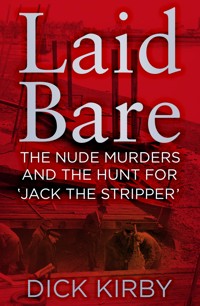
Between 1959 and 1965, eight murders were carried out in and around west London. The victims, all of whom were prostitutes, were asphyxiated. The murders were linked: the last six were all carried out in the space of twelve months. The press dubbed the murderer 'Jack the Stripper' on account of the fact that the victims were all stripped naked. The legendary Scotland Yard investigator Detective Chief Superintendent John Du Rose was brought in to orchestrate the inquiry. Du Rose flooded the night-time capital with police officers in plain clothes, and women police officers dressed as prostitutes to carry out dangerous decoy patrols. Of the 1,7000 potential suspects interviewed, the number was whittled down to twenty-six, and eventually to one. But before Du Rose could interview him, the mean committed suicide and the case was closed down. Was this man 'Jack the Stripper'? Dick Kirby, a former Flying Squad detective, has used his vast experience and contacts at Scotland Yard to re-examine the case, more commonly known as 'The Nude Murders', fifty years on.
Sie lesen das E-Book in den Legimi-Apps auf:
Seitenzahl: 382
Veröffentlichungsjahr: 2016
Das E-Book (TTS) können Sie hören im Abo „Legimi Premium” in Legimi-Apps auf:
Ähnliche


















Dick Kirby has also written:
Rough Justice – Memoirs of a Flying Squad Detective
The Real Sweeney
You’re Nicked!
Villains
The Guv’nors: Ten of Scotland Yard’s Greatest Detectives
The Sweeney: The First Sixty Years of Scotland Yard’s Crimebusting
Flying Squad 1919–1978
Scotland Yard’s Ghost Squad: The Secret Weapon Against Post-War Crime
The Brave Blue Line: 100 Years of Metropolitan Police Gallantry
Death on the Beat: Police Officers Killed in the Line of Duty
The Scourge of Soho: The Controversial Career of SAS Hero Detective Sergeant Harry Challenor, MM
Whitechapel’s Sherlock Holmes: The Casebook of Fred Wensley, OBE, KPM Victorian Crimebuster
The Wrong Man: The Shooting of Steven Waldorf and The Hunt for David Martin
This book is dedicated to my chum, Bill Maclaurin. His link with dubious company led to a flow of indispensable information.
And, of course, to Ann: till the stars grow cold
First published in 2016
The History Press The Mill, Brimscombe Port Stroud, Gloucestershire, GL5 2QGwww.thehistorypress.co.uk
This ebook edition first published in 2016
All rights reserved © Dick Kirby, 2016
The right of Dick Kirby to be identified as the Author of this work has been asserted in accordance with the Copyright, Designs and Patents Act 1988.
This ebook is copyright material and must not be copied, reproduced, transferred, distributed, leased, licensed or publicly performed or used in any way except as specifically permitted in writing by the publishers, as allowed under the terms and conditions under which it was purchased or as strictly permitted by applicable copyright law. Any unauthorised distribution or use of this text may be a direct infringement of the author’s and publisher’s rights, and those responsible may be liable in law accordingly.
EPUB ISBN 978 0 7509 6938 3
Original typesetting by The History Press
eBook converted by Geethik Technologies
CONTENTS
Acknowledgements
Foreword
Prologue
Introduction
Victim No. 1 – Elizabeth Figg
Victim No. 2 – Gwynneth Rees
Victim No. 3 – Hannah Tailford
Victim No. 4 – Irene Lockwood
Victim No. 5 – Helene Barthelemy
Victim No. 6 – Mary Fleming
Victim No. 7 – Frances Brown
Victim No. 8 – Bridget O’Hara
Enter John Du Rose
Du Rose’s Investigation
24 Square Miles of Searches – Plus Decoys
The Source of the Paint Deposits
Death by Blow-Job?
Profile of a Killer
The Suspects
… and a few more Suspects
The Cop
The Enquiry Winds Down
The Aftermath
Rumour and Speculation
Hans Christian Andersen and Co.
Cold Case
Conclusion
Bibliography
ACKNOWLEDGEMENTS
First, I should like to pay tribute to my friend of twenty-plus years Alan Moss for his splendid foreword to this book; a fellow author and a former chief superintendent in the Metropolitan Police, Alan is a well-respected historian. I also wish to thank Mark Beynon, the Commissioning Editor of The History Press, for allowing him to bully me into writing this book. I’m glad he did; it has been a fascinating experience.
I wish to particularly thank John G.D. Grieve, CBE, QPM, BA (Hons), MPhil, Professor Emeritus; and Dr Peter Jerreat, MB, BS, B.Sc., DMJ (Path), Emeritus Home Office pathologist, for their very kind and thoughtful inputs to the book.
Next, Phillip Barnes-Warden, Metropolitan Police; Linda Bailey and Beverley Edwards, chairman of the Metropolitan Women Police Association; Bob Fenton, QGM, honorary secretary of the Ex-CID Officers’ Association; Susi Rogol, editor of the London Police Pensioner Magazine; Barry Walsh, Friends of the Metropolitan Police Historical Collection; and Emily Burnell, senior pensions administrator, Equiniti Pension Solutions, all of whom were very helpful. Special thanks to my fellow author and friend, Stewart Evans, and his wife, Rosemarie, for their hospitality and assistance in researching this book.
There were a number of people I approached who, for reasons best known to themselves, refused to respond to my requests for information. There were others who did so but asked me to respect their request not to be named and, of course, I have done so. And there were a small minority who provided pertinent assistance completely anonymously. Whoever you are, please accept my thanks.
Others who were not so shy appear in alphabetical order: Terry Babbidge, QPM; Brian Baister, QPM, MA; Robert Bartlett; Rod Bellis; Ken Bowerman, GM; Keith Buxton; Geoff Cameron; Janet Cheal; Bob Cook; John Cox; Roger Crowhurst; Mo Darroch; Kevin Gainford; Bob Hayday; Alan Jackaman; Bryan Martin; Jeannette McGeorge; Paul Millen; Michael Nadin; Michael Nesbitt; Barry Newman; John Newman; Gerry O’Donoghue; David Parkinson; Albert Patrick; the late Arthur Phillips; David Pritchard; Peter Quested; Leonard ‘Nipper’ Read, QPM; Bob Roach; Jane Rogers; John Strachan; Peter Westacott; David Woodland and Keith Yeulett.
Photos were supplied by Ken Bowerman GM, David Weir, David Woodland and from the author’s own collection, and whilst every effort has been made to trace copyright holders, if there are any errors or omissions, The History Press will be glad to insert the appropriate acknowledgement in any subsequent printings or editions.
My thanks, as always, to my son-in-law, Steve Cowper, for guiding me through the minefield of cyber-land and my love and admiration goes to my children, Suzanne, Mark, Robert and Barbara, and to their children, Emma Cowper, B.Mus., Jessica Cowper, B.Mus., Harry Cowper and Samuel and Annie Grace Jerreat.
Most of all, my love to my wife Ann; together we escorted each other from the grip of that pernicious disease, cancer.
Dick Kirby, Suffolk, 2016
FOREWORD
The ‘Nude Murders’ that occurred near Duke’s Meadows and the Heron Trading Estate in 1964–65 have all the hallmarks of the classic murder mysteries that have kept authors and journalists busy for many years, but they have never before received the authoritative analysis and style of attention given to them by this book. They were as serious as the Whitechapel Murders of 1888–89 by ‘Jack the Ripper’ and they shared many characteristics. They involved prostitutes and remained unsolved, despite many police resources being sent to the area. They engendered much speculation, by newspapers and others, about potential suspects, including well-known people or even a police officer. There were indirect connections to the concerns of the government, in this case the Profumo scandal. The Nude Murders have not generated books and TV programmes on the industrial scale given to the Whitechapel Murders, but that is not because they were any less noteworthy or intriguing.
Seventy-six years after the Whitechapel murders the police had the advantage of fingerprint technology and many forensic science techniques unknown to their Victorian counterparts, but the Nude Murders nevertheless remain unsolved. The perpetrator disposed of his victims’ bodies in a far more calculating fashion than ‘Jack the Ripper’. The investigation teams made heroic efforts, and spent countless hours and days searching for and cross-referencing information, necessarily using methods that today’s computers would make redundant, if not laughable in some respects. Reputations were at stake in the Metropolitan Police. The world of prostitutes and their unsavoury clients is not something that is generally well known, even within most parts of the police, but the investigation made commendable efforts to work alongside this murky world of vice in order to catch the one crucial insight that might have led to the offender. Luck was not on the side of the police in this case.
Any police officer likes to know the inside story of who really did what, and many of us, especially when retired, like to air our insights into the mysteries that have covered the pages of the newspapers. Because the investigations are still within the living memory of some of the surviving officers from the team, this book, unusually, tells us what some of them thought about the case, and how they regarded the officers in charge of the investigation. We know some of the funny stories that occurred in those dark streets late at night. We can read about the enormous effort that was put in by teams of forensic scientists and how the mysterious marks on the victims’ bodies were painstakingly traced to a specific location on a trading estate. We know the lines of enquiry that were followed, and can even consider the arguments about whether the cause of death was connected to the sex act that may have taken place. We know what the author thinks of people.
This book provides many valuable insights into a large-scale murder investigation and gives us an intriguing picture of the dark world of vice-related crime. This book gives us real history.
Alan Mosswww.historybytheyard.co.uk Orpington, Kent November 2015
PROLOGUE
Before this opus into the investigation of the murders of eight unfortunate young women gets under way, I need to advise you of a cautionary tale.
Nearly forty years ago, I was a detective sergeant in the Metropolitan Police and I was seconded to a murder squad in east London.
The circumstances were these: a 32-year-old housewife, who lived with her husband in a terraced house in a pleasant neighbourhood, appeared not to have an enemy in the world, with the exception of the person who had attacked her in the hallway of her home, as the victim answered the door to him – or her. She had been subjected to a ferocious attack with a sharp-bladed instrument that had left her lifeless body with so many stab wounds, front and back, that it was difficult to count them. It was, as someone remarked (and without the slightest hint at irony or disrespect) that she was ‘as perforated as a postage stamp’.
And yet it appeared there was no motive for the attack – no sexual molestation, no robbery – and what was more, no weapon and no witnesses. Yet the hallway was splattered with the victim’s blood in which the perpetrator would have been absolutely saturated and as he – or she – sauntered away, into the street in broad daylight, nobody saw a thing.
As most people know, the first twenty-four hours of a murder investigation are crucial; if clues aren’t discovered then, they may never be found, so all of us worked hard to secure whatever evidence there was, as well as obtaining statements and making all the necessary enquiries. But as to who was responsible for this atrocious crime, nobody had the slightest idea.
It was late on that first night as the enquiry team finally sat down in the incident room; a bottle of Scotch was produced, uncorked and poured and comments were invited from the senior investigating officer, a detective superintendent. That was the norm then and, to my mind, a sensible tactic: a chance to wind down after the rigours of the day and to assess what had been done and discuss what needed to be achieved.
As suggestions were made, the superintendent nodded, murmured, ‘Good’, and to the office manager, ‘Make a note of that.’
Suddenly, one of our number – and to save him any unnecessary further humiliation, I shall refer to him as ‘John’ – spoke up. ‘Guv’nor,’ he said. ‘I’ve got a theory about this.’
‘Yes, what is it, John?’ asked the superintendent.
‘The only thing is ….’ replied John, hesitantly, ‘Well, it is a bit outrageous.’
‘John, as things stand, we’ve got fuck-all at the moment,’ responded the superintendent testily, ‘so if you got any ideas, let’s have them.’
John smiled brightly and replied, ‘Suicide!’
Never, before or since, in the space of thirty seconds had I heard so much concentrated, blasphemous, filthy abuse uttered by so many people focused upon one person. When the tirade finished there was a silence, followed by John, in a rather hurt voice remarking, ‘Well, I did say it was a bit outrageous!’
‘Let’s book off duty, ladies and gents; early start tomorrow,’ said the superintendent briskly, giving John a piercing look that suggested that his days as a member of the murder squad might well be numbered.
Christmas came and went; still we were no closer to finding the person responsible. And then suddenly, a young woman put herself in the frame by making a number of comments that suggested that she might well be the guilty party.
Her name doesn’t matter – although suffice it to say, I have never forgotten it, or her nickname – and she was an oddity. She had already tried to burn down a police station and was an obsessive pinball machine player, possessing enormous concentration to register high scores. She was not, she told me, a lesbian but she had a very masculine appearance, complete with cropped hair, a bulky physique and heavy boots and she was fanatical about boxing and martial arts. I spent hours on end talking to her about boxers, their fights and their training methods and she would come alive, joining animatedly in the conversation, adding comments of her own; but when I turned to the question of the murder, she shut up like a clam.
As I mentioned, there were no witnesses to the murder but there had been another murder committed a few miles away with a great many similarities to this one; and in that case, there was a witness – an off-duty bus conductor who had seen a suspect run off. He thought that this person was male – but that was exactly what my crop-haired, intrepid pugilist looked like. So I told her that I intended to put her up for identification in respect of that murder; she refused. I informed her that an identification parade was the fairest way of dealing with the matter and that the alternative was to be confronted with the witness. Still she refused, so I had the witness brought to the station and as she waited for the confrontation, she showed her first sign of emotion; she trembled uncontrollably, like a leaf in an autumn gale.
Now, I was in no doubt as to her culpability. The witness came into the room and looked at her for a full fifteen seconds. Finally, he turned to me and shook his head. ‘I’m sorry,’ he said. ‘I just can’t be sure.’
And so, I had to let her go. Eventually, with every avenue having been pursued exhaustively and fruitlessly, no arrests were made. The murder squad was wound up and I went on to pastures new.
But I never forgot the suspect. I had no doubt that not only was she the murderer in my case, she was also responsible for at least one other murder as well and I felt sick to my stomach that I’d had to let someone as dangerous as her out on the streets to possibly kill again.
While this did not become an obsession with me, even after two decades of retirement, from time to time, I still thought of her. And then one day, I bumped into an old friend who, coincidentally had carried out a ‘cold case’ review of the investigation. It transpired that my suspect was exonerated completely; the real murderer (now dead) had been identified beyond the shadow of a doubt. The other murder, for which she was put up for identification? It was not connected to the murder I’d investigated but it was linked to yet another murder, committed on the other side of London and that too was solved in a cold case review. Again, my suspect was guiltless; DNA on both victims matched that of the real perpetrator.
And therefore, the reason for this allegorical tale is this; as you read this book, don’t have preconceived ideas, not like ‘John’ and not like me, either.
Although this book gets under way in 1959, there was a break until 1964 and then for more than eighteen months there was concentrated police work, the like of which had seldom been seen before. And when the investigations were finished, there was speculation, rumours and guesswork in the press, by writers and private individuals as to the identity of the murderer. Some were well founded, others fanciful and some unintentionally hilarious.
For the purposes of this book, you must become the senior investigator. You’ll be in good company; some of the finest detectives at New Scotland Yard participated in these enquiries. Examine the facts and question everything. Look at the suspects; and my goodness, there’s enough of them – twenty-six, in all. Is there proof there, or only suspicion? Those men from the Yard didn’t think there was enough evidence but you might think differently. Were the various leads in the investigation pursued properly, or, given the resources available at the time would you, as the top detective, have taken a different course, have done things differently? As to that and in respect of everything else in this book, you must be the judge, with one word of advice from me. In the pages that follow, keep an open mind as to the identity of the murderer.
Professor David Canter, the eminent psychological profiler and author of many books, disagrees. In his excellent work, Criminal Shadows, he states, ‘Senior investigating officers will say, “I have an open mind on this one”, but no one can act with an open mind. There has to be some shape, some direction to make thought and action possible.’
I don’t entirely agree. Yes, when a lead which appears promising emerges, then follow that line of enquiry and as that great detective, the Chief Constable of the CID, Frederick Porter Wensley, OBE, KPM, would tell his subordinates almost a century ago, ‘Decide upon a line of enquiry and don’t let anything or anybody deflect you from it until you are satisfied that you have gone through with it to the end.’
The point I’m making – and one with which I feel sure that Wensley and Canter would agree – is give that lead your best shot but when it’s exhausted, unresolved, move on; don’t be dogmatic but instead keep an open mind to other possibilities.
We’ll start with an introduction to the world of prostitution and then, to paraphrase the late Bette Davis, ‘Fasten your seatbelts.’ What follows will be bumpy – no error there.
INTRODUCTION
I should think that since time began, there have been prostitutes; for the purposes of this book, whenever I use that term, I shall always be referring to those of the female gender. Let me say (and without wishing to sound overly moralistic), I have always thought that prostitution in the United Kingdom should be legalised and that brothels should be government run. In a clean environment, prostitutes would receive regular medical check-ups to free them of unpleasant antisocial diseases, payment would be subjected to income tax (a far less painful and a cheaper way than recompensing a ponce) and the women would at least be comparatively safe from physical harm. Is that being excessively simplistic? I suppose it is. Right, moral statement over.
So, prostitutes offer their bodies for the purposes of sex, regular or otherwise to men who, for an agreed sum of money, satiate their particular wants – some kind of sexual gratification – while the prostitute satisfies hers – money. Of course, things may change. With the rapid advance in the realm of artificial intelligence, by the time this book is published, ‘sexbots’ will be available for sale or hire. No argument there; these female robots will be programmed to satisfy the most extraordinary demands of their owners/leaseholders. I expect for an added thrill some of the sexbots will be infected randomly with gonorrhoea with the excited punter not really knowing if he might expect a dose of the clap. And think of the fun the owner of a sexbot could have by knocking it about, without the threat of prosecution; slightly different for the renter of such an object, of course. The lessor of such a valuable piece of property would undoubtedly look askance at a bashed-up ‘bot; after all, who’d want to hire an ugly android? Perhaps the renter would have to leave a sizeable deposit, returnable only when the owner had thoroughly checked the sexbot on return to ensure no damage had been inflicted, rather like the owner of a rented flat. Let’s leave this technological world where anything might (and probably will) happen and concentrate on the better-known prostitutes, the living, breathing variety – although in the case of eight of them, not for too long.
Errol Flynn had dealings with quite a number of prostitutes worldwide (and also suffered from a number of deeply unpleasant sexually transmitted diseases as a result) but when he said, ‘They may be sad, sick, victims, nymphomaniacs, or something else, but they deserve something better than any condemnatory term,’ I agree with him.
Therefore, while prostitutes are referred to by a number of nicknames, most of them offensive, the one that I shall use from time to time throughout this book is probably the least disagreeable: ‘toms’, which was how they are inevitably referred to by the police. Their clients are known as ‘punters’ and the men who control the toms, to cater for their welfare, protect what they see as their investment, pay their fines and knock them about for whatever reason and whenever they think it necessary, are referred to as ‘ponces’. Those who solicit for the prostitutes are known as ‘pimps’. I should mention that in the criminal pecking order, ponces and pimps are in the lower echelons (the latter slightly more so than the former) and are looked down on by other criminals, the judiciary and the police. In fact, in the 1930s, one ponce who razor-slashed one of his flock and thought himself immune from prosecution was disabused of this notion when he was run to ground in a Covent Garden pub by that legendary detective, Jack Capstick, who was known to the underworld as Charley Artful. During his off-duty hours, Capstick played bowls and cultivated the beautiful roses that habitually adorned his buttonhole. On duty, his habits were not quite so benign. Capstick effected the ponce’s arrest by drawing his truncheon and hitting him across the face with it, left and right, fracturing both his cheekbones, which also had the effect of wiping the smile off his face. He then completed the ponce’s humiliation by dragging him all the way down to Bow Street police station through lines of cheering prostitutes. Bow Street police station is no more. Nor, unfortunately are cops like Capstick1.
Women convicted of prostitution were known, by virtue of the Vagrancy Act 1824, as ‘common prostitutes’ and this expression was used for almost 200 years until it was replaced with ‘person’. Under the provisions of the Metropolitan Police Act, 1839, Section 54, sub-section 11 catered for the arrest of prostitutes who solicited to the annoyance of passers-by. The maximum fine was one of 40s (or £2) and that was the dire penalty imposed by the magistrates for in excess of the 100 years which followed. Since this niggardly amount could be replenished, back out on the streets in the twinkling of an eye, the toms in the dock could hardly wait to plead guilty. To dispute the charge meant all the longer spent at court, to delay going about their unlawful occupation, dismay their ponce and also to incur the displeasure of the arresting officer. Since the toms were pinched on a highly unofficial rota system, their usual moan was ‘It ain’t my turn!’, although by upsetting the machinery of the courts by pleading not guilty, this was a sure-fire way of ensuring that ‘their turn’ came more regularly than was desirable.
By 1888, there were 5,678 prostitutes in London; however, this number related only to those who were known to police. In the Whitechapel area of east London their numbers were plentiful, due to the number of sailors returning to England after months at sea, bringing with them huge sums in wages of which they were only too glad to impart a percentage for a little sexual gratification. At that time, prostitutes were referred to in genteel Victorian circles as ‘unfortunates’.
Emily Allen was referring to meeting her ponce, Morris Reubens, when she modestly told an Old Bailey jury, ‘I was an unfortunate and he protected me against a man who was attacking me.’ Unfortunately, this fulsome praise of her protector failed to save Mr Reubens from the gallows, since he was found guilty of murdering a sailor who was one of Miss Allen’s clients.
The numbers of prostitutes in that area started to decrease at about that time, either by falling prey to the man who became known as ‘Jack the Ripper’ or by going on to pastures new, to avoid his depredations. But the Whitechapel Murders were a stark reminder to those who made prostitution their precarious living of the dreadful risks that were allied to their occupation.
During the 1920s, fierce criticism of police by the judiciary and Parliament followed a number of high-profile arrests involving prostitution and although 2,291 arrests for that offence in London were made in 1922, the following year the number of arrests fell sharply to 650 due to the reluctance of police to take action through fear of censure, unjustified or not. In addition, a number of corruption scandals knocked the Metropolitan Police sideways and after the commissioner of police resigned, nobody else wanted the job. It was only when King George V intervened personally that his choice, Field Marshal Rt. Hon. Viscount Byng of Vimy, GCB, GCMG, MVO, reluctantly accepted the post – and made an excellent job of it.
However, new commissioner or not, prostitution was rife and by 1930 the commissioner had stopped inserting the number of convictions for prostitution in his annual report. But with the forthcoming coronation of King George VI in 1937, Mayfair residents complained about the number of prostitutes plying their trade in that area and demanded action from the police. They got it: and in that tiny section of London, policed by ‘C’ Division, 1,571 arrests were made. The following year, the number of prostitutes convicted in England and Wales stood at 3,192; of that number, again, the Metropolitan Police’s ‘C’ Division covering London’s West End, accounted for 2,298 of them.
The Second World War intervened and London was flooded with prostitutes to cater for the needs of servicemen on leave plus, of course, anybody else who required their services. A prostitute in the Mayfair area might earn as much as £100 per week (at a time when the average worker’s weekly take-home pay was £5), although due to overhead expenses, i.e. her ponce, she would keep little enough of it. Many of the toms were orchestrated by the infamous Messina brothers, who enforced a rigid ‘ten-minute rule’ with their clients, although Gino Messina later ‘increased production’ so that on VE Day alone, one of his troupe serviced forty-nine servicemen. Several wartime prostitutes were revoltingly murdered by the psychotic Gordon Frederick Cummins; when he was caught, one of the toms fearfully asked the arresting officer, Detective Chief Inspector Ted Greeno if he was sure he had got the right man. When he replied that he was, and it was therefore conceded that it was safe for the West End prostitutes to resume plying their trade, Greeno was rebuked by the Assistant Commissioner (Crime) for encouraging them to solicit.
By 1955, the number of convictions for soliciting prostitution in England and Wales now stood at 11,878 – three years later, it rose to 16,700 – and it was clear something had to be done.
The Home Secretary, Sir David Patrick Maxwell Fyfe, GCVO, PC, QC set out a confidential cabinet memorandum in which he proposed heavier fines with imprisonment for repeat offenders in order to rid the streets of prostitutes, and this led to the forming of a committee of three women and twelve men, led by Lord John Frederick Wolfenden, CBE. The Report of the Committee on Homosxual Offences and Prostitution that was published on 4 September 1957 became known as The Wolfenden Report. Primarily, the committee dealt with legalising homosexual acts between consenting adults (which, in the 26 September 1997 edition of the Pink Paper led to Wolfenden coming forty-fifth in the top 500 of the lesbian and gay heroes list) but it also discussed street prostitution, which was regarded as a ‘community instability’ and ‘a weakening of the family’. This led to the repeal of Section 54(11), Metropolitan Police Act, 1839 and placed The Street Offences Act, 1959 on the statute books. Now, a woman who had been officially cautioned twice for her behaviour by the police could be charged with being ‘a common prostitute’ and upon a first conviction be fined £10, and for a second conviction she could receive a fine of £25 or three months’ imprisonment, or both. Additionally, the maximum sentence for living off the immoral earnings of prostitution was increased from two to seven years.
And it appeared to work. Practically overnight, the streets of Soho emptied, with hardly a prostitute in sight. From 16 August 1959 – the date on which the act was implemented – until 30 September 1963, 2,856 prostitutes were sent to prison, this number including 1,349 who were committed in default of payment of fines. That’s not to say prostitution ground to a halt because, quite patently, it did not. Instead of enticing punters by soliciting them from the streets, printed cards were inserted in public telephone boxes that stated ‘French maid offers services’ and ‘large chest needs polishing’, complete with telephone numbers, and only the most dim-witted user of the telephone box could fail to understand their meaning. If the distributors of these cards were seen by police, that good old standby, Section 54, Metropolitan Police Act 1839 could be used. Although sub-section 11 had been repealed, sub-section 10 had not and it catered for the arrest of anyone ‘who without the consent of the owner, shall affix any posting bill or other paper against …’ well, just about anything, really.
So, many prostitutes stayed in the Soho area, carrying on their trade in cheap hotel rooms or flats, where the hoteliers and landlords had ‘no idea’ of the names or occupations of their tenants. Others drifted away from central London where they undercut their Soho rivals by charging only a pound or two for their services.
Let me make one thing quite clear. The prostitute victims who feature in this book were not anything like the beautiful, exquisitely dressed ‘Happy Hollywood Hookers’ who featured in any of tinsel town’s blockbuster movies and who entertained their equally glamorous clients in their pristine Beverly Hills apartments for hundreds or even perhaps thousands of dollars per liaison; neither did they resemble the jolly, ‘tart with a heart’ prostitutes as portrayed by Dora Bryan in several of the black and white, post-war British films.
The vast majority of these women had reached rock bottom; in a 1942 police report, these types of prostitutes had been rather disparagingly referred to as ‘drabs’. Desperate for a few pounds, usually dependent on drugs, alcohol and a husband, boyfriend or ponce (and it was not uncommon for these three heroes to be melded into one), often riddled with venereal disease, sometimes pregnant, they hung about in dark, unfriendly places, sometimes accompanied by a ponce (but in the event of inclement weather, usually not), waiting for a punter to come along in his car to take them to an even darker, and possibly a far more dangerous, place.
One such area was situated near Chiswick and it was known as Duke’s Meadows. Chiswick is a bustling area of west London, where just downstream from Chiswick Bridge, the crowds increase annually at the finishing post to witness the climax of the Oxford and Cambridge boat race.
A different type of climax used to be achieved in Duke’s Meadows. In recent years the Duke’s Meadows’ Trust has undertaken extensive restoration work so that one of its latest attractions is a children’s water play area, which opened in August 2006. However, this desirable state of affairs has only lately been achieved. Originally owned by the Duke of Devonshire, Duke’s Meadows was purchased by the local council in 1920 to develop the area as a recreational centre, and in the years that followed, many of those who used its facilities put a generous interpretation on the term ‘recreational’.
At the time of the murders, and for obvious reasons, it was known colloquially as Gobblers’ Gulch and it was near there that the first body was found.
1 For more about this famous detective, see The Guv’nors, Pen & Sword Books, 2010.
VICTIM NO. 1
ELIZABETH FIGG
Elizabeth Figg – she was also known as Anne Phillips – had never been convicted of any offence because her fingerprints were not on file at New Scotland Yard. Although there is absolutely no doubt that she was a prostitute, the courts had never punished her for soliciting prostitution nor had she ever been cautioned by the police for that offence. In fact, the very first time she came to the attention of the police was at 5.10 a.m. on 17 June 1959 when the crew of the night-duty area car, call sign Foxtrot Four, saw her lying with her back close to a willow tree. Behind her was Duke’s Meadows and in front of her the River Thames made its brown, sluggish way down to the North Sea. Her eyes stared blankly at the river but she was unable to see it. She was quite dead and had been for several hours.
When the area car had patrolled this part of Chiswick previously – it was the Middlesex bank of the Thames and known as Riverside Lands – at 12.45 that morning, the body had not been there.
It would have been helpful if the area of Duke’s Meadows had been policed adequately but it had not and this was due to a number of reasons. First, the commissioner of the Metropolitan Police (prior to the existing one, Sir Joseph Simpson, KBE), Sir John Reginald Hornby Nott-Bower, KCVO, KPM, OStJ must be held to account. He had a been a police officer all his life and a high-ranking member of the Met since 1933 but when he became commissioner in 1953 at the age of sixty-one, whatever get-up-and-go he had possessed had got up and gone. By 1954, the crime figures at 93,937 were the best they had been since 1946, when they numbered 128,954; this, in no small part was due to the activities of the Ghost Squad. But that select team of detectives had unwisely been disbanded and now the crime figures surged. By 1958 they had reached 151,796 and the following year the number of indictable offences in the Metropolitan Police District had shot up to more than 160,000 – and that represented the worse crime figures of the century. However, the commissioner did nothing to curtail this alarming number of offences, nor did he do anything to support the pay and conditions of the police. Another 4,000 policemen were needed to supplement the existing 16,661 officers, but with conditions so poor and pay so low, nobody wanted to join the police and, in consequence, there were inadequate numbers of officers to patrol the capitol properly. Lastly (and quite apart from the crime figures) the police workforce was being stretched in a different direction. Public disorder was on the rise; it had commenced with the Notting Hill Race Riots of 1958 and officers had been hastily drafted in from all of the neighbouring divisions to deal with this civil disobedience, as they were with the CND’s Aldermaston marches and the Committee of 100’s protests. The government made it clear that they wanted this insurrection on the streets of London nipped smartly in the bud; the officers were overworked, exhausted and the overtime demands had stretched the Met’s budget to breaking point. As the historian David Ascoli noted regarding the commissioner, ‘He was a nice man when what was needed was a bit of a bastard.’
Therefore, those were the reasons why, on the night in question, the area of Duke’s Meadows had only been visited twice by police in four-and-a-half hours – by car, not on foot.
PC Mills, the area car driver, made a quick inspection of the body. Figg was wearing a blue and white striped dress and an underskirt. The dress was torn open at the waist, which exposed her breasts, and there were scratches around her throat. The rest of her clothing, her brassiere, knickers and shoes, were all missing. So was her handbag.
Assistance was called for and Detective Chief Superintendent Ted Greeno MBE, the CID head of No. 1 District Headquarters, arrived. He had only three months to go before retirement with more than thirty-eight years’ service but, being the detective in charge of the district, he wanted to view the scene first-hand. He was accompanied by his deputy, Detective Superintendent Leonard Woolner, plus Detective Superintendent James Mitchell, who would assume responsibility for the investigation.
Mitchell was a 6ft Scot from Alloa who had joined the police in 1931 following a five-year stint with the Royal Air Force. He was liked by his subordinates and referred to as ‘Gentleman Jim’, and he had served at the Detective Training School as well as two terms on the Fraud Squad. He was not really a murder investigator, he was a plodder. Of his thirteen commendations, nine were for his ability in cases of fraud.
However, that is not to decry his abilities as a detective; he got to work and the area between Barnes Bridge and Chiswick Bridge was sealed off and a shelter was erected around the body to await the arrival of the noted pathologist, Dr Robert Donald Teare, MA, MD, FRCP, FRCPath, LL.D, DMJ.
Following a cursory examination, the body was removed to Acton mortuary, where just over two hours after his initial inspection, Dr Teare carried out a post-mortem examination. At 5ft 5½in tall, Figg would be the tallest of the victims to come. There were a number of abrasions on her body, including several on the front of her throat. Several teeth were missing, it appeared that Figg had at some stage had a miscarriage, was suffering from venereal disease and there was dried blood at the rear of her anus which, said Dr Teare, ‘could have been caused by a fingernail’. Figg had recently had sexual intercourse and Dr Teare believed she had died as a result of manual strangulation at about two o’clock that morning.
Three photographs were taken of the body at the scene, although it was claimed that, surprisingly, none were taken at the mortuary. However, one was. The corpse’s eyes were propped open with matchsticks and the resultant photograph was published in the press. Meanwhile, an ‘AS’ (All Stations) message was sent out from Chiswick giving a description of the victim and asking the stations to search their missing persons registers. In addition, CID officers were drafted in from neighbouring stations on ‘F’ Division to assist in tracing witnesses and obtaining statements. On the opposite side of the river, the licensee of The Ship public house and his wife described how, on the night of the murder at just gone midnight, they had seen the lights of a car at the murder scene that were extinguished suddenly. There was the sound of a woman’s piercing scream, which was extinguished as promptly as the car lights had been. This information was passed on to the murder squad and the usual systematic search of the area was carried out by the local uniform police, aided by the River Police, but nothing of any interest was found.
Within days, the photograph was recognised and Mrs Elsie King (who had remarried ten years previously) and her husband identified the corpse as that of her daughter, Elizabeth.
Born in Cheshire in 1938, Elizabeth Figg came from what used to be colloquially known as ‘a broken home’. It was a dysfunctional family, which broke up, made up and rowed constantly. She drifted all over the country, starting relationships with men that often ended as soon as they started and commenced even shorter employments, in and out of London, until March 1959. It was about that time that she met Fenwick ‘Baby’ Ward, a native of Trinidad and Tobago. Also born in 1938, and weighing in at 15st, Ward had a fairly impressive record as a heavyweight boxer, having won ten of his fights, lost five and drawn one. It appeared that Figg was immediately enamoured with him, not least because, as she told her stepmother, ‘he gets hundreds of pounds each time he wins a fight’.
However, it appears that Ward was being less than frank with her regarding his recent earning capacity because on 24 February that year he had appeared on the bill at Wembley Stadium and during his bout with Feleti Fred Kaho had suffered a technical knock-out in the first of what was intended to be eight rounds. It was Ward’s first fight in fifteen months and also his last professional one.
Long before London became the welcoming multicultural city which, of course, it is now, several of Figg’s friends, not noted for their high moral tone, looked askance at her new relationship. Ward arranged for her to move into a furnished room at Duncombe Road, Archway, N19, and it was then that she met a young East End prostitute, who moved in with her. Inelegantly referred to as Big Pauline, she was only 19 but she had already amassed a staggering thirty-three convictions for soliciting. Figg had commenced upon a short-lived life of prostitution only a few months prior to her death, soliciting with her new-found friend in the Harringay area at night and the area of Holland Park Avenue in the early hours of the morning. Ward apparently disliked their association, saying that they ‘larked about’ too much when he believed that Figg should be concentrating on earning at least £6 per night. Her clients were mainly men in cars and it was usually in their vehicles that sex, of whatever description, took place; neither Figg nor Pauline took their clients home.
Figg left Durley Road, N16, where she had been to see a seamstress, at about 9.30 on the evening of 16 June 1959 and said that she was going to catch a trolleybus to go to the Commercial Road. And she might have done; however, the fact remains that just over two hours later at 11.45 p.m. she met 34-year-old, self-employed builder Ernest Patrick Forrest at Endymion Road, N4. This was a mile from Durley Road and less than three-quarters of a mile from Duncombe Road. After having sexual intercourse in Forrest’s car, he drove her to Holland Park Avenue, where she told him she had an appointment, and dropped her off at the junction with Lansdowne Road at 1.10 a.m. He made an appointment to see her again at 3.30 a.m. and drove around before returning to the area at 3.10 a.m. He was spoken to by two police officers at 3.20 a.m. and waited until 3.45 a.m. When Figg did not reappear, he went home.
If Forrest’s account was right, then Figg could not have emitted the ‘piercing scream’ that was heard by the publican and his wife just after midnight, since she would have still been alive an hour later. Plus the crew of the wireless car had passed that area forty minutes later and the body was not there then. The pathologist’s view that she had been murdered at about 2 a.m. would also therefore have been incorrect and consequently, whoever it was who had screamed, it could not have been Elizabeth Figg.
It is not known if she was alive or dead when she arrived at Riverside Walk but no effort was made to conceal her body and she was left at the spot either where she was murdered or dumped there shortly afterwards. However, it is certain that she arrived there by car. There was no evidence that the missing items of clothing were removed after death. Therefore, if that was the case, it appeared that all of her clothing and her shoes were removed prior to her death – either voluntarily or by her killer – and then following her death, she was partially re-dressed (this included her underskirt) by the killer and her dress was torn open at the waist, if it had not been ripped open previously. It seemed a very odd business.
But twenty-four hours before Figg’s murder, and less than a mile away from the scene, a 17-year-old girl was attacked by a man in Cromwell Road Extension, W4, as she walked home. He kicked her in the stomach, punched her in the face, tore at her blouse and tried to strangle her. As she collapsed on the pavement, he ran off. Could the two attacks be linked? Possibly.
‘Baby’ Ward told Figg’s fellow prostitute not to tell the police that he had been poncing off her and made himself busy establishing alibis with friends at the time of Figg’s disappearance, saying, ‘a coloured man has got no chance in this country’. It was possibly one of the first times the race card was produced and since then, more than fifty years later, it has flourished. However, he need not have worried. Although Big Pauline did contact the police, during the two-month-long enquiry no real suspects surfaced.
On 18 June the inquest was opened and adjourned at Ealing Coroners’ Court until 13 August, when the coroner, Dr Harold Broadbridge, heard evidence from Dr Teare, Superintendent Mitchell (‘There was little doubt she was a prostitute,’ he helpfully told the court) and Ernest Forrest – the last person to see Figg alive. The jury recorded a verdict of murder ‘by a person or persons unknown’.
On 5 September, Figg was buried at Chiswick Cemetery. Only a detective and the undertakers were present; nobody else. It was a miserable end to an equally miserable life.




