


Erhalten Sie Zugang zu diesem und mehr als 300000 Büchern ab EUR 5,99 monatlich.
- Herausgeber: Banipal Books
- Kategorie: Sachliteratur, Reportagen, Biografien
- Sprache: Englisch
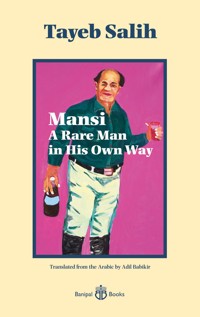
Tayeb Salih is internationally known for his classic novel Season of Migration to the North. With humour, wit and erudite poetic insights, Salih shows another side in this affectionate memoir of his exuberant and irrepressible friend Mansi Yousif Bastawrous, sometimes known as Michael Joseph and sometimes as Ahmed Mansi Yousif. Playing Hardy to Salih's Laurel Mansi takes centre stage among memorable 20th-century arts and political figures, including Samuel Beckett, Margot Fonteyn, Omar Sharif, Arnold Toynbee, Richard Crossman and even the Queen, but always with Salih's poet "Master" al-Mutanabbi ready with an adroit comment.
Sie lesen das E-Book in den Legimi-Apps auf:
Seitenzahl: 199
Veröffentlichungsjahr: 2020
Das E-Book (TTS) können Sie hören im Abo „Legimi Premium” in Legimi-Apps auf:
Ähnliche



















Mansi: A Rare Manin His Own Way
Mansi: A Rare Man in His Own Way
First published in English translation
by Banipal Books, London 2020
This translation © The Estate of Tayeb Salih, 2019
First published in Arabic 2004
Original title:
Mansi: Insaan Nadir ala Tariqatihi
published by Riad El Rayyes, Beirut 2004.
© The Estate of Tayeb Salih 2009
The moral rights of Tayeb Salih to be identified as the author of these works and of Adil Babikir to be identified as the translator of this work have been asserted in accordance with the Copyright, Designs and Patents Act, 1988.
No part of this book may be reproduced in any form or by any means without the prior written permission of the publisher
A CIP record for this book is available in the British Library
ISBN 978-0-9956369-8-9
E-book: ISBN: 978-0-9956369-9-6
Banipal Books
1 Gough Square, LONDON EC4A 3DE, UK
www.banipal.co.uk/banipalbooks/
Banipal Books is an imprint of Banipal Publishing
Typeset in Bembo
Mansi and Tayeb Salih
INTRODUCTION
Tayeb Salih: Non-Fiction Writing at its Best
With only three novels, written between 1966 and 1976, Tayeb Salih rose to international fame as one of the greatest novelists of our time.
His Season of Migration to the North has been making waves throughout the Arab world since it was first published in 1966, and across the globe once it appeared in Denys Johnson-Davies’s English translation in 1969. The highly celebrated novel immediately received critical acclaim as “among the finest six novels to be written in modern Arabic literature” in the words of Edward Said, and the most important Arabic novel of the 20th century, according to the Damascus-based Arab Literary Academy. It has been translated into more than 20 languages and selected by the Norwegian Book Club among the world’s top 100 works of all time.
While Salih has continued to be in the spotlight among critics and academia, with scores of critiques and scholarly articles focused on his work, he remained virtually unproductive for almost a decade. His last novel, Bandarshah, was published in two parts in 1971 and 1976.
However, starting from the late 1980s, Salih appeared every week on the last page of the London-based Al-Majalla magazine and over the next ten years captivated readers with his fine writings on diverse topics, including literary criticism, political commentary and reflections on life. These writings were later published in a collection of ten volumes.
One of the ten was the book in question here, published for the first time in English translation – Mansi: A Rare Man in His Own Way. The Arabic Mansi: Insaan Nadir ala Tariqatihi had been published in weekly instalments, starting in 1988, before being collected together and published in 2004. It is a unique type of writing, combining biography, autobiography, political analysis, and philosophical insight with a great sense of humour and satire.
Salih points out from the outset that the person he is writing about is not someone of note. “Yet, he was important in the eyes of a few, including myself, who accepted him as he was and loved him regardless. He was a man who had traversed life’s short journey in leaps and bounds, occupied more space than had been allocated for him, and caused quite a clamour within the realm of his existence.”
With that introduction, Salih sets us off on a hilarious journey with a friend whose rashness and indifference cause Salih tremendous embarrassment and almost costs him his job. Yet, the way Salih portrays Mansi strongly suggests the profound love he held for him.
Although Salih repeatedly pointed out that all the events in this book were “factual anecdotes”, many in the Arab world have misread the book as a novel. The confusion is partly related to Mansi, who has a unique blend of traits typical of a fictional character. A man who lived with at least three different names, and who played at least eight real time roles, from a porter to a university lecturer, and from a nurse to a clown. A penniless man who rose to the upper echelons of British society and married a girl from a prominent English family, a descendant of Sir Thomas More. A man daring enough to cross all security and protocol barriers – presenting himself to Queen Elizabeth as the head of an official Egyptian delegation, and engaging in a public debate, on a subject he knew little about, with no less a historian than Arnold Toynbee.
But it also had to do with Salih’s writing style. In Mansi, and invariably in all his other non-fiction writing, including even political commentary, Salih skilfully employs fiction-writing techniques to weave texts that seem to slip through the borders of genres. His amazing ability to mould his ideas into a captivating, coherent, and well-knitted narrative is evident throughout this book.
Another unique advantage of this book is that it provides a rare exposure to Salih’s personal life as it contains glimpses of his career years at the BBC, at UNESCO, and of his social encounters with friends in Cairo, Beirut, and other cities. Here, Salih comes out into the open without the usual camouflage of the fiction writer, unlike in his novels where he consistently hides behind an unnamed narrator who has some aspects in common with him. Through the lens of this exposure, we see a highly satirical Salih with a keen sense of humour. We also see a collected person who remains unflappable in the face of the most delicate challenges.
Apart from Mansi, the ten-volume collection, published by the Beirut-based Riad El-Rayyes publishing house and the Omdurman-based Abdel Karim Mirghani Center, included a volume on al-Mutanabbi, which contains thought-provoking insights into the verse of this legendary poet for whom Salih showed great admiration, calling him “the master”.
Another volume, dubbed Fi Rehab al-Janadriyah and Asilah (About al-Janadriyah and Asilah), focuses on two prominent cultural festivals hosted by Saudi Arabia and Morocco respectively. A third, Al-Mudi’oun kal-Nujoom (Prominent Stars), discusses the works and ideas of some prominent figures from the East and West.
The list from the West includes British politician Rab Butler (Lord Butler), British journalist Michael Adams, French literary critic and theorist Roland Barthes, British historian and journalist A. J. P. Taylor, French novelist Marcel Proust, and others. There are also dedicated volumes about Sudan, travel commentary, and other topics.
In his introduction to the ten-volume collection, Salih’s lifetime friend, the late Mahmoud Salih, wrote: “To me, Tayeb Salih is an all-rounder, with a well-founded knowledge drawn from extensive readings across linguistics, religion, philosophy, politics, psychology, anthropology, literature, poetry, drama, and media, in both Arabic and English. This collection stands witness to his superb ability to captivate readers with great narratives, analysis, criticism, and insights.”
There is consensus among those who read the original Arabic version of Mansi that only a few writers can write non-fiction as poetically and lyrically as Salih. Perhaps many of those who come to read this English translation will have the same impression.
Adil BabikirJanuary 2020
1
The man who died about this time last year [1987] was hardly anyone of consequence. Yet, he was important in the eyes of a few, including myself, who accepted him as he was and loved him regardless. He was a man who had traversed life’s short journey in leaps and bounds, occupied more space than had been allocated for him, and caused quite a clamour within the realm of his existence.
He had assumed several names: Ahmed Mansi Yousif, Mansi Yousif Bastawrous and Michael Joseph; and had played several different roles: porter, nurse, teacher, actor, translator, writer, university lecturer, and clown. He was born to a faith different to the one he embraced along the way until his death, leaving behind Christian sons as well as a Muslim widow and sons. When I first met him, he was penniless. When he died, he left behind an estate of 200 acres of the best land in southern England, that included a huge and luxurious mansion with a swimming pool, stables and a fleet of cars: Rolls Royce, Cadillac, Mercedes, Jaguar, and other makes. He also left behind a 200-acre ranch in Virginia, USA, as well as a restaurant and a travel agency.
When I heard the news of his death, I called his home in Tatchbury, on the outskirts of Southampton. A young voice answered, in an American accent. It was his eldest son, Simon, who told me his father had been in perfect health until a few weeks before when he developed a fatal liver tumour. I had been in the Sudan at the time. It occurred to me to ask about the funeral. He said a funeral had not yet been arranged, ten days after his death. They had been waiting for some formalities to be finalised before going ahead with the cremation. “But your father is Muslim,” I told him, “and cremation is forbidden in Islam.”
“We don’t know about his conversion,” he said. “What we do know is that our father was Christian and he used to tell us: ‘Cremate my body when I die’.”
“Look,” I said, “your father was indeed a Muslim. There is no doubt about it – and I was witness to his conversion. It’s a serious act to cremate the body of a Muslim. And remember, he left behind a Muslim widow and Muslim son, who is now your brother. Saying your father was not Muslim is equivalent to saying his marriage to that woman was illegal.”
I called up his wife in Riyadh, who appealed to the Saudi Ministry of Foreign Affairs for help. And thanks to the latter’s intervention, the matter was finally settled, and Mansi, as we used to call him, was given an Islamic burial ceremony a month or so after his death. However, Al-Ahram newspaper reported that his relatives in Egypt held a mass at a Coptic church. In my grief, I could not help but laugh. That’s truly what Mansi was, I said to myself, a living mystery in both his life and his death. He had always perplexed those around him when he was alive – and now, as a dead man, he was no less perplexing. To him, life was a big joke – an endless laugh, or as he put it, ‘a series of crafty games’.
He was born into a Coptic family in the town of Mallawi, deep in Upper Egypt, where he grew up. Having spent most of his time with Muslim boys of his age, he was closer to Muslims than to Copts. Although the eldest son in the family, he was a young boy when his mother died. His father remarried and had other children. They were poor but proud. And it was with great difficulty that he made his way to university. He studied English at the University of Alexandria and I can think of only a few among my Arab acquaintances who were as proficient as he was in English. Yet, it was futile to put across to anyone that this chatty dilettante could excel in anything. I, for one, spent years trying to convince people that he was a truly gifted person.
His love for the English language naturally led him to England, where he landed in 1952, after a series of adventures and ploys. He got himself admitted to the University of Liverpool. Being penniless, he had to work to support himself, taking part-time jobs as a porter, a dishwasher and a nurse. Then he moved to London. In all his moves, as he later told us, he made approaches to philanthropic societies and churches, pulling as many strings as he could.
I met him in 1953, when I had just joined the BBC Arabic service. We would give him some script-writing or translation jobs, sometimes minor roles in our drama programmes to help him support himself through his studies. He had always had a strong passion for acting. Even after he became rich, he kept coming to us seeking to take part in our drama activities and would insist on being paid. And I used to tell him: “You’re a good actor in life, but a lousy one on stage”.
Before we became close friends, he once visited me at home – he lived in Fulham, not too far from my home in South Kensington. He presented me with a pair of socks of poor quality.
“What is this?” I asked.
“A present.”
“What’s the occasion?”
“Your birthday.”
“What birthday? Today’s not my birthday. Are you trying to bribe me?”
“Sort of,” he said, laughing.
“You are hopeless. Even when you decide to bribe me, you choose something that’s worth only two shillings?”
He showed no sign of being embarrassed, though. That was one of his unique attributes: he never felt shy, deterred, or embarrassed.
Letting out a childish laugh deep from his heart, he said: “Well, I thought I should give it a try. Who knows?”
After that we became close friends. Of all our mutual friends, I was to become like a godfather to him, although we were about the same age. That was perhaps because the others – Abdel Moneim El Rifaie, Akram Salih, Abdel Hai Abdallah, Nadeem Sawalha and more – all treated him curtly and didn’t take him seriously. Deep down, though, they all truly loved him.
2
Were Mansi an inch or two shorter, he would have been regarded as a pygmy. With age he became flabby, having a large pot belly and protruding bottom, which made him look more like a ball cut into two halves: upper and lower. He paid great attention to his appearance: he would wear silk shirts and fine suits that he bought at very low prices. At first he used to buy his suits from a tailor near Holborn, who bought the fabrics at wholesale prices from Dormeuil, the well-known shop in Piccadilly. One day, the tailor was too busy to go to Dormeuil, so Mansi offered to go in his place. Taking advantage of that opportunity, he registered his name as a tailor with Dormeuil and acquired a membership card that allowed him from then on to buy fabrics at wholesale prices. But, I have to admit, he was so generous with us that he would allow us to go with him to Dormeuil’s and buy what we needed at his discounted rate.
Using his extraordinary skills, he discovered a smart tailor in the poorer East End of London, who charged a quarter of the rates of central London tailors. From that moment, this tailor became his permanent choice. Even after migrating to the United States, where he made a fortune, he continued to come back to London specifically to buy new suits and shirts. He would still buy the fabric from Dormeuil and deliver it to his favourite tailor in the East End. He would have dozens of suits and shirts made during a single visit, and he must have left behind a great number that unfortunately no one else could make use of, as I am sure there was not another person in the whole world who could fit into Mansi’s suits.
Nonetheless, he never lacked the company of girls, who would fall in love with him. Some were remarkably beautiful, and tall. When he swaggered along beside one of them, he would look like a doum tree dwarfed by a palm tree. He had a radiant, almost round face and wide saucy eyes that he would fix on the speaker without blinking. Knowing that of him, we would tease him into breaking his constant gaze and he would succumb helplessly, bursting into a childish fit of laughter.
He was also witty and had an excellent command of the English language. He was bold enough to storm into any group of people, taking liberties with them as if he were a longtime acquaintance, giving the impression that the person he was talking to – however high-ranking they might be – was inferior to him. I took him to my convocation day where, for the first time, he met an Arab ambassador and his wife, both from a ruling family. I had to leave him briefly in their company and when I came back, I was stunned to see him standing between them and patting them on their shoulders, saying between persistent chuckles: “Ah, do keep talking. What cute accents you have!”
I drew him away. “Are you crazy?” I said. “Don’t you know who they are?”
“And who on earth are they?” Even when I explained, he just said: “So what?”
Impudence was a help to him in some instances, but harmful in others. With women, however, in most cases it was a great help!
He told us once that in Liverpool he had fallen in love with a girl. They became engaged and a date was set for their wedding but unfortunately she died in a tragic car accident. He said she was his first and last love and that he would remain faithful to her memory forever and would never get married. Mansi had a strange way of expressing sadness: he would tell you he was sad, but you would not see any traces of it on him. We were taken by surprise when, shortly after that episode, he came to tell us he had got married. We then found out he had married a girl from a prominent English family, a descendant of Sir Thomas More. Some of us knew who Sir Thomas More was, but those who did not gave Mansi a golden opportunity to boast about it and explain everything to those of us who knew as well to those who did not, and in a scholarly English as if we were in a classroom:
“Sir Thomas More, the great-grandfather (many times over) of my beloved wife, is the minister and philosopher and author of Utopia. Of course you haven’t heard of Utopia, Abdel Hai. What an ignoramus you are! He was senior minister to King Henry VIII. Yes, that same king famous for his six marriages. The King sentenced Sir Thomas More to death for refusing to pay allegiance to him when he separated the Church of England from the Vatican authority in Rome. Sir Thomas More also objected to the King’s divorcing his wife Catherine of Aragon in order to marry Anne Boleyn. Understood, ignorant bunch? And oh yeah … remember Robert Bolt’s play, A Man for all Seasons? That was about Sir Thomas More. He, in a nutshell, is the ancestor of my beloved wife.”
In such situations, Mansi would be at his best, boasting about his impeccable English and in-depth knowledge of English history. Now, he seemed to have another reason for boasting: he had himself become a part of English history. Adding to our surprise, we understood that the bride, over and above all that history, was an up-and-coming pianist who played in concerts at the famous Wigmore Hall.
“But what on earth would make such a respectable lady fall in love with a mule like you?” Abdel Raheem asked.
He told us he had met her at a meeting of the Young Conservatives, the youth wing of the Conservative Party, where Mansi had a heated discussion with no less a figure than Sir Anthony Eden, Britain’s Prime Minister at the time. I am going to tell you later how Mansi outsmarted one of Britain’s most skilful politicians in a debate on the Palestinian cause, of which he knew little. But that night at the Young Conservatives Mansi believed he was great, dealing verbal blows at Eden, that veteran diplomat and politician. Mansi defended Egypt’s decision to nationalise the Suez Canal and criticised the Eden government’s adversarial policy towards Egypt. After the meeting, a kindhearted young woman approached Mansi to express her admiration of his courageous defence of his country. She invited him home and introduced him to her family. That very night, Mansi decided to marry her.
Thus Mansi underwent a complete transformation. From his small room in Fulham, he moved to a two-storey house on the famous Sydney Street in the posh district of Chelsea, where Mary and her mother lived on their own, her sister and two brothers having all married and moved elsewhere. In no time, Mansi became the undisputed master of that conservative English house. His mother-in-law, who had been brought up by French governesses and spoke English with a French accent, lived on the ground floor, so he took over the entire upper floor. Whenever we visited him, we would see him running around, up and down, issuing orders. He turned that house upside down and it would never have crossed the minds of Mary’s noble ancestors, lying in peace in their graves in the English countryside, that the kind of people who now frequented their home would ever set a foot there. Call on Mansi at home, and once he opened the door, cooking smells of molokheya, kammoneyah, kawarie, and masaqaa1 would invade your nostrils: smells that would have caused the intestines of those ancestors to writhe as they lay in their remote graveyards.
Abdel Hai, who was doing his PhD in economics at Oxford, said, in his favourite accent of Egyptian Delta peasants: “How ironic, you saeedi2, Coptic son of a … coming to England and ending up marrying a descendant of Sir Thomas More?”
Mansi’s torso, now showing signs of indulgence and a comfortable life, shook with laughter, his round face grew taut and his saucy eyes radiated with that childish laughter which was part of his appeal: “You just don’t understand, you poor peasant. Do you think it’s a big deal? Who cares about Sir Thomas More? Don’t forget I’m a descendant of the Pharaohs, the kings of Upper Egypt!”
“Who’s a descendant of Pharaoh Kings? You’re a descendant of the beggars of Upper Egypt!”
“Shut up, peasant! Just listen to what he’s saying! And he’s here to do a PhD in economics. What a joke! What have peasants got to do with economics?”
1 Popular Egyptian dishes
2 A person from Upper Egypt
3
Mansi was blessed with two wonderful qualities: genuine sympathy towards poor people, and faithfulness. He managed to maintain all the friendships he had developed over the years, adding many more along the way. He had an amazing ability to make, and maintain, acquaintances and friends of all races, sects, tastes and ranks. And he treated them all – the prince and the pauper alike – on equal terms, in his amazing down-to-earth way. He accorded special attention to poor people, and to children with whom he would be carefree and truly himself. With children, he was transformed into a child himself, and was very much one of them.
During his first visit to Doha – in the early 1970s, when I had just arrived there – he managed in a very short time to develop the acquaintance of a large number of people, who still remember him and ask about him, particularly taxi drivers.
He was the type of man who would leave a lasting impression on people – a good one in most cases, and a feeling of annoyance and alienation in rare instances. In all cases, however, whoever happened to meet him never forgot him.
No wonder, then, that he found old friends wherever he went. When he travelled with me to India and Australia, a trip I will tell you about later, a young man visited him in our hotel in Sydney. I noticed that he treated Mansi with profound respect. When I asked him why, Mansi said: “He’s the son of X, the butcher in Sloane Street – remember him?”




