


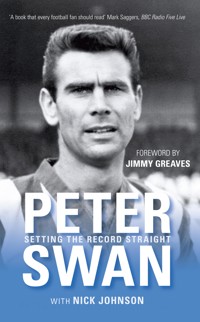
Erhalten Sie Zugang zu diesem und mehr als 300000 Büchern ab EUR 5,99 monatlich.
- Herausgeber: The History Press
- Kategorie: Sachliteratur, Reportagen, Biografien
- Sprache: Englisch
England appearances, a courtroom drama and a spell in prison were just the start. He later returned to Sheffield Wednesday's first team before going into management and guiding Matlock town to the FA Trophy, but since retiring he has faced an increasing battle with Alzheimers. Setting the Record Straight lifts the lid on what was termed 'the biggest sports scandal of the century' and all that happened afterwards for this outstanding footballer.
Sie lesen das E-Book in den Legimi-Apps auf:
Seitenzahl: 351
Veröffentlichungsjahr: 2021
Das E-Book (TTS) können Sie hören im Abo „Legimi Premium” in Legimi-Apps auf:
Ähnliche



















First published 2006
Paperback edition first published 2007
The History Press
97 St George’s Place,
Cheltenham, Gloucestershire GL50 3QB
www.thehistorypress.co.uk
© Peter Swan and Nick Johnson, 2007
The right of Peter Swan and Nick Johnson to be identified as the Authors of this work has been asserted in accordance with the Copyrights, Designs and Patents Act 1988.
All rights reserved. No part of this book may be reprinted or reproduced or utilised in any form or by any electronic, mechanical or other means, now known or hereafter invented, including photocopying and recording, or in any information storage or retrieval system, without the permission in writing from the Publishers.
British Library Cataloguing in Publication Data.
A catalogue record for this book is available from the British Library.
ISBN 978 0 7524 4437 6
Typesetting and origination by
The History Press
Printed in Great Britain by TJ Books Limited, Padstow, Cornwall
eBook converted by Geethik Technologies
Contents
Foreword by Jimmy Greaves
Acknowledgements
Introduction
1 ‘Are You Prepared to go to Jail?’
2 Football Daft from an Early Age
3 ‘I’m Going to Put You in the Middle of Defence’
4 Sleeping on the Job
5 Army Life with ‘Snake-hips’
6 ‘Mr Taylor, I Think I’m Ready’
7 ‘Go Straight Through Him’
8 Three Lions on my Shirt
9 League Runners-up
10 The Biggest Sports Scandal of the Century
11 Banned Sine Die
12 Comeback After Eight Years Out
13 Promotion with Bury
14 Wembley Cup Triumph
15 Lies in The Fix
16 Family Tragedy
17 Battling with Alzheimer’s
18 Life Goes On
Epilogue
Career Statistics
Foreword
PETER SWAN – BY FAR AND AWAYA WONDERFUL CENTRE HALF
Nineteen caps was meagre reward for such a talent as Peter Swan possessed. Without taking anything away from the glorious England team that won the World Cup in 1966, it is my considered opinion that the team Walter Winterbottom created prior to the 1962 World Cup was better.
I am firmly of the mind that, should injury not have deprived us of three key players prior to the 1962 World Cup in Chile, England would have progressed to the final and possibly won it. The loss of Bobby Robson, Bobby Smith and Peter Swan ripped the heart out of Winterbottom’s team in Chile and, with all due respect to the two Bobbys, the loss of Peter Swan was felt the greatest.
We all make mistakes in life. Mistakes are what we men call experience and should Peter not have made a mistake when young, one that ended the career of an outstanding centre half, his experience and skill as a top-class defender would have ensured he would have been a part of England’s successful team of 1966. Of that I am sure. It is not for me to pass judgment on anybody, particularly for mistakes made when young. In this book, Peter gives his personal account of matters; better he does that than anyone else.
What I can comment upon is Peter as a man and a footballer. Peter and I have been pals for over forty years and I feel fortunate to count him among my close friends. When he invited me to pen a foreword to his book, I had no hesitation in accepting. Peter was a breathtaking player; one who, in the days before football was subjected to hyperbole, was termed ‘an outstanding pivot’. His perfect physique made him a handful for opponents and, for a big man and a centre half, he possessed outstanding ball control, passing, tackling and heading ability. This football package was wrapped up in the most genial of personalities, albeit one that was too trusting of people at times.
Peter also possessed a fine footballing brain which seemed to enable him to read the minds of opposing forwards. Graft on his awesome physique and you had a defence in itself. In those heady days of the early sixties when Tottenham Hotspur became the first club to win the League and cup ‘double’ in the twentieth century and did so with such great style (and this on Christmas pudding pitches), the only club really to challenge their dominance was Sheffield Wednesday. Without doubt one of the finest of all Wednesday players at that time was Peter who, no matter how tough the going became, remained unmoved like some rock in a raging sea.
I, for one, am glad Peter has decided to commit his story to book form. It is high time he offered his account of things, related the events and story of an international-class centre-back whose career was terminated far too early and who has had to live with the repercussions of having committed one mistake in his salad days.
Enjoy this book and his story, it is the story of a great centre half and a wonderful human being. Some cynics might be given to say ‘but not the story of a great man’, but as you will hopefully realise from Peter’s story, there are no great men, only men.
Jimmy Greaves
2006
Acknowledgements
I would like to thank first of all my co-author Nick Johnson for helping me to write this book. It has been a lengthy, but rewarding process.
Thanks to Holly Bennion and Rob Sharman at Tempus Publishing for their efforts.
I am also grateful to my old mate Jimmy Greaves for writing the foreword.
For sharing their memories and helping to fill in the gaps, I’d like to thank the following people (listed alphabetically): Joe Ashton, Keith Brown, Peter Cooper, John Forrest, David Layne, Gordon Sorfleet and Derek Spence.
Others who have helped in various ways during the writing of this book include: Jonny Dennis, Helen Johnson, Mark Johnson, Colin and Paula Sedgwick, Elizabeth Swan, Peter Swan jnr, Peter Thompstone, Wayne Vaughan, Maria Walker, John White and Tom Wright. Thanks also to the staff in the Local Studies Department at Sheffield Central Library.
Introduction
My first ever conversation with Peter Swan did not get off to a promising start.
After securing a commission to write a magazine feature on Peter in the mid-1990s, I made a phone call to his pub in the hope of arranging an interview. I introduced myself as a journalist and there was a brief pause before Peter replied, ‘You guys have been chasing me for thirty years.’ It was not a response I was prepared for, but I assured Peter that I wanted to write about his whole career, not just the so-called ‘match-fixing’ scandal. Sensing his continuing reluctance to be interviewed, I offered to meet him for an initial chat without any obligation. This met with Peter’s agreement and I travelled to his pub the following week.
When I met Peter, I repeated my intention to cover his career in general and offered to let him see the feature before it was submitted for publication. To my relief, he readily agreed to the interview and we sat down in a quiet corner of the pub. I recall him joking that the locals referred to his hostelry as ‘The Crooked Swan’ – a self-deprecating aside which made me warm to him immediately. With the tape recorder switched on, Peter patiently answered my questions. When the interview was concluded, I reminded Peter that he would be shown the finished article before submission. ‘No, it‘s okay, I’ll trust you,’ he said. By the time I got round to taking the published article to Peter, one of the pub regulars had already taken a copy of the magazine to him. He told me that he was pleased with the piece, saying, ‘It’s the first time anyone has written exactly what I’ve said.’
A decade after our first meeting, I was delighted when Peter asked me to work with him on his autobiography. I had no hesitation in accepting because I felt it was a story which needed to be told. From humble beginnings in a South Yorkshire mining village, Peter went on to star at the highest level in English club football and made 19 consecutive appearances for England. We will never know what he might have gone on to achieve had the scandal not halted his career when he was at his peak.
There have been inaccuracies told about the scandal over the years and Peter wanted to give his account of what happened, hence the title of this book: Setting the Record Straight.
Peter and I have spent many hours discussing his life and career. Faced with seemingly relentless questioning, he has spoken with refreshing candour, never once refusing to answer a query, even when forced to revisit periods in his life he would no doubt rather forget.
It has been an honour and a privilege to have been trusted with the task of putting Peter’s thoughts and recollections down in print, telling the story of his remarkable life. I hope you enjoy the journey.
Nick Johnson
2006
1
‘Are You Prepared to go to Jail?’
‘Are you prepared to go to jail?’ The question posed by my solicitor, Mr Arnold, hit me like a ton of bricks.
‘I’m not, no,’ I replied, struggling to take in the enormity of what he was saying.
‘Well, you could be going to jail,’ he warned.
At that moment I realised for the first time that something big was going to happen.
How had it come to this? I was a footballer at the top of my profession, playing for Sheffield Wednesday and England, when The People newspaper ran a sensational story about a ‘match-fixing’ scandal involving myself, David Layne and Tony Kay. David and I were teammates at Sheffield Wednesday and Tony had also played for the club before moving to Everton.
The People claimed that the three of us had been bribed to fix the result of a game between Wednesday and Ipswich on 1 December 1962. The fact was that we had not fixed the game. We had each placed a bet on Ipswich to win, which they did, but none of us had done anything to affect the outcome of the match. However, a police investigation resulted in David Layne, Tony Kay and myself being charged with conspiracy to defraud bookmakers.
It had appeared at one stage that we were in the clear when a clerk from David Layne’s solicitors called in to see David one day at the café he owned in Sheffield, saying he had some good news. ‘I’ve come to tell you that it looks as if they’re dropping the case against you lads,’ he said. ‘It’s all done with, so that’s it.’
With that in mind, David went on holiday to Cornwall, thinking that everything was going to be alright. It turned out, however, to be a false dawn. By the time David returned home from his holiday, someone had apparently put some pressure on to make an example of us and made the situation even worse, so we were in deep trouble.
The case was first heard at Mansfield Magistrates Court before being switched to Nottingham Assizes. Journalist Mike Gabbert, who wrote the story in The People, was called as a witness. I’d met him briefly when he came to my house and accused me of helping to fix the Ipswich game, which I denied because it wasn‘t true. But he stood up in court to testify and said I’d confessed to everything. I couldn’t believe what I was hearing because it was totally untrue. I fixed a stare at Gabbert as he was giving evidence, desperate to catch his eye. But he wouldn’t look at me. He refused even to glance in my direction.
Under cross-examination, Gabbert admitted he had ‘left things out’ from the answers I gave him. It also later emerged that Gabbert had lied under oath. He claimed he had collaborated with the police during the course of his investigations, but a police officer told the court that The People had stated they would only provide information once the story had been published.
It was so frustrating to have to sit there and listen to people accuse me of doing something I hadn’t done. I was determined to set the record straight and didn’t hesitate when I was offered the chance to stand in the witness box and face questioning. Mr Arnold tried to talk me out of it, pointing out that I did not have to go in the witness box.
But he failed to persuade me. ‘I want to go,’ I insisted. ‘I want to have my say and explain what happened.’ When I faced the prosecution lawyer, everything I said was turned round. He cut me to pieces, saying that similar incidents to the one we got involved with had been going on regularly. I could only answer ‘yes’ or ‘no’ to the questions he was asking me. I was stopped as soon as I started saying anything else. They’re very cute these lawyers and I was tied in knots. There was absolutely nothing I could do about it.
Looking back, I wish I hadn’t gone into the witness box. I should have taken the advice and stopped out, but I’m an awkward bugger and I thought I could have my say. But it didn’t help at all. If anything, it probably made the situation worse.
Addressing the jury, Mr Peter Mason QC said:
Friday last week was a very sad day. You heard an esteemed international footballer give evidence that he had made a dishonest bet, that he had placed a bet on two football matches which he knew were fixed. You may think it took some courage for Peter Swan to go into the witness box and before this court in public give that admission.
Mr Mason said that the jury might think that I had committed a flagrant breach of one of the most important rules in the Football Association rule book. He went on:
You may wonder in view of that how much is left of the playing career of Peter Swan. Of course, certain other proceedings may follow these, certain other enquiries may have to be made by the Football Association and you may think that the probability is that this man’s professional career is in ruins about his feet whatever may be the result of this case.
I say these things because they are important in this manner: that Peter Swan from the very first moment he acted as he admitted he did, from the moment he placed that bet on these football games, had a guilty conscience. He was a man who knew right from the start that he had done wrong, he was a man who knew what the peril was if the matter came to light. He doesn’t ask for sympathy, he asks only that you discharge your oaths and hear this case according to the evidence.
Mr Mason reminded the jury of the charge against me and said I was not accused of placing dishonest bets but of being party to an agreement to ensure my team lost and it was to that that the jury had to direct their minds. He added:
You will, of course, pay regard to the fact that he has never been in any sort of trouble before and that goes into the balance in his favour. The balance has got to go down firmly on the side of the prosecution before you can convict.
Association football is a rough game and there are some rough people playing, but that’s no reason for doing rough justice. Justice is a delicate and very nice thing and you have got to be sure that it is done in this case. Peter Swan has been guilty of telling lies to the police. He has been guilty, if that be the right word, of admitting his discreditable conduct to newspaper reporters. But do these matters mean that he has been guilty of this criminal offence?
Has it been proved, have the prosecution established in the way in which they have to establish before guilt can be brought home, that there was this agreement to ensure that the match was lost? Unless you can be sure, unless you can say there is no reasonable doubt about it, having heard the evidence, can you convict him? I submit to you the evidence has far from proved this charge on this indictment and that Swan is entitled at your hands to be acquitted.
Summing up, the judge, Mr Justice Lawton said, ‘The People newspaper didn’t try them. They made allegations. We do not have trial by newspapers, we have trial by jury and it matters not what The People said about these two men. What matters is your verdict.’ The judge added that the police had investigated thoroughly and they couldn’t find another bet that we’d placed on any other game.
Apart from the mauling I had received in the witness box, everything had appeared to be going well. I’d received some great support from Mr Arnold who was a brilliant fella. It was a very worrying time of course, but he helped me a great deal. He was always positive and happy. He believed everything I said and he’d keep my spirits up by saying, ‘You’re okay, there are no problems.’
Mr Arnold’s attitude made me feel confident about the outcome and I was certainly not prepared for the bombshell that was about to be delivered when the day of the verdict arrived. Mr Arnold collected me in his car, just as he had done every morning while the court case was going on. We were sat together in the car and about to set off on our journey when, right out of the blue, he gave me the warning about going to jail. It was as though he knew what the outcome would be. These solicitors must get to know by talking to their colleagues.
On 26 January 1965, just over two years after the Ipswich match, I was faced with the prospect of losing my livelihood and going to prison. David Layne was tried separately after pleading guilty. He had been advised by his barrister that if he pleaded not guilty, all the evidence against him, which included affidavits saying that it was a one-off incident, would come out and incriminate myself and Tony Kay. He was told that if he pleaded guilty, none of his evidence would come out and be used against either of us.
David then went out for lunch and considered his options. When he returned and appeared in court, he pleaded guilty and was taken to Lincoln Prison along with another footballer, Ken Thomson. That was on the Friday and David was remanded in custody over the weekend before returning to court for sentencing the following Tuesday.
The jury retired to consider their verdict and spent just under an hour deliberating before returning to court. I waited with Tony Kay for the decision. The trial had lasted eleven days and there was a sense of relief that it was coming to a conclusion. But at the same time, my solicitor’s words were ringing in my ears, telling me to that I had to be prepared to go to prison. The tension was mounting as a deathly silence fell over the court. I steeled myself, clenching my fist, as the foreman of the jury prepared to deliver the verdict.
I can still hear the judge saying we had been found guilty of conspiracy to defraud. We were both sentenced to four months in jail and fined £100. My whole world came crashing down and I’m not ashamed to admit that I just broke down and cried. I get emotional thinking about that moment even now. I’d got a wife and four young kids and I was going to jail, leaving them at home. What would happen to them? I felt helpless.
There was not even a chance to say goodbye to anyone before we were bundled off. The police put handcuffs on us, marched us out and sat us on the bus. It was then that the realisation set in that I was going to prison. I was with the other convicted people from court and we were taken to Lincoln Prison.
At the end of the trial, a total of ten players were found guilty of conspiring to defraud bookmakers. Jimmy Gauld, who was the ringleader, was handed a four-year prison sentence and ordered to pay £5,000 costs. The other players convicted were: Brian Phillips (Mansfield), Jack Fountain (York), Dick Beattie (Peterborough), Sammy Chapman (Mansfield), Ron Howells (Portsmouth) and Ken Thomson (Hartlepool). I’m told there were others who were involved in match-fixing who escaped punishment, including one high-profile figure who went on to enjoy a lengthy career in management. The People were due to expose him the week after but they were prevented from printing any further revelations.
Gauld had a network of lower league players who rigged matches. The match-fixing that was going on at that time only came to light after Bristol Rovers’ goalkeeper Esmond Million conceded two soft goals in a game against Bradford Park Avenue in April 1963. After being confronted by his manager, Bert Tann, he confessed to letting the goals in. During the resulting case at Doncaster Magistrates Court, Gauld’s name was mentioned. Gauld wasn’t charged, but The People approached him and he admitted everything. He agreed to co-operate with their investigation into match-fixing in return for a payment of £7,240. Gauld knew David Layne from their time together at Swindon and he must have passed his name on, even though David had not been involved in match-fixing. His only crime had been to bet on a match he was involved in.
It was stated in court that Gauld made £3,275 out of bets from 1 April 1960 to 20 April 1963. The judge told him:
Over a long period and from one end of this kingdom to another, you have befouled football and corrupted your friends and acquaintances. You are responsible for the ruin of footballers of the distinction of Kay and Swan and you have ruined the life of an intelligent man like Thomson. I have not forgotten the tens of thousands of ordinary citizens who find relaxation in watching professional football. For their shillings they got not a match, they got a dishonest charade.
Going to prison was a very demeaning experience. How a criminal could want to keep going back to jail, I’ll never know. The experience should be enough to put anyone off for life. When I first got there, my clothes were taken from me and I was left to stand there completely naked while they examined me. They look to see if you’re clean and check that you haven’t smuggled anything in.
After the examination, I was given a prison uniform and then shoved in a cell with other prisoners. Just using the ‘toilet facilities’ in the cell was degrading. There were two others in my cell and I was handed a little pot to use which stayed there until the next morning. I would be sat on the pot with two fellas just a few feet away. The routine each morning was to ‘slop out’, which meant carrying the pot to the toilet block, washing it out and then returning to the cell.
They’d take you out of the cell to walk around the prison yard, under supervision, for half an hour and then put you straight back. Then it was back to doing nothing, just sitting in the cell until meal time. The meals, which were basic, were shoved under the bars. When you don’t know anything about that way of life, it’s very hard to adapt.
It was a position that I never imagined in my wildest dreams I would find myself in, but all of a sudden, I was there. I didn’t consider myself a criminal, so it was an especially shocking experience. I got very depressed and there were many times when I just curled up on my bunk bed and started crying.
Things improved when I was moved, along with David and Tony, to a prison at Thorp Arch, near Leeds. Being at Thorp Arch was like being in the Army because it’s an open prison where you’re given jobs to do. We were working on making camouflage nets at first and then they put us on the gardens.
The governor called us to his office before we were locked up and said, ‘Keep out of the way and don’t listen to any criminal. Do as you’re told and the time will fly past for you. Keep your noses clean and don’t do anything to make yourself stay here longer than you have to.’ He then added, ‘I don’t think you should be in here.’
It turned out to be good advice because the other prisoners were always bragging what crimes they had committed. They were talking about ways to break into a house and things like that. With all the tips on offer, I could have come out of prison and turned to burglary if I’d wanted. But I always kept myself to myself and tried to keep quiet as much as possible.
We were also warned by the governor that prisoners sometimes conned their way into the houses of people they had been in prison with once they had been released. Apparently, it had been known for a criminal to tell the wife of someone who was locked up that they were going back to prison the following week and their husband wanted some money.
In one of my phone calls home, I told my wife Norma to be on her guard against any such possibility. I said, ‘If anyone comes knocking at the door saying they’ve come from Thorp Arch or Lincoln Prison with a message from me, you should not let them in.’
There were no real problems at Thorp Arch. As well-known footballers, the other prisoners accepted us. There was the odd comment made, but nothing to talk about really. We played football a lot of the time. The governor arranged games for us and sometimes we’d play three times a week. In Lincoln Prison we had been treated just like normal prisoners, but the open prison was like being in the Army.
As well as David, Tony and myself, there was the old Portsmouth player Ron Howells, who’d also been at Scunthorpe and Walsall, along with Brian Phillips, who went to Mansfield after leaving Middlesbrough.
Jimmy Gauld was kept away from us, no doubt for his own safety. I think the authorities knew he would have been hammered if he’d been put with us. It’s amazing how many prisoners came up to us and asked if we wanted them to sort out Gauld. They knew we were bitter about him and offered to ‘get him’ in return for payment. But it wasn’t made clear exactly what they would have done to him if we had accepted the offer.
I was disappointed with the lack of help from our union, the Professional Footballers’ Association. Before we were even found guilty, they refused to get involved because they said the case was ‘too big’ for them. When we were at Thorp Arch, the PFA chairman, Cliff Lloyd, came to see us and he asked me if my wife and family had enough money to survive. But at that time I was still annoyed with the way the PFA had abandoned us leading up to the court case, so I told Lloyd that I didn’t want anything from them.
Sheffield Wednesday manager Alan Brown also let us down. Before we were sentenced, he promised to do anything he could to help David Layne and myself. But Cliff Lloyd told us during his visit that we could not expect any support from Brown. ‘I saw Alan Brown at a dinner last night and he said he didn’t have time for either of you,’ said Lloyd.
Brown’s reaction was disappointing, but Wednesday’s general manager, Eric Taylor, didn’t turn his back on us. He came to see us in prison and that was very much appreciated. It was typical of him because he was an honourable man who I had a lot of respect for.
I didn’t want my wife Norma to see me in that environment, so I told her to stay away on visiting days. I didn’t really want to see anybody, but of course Norma did visit and there were other family members and friends who also came. At visiting time, we were taken to a room where we would meet our visitors. It wasn’t a pleasant experience, having to sit behind a table with someone at the other end of the table.
It was a very difficult time for my family but, from the moment the scandal broke, I was given tremendous support by them and they tried to help in any way they could. When the story came out, I gathered various members of my family together one night and told them exactly what had happened, explaining that the only thing I had done was to have a bet. All the talk of me being involved in bribery, I added, was a load of rubbish. They believed what I had to say and never criticised me.
My seven brothers, who were all miners, got involved in fights in my home village, sticking up for me. They’d be in the local pub and someone, no doubt fuelled by booze, would start saying things about me, referring to the case. They would call me all sort of names and my brothers wouldn’t stand for it. The people who were shouting the abuse weren’t from the local village who knew me and my family, they were outsiders stirring up a bit of trouble.
There is no doubt that it was a testing time for Norma while I was in prison. As well as looking after four kids, she had to put up with some nutters on the phone. There were people who sympathised and wished me good luck, but there were a lot of cranks making abusive calls and we had to have the phone monitored by the police. I also received threats in the post. I had of course let down Wednesday supporters who were no doubt disappointed about what had happened, but I don’t think the threats came from fans.
I have to say that the Sheffield people, particularly those in Stannington where we lived, were brilliant. You got the odd one here and there shouting things like, ‘You bent bastard.’ But on the whole, we had a lot of support from those who lived near us. When I was in prison, our neighbours really looked after Norma, rallying round to do whatever they could to help and I’ll never forget that.
After being handed a four-month sentence, myself, Tony Kay and David Layne ended up serving ten weeks. I couldn’t wait to leave prison and when the release date came everything was arranged in secret to avoid the waiting members of the press.
David was released three days before Tony and myself due to the fact that he had been on remand. Despite the fact that it was six o’clock in the morning, there were still plenty of press people waiting for him to come out of the main gate. To help him try and avoid them, David was let out of the rear exit to meet his father who had arranged to collect him. He was carrying his football boots, which was a real give-away as to his identity, and thought he had been rumbled when a passing photographer pulled over in his car. ‘Excuse me,’ the photographer called over, ‘can you tell me what time they’re releasing David Layne?’
‘No,’ David replied, ‘I haven’t got a clue, kid.’
After driving off, the photographer realised his error, stopped and tried to get a picture of David who had by now set off running. David hid from him before dashing down the road to get in his dad’s waiting car.
When it came to the day when Tony and myself were released, we were also let out early. We should have been released at about ten or eleven o’clock in the morning, but the prison officials agreed to let us out at six. A friend of mine called Jim Grundy came to pick me up from prison and took me straight home.
I had an emotional reunion with my wife and children. I had not seen my kids at all during my time in prison because I didn’t want them to see me there, so a few tears were shed when I was reunited with them.
I was naturally delighted to be back at home with my wife and family after two and a half months locked up in a cramped, grey prison cell. But, at the same time, I was faced with the realisation that my football career was in ruins at the age of twenty-eight, when I should have been at my peak.
One thing was for certain – life would never be the same again.
2
Football Daft from an Early Age
I was born in South Elmsall, a mining village near Pontefract, West Yorkshire, on 8 October 1936. I have no memories of living in South Elmsall because when I was at a young age we moved about twenty miles away. Our new home was in another pit village, Armthorpe, near Doncaster, which is approximately five miles from the town’s famous racecourse.
My parents, Len and Alice, raised seven of us, all boys, in a three-bedroom semi. My brothers – Len, Stan, Bernard, Billy, Terry and Mick – and I were kept in check by our mother who was the gaffer of the house. She was a dominant figure who ruled my father. He’d work a twelve-hour shift every day, get his pay packet on a Friday and, without even opening it, hand it over to my mother. With a big family to look after, she had to make the money stretch a long way because of all the things she needed to buy.
We also had a half-brother, Jack, who was raised by my grandparents. My mother gave birth to him out of marriage, which was a big taboo in those days. She was at a young age and it was a terrible thing to happen. In fact, the shame forced Jack’s father to commit suicide, throwing himself down a mine shaft. When I was young, I thought that Jack was our mother’s brother and it was not until I had left school that I was told the truth.
I would imagine that my mother’s pregnancy would have been hushed up at the time and she probably rarely went out of the house for fear of people seeing that she was expecting. Then after she gave birth, the child was brought up by her parents in order to protect her reputation. In those days, it wasn’t unusual for one member of the family to be raised by a relation. With such big families, that sort of arrangement was fairly commonplace and I can remember no end of families doing that.
My parents were proud working-class people who instilled the right values in us. They wouldn’t stand for bad behaviour or foul language. In fact, I can’t ever remember hearing my mum and dad utter a swear word when we were kids. Life was far from easy with nine of us living in such a small house, but we managed. There were double beds in both bedrooms occupied by myself and my brothers and we all slept together. It helped in winter time because you were really warm when there were four in a bed. It was lucky that we had no sisters because that would have complicated the sleeping arrangements! With the toilet down at the bottom of the garden, a bucket with Dettol or Domestos in it was placed in the middle of the bedroom, in case you needed to go during the night.
My father worked at the pit top as a shunter on the railway side. He was on a very low wage and had to do a lot of overtime to make ends meet. He never did an ordinary eight-hour shift. It was at least a twelve-hour day for him, seven days a week. Sometimes he’d even be doing fourteen or fifteen hours, so we rarely saw him because he was always at work. In winter, we’d get up for school as the old fella was coming in and by the time we’d come back from school, he’d gone to work again.
There was a ‘knocker-up’ called Mr McGarry who’d wake up all the mine workers who were on day shifts. They had to get up at half past four in the morning, so Mr McGarry was employed to make sure they got up on time. He carried a long pole to help him carry out the task. First of all he’d rattle the letter box and shout through it. Then, if no lights went on, he’d knock on the bedroom window with his pole. You heard him every morning at half past four, without fail. My mum paid him something like a shilling a week and he had to knock everybody up in the village, so he’d earn a lot of shillings.
My brothers all went down the pit. Len, as the eldest, was the first to start working there and we all followed suit. It wasn’t a case of thinking about what type of job you wanted to do and then weighing up your options. Being from a mining village, you were more or less expected to work at the colliery.
They were generally hard workers in those days, but the money was poor compared to what people earn today. My mother had to take on jobs, as well as doing her household chores, to make ends meet. In the summer, for example, she would work in the farmers’ fields. Once she’d got us all packed off to school, a lorry would come along and collect her and other women in the area and take them to the farms where they would pick peas and potatoes.
We were self-sufficient to a large extent with a garden full of vegetables and livestock, which were raised for killing. There was a small play area for us kids at the top of the garden, with chickens in the middle of the garden and pigs at the bottom. When a pig was killed for Christmas, a retired butcher from the village would come along, armed with a tool known as a pig hammer. He would strike the pig’s skull with the hammer, stunning it before cutting its throat and hanging it up to let the blood drain out. The pig’s blood would be used to make black pudding. My brothers would fight for the pig’s trotters, but I couldn’t stand them. The feet would be cut off, cleaned and washed before being boiled, with the meat then picked out.
We’d always get the bladder from the slaughterman, blowing it up to play football, although it was more like a big beach ball than a football. The fact that it wasn’t a perfect round shape meant that it would bounce about all over the place and the unpredictable movement helped you learn how to control the ball. I’d also use the bladder to help improve my heading ability, spending time throwing it against the house wall and heading it back. The hen pen was only a few yards away from the back door and my dad would breed about twenty cockerels which would be killed and sold at Christmas. Instead of wringing their necks, which some people did, he always used a knife with a long, thin blade to kill them. He would hold the chicken between his legs and push the knife down the centre of the head, killing it instantly. It was quicker than wringing the neck. The bird would then be hung up to let the blood drain out.
My father wasn’t a big drinker and the only time my parents went out was on a Saturday night when they’d visit a local working men’s club. It was left to my mum to discipline us lads. My dad never hit us, but my mum would knock us all over the place! It must have been a really difficult job for her to keep us all in check and do everything that was required at home. All the washing was done by hand, of course, because there were no washing machines in those days. She’d use a washing board and other labour-intensive devices.
All the cooking was done on an open fire with an oven at the side. My mother would give jobs to me and my brothers, so we did chores like peel potatoes and bring the coal in. The coal was always tipped out on the road when it was delivered from the colliery and we would have to bucket it in to the coal house.
People take for granted having a bath or shower in a bathroom, but we didn’t have that luxury when I was a young lad. I can remember at a very young age being bathed in ‘the copper’, as it was called, in front of the fire. The copper bath would be filled with water and heated using a little coal fire underneath. The bath would also be used to boil the clothes. Because there was no time to heat up the water first thing in the morning, we’d be given a cold strip wash which was harsh, especially in the winter. Things improved in later years when the colliery installed boilers and put in bathrooms.




