


Erhalten Sie Zugang zu diesem und mehr als 300000 Büchern ab EUR 5,99 monatlich.
- Herausgeber: The History Press
- Kategorie: Sachliteratur, Reportagen, Biografien
- Sprache: Englisch
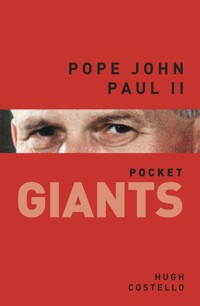
The world was stunned when little-known Karol Wojtyła became the first non-Italian pope for 450 years. As Pope John Paul II, he continued to surprise, directly confronting Communist regimes, flying hundreds of thousands of miles to meet the faithful, and building bridges with other faiths. John Paul II became a bête noire in the eyes of liberals for his staunch refusal to accept contraception or the ordination of women. But for others he was a Churchillian figure who took on the forces of godlessness and moral relativism. He gained a stature that left secular statesmen in his shadow. Love him or loathe him, few could deny that he was a man of rare courage. He survived two assassination attempts, fought off cancer and waged a very public battle with Parkinson's disease. Seven years after his death he continues to exert a hold over the Church and to inspire an almost cult-like devotion.
Sie lesen das E-Book in den Legimi-Apps auf:
Seitenzahl: 116
Veröffentlichungsjahr: 2014
Das E-Book (TTS) können Sie hören im Abo „Legimi Premium” in Legimi-Apps auf:
Ähnliche

















Contents
Title Page
1 A Revolutionary Pope
2 ‘Upon This Rock’: A Brief History of the Papacy
3 A Motherless Only Child
4 A Brother of the People
5 Called from a Faraway Land
6 The Portable Pope
7 Cold Warrior
8 Culture Wars
9 Millennial Pursuits
10 Legacy
Notes
Timeline
Further Reading
Web Links
Copyright
1
A Revolutionary Pope
The Italians have a word for it: papabile. The literal English translation is ‘popeable’. A more helpful interpretation is ‘electable’. The man who is papabile is believed by his fellow cardinals to possess an elusive blend of personal qualities – authority, holiness, forbearance – that together equip him to take on the most demanding, and frequently most thankless, of jobs.
Over the centuries, many holders of this unique office have struggled to convert those pre-election papabile virtues into effective leadership of the worldwide Church. The majority have been sincere and capable figureheads; but others have proved spectacularly ill suited to the role. There have been vain popes, libidinous popes, ignorant popes and inept popes. Some have been downright corrupt, exploiting the office for their own distinctly unspiritual ends. Others have begotten chaos or presided helplessly over decline. Many, crushed by the weight of expectation, have simply subsided into inertia.
Every so often, however, a figure has ascended to St Peter’s throne who has delivered on the promise he showed as a cardinal. These men have not pleased everyone (an impossible task for any pope), but they have demonstrated unquestionable qualities of leadership and vision. They have been true helmsmen, guiding the Church through hostile times and keeping it vital and relevant in the face of sometimes forbidding odds. Among these figures was the eleventh-century Pope Gregory VII, who stood up to state power and cemented the Church’s primacy in medieval Europe. The controversial Pope Pius IX – or ‘Pio Nono’ as he was known in Italian – masterminded a resurgence in Catholicism in the nineteenth century. Another remarkable figure was the avuncular Pope John XXIII, who reigned for just five years (1958–63) yet began a series of reforms that radically overhauled the faith’s relationship with secular society. These men could truly be said to have changed the world.
Another such figure, and one of the unlikeliest, was a little-known Polish prelate. In October 1978, when the College of Cardinals met to elect a pope for a second time in just two months, Karol Wojtyła, the Archbishop of Kraków, was not widely considered to be papabile. The college had recently elected one obscure figure: Albino Luciani, Pope John Paul I, who reigned for barely a month before his sudden (and some believe suspicious) demise. The College were hardly in the mood to choose another wild card. The expectation this time was that they would elect a senior figure from within the Curia, the administrative and political establishment of the Roman Church.
For reasons of factional infighting and ideological division (outlined in more detail in Chapter 5), the cardinals failed to give decisive backing to either of the main contenders. Since no conclave can break up without choosing a pope, a third way was required. Out of the pack emerged Wojtyła, the first non-Italian pope in 450 years. As a tribute to his late predecessor, he took the name John Paul II.
There were some who feared that Wojtyła’s obscurity and his lack of a broad base of support prior to his election would undermine his authority as pope. How emphatically wrong they were. John Paul II revolutionised the office and dragged it into the modern age. In the process he became a global phenomenon. Where previous popes had barely featured in the mainstream media for years on end, John Paul II was rarely off the news pages. His relative youth – he was 58 when elected – meant he would have time to mould the Church in his own image and leave a legacy that might be sustained for generations. This he achieved with vigour and charisma, but at a cost.
His reign – one of the longest in papal history – was marked by controversy and division. John Paul II became a bête noire in the eyes of liberals for his staunch refusal to allow contraception or to reconsider the Church’s position on priestly celibacy and the ordination of women. But for others he was a Churchillian figure who took on the forces of godlessness and moral relativism. He gained a stature that left secular statesmen in his shadow. It is these qualities that make John Paul II a worthy subject for this book. He is an enduringly fascinating figure not despite but because of the strength of feeling he inspired – and continues to inspire – both among his legions of admirers and his armies of critics.
Karol Wojtyła was unquestionably a man of intelligence, a gifted theologian and philosopher who also had the ability to communicate complex ideas in plain language – a rare combination even among democratically elected public figures. He took over an institution reeling from the loss of influence it had suffered in post-war Europe and the United States. His immediate predecessors had remained immured in Vatican City, showing little apparent interest in an increasingly diverse world outside. John Paul changed all that. He had a message and he was determined to deliver it personally. If the world had stopped listening to the Vatican, he believed, maybe it was time for the Vatican to increase the volume.
He was uniquely suited to the task. Handsome, charismatic, energetic, he bore no resemblance to the often remote and desiccated figures who had traditionally held the office. Where they had kept the world at arm’s length, he embraced it; where they had located the epicentre of faith in the confines of the Holy See, he set out to discover it in the hearts and minds of every individual believer, whatever benighted corner of God’s earth they lived in. This difference of approach was encapsulated in his trademark gesture: where earlier popes would extend an imperious ringed hand to be kissed by the supplicant, John Paul got down on his knees and kissed the ground in each new country he visited. As a signifier of humility and openness it was hugely effective; as a visual motif, a photogenic ‘moment’ for an image-hungry mass media to capture and disseminate, it was beyond compare.
There were, of course, other reasons for Wojtyła’s rapid rise to global prominence. Here was a man who had lived most of his life under totalitarian regimes. The Cold War was not, for him, some theoretical construct but a harsh fact of daily life. At the time of his election in 1978, the Soviet Bloc was still a powerful and implacable reality, but the cracks were beginning to show. In the West, a generation of leaders was emerging who would share Wojtyła’s conviction that the twentieth century’s Marxist experiments had run their course. Margaret Thatcher would become the British prime minister less than a year after Wojtyła’s election. In 1980, the hawkish Ronald Reagan won the White House. They would become John Paul’s ideological soulmates, and together they were in the vanguard of events that led to the collapse of what Reagan called ‘the Evil Empire’. The timing of Wojtyła’s election, then, could hardly have been more serendipitous – but it was the man himself, through his steely single-mindedness, who capitalised on this opportunity.
Many Catholics look back on John Paul II’s pontificate as a golden age. For others it marked a descent into autocracy and fundamentalism. His detractors, while acknowledging that he advanced the cause of freedom and made the Church relevant again, point out his failure to provide effective leadership when sexual abuse scandals rocked the institution. This failure, they argue, was consistent with John Paul’s earlier refusal to show any flexibility on issues that have come to define the Church’s relationship with the modern, secular world. John Paul insisted on excluding from the sacraments all Catholics who had divorced, those living together out of wedlock and those in homosexual relationships. These doctrinaire positions, while applauded by traditionalists in the Church, alienated millions of otherwise devout Catholics.
His obstinacy when it came to artificial birth control was even more draconian. He rejected arguments that Catholics in AIDS-ravaged parts of the world, particularly Africa, should be allowed to wear condoms – an absolutist position that condemned many thousands to death. In his war on what he described as a ‘culture of death’ in the modern world, symbolised by abortion and contraception, he himself added to the toll of casualties.
Absolutism is generally near the top of the charge sheet against John Paul. While his many overseas trips carried a message to the world, it was, say critics, his own distinctly narrow message. Far from opening up the papacy to a conversation with the wider world, he shut down debate, stifled dissent and demanded unquestioning loyalty and obedience. For that reason, he left the Church weakened, divided and deeply unpopular with many of its own members.
As time goes by, the debate about his legacy shows no sign of mellowing. Where one stands on John Paul’s pontificate has become a litmus test of Catholic opinion. Those who seek an accommodation with the secular sphere tend to see his tenure of office as a missed opportunity. Advocates of traditional values view him as an arch defender of truth and godliness. The former group aim to roll back many of John Paul’s measures; the latter have been a driving force behind an unusually rapid process of canonisation.
This ongoing schism of opinions reflects the fact that he was a man of compelling contradictions: doctrinaire and conservative on some issues, bracingly libertarian on others. In the words of respected Vaticanologist John L. Allen: ‘Outside the church a democrat, inside the church an autocrat.’1
This short book does not aspire to be an exhaustive account of John Paul’s life and times. Rather, it aims to explore what it was that made him such an important and iconic figure in late twentieth-century history. What were the forces that shaped his ideas and his attitudes? What clues can we find in his early life to help us understand this most contradictory of men? What gave him the strength to survive an assassination attempt and to keep going during his long, very public battle with Parkinson’s disease with his authority and – among many – his popularity undiminished? Even in his final days in April 2005, as thousands waited in St Peter’s Square for news of his passing, he continued to exert a dominant hold on the Church and many of its faithful.
John Paul II remains a man to be reckoned with. A giant. This book explains why.
2
‘Upon This Rock’: A Brief History of the Papacy
A favourite story among professional Vatican watchers concerns a young priest who arrives in Rome to start a new job in the Church’s civil service. He tries to open the window beside his desk but it will not budge. When he asks his superior why the window has been painted shut, he is told: ‘That’s how it was when I got here.’ Our enterprising young priest decides to take action. The Vatican might be stuck in its ways, but he isn’t, and nor is his window. He prises it open, breathes in the fresh air, and goes for lunch. When he gets back he finds half a dozen pigeons sitting on his desk and a very unpleasant mess all over that day’s copy of the Osservatore Romano.
Like other ‘be careful what you wish for’ parables, this one may well be apocryphal, but it illustrates an essential truth: resistance to change, whether due to hard-earned wisdom or mule-like stubbornness, is at the very heart of the Catholic Church’s culture and philosophy. This is not, as many of the Church’s critics argue, a knee-jerk conservatism. Continuity at all costs is the core principle on which the Church and its institutions are built. Those who expect the Church to change with the times as if it were a political party simply do not understand how it works. Witness the worldwide astonishment that greeted Pope Benedict’s decision to retire in early 2013. Such dramatic change happens only once or twice in a millennium in the Church.
When Karol Wojtyła was chosen by his fellow cardinals in October 1978, he became the 263rd custodian of that precious continuity. Popes have many roles but by far the most important is to be a strong link in the chain that goes all the way back to St Peter, the man Jesus chose to propagate the faith with the words (according to Matthew’s Gospel): ‘You are Peter and upon this rock I will build my Church and I will give to you the keys to the kingdom of heaven.’
What made Peter worthy of such special treatment?
Throughout the New Testament, Peter is described as leader of the apostles. He stands out from the crowd right from his first appearance when, as a fisherman called Simon, he is told by Jesus that he will soon become a ‘fisher of men’. Jesus then renames him Petrus, or ‘rock’ – a foreshadowing of Peter’s later status as the foundation stone of Christianity. Peter is present at a number of miracles and when Jesus is arrested at Gethsemane. Perhaps the key event in this relationship is when – under interrogation – Peter thrice denies that he knows his master. This betrayal is forgiven by Jesus after his resurrection, and Peter’s standing as his most trusted lieutenant is confirmed when Jesus instructs Peter to ‘feed my lambs, feed my sheep’.




