


Erhalten Sie Zugang zu diesem und mehr als 300000 Büchern ab EUR 5,99 monatlich.
- Herausgeber: The History Press
- Kategorie: Sachliteratur, Reportagen, Biografien
- Sprache: Englisch
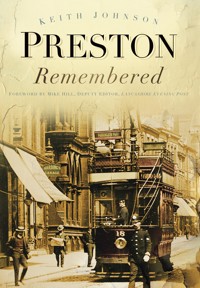
Preston Remembered is a fascinating collection of articles written by author and Lancashire Evening Post historian Keith Johnson. Take a nostalgic journey into Preston's colourful past, recalling the events that transformed this historic cotton town into a university city. Take a peep at the days of cotton mills, factories, public houses and endless rows of terraced homes that shaped the lives of many. Return to the traditions of Whitsuntide, Easter, Wakes Weeks and Christmas that continued from generation to generation. Recall the churches and chapels, the streets, parks and, of course, the people who lived and worked in Preston. Richly illustrated with over 50 pictures, this nostalgic volume will appeal to everyone who knows this part of Lancashire.
Sie lesen das E-Book in den Legimi-Apps auf:
Seitenzahl: 196
Veröffentlichungsjahr: 2011
Das E-Book (TTS) können Sie hören im Abo „Legimi Premium” in Legimi-Apps auf:
Ähnliche

















PRESTON
Remembered
A postcard view looking down Church Street, c. 1925.
PRESTON
Remembered
KEITH JOHNSON
First published 2011
The History Press
The Mill, Brimscombe Port
Stroud, Gloucestershire, GL5 2QG
www.thehistorypress.co.uk
This ebook edition first published in 2014
All rights reserved
© Keith Johnson, 2011, 2014
The right of Keith Johnson to be identified as the Author of this work has been asserted in accordance with the Copyright, Designs and Patents Act 1988.
This ebook is copyright material and must not be copied, reproduced, transferred, distributed, leased, licensed or publicly performed or used in any way except as specifically permitted in writing by the publishers, as allowed under the terms and conditions under which it was purchased or as strictly permitted by applicable copyright law. Any unauthorised distribution or use of this text may be a direct infringement of the author’s and publisher’s rights, and those responsible may be liable in law accordingly.
EPUB ISBN 978 0 7509 6000 7
Original typesetting by The History Press
CONTENTS
About the Author
Acknowledgements
Foreword
Introduction
1.The People who Made Preston Proud
2.The First Citizens of our City
3.Freemen Fit for a City
4.Making a Lasting Impression
5.In the Footsteps of the Friars
6.In Search of Preston’s High Street
7.Tithebarn – Times They are A-Changing
8.Those Taverns in the Town
9.Read All About It
10.On the Buses
11.What a Picture: The Golden Age of the Silver Screen
12.Our Green and Pleasant Lands
13.First Class: the Post
14.Remember, Remember the Fifth of November
15.Banking on Preston
16.Preston Bobbies on Parade
17.Full Steam Ahead
18.Thank God for Churches
19.Hallowe’en Hauntings
20.Dawn of the Dead
21.Grave Matters Once More
22.Fulwood – Pride of Preston?
23.Bypassing Broughton
24.Who Were the Invincibles?
25.The Golden Days of Doctor Syntax
26.Goodbye Old Stand
27.Imagine an Easter when …
28.All the Fun of the Whitsuntide Fair
29.Waking Up to Wakes Weeks
30.Those Twentieth-Century Christmas Times
ABOUT THE AUTHOR
Keith Anthony Johnson is Preston born and bred. A former pupil of St Augustine’s Boys’ School, he completed his studies at the Harris College – now Preston’s university. A keen local historian, Keith has worked in the city all his life, being employed as an engineering designer in the printing-press industry for almost four decades. In recent years, as the Lancashire Evening Post historian, he has contributed regular articles to the newspaper. His previous works include the local bestselling Chilling True Tales of Old Preston series of books, the popular People of Old Preston, the regional bestseller Chilling True Tales of Old Lancashire and Chilling True Tales of Old London.
ACKNOWLEDGEMENTS
I am indebted to the staff of the Harris Reference Library for their assistance, given so willingly, in my gathering of information and suitable images/illustrations.
I express my appreciation to the Preston historians and newspaper reporters whose accounts of past events are a delight to research – historical information all painstakingly recorded in the Preston Chronicle, Preston Guardian, Preston Pilot, Preston Herald and the Lancashire Evening Post, leaving a legacy of knowledge.
I also wish to thank the Preston Digital Archive for permission to use images/photographs from their collection. My thanks go also to Glen Crook and James Fielding, for photographs and line sketches as appropriate.
FOREWORD
Any journey through the history of Great Britain could be told through the life and times of Preston. From its entry in the Domesday Book to the Queen bestowing City status in 2002 to mark her 50th year on the throne, Preston’s story has been a rich and varied one. Its soldiers have fought in foreign fields, its workers have provided the heartbeat for the industrial revolution which changed our land forever, and its sportsmen have risen to become heroes to millions.
For the past 125 years, the Lancashire Evening Post has been proud to cover the city we call home. While bringing the latest news to our readers, we have always found time to look back and revisit the everyday stories of Preston life, both big and small. And for that we so often turn to Keith Johnson.
Keith’s passion for scouring the archives to shine a light on our past is unrivalled. With a newshound’s nose for a story, many has been the day I have switched on my computer to find an e-mail nestling in my inbox from Keith. And it is always with interest that I open it up, knowing I will learn something illuminating about our past. Keith has a great skill for providing an historical perspective on any topical issue which has fired his imagination from that week’s headlines.
Just one example from recent times arrived when the Evening Post carried a special investigation looking at the number of pub closures in the city in the past few years. Without warning, an e-mail arrived with a well-researched feature charting the history of the city’s drinking establishments, listing places familiar to some and long lost to many. This ability to spark old memories and make sense of our past comes from Keith’s love of local history. Much of his research is painstakingly plucked from old copies of the newspaper and there is a nice symmetry to being able to bring new generations eyewitness accounts from generations past.
Some of the chapters in this book first saw the light of day in the Evening Post in the very way described – with the unprompted arrival of an e-mail. It is great to see them given greater longevity in this fascinating book.
Allow Keith to take you on his own journey through Preston past; there is no finer guide.
Mike Hill, 2011 Deputy Editor, Lancashire Evening Post
INTRODUCTION
Preston, in Lancashire, is a cotton town that became a university city. It was quite a journey and I hope that this book helps to tell the tale of Preston through the centuries. We live in an age of discovery, but can still marvel at the people who shaped the place we live in and the lives they led. Yes, there has been toil and troubles along the way, and grit and determination needed to get many an enterprise on the move. Many great folk have shaped the city’s destiny and have served with dignity to keep the pride in Preston. Rich man, poor man, banker and Freeman have all played their part.
It has been a pleasure to research the origins of so many Preston institutions, and to marvel at their advances as the Industrial Age evolved. Many landmarks have disappeared – their time having passed – yet many still remain to keep the link between generations. Monuments and statues too are worth more than a passing glance.
Preston, with its rapid growth in the nineteenth century, had difficult times to endure, but it coped well and the advances in the twentieth century led to it gaining City status at the dawn of the twenty-first century. It is now a sprawling city, some may say, compared with the Victorian town, when most resided within the old borough boundaries, not far from the mill in which they worked or the public house where they spent their leisure time.
Few places are blessed with so many public parks and those, along with the old familiar streets and highways, have historical links of their own.
Delving into the archives is always a nostalgic trip – old cinemas, old footballers, old public houses; they all jog the memory and remind us of days gone by. Then there are the steam engines, the horse-drawn trams, the double-decker buses, the churches and chapels, the graveyards and ghosts, which all have a place in our memories. And, of course, those wonderful customs associated with Easter, Whitsuntide, Wakes Week and Christmas – all of which provide fond recollections.
The great historian Anthony Hewitson, after writing his History of Preston in 1883, remarked that it was ‘not a perfect place, but amid the toil and hurly-burly of daily life what is?’ So reader, if you enjoy this journey, as I did, then I shall be pleased. Begun long ago, the story of the city is never-ending and will continue for many generations to come.
Keith Johnson, 2011
1
THE PEOPLE WHO MADE PRESTON PROUD
Industry, arts and literature have been blessed by the contribution of Preston folk. Once the winter residence of the rich gentry, the town was to take its place at the very heart of the cotton trade. Some residents went on to local or national fame, or prospered despite the poverty of their surroundings – many earning their place in history through feats of human endeavour and achievement, at a time when heroes were not manufactured.
Mention the cotton industry and John Horrocks springs to mind. His life was short, a mere thirty-six years, yet in the thirteen years he spent in Preston he left a lasting impression, having developed a cotton business that would span centuries. Almost yearly he added another cotton factory to his booming business, attracting mill hands from far and wide.
Nor can Sir Richard Arkwright’s contribution to industry be ignored. This Preston-born lad developed his spinning frame in Stoneygate, and then headed to Nottingham to develop the factory system of production with his water-powered machinery. Who would have thought that a lad who worked cutting hair and pulling teeth in Bolton would end up with a knighthood?
Local industry still owes a debt to Joseph Foster, a pioneer in the newspaper-printing world. A revolutionary web-feed printing press for the Preston Guardian in 1872 was to firmly establish Foster at the front of technology, his inventiveness leading to employment for thousands of local people through the years.
Back in 1948, at a cost of £98, the first Bond Minicars rolled off the production line in Ribbleton Lane. For over a decade these three-wheelers, designed by Lawrence Bond, were a popular mode of transport throughout the UK, said to need just one gallon of petrol to travel 100 miles. Bond’s groundbreaking design brought cheap transport to many and a hundred vehicles were produced per week, giving employment to many local folk.
John Horrocks lived a short life but left a lasting legacy.
Also providing employment was William Henry Woods. In the days before government health warnings, he ran a tobacco factory in Derby Street. With a shop on the corner of Church Street and Avenham Street, the business, begun by his father, thrived, employing hundreds of local workers at the dawn of the twentieth century. He not only built up the business but also played a significant part in the town’s affairs, being thrice elected as an alderman.
Another local hero, John Huntington, fought on behalf of workers over a 10 per cent wage reduction imposed by the cotton bosses. The feud was long and bitter, and starvation brought an end to operatives’ hopes. The factory gates were locked in Huntington’s face and he was forced to flee to America to earn his living. Fate was with him; soon he was instrumental in the discovery of oil and the development of the Standard Oil Co. In his later years, this modest man paid a visit to Preston and his old friends welcomed home a millionaire.
Edith Rigby, a doctor’s wife from Winckley Square, also fought hard for her cause, becoming the secretary of the Preston Suffragette Movement and proudly proclaiming ‘Votes for Women’. Imprisoned for over-zealous protests, she did not shirk from her beliefs and was a true champion for women’s rights.
Another doctor’s wife, Avice Pimblett, was a pioneering lady on the local political scene. She was the first woman elected on to Preston Town Council in 1920, the first woman to be Mayor in 1933, and was rewarded for forty years of public service with the Freedom of the Borough.
Other Preston women of note include Frances Lady Shelley and Emma Lyon. The former, of Winckley family descent, became part of high society – mixing with the likes of the Duke of Wellington and Queen Victoria – after marrying a descendant of poet Percy Bysshe Shelley. Emma Lyon, said to have been born of poor parents at Preston, Lancashire in 1764, became the much adored Lady Hamilton, a woman who was to steal the heart of Lord Nelson following their liaison in Naples.
John Huntington went from cotton outcast to becoming an oil millionaire.
Matthew Brown built a thriving brewing business in Preston.
Joseph Livesey, a kindly man who led the Temperance Society.
Preston can boast numerous entrepreneurs and businessmen. Many of the inns and taverns of old Preston carried the name of Matthew Brown, who took over a brewing business from his father and developed a thriving company. It all began in Pole Street, near to where his beloved Anglers Inn once stood, and with the abolition of Beer Duty he soon owned numerous public houses around the town and supplied ale to many others. With similar success, errand lad Edwin Henry Booth built up a chain of stores from his grocery store in the Preston Market Place. The business grew and prospered under his guidance and his belief was ‘To Thine Own Self Be True’, a philosophy that guided his ways.
Joseph Livesey was also guided by his values, and is regarded by many as one of Preston’s most kindly men. A scroll upon his grave in Preston Cemetery declares him to have been a great moral and social reformer during his ninety-one years on earth. Besides his great work with the Temperance Society, he was a very significant publisher, starting the Preston Guardian newspaper and The Struggle, a publication that highlighted the plight of nineteenth-century Prestonians in poverty.
The name of Edmund Robert Harris is surely etched forever into Preston’s history. The son of a vicar of Preston, he showed his love for the town by leaving his family’s fortune for the benefit of local people. An orphanage, an Institute for Knowledge and of course the free library, art gallery and museum were all to bear the Harris name thanks to the solicitor’s generous legacy. His fortune planted the university seed, gave hope to the orphan and enabled ordinary folk to read for free.
Also renowned for generosity was Sir Robert Charles Brown, who for sixty-four years was a Preston physician. Day trips for nurses and the costs of a new operating theatre were samples of the generosity of one who, in his latter years, local folk referred to as ‘Preston’s Grand Old Man’.
On Preston’s Miller Park stands a statue of the 14th Earl of Derby; it is a reminder of a man who was to thrice hold the office of Prime Minister in the mid-nineteenth century. In a time when the Derby mansion stood on Church Street, the local voters rejected him, but his steely determination took Edward Geoffrey Stanley to the height of political matters.
Our skyline out Maudland way gives us a permanent reminder of the work of Joseph Aloysius Hansom, who was the architect and inspiration behind the building of St Walburge’s Church with its magnificent spire. He spent some twenty years of his busy life in our town, and buildings in Liverpool, Hull and Birmingham are further testimony to his talent. Throw in the Hansom Cab, which he patented in 1834, and you have a measure of the man.
For architecture in our city, few could have a greater claim than James Hibbert, a former Mayor of Preston who earned much praise after building the Fishergate Baptist Chapel. So much so that the building of the Harris Museum in the Market Place was entrusted to his care and, after a decade of dedication, it became Preston’s pride.
Builder John Turner, who was born in Havelock Street in Preston back in 1876, started in a humble way, repairing brickwork on a property in Inkerman Street. From that beginning he developed a business along with his three sons, being responsible for various landmark buildings in the town: the Guild Hall, Moor Lane Telephone Exchange, Preston Magistrates’ Court and the ring road – all helping to shape the Preston of today.
Another local architect – of the more recent past – to earn deserved praise was Sir George Grenfell Baines, the founder of Preston-based Building Design Partnership. With contracts for universities, libraries, hospitals and numerous other buildings, his company was soon employing hundreds of people locally.
Preston folk also made numerous developments to the field of transport. Harold Bridges, the son of a Warton gamekeeper, became known as Preston’s Mr Transport as he built a vast motor-haulage empire with over 100 vehicles and 400 employees. His company was taken over by a national enterprise in the mid-1960s and, in the years that followed, he was a generous benefactor for many charitable trusts.
Roland Beaumont joined English Electric in Preston in 1947 as Chief Test Pilot as the world’s first jet bomber was being developed. He was soon taking the Canberra on its maiden flight, and down the years was at the controls of numerous pioneering aircraft. In all, his flying career lasted forty years; he was the first Briton to reach true supersonic flight, travelling at twice the speed of sound in a Lightning prototype.
When walking down Winckley Square, you may notice a commemorative stone embedded in an office wall. It reads simply: ‘JT 1863–1931’. It is a reminder of accountant James Todd, who expanded his business interests worldwide. Motor companies and aircraft suppliers were amongst his portfolio, and his last request was that his ashes be placed in the office wall behind the stone.
In eighteenth-century England, the role of Town Clerk was important; there was one in every borough and Richard Palmer served Preston for over fifty years. His stint began in 1801 and ended with his death in 1852, when he was aged seventy-eight – at which time he was the oldest Town Clerk in England.
Sir Harry Cartmell is a Preston knight worthy of consideration. Throughout the years of the First World War, he was at the helm of Preston’s civic matters as Mayor of Preston. Under his guidance, local folk played their part in the war effort, enlisting in their thousands to bolster the soldiers needed to fight at the front. His book, entitled For Remembrance, offered fascinating insight into his war work. He was on hand to take the salute as the regiments departed, and on hand to welcome them back home. Another local hero of those war years was Private William Henry Young, whose bravery on the battlefield earned him a Victoria Cross. He was hailed a ‘conquering hero’ when he returned to town but, tragically, he died in the operating theatre before he could collect his award.
Jesuit missionary Revd Joseph ‘Daddy’ Dunn was instrumental in the building of the chapel and school for St Wilfred’s; he also found time to inspire the formation of the Preston Gas Co. in 1815. His fundraising earned him the tag ‘best beggar in town’.
When talking of church builders, the Revd Roger Carus Wilson is owed a debt of gratitude by Preston folk. St Peter’s, St Paul’s, St Thomas’s, St Mary’s and Christ Church were all erected during his years as the vicar of Preston. The quality of the buildings is reflected in their preservation long after the congregations dwindled.
Let’s not neglect our poets either, who earned fame far and wide. Robert Service from Christian Road made his name abroad; his travels to the Yukon in gold rush days earned him worldwide fame as the ‘Bard of the Yukon’. Francis Thompson, a poet born in Winckley Street, wooed the nation with the brilliant lyrics in his ‘Hounds of Heaven’. Ill health dogged his latter days, which were spent in London, but his roots were firmly planted in Preston.
The work of Preston’s artists is also still treasured, the eighteenth-century art of Arthur William Devis and his Preston-born sons being much admired. The father was a prolific painter; his eldest son Arthur, said to have a striking resemblance to Bonnie Prince Charlie, painted many a landscape too, and half-brother Anthony contributed numerous drawings and sketches to the family’s collection.
Towards the end of the nineteenth century, Edwin Beattie produced a series of watercolours and sketches for which the city will be forever grateful. His work reminds us how the old town used to be. No fortune ever came his way and in his latter days he’d sketch buildings for a glass of ale or two.
Long admired is the statue of Robert Peel in Winckley Square, the work of local sculptor Thomas Duckett. His talent with mallet and chisel was unsurpassed, and in Preston Cemetery there are many examples of his fine work.
When one talks of entertaining the public then Hugh Rain, who was professionally known as Will Onda, had few equals locally. He was a pioneer in the early days of the cinema after his acrobatic stage career ended following an accident. He set up his own Preston film company, with royal visits, Preston Guild and football matches all being recorded by him. The Picturedome and the Princes were amongst the places crowded to watch the early films that this prominent town councillor provided. His productions were in black and white but his life was very colourful.
These days Prestonians take pride in the exploits of film animator Nick Park, a local lad who found his creative ability, coupled with a Preston education, was enough to earn numerous Oscars. The creation of Wallace and Gromit took him to the top of his profession and he continues to astound and entertain with his character creations.
Alfred Aloysius Horn, who spent his early years down St Ignatius Square, took the literary world by storm in the 1920s when the tales of his life as a trader on the West Coast of Africa were published. A Hollywood film, Trader Horn, was even made to chronicle the old man’s life of adventure, trading in ivory and rubber.
Likewise, Angela Brazil, who was born in West Cliff Terrace, earned recognition for her literary works. Her schoolgirl adventures, including Schoolgirl Kitty and The Fortunes of Philippa, were a must for thousands of teenage devotees in the early years of the twentieth century.
Preston-born Albert Edward Calvert earned fame when he became known throughout the world as ‘The Man with the Golden Trumpet’. For Eddie Calvert, who had started life in the Preston Silver Band, there was chart success as he recorded ‘Oh, Mein Pappa’, a tune that was number one in the UK chart in December 1953 and sold over a million copies in America.
On the sporting front we have, at times, excelled and of course the legendary Invincibles brought fame for Preston and their beloved North End. At the helm in Preston’s all-conquering days was William Sudell, a local mill manager, whose passion for football led him to recruit the first champions of the Football League. Amongst those brought to Deepdale by him were Jimmy Ross and Johnny Goodall, top strikers of the early days.
Then there is the Preston plumber Sir Tom Finney, who earned ‘living legend’ status for his sporting achievements. His career blossomed after the Second World War, and for both club and country he was an inspiration. Twice named ‘Footballer of the Year’, his skill and sportsmanship were second to none. The Sir Tom Finney Stand is testimony to the high regard with which he is held.
Alfred Aloysius Horn was an African adventurer from St Ignatius Square.




