


7,60 €
Mehr erfahren.
- Herausgeber: Simply Charly
- Kategorie: Sachliteratur, Reportagen, Biografien
- Serie: Great Lives
- Sprache: Englisch
“Michael Olinick has written a vibrant and absorbing biography of Alan Turing. Turing's work as a cryptographer during WW II and his pioneering development of the digital computer helped us win that war and make our technology-driven world of today possible—all this against the backdrop of the homophobic world Turing tried to navigate.”
— Joseph Malkevitch, Professor of Mathematics at York College (CUNY) and CUNY Graduate Center
Alan Turing (1912-1954) was born in London and showed signs of genius from a very young age. Turing was just 24 when he devised the theory that led to the development of modern computers and he went on to achieve major breakthroughs in probability, number theory, cryptology, and mathematical biology. His codebreaking efforts during World War II allowed the British to decipher secret German communications, effectively shortening the war and saving millions of lives. Yet instead of being celebrated for his accomplishments, Turing was prosecuted for being a homosexual and was forced to undergo hormone treatments designed to reduce his sexual drive. Turing died of cyanide poisoning in 1954 at the age of 41, a tragic end to a brilliant life, and an event that remains mysterious to this day.
In Simply Turing, Professor Michael Olinick recounts the life and work of a man who, along with Newton and Darwin, is considered one of the three most influential British scientists of all time. Prof. Olinick provides an accessible explanation of Turing’s monumental achievements, while introducing us to the friends, colleagues, and rivals who shared his life, and exploring the controversy surrounding his death.
For anyone interested in the beginnings of our computer-defined age, or anyone who wants a better understanding of why LGBTQ rights are so important, Simply Turing is an indispensable and fascinating introduction to a man who was both ahead of his time and a tragic victim of it.
Das E-Book können Sie in Legimi-Apps oder einer beliebigen App lesen, die das folgende Format unterstützen:
Seitenzahl: 289
Veröffentlichungsjahr: 2021
Ähnliche


















Simply Turing
Michael Olinick
Simply Charly
New York
Copyright © 2020 by Michael Olinick
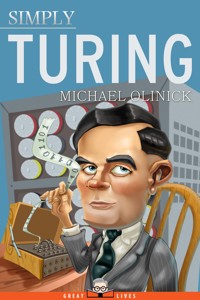
Cover Illustration by José RamosCover Design by Scarlett Rugers
All rights reserved. No part of this publication may be reproduced, distributed, or transmitted in any form or by any means, including photocopying, recording, or other electronic or mechanical methods, without the prior written permission of the publisher, except in the case of brief quotations embodied in critical reviews and certain other noncommercial uses permitted by copyright law. For permission requests, write to the publisher at the address below.
ISBN: 978-1-943657-38-4
Brought to you by http://simplycharly.com
Contents
Praise for Simply TuringOther Great LivesSeries Editor's ForewordPrefaceAcknowledgements 1. Roots and Childhood 2. Sherborne and Christopher Morcom 3. Cambridge Days 4. Birth of the Computer 5. Princeton 6. Cryptology From Caesar to Turing 7. The Enigma Machine 8. War Years 9. London and the ACE 10. Manchester 11. Artificial Intelligence 12. Mathematical Biology 13. Regina vs Turing 14. Breaking The Enigma of Death 15. Turing’s LegacySourcesSuggested ReadingAbout the AuthorA Word from the Publisher1
Praise for Simply Turing
“Simply Turing explores the nooks and crannies of Alan Turing’s multifarious life and interests, illuminating with skill and grace the complexities of Turing’s personality and the long-reaching implications of his work.”
—Charles Petzold, author of The Annotated Turing: A Guided Tour through Alan Turing’s Historic Paper on Computability and the Turing Machine
“Michael Olinick has written a remarkably fresh, detailed study of Turing’s achievements and personal issues. Bravo!”
—Brian Winkel, Director of SIMIODE and Professor Emeritus of Mathematical Sciences at the United States Military Academy
“Michael Olinick presents an impressive work, covering Turing’s early life, the wartime period of code-breaking, and his post-war life and death. Most touching was Turing’s request, as an adult, that his parents give him a teddy bear for Christmas, as he had never had one as a boy. On the war years, Olinick draws us methodically through a simple, clear history of codes and code-breaking, featuring Turing’s contributions. Most fascinating are Olinick’s questions about Turing’s death: Was it a suicide, as the inquest declared, or a tragic accident? Or perhaps something more sinister? Perhaps we will never know.”
—Paul Wonnacott, Professor Emeritus of Economics, University of Maryland and Middlebury College
“Michael Olinick has written a vibrant and absorbing biography of Alan Turing. Turing’s work as a cryptographer during WW II and his pioneering the development of the digital computer helped us win that war and make our technology-driven world of today possible—all this against the backdrop of the homophobic world Turing tried to navigate.”
—Joseph Malkevitch, Professor of Mathematics at York College (CUNY) and CUNY Graduate Center
“As the father of the field of computer science, every aspect of Alan Turing’s life and work is important to us today as we benefit from his brilliant insights. Michael Olinick’s book makes them all interesting and accessible. He highlights the development of Turing’s fascination with the biology of the human body and brain and the idea that they can be considered as complex machines. He shows how this idea formed the basis of much of Turing’s work and how his understanding of the mechanistic principles of biological systems coupled with his ability to ‘think outside the box’ and his thorough understanding of mathematical principles informed and guided his developing ideas about how to design thinking machines that would ultimately lead to his ‘universal computing machine’. Reading Simply Turing is like walking alongside this fascinating man. Olinick has meticulously researched and clearly explained Turing’s life, his passions, and his work so that his personality comes alive, his brilliant creativity astounds and we come away feeling that we have lost a close and dear friend.”
—Tom Perera author of Inside Enigma and The Story of the Enigma and Professor Emeritus of Neuroscience at Montclair State University
“Michael Olinick tells the story of Alan Turing in clear, energetic prose. Those who don’t know Turing’s story will find Simply Turing to be a compelling introduction to one of the key pioneers of computer science, artificial intelligence, and logic. Olinick includes enough technical details, easily accessible to the undergraduate mathematics student, to help the reader understand the breadth and creativity of Turing’s contributions. Far from the conventional story of a colorful and misunderstood martyr, Simply Turing shows why Turing was a foundational figure in computer science and why the ultimate prize for innovation in computer science is named in his honor.”
—David Alan Grier, author of When Computers Were Human and Former President of IEEE Computer Society
2
Other Great Lives
Simply Austenby Joan Klingel RaySimply Beckettby Katherine WeissSimply Beethoven by Leon PlantingaSimply Chekhov by Carol ApollonioSimply Chomskyby Raphael SalkieSimply Chopinby William SmialekSimply Darwinby Michael RuseSimply Descartesby Kurt SmithSimply Dickensby Paul SchlickeSimply Diracby Helge KraghSimply Einsteinby Jimena CanalesSimply Eliot by Joseph MaddreySimply Euler by Robert E. BradleySimply Faulkner by Philip WeinsteinSimply Fitzgerald by Kim MorelandSimply Freud by Stephen FroshSimply Gödel by Richard TieszenSimply Hegel by Robert L. WicksSimply Hitchcock by David SterrittSimply Joyce by Margot NorrisSimply Machiavelli by Robert FredonaSimply Napoleonby J. David Markham & Matthew ZarzecznySimply Nietzsche by Peter KailSimply Proust by Jack JordanSimply Riemann by Jeremy GraySimply Sartre by David DetmerSimply Tolstoy by Donna Tussing OrwinSimply Stravinsky by Pieter van den ToornSimply Wagner by Thomas S. GreySimply Wittgenstein by James C. Klagge
3
Series Editor's Foreword
Simply Charly’s “Great Lives” series offers brief but authoritative introductions to the world’s most influential people—scientists, artists, writers, economists, and other historical figures whose contributions have had a meaningful and enduring impact on our society.
Each book provides an illuminating look at the works, ideas, personal lives, and the legacies these individuals left behind, also shedding light on the thought processes, specific events, and experiences that led these remarkable people to their groundbreaking discoveries or other achievements. Additionally, every volume explores various challenges they had to face and overcome to make history in their respective fields, as well as the little-known character traits, quirks, strengths, and frailties, myths, and controversies that sometimes surrounded these personalities.
Our authors are prominent scholars and other top experts who have dedicated their careers to exploring each facet of their subjects’ work and personal lives.
Unlike many other works that are merely descriptions of the major milestones in a person’s life, the “Great Lives” series goes above and beyond the standard format and content. It brings substance, depth, and clarity to the sometimes-complex lives and works of history’s most powerful and influential people.
We hope that by exploring this series, readers will not only gain new knowledge and understanding of what drove these geniuses, but also find inspiration for their own lives. Isn’t this what a great book is supposed to do?
Charles Carlini, Simply Charly New York City
4
Preface
One mid-afternoon in late June 2012, people of all ages gathered along Sackville Street in Manchester, England. As the hour advanced, the crowd grew until it was four or five deep. Many took seats along a wall on the north side of the street, beyond which lay a small park, Sackville Gardens. The opening ceremony of the London Olympics was but a few weeks away, and the Olympic torch was due to pass this spot in a few minutes.
The arrival of half a dozen motorcycle police heralded the start of the procession, which included other security personnel on foot, on bicycles, and in cars and vans. Large buses trumpeted commercial sponsors of the Olympics: red ones for Coca Cola, blue ones for Samsung, green ones for Lloyds Trustee Savings Bank. Other coaches ferried torch carriers, Olympic officials, dancers, instrumentalists, and local celebrities. At last, the torchbearer ran down the center of the street, flanked by a dozen security men and women in jogging attire.
Carrying the lighted torch in his left hand was 30-year-old Martin Hewitt, whose right arm was paralyzed by a bullet as he led his troops in a battle in Afghanistan five years earlier. Martin overcame the injury to join the British Disabled Ski Team and participated in expeditions to the North Pole and Mount Everest. Onlookers cheered and waved British and Olympic flags, but suddenly turned and ran into the park when Hewitt passed by. He had turned the corner and headed toward a bench in the park’s center where the crowd had reformed. Waiting at the bench with his yet unlit torch was the next carrier, 14-year-old Jonathan Whitehead, who was selected for battling epilepsy and raising funds for Epilepsy Action UK.
Why was this spot chosen for the passing of the Olympic flame? On the bench behind Hewitt and Whitehead sits a nearly life-size bronze statue of a man. He is dressed in a modest suit of mid-20th-century design, his necktie loosened, and the top button of his shirt unfastened. He stares straight ahead and holds an apple in the palm of his right hand. His face is framed by the inverted V formed as the two torches are brought together to transfer the flame from one to the other. The bench is covered with bouquets of fresh flowers; rainbow sashes and scarves adorn the statue. The ceremony clearly honors this man—but who is he?
The inscription on the vertical face of the bench behind the statue gives some clarity, but deepens the puzzle at the same time. It reads:
ALAN MATHISON TURING 1912-1954
IEKYF RQMSI ADXUO KVKZC GUBJ
Who was Alan Turing? Why was he being honored? What is the gibberish below his name? A plaque at the statue’s feet reveals even more intriguing information:
Father of Computer Science
Mathematician, Logician,
Wartime Codebreaker,
Victim of Prejudice
—
“Mathematics, rightly viewed, possesses not only truth,
but supreme beauty — a beauty cold and austere,
like that of sculpture.” — Bertrand Russell
The Olympic torch passing at Turing’s statute took place on June 23, 2012, his 100th birthday. A major conference on Turing’s intellectual legacy convened that morning in Manchester’s City Hall, following the close of another such meeting at Cambridge University the day before.
A year earlier, Barack Obama became the first United States president given the rare honor of addressing Parliament in London. In his speech, he singled out three British scientists: Isaac Newton, Charles Darwin, and Alan Turing. The names and achievements of Newton and Darwin are known throughout the world. Famous in their own time, they were honored in death—Newton in 1727 at age 84 and Darwin in 1882 at 73—by burial in Westminster Abbey, with thousands attending their funerals.
Turing, by contrast, died in relative obscurity at the tragically young age of 41. His contributions to the creation of computer science were not widely known, and his codebreaking achievements shortening World War II by an estimated two years remained secret for two decades after his death. His concerns about the creation of artificial intelligence seemed premature in the 1950s when only a handful of computers existed. His pioneering ideas on developmental biology lay unnoticed for nearly half a century. Only a handful of close relatives and friends observed the scattering of his cremated ashes in a garden. Instead of being honored by the nation he had helped save, Turing was prosecuted by the state for his sexual orientation and forced to undergo a process of chemical castration that may have driven him to suicide by cyanide poisoning.
We will explore why Turing’s work earns him a place alongside Newton, Darwin, and Albert Einstein in the pantheon of great scientists, as we also trace the arc of a life that recalls the tragic heroes of dramatic plays.
Michael Olinick Middlebury, VT
5
Acknowledgements
My deepest appreciation goes to Andrew Hodges for his masterful work, Alan Turing: The Enigma, as well as his creation and maintenance of an online Turing archive. I strongly encourage readers wishing to study Turing’s life and work in greater depth to read Hodges’ book. The Turing archive provides an opportunity to examine many important letters, documents, and photographs.
I have also benefited greatly from the works of Jack Copeland, David Leavitt, and Dermot Turing listed in the Suggested Reading. Thanks are also due to Charles Carlini, who invited me to prepare this book, and to Helena Bachmann, whose careful copyediting substantially improved the manuscript.
I owe a special note of gratitude to my friend and colleague Robert P. Martin, who first suggested we develop and teach a course about Alan Turing together. I had the pleasure of working with Bob both inside and outside the classroom over many years. This work builds on many of his ideas and suggestions.
Finally, and most importantly, a special note of thanks to my wife Judy for her encouragement and support. Her careful reading of the manuscript has substantially improved the presentation and writing. Any errors of fact and infelicities of language remain the responsibility of the author. Please direct any comments to me at [email protected].
1
Roots and Childhood
It was a shipboard romance.
Ethel Sara Stoney (1881-1976) was the 26-year-old daughter of the Madras Railway Company’s chief engineer. Born in India, she spent much of her childhood in Ireland, studied at the Sorbonne in Paris, and returned to India at age 19. In April of 1907, she joined her family for a long trip to Ireland, traveling by ship over the Pacific, train through the United States, and another ship across the Atlantic. Julius Mathison Turing (1873-1947) was a fellow passenger. He was the second son of a curate who died when Julius was 10 years old, leaving the family struggling financially. Julius earned a scholarship to Oxford and won a placement in the Indian Civil Service, arriving in Madras in December 1896. After serving a decade, he took his first leave to England and met Sara Stoney on the voyage.
The ship-board romance progressed quickly. The couple married in October of 1907 in Dublin and soon returned to India. September saw the birth of their older son, John Ferrier Turing (1908-1983) in Coonoor. Although John had fond memories of his early years in India (“I saw much of the elephants for they were wont to wash themselves with great drenchings and slurping from their trunks outside my father’s bungalow”), he contracted a serious case of dysentery from infected cow’s milk. Because of John’s dangerous illness, Sara decided to have her second child in England.
Alan Mathison Turing entered the world on Sunday, June 23, 1912, at the Warrington Lodge Medical and Surgery Home for Ladies in London. At that time, Britain was a rigid, class-based society. There were stirrings of discontent and challenges from Irish nationalists, suffragettes, and the trade unions, among others. War clouds gathered over Europe as tensions fueled an arms race. Five days after Alan’s second birthday, Austria’s Archduke Franz Ferdinand was killed, triggering the start of World War I.
In the biography of her younger son, Sara Turing noted that “It had been intended to take Alan out to India, but owing to his having slight rickets it was thought better to leave him in England. Despite his delicacy, he was an extremely vivacious and forthcoming small child.” Julius returned to India in the spring of 1913; Sara followed in September when Alan was only 15 months old.
It was common for Britons serving in India to leave the children behind, and John’s bout with dysentery and Alan’s with rickets also affected the decision. While their action strikes modern sensibilities as cruel abandonment, Julius and Sara were following the wisdom of the times. The London-published The Care of Infants in India: A Work for Mothers and Nurses in India Upon the Feeding and Management of Infants in Health and Sickness advised:
European children demonstrate most forcibly the unfavourable effects of hot climates, and in India it is generally thought desirable to bring them at an early age to a cold climate like that of this country to escape the effect of the tropical heat, and few sights are more pleasing than to see these puny, pallid, skinny, fretful little ones converted, by British food and British meteorology, into fat and happy English children.
Sara and Julius left their boys in the care of a retired army colonel and his wife who presided over Baston Lodge, a large house in St. Leonards-On-Sea, with their four daughters, several nieces, a nanny, and various servants. Baston Lodge was “home” to Alan and John for eight years, their fostered childhood punctuated by brief periods when their parents visited on leave.
The long family separations had significant impacts on both boys. In “My Brother Alan,” a postscript to the Centenary Edition of Sara’s biography Alan Turing (originally published in 1959), John wrote:
But it was a harsh decision for my mother to have to leave both her children in England, one of them still an infant in arms. This was the beginning of a long sequence of separation from our parents, so painful to all of us … I am no child psychologist, but I am assured that it is a bad thing for an infant in arms to be uprooted and put in a strange environment … [B]oth of us were, in our different ways, sacrificed to the British Empire … [T]he unsettled existence of our childhood was to leave its mark on us both.
From infancy until age four, Alan saw little of his parents; but his mother stayed in England when Julius made the dangerous wartime trip back to India in 1916, and remained until the war’s end. When Sara saw Alan again in 1921, she was alarmed about changes in his personality: “From having been extremely vivacious—even mercurial—making friends with everyone, he had become unsociable and dreamy,” she wrote.
Alan’s relationship with his mother was especially complex and challenging. His early letters to his parents began “Dear Mother and Daddy,” a curious blend of the informal for Julius and the formal for Sara. Later in life, he made disparaging remarks about her to his friends, told his psychiatrist that he hated his mother, and reported dreams that revealed hostility toward her. John observed that while his father viewed Alan’s eccentricities with amused tolerance, his mother displayed constant exasperation, “nagging him about his dirty habits, his slovenliness, his clothes and his offhand manners … achieving nothing by it except a dogged determination on Alan’s part to remain as unconventional as possible.”
My mother implies [John wrote] that his many eccentricities, divagations from normal behaviour and the rest were some kind of emanation of his genius. I do not think so at all. In my view, these things were the result of his insecurity as a child, not only in those early days … but later on as his mother nagged and badgered him.
Thus, the unconventional behaviors that continued throughout Alan’s life appeared quite early. As a child, Alan showed an intense interest in the biological, chemical, and physical aspects of nature. One example was regeneration. Many animals are capable of growing new body parts to replace those damaged or lost. Spiders can regrow missing legs, lizards can sprout new tails, and starfish can replace lost arms. If cut into chunks, each piece of a flatworm can develop into a new worm. Humans can display modest regeneration, particularly of fingertips and certain kidney tissues. Turing’s last major research concerned morphogenesis: how biological form and structure are generated. Alan’s interest in regeneration was evident already at age three when one of his toy wooden sailors broke into pieces. He planted the arms and legs in the garden, hoping that whole new toys would grow.
Budding interest in mathematics and science
At age six, Alan began his formal education at St Michael’s school in Hastings. When Sara removed him from the school three years later, the headmistress told her that Alan was a genius. She was perhaps the first person to note his extraordinary mental powers, but Sara was alarmed by his “unsociable” and “dreamy“ personality. She focused her energy for a time on her son, but left for India once again, placing Alan at Hazelhurst, a small boarding school.
The Turing brothers were two of the 36 boys attending Hazelhurst in 1922—John in his last year and Alan in his first. Alan was a lackluster student. He shied away from the emphases on group sport, scouting, and carpentry. He engaged other students in origami, but more importantly pursued a deepening understanding of mathematics, complaining, for example, that the algebra instructor “gave quite a false impression of what is meant by x.”
An important influence on Alan’s thinking was the book Natural Wonders Every Child Should Know. Author Edwin Tenney Brewster introduced human physiology to help a young reader answer such questions as, “By what process of becoming did I myself finally appear in the world?” and “What have I in common with other living things and how do I differ from them?” Natural Wonders revealed to Alan that there was a field of knowledge called science, and its description of the human body as a machine impacted his views on the nature of intelligence. Turing’s adult speculations about minds and machines, along with the provocative question, Can Machines Think? will occupy our attention later. In part, however, their roots lie in Brewster’s words:
We shall learn about how the body of the plant or animal feeds itself and keeps alive, and how the different parts of it, the bones and skin and leaves and bark, manage to get on with one another, and work together like a well-made machine. For, of course, the body is a machine. It is a vastly complex machine, many, many times more complicated than any machine ever made by hands; but still after all a machine. It has been likened to a steam engine. But that was before we knew as much about the way it works as we know now. It really is a gas engine; like the engine of an automobile, a motorboat, or an airplane.
Turing had certainly shown an interest in science before reading Natural Wonders. He would run a magnet along street gutters to pick up iron filings left by metal cartwheels, or ask how hydrogen bonded to oxygen to make water, or pen, at age eight, a one-sentence book, About a Microscope: “First you must see that the lite is rite.” Brewster’s book, however, was special to Alan. Sara wrote that it “greatly stimulated his interest in science and was valued by him all his life.”
Hazelhurst’s curriculum focused on Latin, French, English, history, geography, mathematics, and Scripture. Science was definitely not a mainstream topic, so Alan spent much of his time outside of class reading and thinking about scientific ideas, as well as planning and carrying out his own experiments.
He began to display another lifelong trait: a determination to design and build things on his own from basic materials. At age 10, he wrote a letter home using a fountain pen he had invented himself. A few months later, he described plans for building a typewriter.
In his final years, Turing set aside “the nightmare room” in his house for conducting experiments and creating new compounds, including his own weed killer and sink cleaner. These projects often involved home-made electrical contraptions. His carelessness frequently resulted in high-voltage shocks. One contemporary observed that Alan was “like a child when experimenting, not only taking in the observed mentally but testing it with his fingers.” One project used potassium cyanide to gold-plate a spoon using gold from his grandfather’s watch. Turing’s death by cyanide poisoning could have been a suicide, as commonly believed, caused by accidental ingestion when he ate an apple without washing the lethal toxin from his fingers.
The year 1924 brought major changes for the Turings. Exasperated at being passed over for promotion, Julius suddenly resigned from the Indian Civil Service. He received an annual pension of 1,000 British pounds, roughly equivalent to 70,000 U.S. dollars today. Julius considered this sum sufficient to sustain his family and pay school fees, but worried about further erosion by British income taxes. He and Sara decided to live in Dinard, a French town on the Brittany coast, taking advantage of a provision exempting them from British taxes if they spent no more than two weeks a year in the United Kingdom. Alan and John commuted to and from France during school vacations.
Now in more regular physical contact with Alan, Mrs. Turing launched an effort, by no means entirely successful, to make him more presentable to the outside world. She tried to get him to improve his penmanship, hired a tutor to help him prepare for the secondary school entrance examinations, and considered carefully where he should continue his education after Hazelhurst. The fateful decision was Sherborne.
2
Sherborne and Christopher Morcom
Sherborne is one of the oldest independent boys’ schools. In England, these institutions are called public schools. Many were founded by particular churches exclusively for their own members. They adopted the term public when church affiliation was dropped as a matriculation requirement.
Sherborne, which traces its roots back to the eighth century, was re-founded as a grammar school for local boys by King Edward VI (1537-1553), the first English monarch raised as a Protestant, and became a private boarding school in 1869. When Alan arrived in May of 1926, Sherborne was considered a “moderately distinguished” educational institution of 400 male students.
Notable Sherborne graduates before Turing include the mathematician and philosopher Alfred North Whitehead (1861-1947), co-author of Principia Mathematica, a major work in mathematical logic. Alumni closer to Alan’s time at Sherborne were Evelyn Waugh (1903-1966), author of the novels A Handful of Dust and Brideshead Revisited, and Cecil Day-Lewis (1904-1972), poet laureate of the United Kingdom.
Alan had an auspicious start at Sherborne. He had taken an overnight ferry from France to Southampton, England, intending to travel to the school by rail. He landed on Monday morning, May 3, at the beginning of a general strike protesting plans to cut coal miners’ pay and lengthen their workday. The strike shut down mass transportation throughout the country. Alan was apparently stuck on the docks, 60 miles from Sherborne, with a trunk full of clothes and books.
But the 13-year-old had his bicycle and was determined not to be overly late. He checked his luggage with the baggage master, telegraphed his housemaster about his delayed arrival, bought a map, and set out for Sherborne. He stopped for lunch and a minor bicycle repair, staying overnight at a hotel. He completed the ride the next day, to everyone’s astonishment, earning a mention in the local newspaper and a reservoir of esteem and goodwill at the school. When his subsequent behavior and academic performance fell below Sherborne’s expectations, his housemaster, Geoffrey O’Hanlon, defended Alan with the comment “Well, after all he did bicycle here.” Even today, Sherborne boys honor Turing by recreating his ride each May.
At Sherborne, Turing pursued his interests in mathematics and science, paying insufficient attention, in the eyes of the staff, to the parts of the curriculum and the extracurricular program they considered more important. A generation earlier, the school focused on “rugby, religion, and relentless Latin.” A new headmaster broadened the classical education to include chemistry and physics, but continued to emphasize Latin, Greek, English, and French—subjects which held little appeal for Alan.
The initial admiration earned by Turing’s solo bicycle trip gradually shifted to tolerance and then exasperation over the neglect of his studies and his idiosyncratic attitude toward his personal appearance. In the fall of 1926, O’Hanlon reported:
Slightly less dirty and untidy in his habits: & rather more conscious of a duty to mend his ways. He has his own furrow to plough, & may not meet with general sympathy.
But by the next spring, the housemaster observed:
He is frankly not one who fits comfortably for himself into the ordinary life of the place.
And by autumn of 1927, O’Hanlon noted:
I have seen cleaner productions from this specimen … No doubt he is very aggravating: & he should know by now that I don’t care to find him boiling heaven knows what witches’ brew by the aid of two guttering candles on a naked wooden window sill.
In the headmaster’s report at the same time, we find the conclusion that Alan “is the kind of boy who is bound to be rather a problem in any school or community.”
Alexander H. Trelawny-Ross, his English and Latin teacher, who caught Alan doing algebra during a divinity lesson, thundered:
I can forgive his writing, though it is the worst I have ever seen, & I try to view tolerantly his unswerving inexactitude and slipshod, dirty work … but I cannot forgive the stupidity of his attitude towards sane discussion on the New Testament … [in Latin] he is ludicrously behind.
Trelawney-Ross posited that Germany had lost World War I because it believed “science and materialism were stronger than religious thought and observance.” He characterized scientific subjects as “low cunning” and had little patience for Alan’s favorite study. “This room smells of mathematics,” he sniffed, exclaiming to Turing, “Go out and fetch a disinfectant.”
Boys facing the regimen of public schools like Sherburne, which aimed to produce graduates suited to a class society of masters and servants, reacted in different ways. Most accepted the program, a few rebelled, and some withdrew. Alan disengaged as much as he could. While the adults bemoaned his lack of school spirit, passive resistance to academic lessons, and avoidance of team sports, many of his peers reacted with hostility. “His ways sometimes tempted persecution,” O’Hanlon reported. Ostracism was perhaps the mildest response from the other boys, while bullying was common, especially in his first year. They trapped him under the floorboard of a dorm room at least once and kept him there until he nearly suffocated.
Turing biographer Andrew Hodges describes how the teenager appeared to his peers at Sherborne and some of their reactions to him:
But he made himself ‘a drip’ by letting down his house contingent at the gym with his ‘slackness.’ He was also called dirty, thanks to his rather dark, greasy complexion, and a perpetual rash of ink stains. Fountain pens still seemed to spurt ink whenever his clumsy hands came near them. His hair, which naturally fell forward, refused to lie down in the required direction; his shirt moved out of his trousers, his tie out of his stiff collar. He still seemed unable to work out which coat button corresponded to which buttonhole. On the Officers Training Corps parade on Friday afternoons, he stood out with cap askew, hunched shoulders, ill-fitting uniform with puttees like lampshades winding up his legs. All his characteristics lent themselves to easy mockery, especially his shy, hesitant, high-pitched voice—not exactly stuttering, but hesitating, as if waiting for some laborious process to translate his thoughts into the form of human speech.
Essentially friendless in his early time at Sherborne, Alan focused his mental energy on mathematics and science. At age 15, he carefully studied Einstein’s theory of relativity, writing notes to explain it to his mother. One of the strong appeals to Turing was that Einstein rejected the axioms about place and time that had dominated physical thought from the times of Euclid and Newton, substituted his own, and derived new conclusions that revolutionized science.
Any system of deductive thought begins with a set of axioms or postulates, statements presumed to be true as the initial step for further reasoning. Euclid had laid down a small set of axioms about plane geometry. In the 19th century, other mathematicians showed that discarding or revising some of these axioms could result in interesting and applicable geometries.
Turing’s imagination was captured by the notion that one could negate the axioms others accepted, that what appeared “obvious” need not be so, or even true. One could start by denying the obvious and construct from a new set of axioms a consistent and perhaps even useful set of results. As his brother John observed, such a belief could be annoying:
“You could take a safe bet that if you ventured on some self-evident proposition, as, for example, that the earth was round, Alan would produce a great deal of incontrovertible evidence to prove that it was almost certainly flat, ovular, or much the same shape as a Siamese cat which had been boiled for 15 minutes at a temperature of 1,000 degrees Centigrade.”
Meeting Morcom
Alan’s loneliness and isolation from his peers at Sherborne underwent a profound change that affected him deeply for the rest of his life: the discovery of a kindred spirit and his first love, Christopher Morcom.
Morcom was a year older than Turing and in the next form (roughly equivalent to grade), small for his age, but intensely interested and gifted in mathematics and science. Turing was struck by and attracted to Morcom’s appearance, wanting “to look at his face again.” The two boys connected with mathematics. “During this term,” Alan wrote, “Chris and I began setting one another our pet problems and discussing our pet methods.” On Alan’s side, it was more than exchanging ideas. “I worshipped the ground he trod on,” Alan confessed later to Morcom’s mother. “It never seems to have occurred to me to make other friends besides Morcom, he made everyone else seem so ordinary.”
In the spring of 1929, Alan advanced to the same form as Christopher. He sat next to him in all their classes. Morcom was such a model of academic success and excellent work habits that Alan began to expend extra energy to organize his own efforts:
Chris’ work was always better than mine because I think he was very thorough. He was certainly very clever but he never neglected details. … One cannot help admiring such powers and I certainly wanted to be able to do that kind of thing myself. Chris always had a delightful pride in his performances and I think it was this that excited one’s competitive instinct to do something which fascinated him and which he might admire.




