


Erhalten Sie Zugang zu diesem und mehr als 300000 Büchern ab EUR 5,99 monatlich.
- Herausgeber: Salt
- Kategorie: Sachliteratur, Reportagen, Biografien
- Sprache: Englisch
Ursula Owen has been a significant figure in the worlds of literature and free expression since the 1970s. A founding director of Virago Press in 1974, later becoming Joint Managing Director, she worked with a committed teams as the company rapidly developed an international reputation, rediscovering and repositioning women writers and, over two decades, transforming both the literary canon and the contemporary publishing world. During the 1990s, Owen became a director of the Paul Hamlyn Fund, Cultural Policy Advisor to the Labour Party and Chief Executive of Index on Censorship. Yet behind these and other signal achievements lies the story of a refugee, a child who fled the Nazis, was educated at Putney High School, went up to Oxford, trained as a researcher in social services, travelled extensively, marrying, becoming a mother, and eventually separating. In this frank and compelling memoir, we discover an extraordinary life where culture prevails against the tumultuous conflicts of the twentieth-century, as well as the twenty-first.
Sie lesen das E-Book in den Legimi-Apps auf:
Seitenzahl: 466
Veröffentlichungsjahr: 2019
Das E-Book (TTS) können Sie hören im Abo „Legimi Premium” in Legimi-Apps auf:
Ähnliche



















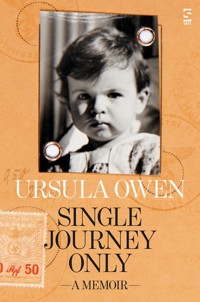
SINGLE JOURNEY ONLY
A Memoir
URSULA OWEN
To my wonderful gang of girls Kadi, Charlee, Kate with Maya, Tally, Leonie
‘Every migration, irrespective of its cause, nature and scale, leads to conflicts. Self-interest and xenophobia are anthropological constants: they are older than all known societies. To avoid bloodbaths and to make possible even a minimum of exchange between different clans, tribes and ethnic groups, ancient societies invented the rituals of hospitality. These provisions, however, do not abrogate the status of a stranger. Quite the reverse: they fix it. The guest is sacred, but he must not stay.’
HANS MAGNUS ENZENSBERGER
‘The sense of limitless freedom that I, as a woman, sometimes feel is that of a new kind of being. Because I simply could not have existed, as I am, in any other preceding time or place’
ANGELA CARTER
CONTENTS
1
FIRST JOURNEY
IT’S A CLOUDY March day in 1937. A young woman in her late twenties, dark hair and brown eyes, boards a plane to Berlin at Croydon airport, south of London. The woman is carrying her six-week-old baby. The baby too has brown eyes and a tuft of black hair. My mother later tells me that before the plane reaches Berlin Templehof I start yelling. I am hungry. No German woman at that time may breastfeed her child in public, das tut man nicht.
My mother feels intense relief at getting to Berlin, the prospect of being met by my father, being able at last to feed me. As she walks down the steps of the plane and on to the runway with me in her arms, a fellow passenger, English, distinguished-looking with silver hair and elegant grey suit, turns to her and lifts his arm in a mock Nazi salute. ‘Goodbye, Madam and baby’, he says. And he is gone.
An understandable mistake, my mother always said. ‘He thought I was a Nazi sympathiser, returning to the Fatherland to support my Fuhrer.’ And after all, it was 1937 and who but a Nazi sympathiser would be going to Germany with a baby at such a time?
For the first eighteen months of my life Berlin is my home. I don’t return there until I’m forty-four, when I’ve fallen in love with Bill, a man who is completely English – not an un-English gene in him – and he has fallen in love with Central Europe and understands it, culturally and politically, better than I do. I begin to take an interest in the German part of myself, something I’ve avoided up to now.
In the winter of 1981, Bill takes me to Berlin. I love it immediately; it’s full of drama and I discover the subversive vitality Berliners are famous for. It’s also full of reminders of the Nazi past. As we wander around the Tiergarten in the biting cold – across the little bridges over the small lakes, through the birch tree woods, down the tree-lined avenues into the open meadows. I imagine how it might have been if this was where I had grown up. We travel on the S-Bahn to Dahlem, the suburb where I lived with my parents and brother for t hose first eighteen months. I walk down Königin-Luise-Straße and it looks very familiar. There’s a watery sun in the sky and it’s very cold. I hear German all around me and it sounds like the language I belong to. I have heard it all my life. We reach the place where our house was. I knew that it was no longer there – bombed in 1944. There’s a nondescript one-storey building in its place. I walk up the side of it and Bill takes a photograph of me. I begin to weep and I can’t stop. I’m thinking about how envious I have so often felt when people are able to claim the place, the house, the territory that they come from. Now I feel overwhelmed by a sense of loss. The past feels like home. I feel an urge to reclaim it, but I don’t know how.
2
DISLOCATIONS
IN FEBRUARY 1933, a month after Hitler became Chancellor, my mother, Fips, discovered she was pregnant. My parents were people who planned ahead; they found uncertainty and disorder difficult. A perspicacious friend of the family suggested they must prepare for the worst: Hitler’s intentions towards Jews, he said, were clear and malign. My mother should go to England to have her child, giving the baby British citizenship, which would make emigration easier if that time were to come. So, my brother Peter was born, a forceps delivery, on a cold November day in Leeds, where my mother’s aunt Flora – part of a branch of the family that had left Germany a generation earlier – had settled. Fips returned to Germany two weeks later.
By the time of Peter’s birth, the Nazi Party had already done the groundwork for its brutal regime; the establishment of the first concentration camp, Dachau, the formation of the Gestapo, the beginnings of forced sterilization. My parents had as yet no definite plans to leave Germany. For the time being my father Werner was able to continue his work. He was a chemical engineer in the Jewish family firm, Gesellschaft für Electrometallurgie, GfE – an international company dealing with non-ferrous metals and providing alloys for the German rearmament effort.
But for others in the family, life was deteriorating. By 1933, Werner’s sister, sweet round-faced Ilse, three years younger than him, had been prevented from completing her medical studies. In 1935, Hans Sachs, my paternal grandfather was ‘retired’, for explicitly racial reasons, as director of cancer research in Heidelberg.
At home in Dahlem, Peter, now aged three, repeatedly refused to give the Heil Hitler salute at kindergarten, making my mother increasingly anxious. She herself was regularly defiant. She continued to go into boycotted Jewish shops and at my father’s office outing to the 1936 Olympic Games, she refused to raise her arm in salute, shaming the woman next to her into lowering hers. This at a time when Nazi propaganda had manipulated mass opinion and paralysed opponents, when constitutional rights had been suspended, when public humiliation of Jews was commonplace in streets and schools and when living in fear of denunciation or the doorbell ringing at an unusual hour was part of daily life for Jews.
Then Werner accidentally ran his car into an SS officer on a motorbike. He was lucky. The officer rang him that night to say he’d prefer my father not to report the accident as his insurance was out of date. Another reminder that something could happen to them at any time.
At the end of 1936, my mother went to England, this time to Oxford, again to give birth, where Ilse had settled that year in a community of refugees and sympathetic academics. Peter stayed with my grandparents in Heidelberg. I was born in the Radcliffe Infirmary on January 21 1937, a week later than expected. My father came for the birth but had to hurry back to Germany for work.
It was an easy birth and my mother had family and friends around her. She told me later she loved the hospital staff and felt well looked after, only briefly alarmed when they whisked me off to open up a closed tear duct, returning me to her with a huge bandage round my head. She felt relief at being away from the stresses of life in Germany. It was a happy time for her and she stayed for six more weeks.
Dahlem, to where my mother and I were returning on that March day in 1937, is a prosperous suburb of Berlin, wide tree-lined streets with large villas near woods and lakes. I have a persistent memory of being wheeled in my pram, past the post office, down Königin-Luise-Straße. We lived in a large apartment at number 30. Apparently I cried at night, having got used to night feeds in the Oxford hospital and my parents put me ‘in a room in the farthest corner of the flat, where we couldn’t hear you’ – something of the strictness of a Truby King regime, though I’m sure they knew nothing about him. After a week, my father said, I stopped crying. I have later memories of my mother singing my brother and I to sleep with her light tuneful voice – ‘Ah du kleine Augustin’, ‘GU ten Abend, Guten Nacht’.
We are a family of amateur photographers, my bookshelves full of albums from Fips’ and Werner’s adolescence onwards. There are photos from the late thirties of the family walking in the woods in nearby Grunewald, Werner in his plus fours, Fips with a patterned scarf round her head, Peter speeding down hills on a sledge in winter, he and I happily sitting on our grandparents’ laps in Heidelberg and Frankfurt, or with bucket and spade on a trip to Zoppot, the seaside town on the Baltic Sea where we stayed with my mother’s aunt. For some events there are no photos, only stories; none, for instance, of Dahlem’s St.-Annen-Kirche where my parents went regularly to hear the Protestant Pastor Niemöller, famous for his opposition to the Nazis, flanked by two Gestapo officers as he gave his sermons. After he was arrested in 1937 and for each day of his eight years in concentration camp, the congregation at Dahlem came together for prayers twice a day.
With grandfather Hans and Peter, 1938
In 1937, the ‘unholy weight of the Nazi machine’, as my father described it, descended on Jewish industry and by the end of that year the Jewish management of GfE began organizing a compulsory sale to the most sympathetic ‘Aryan’ owners they could find.
In 1938 there were new anti-Semitic edicts coming out every few weeks. In March, all Jewish passports were confiscated. After ‘endless tedious discussions’ GfE was taken over and renamed Reichswerke Hermann Göring, the deal being that the senior staff, including my father and his two cousins, were given permission to emigrate.
The Nazi’s infamous Berlin police president, Graf von Helldorff, had to be persuaded to release passports for Werner and his cousins and their families. This involved shouting and bullying which my father described to me in graphic detail. Their colleague, Kurt Dithmer, prepared to go to any lengths to help his Jewish friends get out, faced Helldorff three times before passports were finally issued. Even then, Helldorff decided to keep my father’s cousin Ernst temporarily as a hostage in Germany to see how the others ‘behaved abroad.’ There was no question of compensation, though the new managers were friends of the family and handed back GfE when the war was over.
In July 1938, my mother visited her widowed father Henry in his apartment in Frankfurt. He was old and unwell and she’d decided not to tell him she was leaving Germany – ‘though I’m sure he knew,’ she said. He died in September that year.
In late July, Fips and Werner left Germany for good. They left without Peter and me. We stayed with Hans and Lotte, my father’s parents, in Heidelberg, where they were still living in middle class comfort, though Hans had by this time lost his job. Like many of their generation, they were still hoping that the ‘nonsense’ of political extremism would pass, though their hopes were fading. Peter was four and I was eighteen months old.
Much later I questioned my parents about this – why did you go without us? How could you have taken the risk? They replied, vaguely and rather defensively, that they wanted to settle down first, to bring my brother and me over when they’d found somewhere to live.
There is an alternative explanation: given the awful negotiations with the Nazis and having handed over the company, it could be that my father feared that the Nazis had no further use for him, that he and my mother might be arrested as they left. He had signed a certificate, issued by a Nazi office in Berlin, in which he, my mother and my brother and I, resigned from the Jewish Synagogue community and the Jewish religion. I can only imagine what level of fear had induced him to do that.
And it’s even harder for me to imagine how they dealt with the contradictions they were living with: on the one hand the fear of the knock on the door in the night; on the other, the insistence, often half conscious, that life goes on, that decisions are made as if these terrors did not exist.
Before they left my parents made sure that Peter and I had each been assigned an exit visa – an official document with a photograph, stamped with a Nazi eagle and the words ‘Single Journey Only.’ American Express in Heidelberg provided the £4 12s 6d which despite the gratis stamp, had to be paid.
They sent their books, the crockery, the silver cutlery and crystal glasses, their grand piano, the linen and furniture they’d accumulated over their married life, ahead to England, where it arrived safely a few weeks later. They left Germany with ten Reich marks in cash, worth less than a pound – all they were allowed. When they went through German customs, the official, seeing the large J on their passports, hurried them through without looking at their suitcases, while the SS officer behind them was made to open everything for examination. They were, relatively speaking, fortunate.
A few weeks after they arrived in England, Neville Chamberlain announced that he was to meet Hitler in Berchtesgaden in September, an attempt to keep the peace over the issue of the Sudetenland. My parents, already alarmed at the increasing talk of war, decided to send for us.
In mid-September Hans and Lotte made the arrangements for our journey. Peter and I, he clutching his favourite clockwork rabbit, were taken by an Aryan maid across the Dutch border on the Rheingold train, where my father was waiting to meet us. My grandfather, pipe in hand, came to the border, but, having no exit visa, could not cross over with us.
The three of us caught a plane in Amsterdam, landing in Croydon airport, where my mother and her cousin Dorrie were waiting for us. I’d been sick on the journey and Peter had been playing on the luggage racks; we were tired and scruffy and dishevelled. My mother later told us that Dorrie turned to her in amazement and asked ‘Are these your children?’
For years I heard this story of our leaving and accepted the way it was told – as unproblematic, routine. My parents usually talked about their experiences in Nazi Germany with the minimum of drama and self-pity. It was years before their fears became apparent to me. Two years before he died, I asked my father whether he’d been frightened at the possibility that the arrangements to get Peter and me out of Germany might have gone wrong. He said yes with uncharacteristic vehemence.
3
LESSONS IN ASSIMILATION
I COME FROM a long line of assimilators. For my family, as for me, being Jewish has been a social, cultural and even psychological inheritance but not a religious one. There was no identification with the idea of a Jewish homeland in Palestine. I don’t remember any talk of Israel among my parents or their friends. The story goes that when a question arose about possible emigration to Palestine, my grandfather Hans said that he ‘preferred to remain an individual.’ Our family never went to synagogue and never celebrated Jewish holidays or festivals. The first time I went to a Seder was in my sixties, with my granddaughter, in the house of friends. I wish I’d taken more part in Jewish life as a child, but there was none available.
But in the 1930s, Jewishness for my family became an inescapable identity. They identified with being part of a persecuted group and took pride in it. When, in the 1990s, twelve branches of the family were together making a property claim over a plot in Berlin, German legal advisers suggested a form of words which indicated the family had emigrated ‘on account of their faith’; several of us asked for this to be deleted and replaced with words making clear that their emigration was the result of racial persecution.
My parents were born in Frankfurt in the first decade of the twentieth century, into prosperous Jewish families already highly assimilated into bourgeois German life. My grandparents remained identified with a Germany they thought of as their generation’s best.
In the photograph albums I inherit I see my grandparents Hans and Lotte, whose world in the twenties and early thirties was continental Europe, carrying their Baedeker guides, my grandfather in well-cut suits, my grandmother wearing stylish long dresses with lace collars, her thick black hair parted in the middle. There they are, stepping on to trains in Switzerland, sitting on deckchairs on Italian steamers, their handsome brass-bound monogrammed cabin trunks painted across the ends with the imperial German colours, red, white and black, so that they could be easily recognized. They look completely at home and settled, with enough freedom and money to enjoy their comfortable bourgeois life.
Left to right, my father Werner, my aunt Ilse, grandmother Lotte, grandfather Hans on holiday in Flims, 1928
There is an ongoing scholarly debate about the virtues and vices of Jewish assimilation into pre-war Germany in particular. Since 1945, assimilation has, it seems to me, been judged more and more harshly, as a way of succumbing to the dominant culture. It is ethnic identity which is seen as desirable, the route to personal satisfaction.
The double identification – Jewish and German – was so much part of my upbringing that I was surprised to discover in my teens that, in the eyes of some Jews, the desire to assimilate is seen as shameful. This sense of shame was particularly aimed at German Jews. Recently a friend told me that when he was working as a graduate in Princeton in 2006, the word ‘assimilation’ was as hateful in some circles as the word ‘nigger’.
I took assimilation for granted. No one particularly made arguments for it. It was just part of our lives.
What was it I was taking for granted? With hindsight and ideally, it seemed like this: you learn the language, keep what’s good from your own culture and take what’s good for you from other cultures, use familiarity and unfamiliarity to make sense of your world, live with others who are like you and not like you, in places which may not be yours, create a new world for yourself out of other worlds as well as your own, assimilate.
I thought of myself as Jewish and German. I was brought up in a household more German than Jewish in its habits and culture, though it was often hard to distinguish the two. Then, as a child growing up in England, I wanted to be English, to belong to Englishness. I struggled to be at ease with seemingly contradictory desires and identities – which is perhaps not saying more than that I was a person who wanted badly to belong. I, like everyone in my generation – siblings, cousins, second cousins – married out.
Assimilation was certainly part of my great grandfather Elias Sachs’s thinking. Born in 1829 in Kattowitz, when it was still a village, he started his young adult life shovelling horse manure into carts, which was delivered to the Eisenhütte (iron works) where it was used as fuel. He rose from poverty to great affluence, a successful self-made man of the German industrial revolution, becoming one of the richest men in Prussia. Known in the family as the ‘coal king’, he acquired several mines in Upper Silesia, set up an iron and steel works and established the first bank in Kattowitz. He became a bürger of the city, which grew rapidly.
At the age of forty-one he married Flora, a woman twenty years younger than him and promptly retired. This early retirement was a mistake. He failed to find enough outlets for his energies and concentrated on the upbringing of his five children. My petite and fierce grandmother, Lotte, his daughter-in-law, always articulate and highly expressive, remembered him as difficult and domineering, forcing his own ambitions on to his children. In 1973, when Morton Schatzman’s book Soul Murder: Persecution in the Family, the study of a man who dominates his sons to the point of driving them mad, came out, she told me, seething with indignation ‘This was exactly the upbringing of your grandfather and his brothers.’ She was proud of the fact that her husband Hans, the eldest child and a high achiever, somehow managed to deal with his father’s unbearably controlling behaviour.
Elias wanted to equip Hans with the ‘cultural capital’ needed to create the assimilationist dream he shared with many Jews of his generation. Towards the end of the 19th century it became possible for Jews to be more active in German culture and society. Some historians would say that this was the result of Jews aspiring to be Germans, with little help and sometimes considerable hostility, from Germans. The historian Fritz Stern believes there was something more – a Jewish-German symbiosis where German Jews had merged elements of German and Jewish culture into a unique new one. Whatever the reality, it was almost certainly not the symbiosis my great grandfather dreamed of.
Born in 1877, my grandfather Hans went to schools where Jewish children were either a majority or a substantial minority. Quiet and shy, he was a good pupil and flourished, went to university in Berlin and later Frankfurt. Already there was no possibility, as a Jew, of a career in surgery and he had to go into the new medical sciences – he chose bacteriology and serology – the only ones which promised serious professional opportunities for Jews.
Hans defined himself as a public scientist. He believed in experimental medical science, in the logic of laboratory work as a way of trying to contain the scourges of the time – diphtheria, syphilis, typhus. Together with colleagues, he developed the Sachs-Georgi reaction, the first diagnostic test for syphilis – something my grandmother in her later years delighted in telling anyone who’d listen.
No one would have described my grandmother as shy. There are endless gold-edged sepia photographs of her as a child showing a pretty girl gazing directly and confidently at the camera. She was the eldest child of doting parents, both with strong liberal tendencies. Though her parents divorced, she talked to us of a happy childhood, how close she was to her sisters and especially to her brother Kurt. She made friends easily, though she could be opinionated and bossy – characteristics that stayed with her all her life. Deeply interested in her children’s and grandchildren’s lives, she never held back from sharp or disapproving comments if she felt they were appropriate.
Lotte met my grandfather Hans when she was still a schoolgirl in Berlin. From the start there was strong attraction between them. Lotte knew her own mind and, overcoming her mother’s opposition – she thought that her daughter should make a socially better match – got engaged at nineteen and married Hans at the age of twenty in 1905. Hans and Lotte’s birth certificates record them as being Jewish. Though they came from backgrounds of secularization and assimilation, marriage to a Jewish spouse was still expected in their generation. They married in a civil ceremony.
My grandparents with friends in Bring auf Rugen, Germany, 1919. My grandfather in striped swimsuit, my grandmother below him holding Ilse, my aunt, my father bottom far right
My father Werner was born in 1906, his sister Ilse in 1909. Werner inherited his grandfather Elias Sachs’s stubborn spirit and Hans’s scientific curiosity and analytic skills. Ilse was, like her father, gently tolerant towards others; Werner from all accounts had a short temper and an obsessional side to his nature as a child. He famously flew into a rage aged eleven when Ilse failed to put his ruler back in exactly the right place. He once tried to throttle a hated governess.
The household they grew up in was steeped in German culture. On the bookcases that lined the sitting room in their tall house in Frankfurt’s Bockenheimer Landstraße were the German classics of the eighteenth and nineteenth century, Thomas Mann and Rilke from the twentieth, as well as biographies, political memoirs and letters. English literature was represented by Shakespeare (in translation), some Dickens, Scott and Galsworthy and Lotte’s taste in racier novels – Elinor Glyn and Grant Allen’s The Woman Who Did. They bought Hitler’s Mein Kampf from the first printing in 1933. There was no outward evidence of an interest in Jewish religion – their menorah was used as a candlestick – and there were no Jewish religious or devotional books, just a book of Jewish history on their shelves, together with a text of Luther’s, a copy of Freud’s Moses and Monotheism and six sermons given by Pastor Niemöller.
A Bechstein grand sat in the corner. Hans was a good pianist and accompanied friends regularly at musical evenings. Werner had flute lessons and became an accomplished player. Ilse learned the piano. There were scores for Wagner operas, the libretto for the Ring of the Nibelungen, piano scores arranged for four hands of all the main German classical composers which I got to know well when my father and I later played them together, he taking the bass part, thumping away and counting loudly – ‘eins, zwei, drei, vier’ – in his repeated attempts to make me better at sight reading.
Grandmother Lotte Sachs with Werner and Ilse, 1919
Assimilation in my mother’s family also involved making fortunes – this time in America during the gold rush. My mother talked to me often of her American heritage; she was proud of it and to a young adolescent the stories of her family’s rise to riches on another continent were extraordinarily romantic.
Her grandfather, Feist Livingstone, grew up near Frankfurt and joined his brother, Marks, in California in 1849, where they set up a trading company supplying the gold miners with the goods they needed. It was a highly profitable business, the payments sometimes made in gold dust.
California at that time was flooded with adventurers and fortune seekers. Hundreds of Jews joined the westward movement in search of economic and political opportunity, coming from centuries of oppression and discrimination in Europe.
The original reasons for the brothers going to America are unclear, though Marks was thought to be fleeing debts in Germany, which he later repaid. In America they made their fortune. Around 1870 the brothers went back to Frankfurt to live. They felt they were German and belonged in Germany. Frankfurt had become a lively and liberal metropolis, developing a rich and sophisticated Jewish cultural life – the ghetto abolished, in 1853 Jewish people had been confirmed as having full and equal rights with other citizens. And Jews were playing an increasingly important part in the industrial and commercial life of the city. It was a good time for Feist, now called Frank, to return with his wife Emma and their children. There were three boys and eight girls. The boys all died young, the daughters all survived. The story we were told was that all their marriages were arranged, but only my grandmother Marta’s to Henry Boehm was happy. Her sister Flora apparently advised her four daughters never to marry: they never did.
4
MY PARENTS
THREE YEARS APART in age, my parents grew up in those tall bourgeois houses characteristic of Frankfurt’s Westend, where about a third of Frankfurt’s Jews, roughly 4,000 of them, lived. These were the wealthier Jews, the reformist Liberals and those like my grandparents who didn’t practise Jewish rituals at all. Years later when, exhausted after a week at the Frankfurt Bookfair, I met my father there, he took me on a tour of the streets. The exhaustion dropped away as, riveted, I listened to him naming everyone who had lived in the neighbourhood at the time – and what had become of them after the Nazis arrived – exiled to England or America, or taken to the camps.
My mother, a tomboy as a child, was nicknamed Fips after the monkey in the children’s book Max und Moritz. The name stuck with her for the rest of her life. She grew up in an elegant apartment where tea was served at the same time every day from a silver teapot. Her sister Elizabeth, to whom she was never close, was two years older. Fips was devoted to her mother Marta and very dependent on her support. On my kitchen wall is a photograph of Marta, grave expression, hair swept back, elegant in her lacey white blouse, arms round the two dark-haired girls sitting in their long white dresses.
Marta Boehm, my maternal grandmother, with my mother Fips (left) and her sister Elizabeth, 1912
Fips and Werner lived in shouting distance of each other in the same street, Bockenheimer Landstraße. Some friends described her as bold, ‘ein mutiges madchen’ and outspoken. But according to others, including her classmate and close friend Ilse, my father’s sister, she was often anxious and insecure, needing a good deal of reassurance about what she’d said or done. Exceptionally beautiful, when she was young she wore her dark hair short, later in a fashionable bun; high forehead, freckled nose, full lips and when she was happy, a warm smile. She was a bright pupil, particularly good at maths, persistently late for school, exasperating Ilse, who called to pick her up every day.
Fips was eighteen when her mother died of cervical cancer aged forty-seven. Fips’s father Henry was a doctor whose practice in Frankfurt, unusually, included working class as well as middle class patients – though, as my mother would tell me with embarrassment, they came into the practice through separate entrances. His patients called him the ‘Jesus of Bockenheim.’ Marta operated the radium lamps on Henry’s patients – a common practice at the time when the effects of radium were not yet understood. It seems likely that her cancer resulted from this.
Her mother’s death left Fips utterly bereft: it was probably the greatest trauma of her life. Even as an old woman she expressed her grief over the death of Marta as if it had happened yesterday.
She remembered nothing about her mother’s death, nor of her funeral: she wasn’t even sure she had gone to the funeral. Her father withdrew into his grief, while her older sister, already engaged, spent most of her time with her fiancé. ‘I survived by going as often as I could to stay with Ilse in the Sachs household,’ she told me. She felt welcome there and never forgot the relief of going somewhere where people were laughing and talking; in her own home there had for a long time been only silence and gloom.
The death of her mother left Fips not just grief-stricken – a grief that never became bearable, never seemed to be resolved – but also stranded. Her mother, she recalled, had intended her to go to finishing school, but her father was too stunned by his bereavement to be able to attend to her needs and my mother was too devastated to organize things for herself. What she did was to take up Mensendieck, a fashionable form of gymnastics at the time, popular among some Hollywood stars, in which the participants learn to use their will to relax muscles and release tension, all performed naked in front of mirrors. Fips acquired a diploma as a Mensendieck teacher, but she hated it and pursued this career reluctantly and not for long. What saved her at this difficult time were her friends, young men and women, most of them Jewish, who formed a strong group around her; and particularly the Sachs’s, who offered her a haven of cheerful family life.
So it was that, in the late Twenties, my parents began to see more of each other. Their backgrounds were similar culturally – both of them from professional, secularised families who felt themselves to be Jewish and German and saw assimilation as a positive good.
Despite the death of Marta, my parents’ accounts of their teenage years and early twenties had idyllic qualities. They were part of a close-knit group of lively and talented young men and women – one of them a future Nobel Prize winner, Hans Bethe, a theoretical physicist who worked on the formula for the H-bomb and for the rest of his life sat on committees to try and prevent the bomb being dropped. He fell in love with my mother though she turned him down because he had dirty finger nails: ‘I was stupid,’ she told me. Siblings (though noticeably not my mother’s sister), cousins, intimate friends went to dancing classes and on ski trips together – the photo albums tell the story. Ten or twelve laughing young people lined up with their skis, in shirt sleeves, waistcoats and ties – the girls as well as the boys – in beautiful mountain scenery; or sitting, with goggles on their heads, in deckchairs and on sledges in front of mountain huts and small hotels. They produced a cyclostyled magazine, Die Lawine (the Avalanche), with witty accounts of their ski trips, their friendships, who was flirting with whom, in prose and poetry.
Fips and Werner, second and third from left, Ilse second from right, with companions on a winter ski trip in Switzerland, 1931
My mother featured prominently. There are photos of her in her early twenties, sploshing in the sea, black hair dishevelled, arms waving in the air, or standing on her skis, relaxed, slim with broad hips, in deep snow. She is often laughing, sometimes shyly but often with a directness of gaze and a defiant boldness which eclipses the others.
By then my father and mother had been seeing a lot of each other. My father, a talented scientist, after leaving school attended the Max Planck Institute in Munich, becoming one of its star pupils, studying chemical engineering. In 1932 they married. I see in the wedding photos this handsome couple, my father solemn and serious, his black hair parted, my mother in a short white dress with a veil keeping her smooth hair drawn back, smiling tentatively, looking like Ingrid Bergman. Both are looking straight ahead. To me now there are omens in these photographs of their difficult later times – of anxieties and incomprehension.
My parents, Fips and Werner, on their wedding day, Frankfurt, October 11th 1932
Over all this was the shadow of Nazism. In 1933, the year Hitler won power, Werner and Fips moved to Berlin. My father had joined the family firm owned by his uncle Paul Grunfeld. The non-ferrous metal industry was rapidly developing in Germany, not least under the spur of the secret rearmament programme. Gesellschaft für Electrometallurgie was involved in the manufacture of armour-piercing bullets, a programme that increased demand for tungsten ores and the business of the family’s Nurnberg works. (Ironically, a decade later my father was working for the same purpose for the British Ministry of Supply).
My mother disliked the set-up in Berlin: the Grunfelds were a rich and powerful family and seemed to dominate their lives too much. She felt marginalized, less at home in Berlin than Frankfurt at first; she remembers being reproached for telephoning my father at the office. My father went to work every day. My mother, by now pregnant with Peter, stayed at home.
A few months after my father had moved to the head office, the offices of one of the constituent firms in the Ruhr were ransacked by SA storm troopers. Several of the senior Jewish scientists and managers had to withdraw from the works in Nurnberg, where anti-Semitism was particularly rife.
By April 1933, Jewish students were forbidden to attend schools and universities. By September 1935, the anti-Semitic Nuremberg Laws were passed, those endless dirges of horrifying bureaucracy, which were the basis for the exclusion of Jews from all public business life. By November that year Jewish children were banned from using the same playgrounds and locker rooms as other children.
I try to imagine my parents’ life in Berlin. I read memoirs of the time, look again and again at family photographs, at letters, try to remember conversations. I want to know what they felt and thought, what they knew, what they talked about to each other. Standing in the garden of what was their villa in Dahlem in 1981, when I was forty-four, I wondered whether I’d imbibed through being their child a generational feeling of that time. Fips and Werner told anecdotes, often vivid, about their lives. But they were part of a generation, and a class, that didn’t encourage questions, that avoided probing, difficult conversations, taboo subjects. And yet I know too that some of this was about protecting us – above all from fear. I wish I’d asked more questions. Did they encounter anti-Semitism in their private lives? Did their assimilation protect them? How much did fear interfere in their daily lives? Perhaps they understood exactly what the parameters of their world were and stuck to them. How were they affected by being forbidden certain areas, socially and professionally? Unlike my grandparents, I never heard them say that they thought the Nazi influence would pass, that people would come to their senses. I think they understood the lure that the Nazis offered – a sort of liberation from the self into mindless belonging – and recognised its power.
How was their cultural life affected as the Nazi edicts against Jews grew? Berlin was an extraordinary cultural hub. For Fips and Werner classical concerts and theatre were the main features of their cultural life and Jews were not forbidden to attend such events until September 1938. They’d been well-educated in German and to some extent in English literature, with their leather-bound Shakespeare, Schiller and Goethe on the bookshelves. They didn’t go to the cabaret performances in the bars of Berlin that I read about later in Christopher Isherwood’s books; that was not their world. My father in particular always had strong views on what was ‘good’ in culture and shied away from anything too provocative. Years later, I asked him what he thought about a performance he’d seen of Strindberg’s The Dance of Death, a savage account of a disastrous marriage. ‘For me’, he said loftily, ‘this play need not have been written’.
When in 2011, I visit the Topography of Terror museum in Berlin, which lays out in devastating detail the speed with which the Nazi Party acted to change things, I wonder what my parents’ responses were: to the establishment of Dachau, after thousands had been taken into ‘preventive detention’, sometimes using bars and people’s front rooms for this, after the Reichstag fire; the street battles; the public book burning, the political murders, the removal of opposition parties, the banning of Jewish physicians and lawyers. They certainly knew of the boycott of Jewish shops in 1933; my mother told me how she deliberately went into them – and how that wasn’t always welcome for the frightened shopkeepers.
My mother insisted later that she saw dangers everywhere but that my father didn’t want to talk about them or even necessarily recognize them. Perhaps by not talking about his fears he could manage them. He was able to work till 1937 and when Fips talked about how late she felt they had left Germany, he insisted that it had taken a lot of time and organizing to do the necessary things – get exit visas, hand over the company, prepare for exile. They never agreed about this.
5
A NEW-FOUND LAND
Ah, what an age it is
When to speak of trees is almost a crime
For it is a kind of silence about injustice
BERTOLT BRECHT
THE RELIEF MY parents Fips and Werner felt at being in England was palpable – they told me later of the pleasure they felt at taking refuge in a country where, in 1938, arriving from Nazi Germany, the burning issue in the Letters columns of The Times concerned the condition of laburnum trees. My mother warmed to the English and particularly liked what she saw as an English tendency to play down tension and chaos, to be quiet and calm and above all humorous in the face of troubles. It was not the German way – both my parents were inclined to respond expressively, even explosively to what was happening around them.
Considering how disorientated they must have felt, how cut off from their old world, how traumatic the recognition that there was no place for them in their own country, they seemed to have adjusted to their new circumstances – with the support of the four Hesse sisters, my mother’s cousins, all musicians, whose parents had emigrated in an earlier generation. And on the surface at least they adjusted fast.
For them the most important matter was that their children should become integrated into English life. North London, where many Jewish refugees had settled was not, in their eyes, the route to assimilation.
They found a house in a suburban street in South West London, which they first rented and later bought. 19 Tideswell Road in Putney was a plain Edwardian house, a solid yellow and red brick affair two storeys high, detached, double fronted. Two small squares of grass with bordering beds full of primulas and grape hyacinths made up the front garden; a pyracantha, bright orange berries in winter, surrounded the porch. At the back of the house the French windows led on to a lawn surrounded by beds where spring brought daffodils and tulips and my father grew roses and tomato plants for summer ripening. He loved gardening, mowed the lawn regularly, in straight lines, tipping the cut grass on to a compost heap under the apple tree. We were assigned weeding jobs, which for a long time discouraged me from gardening altogether. At the end of the garden a large pear tree stood next to the high brick wall, separating us from the grander houses in parallel Gwendolen Avenue where, in adolescence, I spent hours after school batting a tennis ball till it was too dark to see.
Downstairs in the house the dark hallway was made darker by the coloured glass in the windows. The rooms were filled with our large furniture from Germany – the matching dining table, chairs, sideboard and glass cupboard, all in cherry wood – wedding presents to my parents which now live with me – and the desk and grand piano in my father’s study.
Apart from the kitchen, I never felt much comfort in that house. An observant friend once said that she felt it had no history – that it seemed frozen, with no past or future. The rooms were tidy and somehow empty of life. If they expressed anything it was a kind of careful feeling of the way – not much intimacy, no bold statements, no comfortable places to settle into, no objects scattered about to catch the attention or make you feel at home, hardly any photographs – a few rather drab framed photographs of Riemenschneider carvings on the wall up the staircase, a photo of my grandfather on my father’s desk – that was all. There were some signs of my parents’ past life – they had after all brought many of their belongings from Germany. Yet somehow these things didn’t seem to connect us with each other or our history.
Perhaps the house reflected the isolation Fips and Werner felt at leaving their life behind. Later, when my parents divorced, my mother chose to fill her new flat with family photos and objects from her past. Later still, I filled my own house to overflowing with photographs, obsessively, on every shelf, fading and bending, my grandparents, parents, my daughter, friends, lovers – constant, perhaps rather anxious reminders of who I was, where I came from, where I placed myself.
It was a strange social mix, this street my parents had chosen to live in, with its pollarded plane trees and small, neat front gardens, its little plots of tidy suburbanism more tightly congregated than the spacious villas they were used to in Königin-Luise-Straße. They found comfort in the kind, reserved and austere neighbourliness.
At the top of the road sat the Catholic Church. On the dot of twelve on Sunday mornings the church doors opened and streams of people came out of Mass, down our street and scattering in all directions. As a wistful and moody teenager I leaned out of my bedroom window watching them till they had all disappeared, thinking how fired up they seemed, how full of energy.
The people who now live in Tideswell Road are lawyers, television executives, marketing directors. In the 1940 and 50s they were bank clerks, accountants, teachers, people running small businesses, many of them outsiders and eccentrics. The houses exuded a rather melancholy mystery, secrets I felt I would never understand; the shell-shocked man in the house opposite, ill and unshaven, in his darkened house; the friendly Plymouth Brethren family next door, with their six children who weren’t allowed to play with me because of their religious beliefs, but who kept a careful eye on my mother during air raids when my father was away. Two doors down, the Dickensian spinster sisters: grim, upright, dressed in tweed suits and spotless white blouses. Their long-suffering live-in servant Nellie, tiny, her face full of sadness and anxiety, was a friend of Dolly’s, our daily help.
Dolly, barely five feet tall, with her elfin weathered face and equable temperament, never vehement or angry, became intertwined in the dailiness of our life so quickly that it was hard for me to remember when she first came and what it had been like before her. She was something of a rock for us.
I was close to Dolly. As I became a teenager she would bring me her women’s magazines – ‘books’ she called them – which I devoured, each one, knitting patterns, features about birth, children, illness, make up, recipes and, above all, stories, love stories, usually about difficult but fascinating men and adoring women learning to understand them. I stopped reading books. My father began to despair about my reading habits and tried to thrust classic novels at me. None of it worked.
And I confided in Dolly. She listened patiently, never making judgements, while I told her things I was feeling about my family, my jealousy of my sister, my anxiety about my mother, my fear of exclusion with friends at school. And she told stories about her life as a single mother, of her mother’s life in service, regularly beaten once a week by her employer just to remind her of her place. Dolly confided in me that Nellie too was beaten, by the sisters. I was haunted by that.
Ours is a bilingual household – they speak German to us, we speak English back. We learn each other’s languages and in my head they merge into one. Much later, I realize that I don’t feel entirely at home in English, that I have a small vocabulary, that I often speak in translation. ‘I had three eggs already and Grandpa often does accompany me at the piano,’ I write to my parents when I am eight years old. Jokes, rather German-style, about the English language feature regularly when my parents are with their refugee friends, producing gales of laughter. ‘A refugee from Germany is asked by an acquaintance what his name is. “Mackintosh,” he replies.
‘Yes, but what was your name before that?’
Fips and Werner had always been interested in the Christian opposition to Hitler – they read theologians Dietrich Bonhoeffer and Pastor Niemöller and heard them preach. Now, in England, they joined the Anglican Church. So it was that on a sunny day in the spring of 1939 Fips and Werner were confirmed and Peter and I were christened, in St Mary’s Church in the High Street in Oxford. My mother started teaching at Sunday School. They had personal support from Canon Cockin of Winchester Cathedral, who gave so much help to Jewish immigrants. Werner Simonson, my parent’s friend who had been a judge in Germany, was re-training to become an enthusiastic Anglican vicar, his first parish in working class Dalston in East London. He supported their conversion.
It’s easy to dismiss my parents’ conversion as a somewhat craven desire to belong, but nothing as simple as that makes sense to me. Christianity continued to mean something to them both for the rest of their lives. We regularly walked to the church bordering on Wimbledon Common for Sunday morning services when we were children. I liked the hymns and can still recite most of them by heart, but apart from a brief flirtation with Billy Graham’s ideas (learned from a school friend) in my teens, I felt unengaged with Anglicanism, finding the sermons dull and my confirmation lessons uninspiring, engaging with rather banal versions of girlhood and adolescence while I had by then read Peter Abelard by Helen Waddell and wanted to engage in passionate issues of faith, sex and love. My sister was drawn to a Christian community in her teens where she escaped from home and spent holidays; my brother became a seriously committed Christian at his boarding school and has remained one ever since.
Once we had grown up, my father stopped being much of a churchgoer, but he kept up with changing ideas in Christianity, reading Teilhard de Chardin and Bishop Robinson’s Honest to God when they came out. For my mother, in her later years, the church near her house in Oxford and its vicar, became a central part of her life.
But for both of them being Jewish remained an integral part of their identity and it continued to be the way they described themselves to themselves and to other people.
I suppose in Germany in the Thirties my parents would have seen themselves as Isaac Deutscher’s ‘non-Jewish Jew’ – solidarity with the persecuted, feeling the pulse of Jewish history, supporting the security and self-respect of the Jews. And culturally they lived lives as German Jews which for them had a distinctive though unreligious quality.
What happened, when they converted to Christianity, to their embracing of Jewish race and culture? We as children growing up in England learned a great deal about the place of Christianity in our cultural life, much of it at school and from our peers. Jewish culture, imbibed from our parents and other relatives, was always separated from Jewish religion. And was it Jewish culture? Or for us simply the cultural life of a certain kind of bourgeois German?
Though they’d decided to settle where few Jews were living, Fips and Werner’s closest friends during the war were fellow Jewish refugees, who regularly came over for supper. I remember particularly a lawyer and his wife, also converts to Christianity, she an outspoken woman with sharp features and a startlingly blue nose, witty but often depressed and anxious, talking more openly about the horrors of Nazi Germany than my parents. When I was old enough to be at table, I made myself as inconspicuous as possible and sat silently listening to their stories of narrow escapes, of German collusion with the Nazis and, memorably, of encounters with Germans who ‘behaved well’ – work colleagues, people in the streets, casual encounters with officialdom.
And like all good stories, they were told often and each time I waited for the endings as if I’d never heard them before. They were relieved to be safe and there were roars of laughter about their attempts to make sense of their new life. They were learning the funny side of being exiles – my parent’s handbook being George Mikes’ How to Be an Alien, from which they read extracts at the supper table. These evenings were rare periods when I saw my parents being playful.
There were dark stories and dark thoughts, certainly and fears for people who were not yet safe. Werner Simonson in particular was permanently worried about his wife and son while they were still in Germany. Most of our family had managed to get out. But there were two relatives for whom there were serious concerns. My mother’s aunt from Zoppot – I still picture my mother saying angrily, in sadness and exasperation, ‘she couldn’t keep her mouth shut about what she thought about the Nazis’ – had been taken from her house and no one knew where she was. Eventually we learned she’d been killed in Auschwitz. The other relative was my grandmother’s brother, Kurt, whose reluctance to grasp what Hitler had in mind for Jews meant that he left the attempt to emigrate too late. He and his wife Greta sent their children to safety, to a private boarding school in Switzerland, in 1939. Kurt was arrested while on a visit to Belgium in May 1940, deported to France and interned in various camps. His wife, who was not Jewish, went to join him there in 1941 and together they tried to get visas to Switzerland. The family made every attempt to help them. But all efforts failed. They were sent to Auschwitz in 1942 and were killed there the same year.
For these suppers, my mother made the most of wartime rations, putting on her white cotton apron, tucking her hair behind her ears when it escaped from her neat bun. She’d brought her handwritten recipe books with her from Germany. She was a good cook and resourceful at managing on what there was – sieving sour milk through muslin cloths to make into a sort of yoghurt, making soups with meat bones, Verschleiretes Bauernmadchen pudding with a few precious eggs, apfelmus, using the apples and pears we’d wrapped in newspaper in the summer to preserve them. She seemed to organise domestic life in her new surroundings without too much difficulty; she was touched by the slightly remote friendliness she found around her, the gentleness and understatement of English people, their non-authoritarian way of speaking.
My father quickly settled into work. Within six weeks of arriving in England and even though they had come out of Germany with no money, he and his cousins had been able, with financial support from the Swedish branch of the company and some income from the tungsten mines in Bolivia and Turkey, to set up new offices for the family firm in London. They began with portable typewriters in the drawing room of 3 Hyde Park Gate but soon moved what was now called the London and Scandinavian Metallurgical Company to Wimbledon.




