


Erhalten Sie Zugang zu diesem und mehr als 300000 Büchern ab EUR 5,99 monatlich.
- Herausgeber: The History Press
- Kategorie: Sachliteratur, Reportagen, Biografien
- Sprache: Englisch
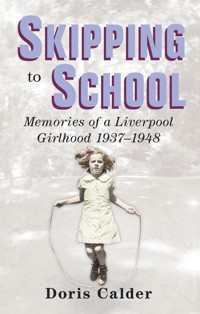
Skipping to School is the true story of a childhood spent in Liverpool before, during and after the Second World War. It recalls the fabric of everyday life on the home front and the impact of war on both family life and the local community. At home in Walton, Doris and her friends learned slogans such as 'Make Do and Mend', 'Dig for Victory' and 'Careless Talk Costs Lives'. They collected shell caps from bombs and did swaps for better, shinier ones. They made skipping ropes out of the twisted silk cords of German parachutes. They were excited by the arrival of American soldiers stationed on Aintree Racecourse. And, despite the raids, they laughed and had fun.
Sie lesen das E-Book in den Legimi-Apps auf:
Seitenzahl: 285
Veröffentlichungsjahr: 2013
Das E-Book (TTS) können Sie hören im Abo „Legimi Premium” in Legimi-Apps auf:
Ähnliche



















To my father George, my mother Alice, and my sister Joyce.
Thanks for the memories.
CONTENTS
Title Page
Dedication
Acknowledgement
Chapter One Skipping to School
Chapter Two School Rules
Chapter Three The School Year
Chapter Four Pills, Potions and Childhood Illnesses
Chapter Five My Friends and the Games We Played
Chapter Six Holidays
Chapter Seven Parties and Presents
Chapter Eight My Mother
Chapter Nine My Father
Chapter Ten Wartime Experiences
Chapter Eleven Make-do-and-Mend
Chapter Twelve The Lights Come on Again
Chapter Thirteen Cycling to School
Plate Section
About the Author
Copyright
ACKNOWLEDGEMENT
Thanks to my son Martin, for his patience and encouragement. Having heard the stories often enough, he told me to write them down.
Chapter One
SKIPPING TO SCHOOL
The summers of the 1930s were quite exceptional. This is not the misty-eyed imaginings of an adult looking back on a well-remembered childhood, but a matter of recorded meteorological fact. The days were hot and sunny, and the nights were warm and still. People kept their doors open long after dark, to let a breeze waft through their houses, keeping them cool throughout the evening. Neighbours chatted over garden fences and walls, couples strolled by, some coming home from a drink at their local, some returning from a visit to friends, others just enjoying an evening walk.
The summers of my childhood were happy times. A carefree season, it was a pause before September brought changes. As summer drew to a close and the season turned, new things happened to me. September of 1937 brought the biggest change in my life so far – I started school. I’d had my fifth birthday in February of that year, and since then I had been waiting to join my older sister at Arnot Street Infants & Juniors School. She was two years older than me and two years ahead at school. The year that I started in the infants she moved up to the juniors, and so I hardly saw her at school after all.
It had been a long wait for me to start school. In the months following my fifth birthday, I watched from our front window as children passed by on their way to school. Arnot Street was only a few minutes’ walk away, so I saw the schoolchildren in the morning, at lunchtime and going home in the afternoon. I heard them laughing and talking and I sensed their excitement. I couldn’t wait to join them.
Most of the older children walked to school on their own, but the younger children were taken by their mothers. The mothers were happy to walk their children to school in the morning and collect them in the afternoon; it was a chance for them to meet up with other women, have a chat and exchange any news and gossip. In those days, married women with school-age children very rarely went out to work and so could easily fit the school walk around domestic tasks.
Girls and boys did very different things on their way to school. Some of the girls skipped happily, some played avoiding-the-lines-between-the-paving-stones, some just walked, talking and giggling with their friends, while others chased a wooden hoop with a stick. The boys shouted a lot as they played tick, raced each other or ran about, kicking a ball. When September came and I finally started school, it was my turn to skip along and play avoiding-the-lines-between-the-paving-stones. To step on a line meant we could bring a terrible disaster down on our family. Sometimes we would step on a line for a dare, and then flew home to make sure everything was all right.
The first Christmas after starting school, at the top of my list of presents was a new skipping rope. I wanted one of the luxury versions – the Rolls-Royce of skipping ropes – with handles made of light-coloured varnished wood and a top which unscrewed so that the length of the rope could be adjusted. The best feature was the two steel rings holding ball bearings set into the top of the handles, allowing the rope to swivel round smoothly as I skipped. With my deluxe skipping rope, I could now skip to school along with the other children. The more you skipped, the more complicated skipping became. Experienced skippers could perform difficult manoeuvres, such as crossed-hands and whizzing-the-rope-round-at-double-speed (turning it twice for one jump), but only the ball-bearing ropes could be used to do cross-overs.
Chapter Two
SCHOOL RULES
Each day, the school bell rang at ten to nine and twenty past one, giving the signal that the morning or afternoon sessions were about to start and we should all be in school. The bell was housed in an open tower at one end of the building and when the caretaker pulled the rope, it could be heard from a long way off. Once the bell started to ring, the pace of the children suddenly quickened, as they realised time was running out. Skipping ropes were wound up, balls picked up, and any stragglers started to run. No one wanted to miss the line-up in the schoolyard or to be marked late. I was never marked late; I was so keen to get to school and was truly happy when I was there.
The children in each year were split into four classes of about thirty pupils. Each class had a team leader, and each wore a sash in one of the primary colours – red, yellow, green or blue – so we could see who they were. When the handbell was rung, we lined up in the schoolyard behind our own team leader; smallest at the front, tallest at the back. We stayed in our colour teams for games, spelling bees and arithmetic tests. Points were awarded to each team for various achievements. We took great pride in our team and tried our very best to make sure we won one of the awards, either a cup or a shield, which were presented at the end of each school year.
When we’d all managed to line up in silence, without too much pushing and shoving, the whistle blew and we marched into the cloakroom, still in silence, then we hung our outdoor clothes on our own numbered pegs, which we had been given at the start of the year and that were ours for the rest of the year.
In the classroom we stood by our places in silence until our teacher, Miss Smith, gave us permission to sit. The desks were in pairs, each consisting of a wrought-iron frame, holding two wooden desks with lids and a tip-up bench. Each desk had a china inkwell set into the corner and a long narrow groove for pens, pencils, rulers and rubbers. Miss Smith was a sprightly mature lady, with grey, neatly permed hair, prominent teeth and sharp, bright eyes behind sparkling glasses. Her eyes never missed anything, good or bad. All of the teachers in our infants and juniors school were female and unmarried. Miss Smith took our class for every lesson, except games and art.
At the beginning of every morning and afternoon, the register was duly taken, and woe betide anyone who failed to answer to their name with the correct reply:
‘Doris Hinchliffe?’
‘Present, Miss Smith.’
Before lessons started in the morning, we had to spend time learning our multiplication tables, and then recite them all together as a class. Every afternoon began with a spelling bee. We were given a slip of lined paper and we wrote down the words that Miss Smith read out. When we’d finished, we swapped it with our neighbour to mark, in order to prevent cheating. We also had sessions when Miss Smith would shoot out random questions to us, on either mental arithmetic or general knowledge.
Good work in general, good behaviour in lessons and punctuality were all rewarded with gold or silver stick-on stars, which were stuck in our exercise books.
Arnot Street School was housed in a typical Victorian building, with shiny red facing bricks at the front, grey common bricks at the back, and brown stone mullions around the windows and doors. The date ‘1884’ was carved on a stone plaque set into the front wall. In the archways over the main doors, clearly carved into the stone, were the words ‘Infants’ and ‘Juniors’.
Inside the school, the classrooms were linked by a series of heavy, dark brown sliding wooden screens. Glass panels were set into the screens just above our head height, so that the teachers could see between the classrooms but the children could not. The school caretaker took tremendous pride in ‘his’ school, and kept the wooden screens highly polished and shiny. The room always smelt of wood, polish and warm bodies.
Each classroom had a huge fireplace surrounded by a brass and wire-mesh fireguard for safety. Extra heating came from black cast-iron radiators, which were fed by thick black pipes that looked like drainpipes. In winter, the caretaker came in very early before school started to stoke the coal boilers, which fed hot water to the radiators, and he filled the metal hoppers with coal. He put one hopper in each fireplace in the morning, and at intervals throughout the day he came round the classrooms to feed the fires with coal – he kept a good blaze going all day. In winter, school was a cosy place to be; some of the children were probably warmer at school than they would have been at home.
The toilets were across the schoolyard, close to the wall which backed onto the railway line. They were in two separate blocks – one block for girls and one block for boys – and each block contained five individual toilets. The girls’ block had large wooden seats with a hole in the middle and white porcelain toilet basins underneath. The wooden doors had deep gaps at the top and bottom, and old iron latches that didn’t work very well, due to years of use. In summer, the biggest problem was stopping the boys from peeping under the doors. In winter, the worst problem was the cold; we had to wrap up in our coats and put on our woolly gloves to go ‘across the yard’. When it was pouring with rain and the wind was howling, we had to struggle to sit on the seats and keep the doors closed at the same time.
We were never allowed out of lessons to go to the toilet; we could only go at break times or lunchtime. Occasionally, children who’d tried desperately hard to put off going until break time, lunchtime or home time, had an accident. If by any chance someone had diarrhoea, we all knew about it. After all this time, I still remember the name of the girl who was sitting next to me when she had a severe bout of diarrhoea. We all had to leave the room while the caretaker threw sawdust on the floor, before he cleaned up the area with disinfectant.
In winter when it snowed, before school and during breaks, the playground rang with shouts, laughter and squeals of delight, as the boys pushed snow down the back of each other’s collars and chased the girls with snowballs. The boys made slides wherever there was a good patch of smooth ice. When we trooped back into the classroom, our woolly gloves were sopping wet and our hands were red with a cold we never seemed to feel. Underneath our thick brown woolly stockings, most of the girls had wet knickers and bruised bottoms from whizzing along and falling on the slides started by the boys. Sometimes we tore holes in our stockings and scraped our knees. In the warmth of the classroom, our eyes sparkled and our cheeks glowed. Life was fun. Later, when we realised what we’d done, we dreaded going home to face our mothers. Once school was over, we couldn’t wait to get out into the snow again. At that age I could never understand why adults groaned when snow appeared and why they thought it was only pretty on Christmas cards.
On my way to and from school I had to pass what I thought was a very scary animal – I was convinced he was a lion. The beast lived in our neighbours’ house, next door but one. The ‘lion’ had a thick, fluffy golden-brown coat, which stood up around his head like a mane. The strangest thing about him was his deep-purple tongue lolling out of his mouth as he sat with his big paws hanging over the edge of the front step.
I eyed him nervously as I walked past, torn between slowing down to look and speeding up to get by safely. The ‘lion’ never roared, but watched me silently. I told my mother how concerned I was about the lion that lived in our neighbours’ house. She said I was not to be so silly, that it was not a lion but a chow-chow, a pedigree dog from China, and his name was Chang. I was never really convinced that this was true.
I breathed a sigh of relief when one day the dog was no longer in the doorway. I thought he’d died. After a couple of weeks, the dog suddenly re-appeared looking very sorry for himself. I found out he’d been for an operation to fix his ingrowing eyelashes, apparently a common problem with the chow-chows, and his eyes were swollen and some of the fur around them had been cut away. In the end, I felt sorry for him; he never ran about freely or chased a ball like other dogs. His owners were an elderly couple, Mr and Mrs Ellams. Mr Ellams was pale and sickly and didn’t work, and Mrs Ellams was small and plump with a red face, and they didn’t have any children. The exotic, purple-tongued dog was the centre of their lives; they fed him on the best of food and wouldn’t allow anyone else to stroke or walk him. Some of the children in my street who didn’t have a dog organised a dog-walking group, but Chang was one dog they had to leave alone.
Children who lived near enough to school could go home for lunch if they wanted. For those who lived too far away and didn’t have time to go home, school dinners were provided, delivered daily by a van, in heated metal containers.
During morning and afternoon breaks, we all had milk given out by the milk monitors, at a small cost of tuppence ha’penny a bottle (about one new penny). Being the milk monitor was an important job, given to those juniors in their final year who had performed well in their tests and had a good attendance record. The monitors wore blue and gold badges. The small milk bottles came in crates of twelve, each bottle had a cardboard top with a round hole marked in the middle, through which we pushed our fingers and inserted a waxed paper straw.
In the Summer Term of my last year in the juniors, as a reward for my academic achievements and good attendance, I became a milk monitor. I felt so important wearing my blue and gold milk monitor’s badge; I must have been insufferable for the whole term.
Chapter Three
THE SCHOOL YEAR
I started school just in time for Harvest Festival, the first big event of the new school year. Local bakers supplied bread made in the shape of golden sheaves of corn, large cottage loaves, twisted circles and long thin plaits. Some loaves were decorated with the name of the school, or the year (1936, 1937 etc.), the figures of which were made by placing strips of dough on top of the loaves before they were baked.
For the Harvest Festival service children were encouraged to bring in fruit or vegetables. Some of the produce was grown by parents, most of it we had to buy, and all of it was English except for the bananas, oranges and lemons. Parents with allotments provided marrows, runner beans, onions, leeks and tomatoes. We had to wash the soil off the vegetables, especially the root vegetables – potatoes, carrots and beetroots – before we took them into school. We had to be particularly careful not to damage the green fern-like tops of the carrots, so that they looked pretty in the display. We had to take care with the beetroots; if the tail was cut off too close to the beetroot or the leaves were cut off too low on the stalk, the beetroot would ‘bleed’. The huge Savoy cabbages with their bright green curly leaves, took up lots of space in the display, and they were so fresh that their leaves squeaked when pressed.
The eating apples were English varieties: Cox’s Pippins, Worcester Permains, Russets and Granny Smiths, and the varieties of pears were Conference, Comice and Beurre Hardy. Most of the fruit came from orchards in Kent or the Vale of Evesham. We knew from our geography lessons that Kent was known as the ‘Garden of England’. The fruits were not perfectly shaped like most of the specimens seen nowadays in supermarkets. They were very tasty and each one had its own distinctive flavour. The produce was carefully arranged on the stage at the front of the school hall for everyone to see at assembly. After assembly, the produce was carried over to the church, which was decorated with big bunches of flowers. Many of the flowers were grown by the children’s parents alongside the vegetables on their allotments. The flowers were vividly coloured bunches of dahlias, gladioli, daisies and a few roses, although roses were well past their best by Harvest Festival time. In church we had a service celebrating the bountiful harvest of the earth and we sang the Harvest Festival hymn:
We plough the fields and scatter
The Good seed on the land,
But it is fed and watered
By God’s almighty hand;
He sends the snow in winter,
The warmth to swell the grain,
The breezes and the sunshine,
And soft refreshing rain.
(Trinity Hymnal, 614)
At the end of the service, we said a prayer of thanksgiving. Afterwards, the display was dismantled and the produce was taken away to be distributed to the elderly, the poor and the sick in the neighbourhood, and the flowers were taken to the local hospital.
Once Harvest Festival was over, the next event in the school calendar we had to look forward to was the nativity play in December. Preparations for the play began towards the end of November, when children were chosen to play the main parts: Mary, Joseph, the Three Wise Men, the Shepherds and the Angel Gabriel. We had a manger and doll in store and every year they were brought out, cleaned and refurbished if necessary, ready for the play. I was always picked to play the part of the Angel Gabriel because of my bright gold hair and blue eyes.
My costume was a white sheet, with a hole cut in it for my head and a magnificent pair of wings made from a wire frame covered with white crêpe paper, with dozens and dozens of silver paper shapes stuck onto it which looked like feathers. On my head I wore a gleaming halo made from bright, glittery, gold ribbon wrapped around millinery wire. Being an angel seemed to me to be too goody-goody. I longed to be something more interesting like a shepherd, to paint my face brown, wear a large black moustache, a black wig and a brightly coloured striped cloak. I never got the chance, because of my colouring I was typecast as the Angel Gabriel, much to the amusement of my parents, who saw me in quite a different light.
Every year as a child, at some point during the winter months, I developed tonsillitis. One year I caught it at the beginning of December, just in time, I thought, to get out of playing the part of the angel. No such luck! I wasn’t off ill for long enough and when I returned to school, the white sheet, the crêpe paper wings and the golden halo were waiting for me. With my voice now back in good working order, as the curtains parted, once again I stepped forward, held up my arms, opened my wings wide, and gave my familiar speech:
Fear not, for behold, I bring you glad tidings of great joy,
Which shall be to all people.
For unto you a boy is born this day in the city of David a Saviour,
Which is Christ the Lord.
(Luke, 2:10-11)
I hated the dark nights of winter. After Christmas, it was the long haul through the rest of winter until spring arrived. The clocks went forward an hour at the end of March and the evenings grew lighter by a cock-stride every night. Daffodils came into bloom, and birds would sing noisily as they built their nests. Easter was the first date on the calendar that showed that spring had really arrived.
Easter meant we had two weeks’ holiday. We could usually play outside in the Easter holidays; the weather was growing warmer and the sun had lost its winter harshness. I really looked forward to chocolate Easter Eggs. We were not allowed to eat many sweets because they were considered bad for our teeth, so Easter Eggs were a real treat. I was usually given three eggs: one from my mother; one from my father and one from my godmother Auntie Liz, my mother’s sister. Chocolate eggs came in many varieties and sizes. Some were wrapped in brightly coloured silver paper, some had our names or ‘Happy Easter’ piped on in white icing; some had extra packets of chocolates rattling tantalisingly inside and others were beautifully decorated with coloured flowers, fashioned from sweet fondant icing.
There were two shops in particular where we went to see the most amazing displays of chocolate confections. One was Mr Edwards’ sweet shop in Aintree, near to where my Auntie Elsie lived. The other was Matti & Tissot in Southport. The shops were very different in style, but they each set out lavish window displays of chocolates for Christmas and Easter. Children and adults were captivated by the wonderful sweet things on display in their windows.
Mr Edwards’ shop was in the middle of a small row of shops set back off the main road and used mainly by local people. His window display was lit up with fairy lights and had lots of chocolate eggs with ‘Happy Easter’ written on in coloured icing, some were even decorated with small roses created from fondant icing and crystallised violet petals. The centrepiece of Mr Edwards’ display was a large chocolate windmill. It was on show every year and had sails made from sheets of spun sugar, and there was a small electric motor inside the chocolate windmill, which made the sugar sails turn round slowly. Small windows in the windmill were lit from inside by a tiny coloured light. The windmill was surrounded by eggs made from spun sugar, and the fronts of the eggs were partially cut away to show miniature cardboard figures inside. Mr Edwards also sold eggs made by the mainstream chocolate manufacturers, Cadbury, Rowntree’s and Fry’s.
Every Easter would see the start to Mr Edwards selling his famous water ices. Triangular in shape, like Toblerones, the ices and had very strong fruity flavours which seemed to explode in the mouth, leaving a tingling sensation like sherbet on the tongue.
The Easter display in the window of Matti & Tissot’s shop in Southport was quite different, however. Owned by a Swiss family, Matti & Tissot was a luscious chocolate shop, patisserie and tearoom in the famous arcade of shops along Lord Street. The front window of the shop was set back at an angle from the pavement. The shelves in the shop window were draped with golden yellow satin, and the variety of chocolate items sitting on the shelves and the floor of the window were amazing. There were life-sized chocolate animals – boxing hares, rabbits, roosters, hens sitting in large chocolate baskets, chickens of different sizes and so many beautifully decorated Easter eggs, all made from chocolate and marzipan. It was almost impossible to take it all in!
My sister and I walked from side to side in front of the window of the shop to make sure we saw everything. At the front of the display, wrapped in cellophane paper and tied with silk ribbon, were tiny chocolate eggs and sugared almonds, tucked into china ornaments. Fluffy, yellow baby chicks sat in small baskets, made entirely from marzipan; towards the back of the display stood the larger creations and some enormous chocolate eggs. We wondered how it was possible to make such big, complicated things out of chocolate, and how long it would take to eat such big eggs! Some of the chocolate wonders in the window, especially the larger ones, were not for sale – they were for display only and would be given to the local children’s hospital on Easter Sunday.
As we walked into the shop our noses were hit by the tantalising smell of chocolate, and the array of handmade chocolates of all different shapes and sizes set out on small golden trays behind the large glass counter made our eyes shine with wonder. A separate glass counter displayed a selection of luscious cakes and pastries. As a special treat, we went through the shop then down the steps at the back into the tearoom, to have cakes and a pot of tea.
My sister and I always had new shoes for Easter. They were given to us on Easter Sunday morning and we would wear them for the first time to Sunday school. I loved the smell of new leather. Whenever I got new shoes, before I put them on, I poked my nose inside and breathed in deeply to inhale the smell of the leather. What I really longed for was a pair of black patent leather shoes. One Easter, my mother finally decided I could have a pair. I couldn’t believe it! I had wanted them for so long. New shoes meant a trip to Hendersons, one of the big department stores in the city centre, where one of my mother’s old school friends worked in the shoe department.
I am flat-footed and so I had to be fitted for Kilte shoes, which were specially made for children with flat feet. The shoes had an extended shaped heel under the arch of the shoe for support. There was another brand of shoes sold especially for children, called Start-rite. The typical advert for their shoes was a small plump child striding out in a lovely pair of shoes, wearing a blue coat and a bright red hat topped with a large pom-pom. After I’d been measured for the shoes I had to stand in the ‘X-ray’ machine. It wasn’t a real X-ray machine, it was a glass panel strongly lit from underneath, and when I stood on it wearing just my socks I could see the flesh of my feet glowing red around my bones, which showed up very clearly. It was magic! I stood looking down in wonder at the shape of the bones of my feet, so many small bits of bone. It was easy to see whether or not the shoes fitted correctly and whether or not my toes were scrunched up and if there was enough room for growth. A new pair of Kilte black patent leather shoes was decided upon. The shoes sat in a box in my wardrobe, waiting for Easter Sunday. I opened and closed the box many times, just to make sure I wasn’t dreaming.
On Sundays, and other special occasions, my sister and I used to take turns wearing a small fur scarf called a tippet, made of white ermine, which, our mother explained to us, is the winter coat of the stoat. The tippet had small black tails hanging along its body, at one end was the head of the animal with shiny black glass beady eyes while at the other end were four small black and white tails. A clip behind the animal’s nose held the head to the tail. The tippet was lined with white satin which felt luxurious against our necks.
Before her marriage, my mother had trained as a furrier and we had lots of small pieces of fur in the house: coney (rabbit), moleskin, musquash and squirrel. Occasionally, as a favour for friends, she would alter or shorten a fur coat for them. She would clean a fur coat by rubbing it with a mixture of warm silver sand and benzine. She kept the bits of fur which were left over from the alterations and used them as trimmings for our coat collars, hats and the backs of mittens.
My Uncle Bill, who was in the Merchant Navy, came home after one of his trips to Canada with a bag of grey squirrel pelts, which my mother made into a stylish, short fur cape lined with grey satin, for his daughter Betty.
After Easter, the next event in the calendar was May Day. We celebrated May Day in school by dancing around a maypole – tying coloured ribbons onto a large pole in the centre of the playground and performing a ritual dance around it. We learnt the intricate system of crossing and weaving the ribbons round the pole, to make a pattern, and then we reversed the process to undo the ribbons.
Empire Day was held on 24th May. All the children who were in the Brownies, Guides, Cubs, Scouts or Boys’ Brigade came to school in their uniforms. We saluted the Union Jack, said a prayer and sang some hymns to celebrate the British Empire and its achievements. Large maps of the world were unrolled and hung on the blackboard, showing the Empire coloured in pink stretching all the way around the world. Empire Day was rounded off by a parade around the school playground.
By the time the summer term drew to a close we were ready for the holidays. Reports were sent home in a sealed envelope with a small tear-off slip to be returned by our parents. I was nearly always top of the class, but one year, 1943, to my shame, I came fourth! I still have this report to remind me of my fall from grace.
Chapter Four
PILLS, POTIONS AND CHILDHOOD ILLNESSES
Before I started school, I’d already caught measles and chickenpox, which my sister contracted at school and gave to me at home. Measles seemed to be the most dangerous, as the doctor came to visit me twice. He took my temperature several times then gave my mother some foul-tasting medicine for me to take. This was in the days before penicillin was available. I knew I was very ill, because I had to stay in bed for a week with the curtains drawn to protect my eyes from bright light, and the fire in my bedroom was lit continuously. Things had to be serious for me to be allowed a fire in my bedroom; even when it was so cold that we could see our breath on the way upstairs, we were not allowed to have a fire in our bedrooms.
In winter, going upstairs to bed meant dressing in long winceyette nightdresses and warm woolly bed socks. On the way upstairs, we had either a metal or a stone hot water bottle, clutched tightly under one arm. If we were lucky, the oven shelves in the kitchen range would still be warm from cooking and we wrapped them up in a piece of sheeting to take upstairs and put in our beds. Our soft feather beds, with their warm winter flannelette sheets and pretty flower-patterned eiderdowns, were nice and cosy once we’d snuggled down under the covers.
To keep us warm during the day, we wore Chilprufe Liberty bodices over our vests. They were thick white cotton sleeveless vests, like waistcoats, strengthened with white tape and fastened up the front with small, cotton covered metal buttons.
When summer came, the flannelette bed sheets were replaced with cotton sheets, and the eiderdown by a fine white cotton bedspread embroidered with white lovers’ knots and flowers. My white cotton nightdress case was embroidered with a matching pattern, and the word ‘nightdress’ was stitched right across the middle. I still have both of these things.
Most of the children I knew, including school friends and relatives, had all had the childhood illnesses: measles, chickenpox, mumps and whooping cough. It was quite important for the boys to have mumps when they were young, because if they caught it later in life it could make them sterile. I hated chickenpox because of the itching; I scratched and scratched at the rash all over my body and had to have my hands tied up in white cotton gloves, but I still managed to make myself bleed when I picked the scabs. Fortunately, most of the spots were on my body and not on my face, so I didn’t have any scars.
After I started school, I caught mumps. This was very uncomfortable as my neck was rubbed with camphorated oil and wrapped in a thick woolly comforter made from one of my father’s stump socks (more about these later). I had difficulty eating, swallowing, or speaking for a week. As a child, I was always very talkative (I still am), but when I had mumps I could barely croak, which was a welcome relief to my family.
Sometimes I didn’t mind being ill, as my mother wrapped me up in a big fluffy blanket, turned out the lights, drew the settee up to the fire, sat me on her knee and rocked me back and forth while she sang:
Just a song at twilight, when the lights are low;
And the flick’ring shadows softly come and go.
Tho’ the heart be weary, sad the day and long,
Still to us at twilight comes love’s old song,




