


19,99 €
Mehr erfahren.
- Herausgeber: Callwey, G
- Kategorie: Sachliteratur, Reportagen, Biografien
- Sprache: Englisch
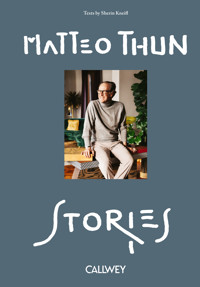
"I don't want to write an architectural bible. I want to sell stories that show what defines me and my work." Matteo Thun In the world of design and architecture there are few personalities whose influence is as profound and lasting as that of Matteo Thun. From pioneering resorts, company headquarters, public buildings, residential and office buildings around the world to the iconic Illy espresso cup, the renowned architect has left his unmistakable signature everywhere and his designs have shaped our perception for decades. His impressive product design, imposing architecture and pioneering concepts bear witness to more than 40 years of professional experience and a life that unfolds between the vibrant metropolises of Milan and Munich. Numerous fascinating stories have emerged from this exciting journey through life. As an author, Matteo Thun has now captured these stories in a captivating book that has been created for his admirers, companions and perhaps also a little bit for himself.
Das E-Book können Sie in Legimi-Apps oder einer beliebigen App lesen, die das folgende Format unterstützen:
Seitenzahl: 153
Veröffentlichungsjahr: 2024
Ähnliche


















Texts by Sherin Kneifl
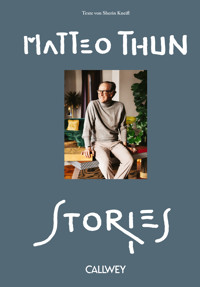
Matteo Thun nurtures an architecture and design practice that strives to create respectful and long-lasting solutions through a future-oriented lens. Born in South Tyrol in 1952, he was a student at the Salzburg Academy before completing his architecture studies in Florence. His formative professional years were spent under the guardianship of Ettore Sottsass—together, they co-founded the globally renowned Memphis Group in 1981. Several years a professor in ceramic design at the Vienna University of Applied Arts and creator of era-defining pieces, Matteo founded his eponymous architecture and design studio in 1984, where he would establish himself as one of his generation’s most influential voices and talents.
STORIES
The Angel of Bolzano / Bolzano, 1952
Clay toys / Bolzano, 1956–1962
Märklin Railway / Bolzano, 1963
Wood / Bolzano, 1956–2024
Castel Thun / Non Valley, 1956–1966
The way to school / Bolzano, 1959–1963
Franciscan College / Bolzano, 1963–1964
The School of Vision / Salzburg, 1967–1970
Monte Morello / Florence, 1974
Santa Carolina / Bolzano, 1952–1970
Flying / Alghero, 1974
Summa Cum Laude / Florence, 1975
Castigo Di Dio / Naples, 1976
Susanne / Zermatt, 1978
Ettore Sottsass / Milan, 1979
Aperol / Milan, 1980
Signorina Riccarda / Milan, 1979
Anna Piaggi and Antonio Lopez / Milan, 1980
Sciara Del Fuoco / Stromboli, 1980
Memphis / Milan, 1981
Karl Lagerfeld / Milan, 1981
Via Borgonuovo / Milan, 1981
Via Appiani / Milan, 1983
University of Applied Arts / Vienna, 1983-2000
Studio Opening / Milan, 1984
Keith Haring / Milan, 1985
A Manifesto on the Surface / Vienna, 1985
Campari / Milan, 1985–1990
Vorwerk / Hameln, 1988
Illy / Triest, 1990
Tiffany & Co. / Venice, 1990
Swatch / Biel, 1990–2000
Our second home / Engadine, 1990–2024
O Sole Mio / Klagenfurt, 1990
Cresta Run / St. Moritz, 1990–2010
Philips, Keramag / Potsdam, 1991
Villa Schnitzler / Vienna, 1991
Archimede Seguso / Murano, 1992
Vigilius / Lana, 1998
Takara Belmont / New York, Osaka, 1995
Pensione America / Forte Dei Marmi, 1992–1996
Side Hotel / Hamburg, 1999–2000
Uncle Josi and Aunt Tesi / Milan, 2000
Summer holidays / Ritten, 1992–2000
WMF / Geislingen, 1984-2000
Vapiano / Hamburg, 2000
Rosetta / Capri, 2000
Julius Meinl / Vienna, 1985
Six Memos For The Next Millenium, Italo Calvino / Milan, 2000
Leopold's Lyceum / Zuoz, 2002
Cars / 1970–2004
Hugo Boss / Coldrerio, 2006
The soul of the place / Katschberg, 2008
Zwilling / Solingen, Shanghai, 2006–2024
Fiji Water / Andorra, 2008
Walter Pfeiffer / Capri, 2009
Venere Bianca / Montelupo Fiorentino, 2009
Nivea / Hamburg, 2012–2018
Moselle Wine / Longuich, 2012
JW Marriott / Venice, 2015
Santa Maria a Cetrella / Capri, 2001–2023
Manus Factor / Bürgenstock, 2010–2015
The Forest Clinic / Eisenberg, 2017-2020
Davines / Parma, 2018
Langham / Venice, 2018–2026
Le Zattere / Venice, 2019
Constantin and Leopold / New York, Berlin, London, 2023
Fratelli Tutti / Alps, Apennines, 2024
Susanne Thun, Celerina
Friends, 2024
72 Stories / Celerina, Milan, Zurich 2023
Acknowledgments
Imprint
Lassen Sie sich inspirieren …
Ob Architektur, Fashion, Kochen & Backen, Wohnen oder Reisen:Callwey Bücher entführen Sie immer wieder aufs Neue in andere Welten.
Mit unserem NEWSLETTER tauchen Sie monatlich ein in unserestilvolle Welt:köstliche Rezepte, Dekorations-Ideen und schöne Geschichten.Seien Sie als Erstes informiert über unsere Novitäten und Verlosungen!
https://www.callwey.de/newsletter/
Jetzt abonnieren
Natürlich finden Sie uns auch auf SOCIAL MEDIA.Folgen Sie uns schon?
@ Callwey
https://www.facebook.com/callwey
https://www.instagram.com/callwey
Callwey Bücher machen glücklich.Probieren Sie es doch mal aus.
Lena Thun, Matteo Thun, Peter Thun
THE ANGEL OF BOLZANO / BOLZANO, 1952
It all began with an angel, the Angioletto di Bolzano. The heavenly figure marked the debut of Thun Ceramics, the pet project of my parents, who following their marriage felt inspired to create something together. Both had a penchant for craftmanship. My father, Othmar, Count von Thun und Hohenstein, held a doctorate in law but had also attended a ceramics school in Urbino shortly after the Second World War. My mother, Helene, was an Architect, always tinkering, painting or modelling. In 1950 they set up their ceramics workshop in the basement of our home, Klebenstein Castle in Bolzano.
The first angel appeared in the hands of «Lene» following the birth of her two sons, me in 1952 and my brother Peter three years later. Story has it that she modelled the angel after our sleeping image, with a chubby face, eyes closed, lips pursed, head slightly tilted back.
The idea of making angels was not a foregone conclusion. Although our family was of Catholic descent, I do not remember messengers of God being particularly welcome in our household. Personally, I never felt a profound connection with angels. In my eyes, the Angioletto is a symbolic mixture of South Tyrolean folklore and kitsch but, I have to admit that Lene had the right intuition—it was an instant success, the angel struck a chord with countless people and sold en masse.
As time passed, Thun Ceramics flourished, employing forty craftsmen. I was introduced as a small boy to help my mother check the quality of each angel figurine. By the time I reached seven I had become a diligent worker and was admitted to the production line.
The most important element was the face. For purely productive reasons the eyes had to be closed: open eyes are tricky, the pupils are so small. We would trace the two eyelids and accentuate the two dotted nostrils with a pointy stick, then form the singing mouth with a rounded one. The craftsmen were paid by the number of angels they produced. The faster you were, the more you earned. I worked hard on getting up to speed with them and by the time I was eleven, I had caught up with these professionals, even setting production records of which I was very proud.
The angel became the symbol of Thun Keramik. It still features prominently on wedding lists: «No wedding without Thun,» they say in southern Italy. My mother’s ingenious creation brought financial security to our family.
Eventually, the manual production became unsustainable and the manufacturing was moved from South Tyrol to reduce costs and keep the selling price in line. My brother and I parted ways due to diverging interests and he left for China to run the company, which now manufactures in Vietnam and employs a few thousand people. I observed with some regret the angel becoming out-shined by all sorts of other figures. But one thing remains the same: the angel still comes out of a plaster mould.
CLAY TOYS / BOLZANO, 1956–1962
As a child who made all his toys out of clay, I was delighted when, at the age of four, I discovered that I could make a turtle by simply pressing wet earth into the palm of my hand and adding five limbs. I soon mastered the process and the clay turtles became my first companions. In those days there were few toys to buy and they were very expensive, too expensive for my parents. Once I had produced a whole family of turtles, at the age of seven I tried my hand at making horse figurines.
Horses were a more challenging task as they stood on four legs rather than lying prostrate on the ground. Hours were spent concentrating on sculpting their bodies and manes down to the smallest detail. Gradually my manual skills improved and the figurines reached a satisfactory level of quality.
The Thun angel is the origin of my relationship with ceramics, a love story that I have never given up on. The love of manual work that my mother passed on to me and that I developed through play has stayed with me all my life. I stand out as the only one without a computer in my architecture and design practice. In the words of Italo Calvino, I strive for a more synthetic, faster and more precise approach, and my way is with pencils and watercolours. Essentially, I believe in the «intelligence of the hands.» I believe they guide the mind, not the other way around. For me, design is first about understanding what the hands are doing, and then the brain gives its approval. Or not.
Turtle made of clay
MÄRKLIN RAILWAY / BOLZANO, 1963
My Märklin railway was a labour of love and took up the whole of my playroom. The correct way to build it would have been to fix the tracks to a board, but I chose to leave the parts loose so that I could lay them as I pleased and have the trains run up and down the furniture. I also built two spectacular plaster mountains, one with a tunnel, the other with a swimming pool and even a trampoline. Armed with patience, I glued whole forests onto them, one tree at a time.
Before I had any tracks or locomotives, I saw a rerailer in a toy shop under the old arcades downtown. The curved metal device was designed to place derailed trains back on the tracks. My grandmother bought it for me, regardless of the limited use I could make of it. In anger or jealousy, my brother stomped on it and that was the end of the rerailer.
I ended up selling my whole collection—tracks, locomotives, carriages, wagons, signals, figures, the trees—everything. I made 60,000 lire, which I reinvested in a radio-controlled aeroplane. Its first landing was a crash and I lost my train, my plane and my investment.
A passion for flying since time immemorial
WOOD / BOLZANO, 1956–2024
The foundations of my career may well have been laid when I was four, when Uncle Roderick, my father’s older brother, gave me a set of wooden building blocks. He was the founder of «spiel gut,» the organisation that still awards the best educational toys in Germany with its orange seal with a white dot in the middle.
I arranged the wooden blocks into sturdy, thick-walled houses. Some of their roofs were flat, others were gabled. What I liked the most about them was that they were I found them all beautiful, regardless of style. My parents were supportive and we would comment together on the quality of my buildings. Since she was an architect, my mother’s praise was particularly motivating.
Building a house is one of our most primary instincts. All children like to play at drawing their dream home. We all desire to own a house, sleep in it, live in it, raise our families in it. This may be why there are so many detached houses, I suppose. I have felt this desire from an early age.
Our home was Klebenstein Castle. It is still there, at the end of Bolzano’s Talfer river promenade, standing like a gateway to the Sarntal Valley. Only a few rooms were heated and I wasn’t allowed to play on the stone-cold floor, so I would build my houses on one of the carpets lying around. The ceilings were wonderfully high, and I imagined the rooms of my wooden houses to be just as tall. Unsurprisingly, I don’t feel comfortable in rooms with low ceilings, however cosy they may be. Length, width and height all affect our sense of wellbeing. The proportions of the castle have grown on me as much as I have grown in them.
It wasn’t until many years later that I began studying Architecture. This complicated matters—statics, building technology, structural systems… all the fun and spontaneity was gone. My drawings were received with varying degrees of appreciation, some positive, others very critical. The notion of style gave me no rest.
I returned to the small scale, to product design. I found space to develop this with my role model and master, Ettore Sottsass, and his credo of holistic design, be it spoons or cities. The «Milan School» of combining design disciplines has stayed with me, as has the motto of looking to the future without nostalgia and designing with simplicity, lightness and durability in mind.
I have a renewed sense of these origins now that I am in my early seventies. I don’t stack wooden blocks anymore, but I do build by piling up huge tree trunks with similarly simple construction techniques. The project that allowed me to return to this total simplicity is Jungle Hut. Here, there are no longer any questions of style, no space for discussions on whether minimalist architecture is beautiful or not. It pleases, and that is all. When approaching total simplicity, questions of style become irrelevant.
I seek reduction to the essential also in other aspects of life and this search for simplicity has proved more complex than seeking complexity itself. Just as Plato is easier to read than Heidegger, but possibly more difficult to grasp. I may be going against the tide, but for me wood is the building material of the 21st century. It is renewable, recyclable, has its own indoor climate and brings healthy insulation, including from noise. Like a sanctuary.
This is why I am now designing a place of self-discovery in the Alps, a gift to Jorge Bergoglio, better known as Pope Francis. All in wood, of course.
Wooden building blocks
Castel Thun in Nonstal
CASTEL THUN / NONSTAL, 1956–1966
Castel Thun, the family castle in the Non Valley, belonged to my great-aunt Teresina. Her son, uncle Zdenko, wasn’t the most handsome of men, but by the age of sixteen he had earned a playboy reputation for being the first man in the valley to own a car. He used to race up the dusty roads to Castel Thun and the farmers would flee from the speeding car shouting, «Arriva il Conte! Arriva il Conte!» Gossip was spreading throughout the region.
When I entered my first year of primary school, Uncle Zdenko gave me this advice: «You will manage with additions and subtractions. Next year, you will manage with multiplications. But keep away from divisions, you’re never going to get it.» His words still ring in my ears.
Aunt Teresina used to serve us children Campari Soda, for the simple reason that there was nothing else available in the castle kitchen. My mother tried to explain that children don’t drink Campari, but she didn’t care. Our time at Castel Thun was carefree, playing hide and seek or cops and robbers in the underground passages.
There were only two rooms in the castle that were heated in winter, yet there was an impressive collection of carriages, which were my uncle’s passion. He even built a museum to house his collection, which still exists today. This expensive passion for carriages ruined him and he gradually lost all his possessions.
The tragedy of it all is that his mother had predicted that he would remain a bachelor, married only to the castle, but Uncle Zdenko eventually had to part with the castle too. He asked my father whether he wanted to buy it, but the roof needed repairing and that alone would have cost 64 million lire. My father had to invest the same amount in new premises for Thun Ceramics, so he did not go ahead and Castle Thun became the property of the State. It is now a museum.
THE WAY TO SCHOOL / BOLZANO, 1959–1963
My family lived in Klebenstein Castle, on the edge of the Sarntal Valley, on the banks of the Talvera River. From the imposing building, a riverside promenade divides Bolzano into the German-speaking old town and the Italian-speaking new town.
Although our house was on the German side of Bolzano and my brother and I went to the German school, we spoke Italian just as well. At that time, the German community tended to avoid the Italian community but there was no place for these cultural barriers in our circles, and friends from both communities mixed in our household.
With primary school came the first taste of independence, cycling to school. My younger brother pedalled diligently beside me, his little bike bravely navigating the promenade that led straight to school. Along this short but eventful route we met a colourful cast of characters and embarked on our earliest adventures, which our youthful imaginations inflated and sometimes turned into terrifying nightmares.
Like that fateful summer morning in 1960 when we saw a man sleeping on a bench along the promenade. Temptation set in and we approached him, stopped, and suddenly shouted into his ears. The man woke up in a startled panic and we made a hasty retreat, pedalling away at full speed. As the day wore on and our attention turned to lessons, the morning’s escapade faded into the background. Finally, the school bell rang and we jumped back on our bikes. When we reached the promenade the man was still there, waiting for us, standing tall in his long black coat and ready to take his revenge. Miraculously, we avoided his grasp and narrowly escaped a severe beating, or worse, capture! For months Peter and I were terrified of ever seeing him again.
Our precious school breaks were often spent playing marbles or football in the square opposite. Goethe was an all-boys school and we were loud and boisterous. In the midst of this lively chaos, a stray football shattered a window of my great-uncle’s residence, the Palais Toggenburg. The incident became a family affair and Peter and I had to make a formal apology to my uncle, the only living Prince Thun. He was in his eighties and rather unconcerned about the broken window, but he nodded approvingly as we bowed our heads in apology.
These are just a few of the many memories I made along the way before I enrolled in the Franciscan College. The Franciscan College may have been conveniently close, but it was worlds away from the joyful days of my first five years of schooling.
Matteo and Peter Thun cycling down the riverside promenade Peter and Matteo
Matteo, second row, fourth from left, with his classmates and teachers at the Franciscan College
FRANCISCAN COLLEGE / BOLZANO, 1963–1964
I was extraordinarily unhappy at the Franciscan College. The brothers quickly understood that I simply did not like them and as I did not share their outlook on life, an inevitable path of misery lay ahead of me.




