


Erhalten Sie Zugang zu diesem und mehr als 300000 Büchern ab EUR 5,99 monatlich.
- Herausgeber: THP Ireland
- Kategorie: Sachliteratur, Reportagen, Biografien
- Sprache: Englisch
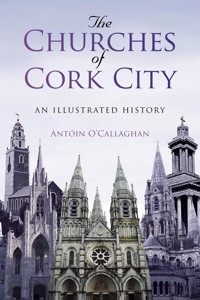
The churches, chapels and meeting houses of Cork are the bedrock of the city. They represent the finest of architecture, house some of our most treasured art and their development mirrors and records the growth of the city itself. A comprehensive and accessible guide for locals, tourists and historians, this work provides a fascinating insight into the wider history of Cork for well over a thousand years.
Sie lesen das E-Book in den Legimi-Apps auf:
Seitenzahl: 457
Veröffentlichungsjahr: 2016
Das E-Book (TTS) können Sie hören im Abo „Legimi Premium” in Legimi-Apps auf:
Ähnliche

















ACKNOWLEDGEMENTS
As on so many other occasions, I owe a great deal to friends and colleagues who have supported me in this latest historical adventure that I have undertaken – seeking a greater understand of the place that churches hold in Cork’s history. Without their support, a project such as this would have been considerably more difficult to bring to completion.
Special thanks to fellow history enthusiasts Michael Lenihan, Pat Poland and Roger Herlihy, three people who are always generous with their advice and support. Also I want to say thank you to Dr Dónal Ó Drisceoil who for many years now has been a huge supporter of my work and given me great advice at all times. Two others who have generously given of their thoughts and time are Capuchin Fr Dermot Lynch and the Capuchin Provincial Archivist Dr Brian Kirby.
The completion of this work would not have been possible without the support and advice of Dr Diarmuid Scully, Medievalist Extraordinaire at University College Cork, who kindly advised on early drafts of the work and for that I am truly grateful.
I would also like to acknowledge Donal Anderson for the provision of medieval sketches of Cork and also the staff of the Local Studies Department at Cork City Library whose knowledge and support is a wonderful resource to the historian.
Finally I would like to acknowledge the part played by the love of my life Sandra. Her patience during the project as well as her advice on how to present aspects of the story to the reader was invaluable. Thanks also to my daughter Lorna and son and daughter-in-law Brenton and Evanna for their support and, of course, not forgetting James.
And so to the churches, chapels and meetings houses of Cork city …
CONTENTS
Title
Acknowledgements
Introduction
One
The Monastery of St Finbarr
Two
St Finbarr’s Abbey Refounded and Norman Beginnings
Three
From Norman Beginnings to the Reformation
Four
Suppression and Resurrection
Five
The Eighteenth and Nineteenth Centuries
Six
The Established and Dissenting Faiths
Seven
Twentieth-Century Churches
Conclusion
Bibliography
Copyright
INTRODUCTION
On Sunday 20 July 1856, speaking at the official opening of the recently completed church of St Vincent de Paul at Sunday’s Well in Cork city, Most Reverend Dr Dixon, Primate of All Ireland, began his homily by referring to the sentiments of the people of Israel as they returned home having witnessed the dedication of the Temple of Solomon:
… and they blessed the King and they went to their dwellings rejoicing and glad in heart for all the good things which the Lord had done to David His servant and Israel His people.1
So also, said Dr Dixon, would the people of Sunday’s Well return home joyous in heart upon the completion of the beautiful church that now stood on the north-western hills of the city, overlooking the valley below. Fifty years later, on Sunday 14 October 1906, at the celebration of the golden jubilee and consecration of St Vincent’s, His Lordship Dr Kelly, Bishop of Ross, recalled the promises made in the Old Testament to Jacob, who, while sleeping in the desert, had dreamed of a ladder which angels ascended and descended to and from heaven. Jacob anointed the stone on which his head had lain and declared the place Bethel or a house of worship to the Lord. It was, Jacob cried, the house of God and the gateway to heaven. Dr Kelly preached that the church of St Vincent was now ‘consecrated for all time to the Divine Service as a Bethel, a House of God’.
A century earlier, on Monday 22 August 1808, at the ceremony of dedication of the Catholic Cathedral of St Mary and St Anne, better known throughout the city as the North Chapel, Dr Florence McCarthy, coadjutor bishop of the diocese, had also recalled the famous sentiments of Jacob when he chose as the theme of his sermon, ‘This is no other but the House of God and the Gate of Heaven’. Nor was it just the Catholic community that placed such importance on the building of churches. In 1862 the Church of Ireland community in Cork began the process that culminated in the construction of St Fin Barre’s Cathedral in the Gill Abbey area of the city.2
Let us raise a monument of Christian zeal, love, and piety, to the Almighty giver of all our blessings … and thus leave a witness to the faith, liberality and self-denial of our present age, to our children’s children.3
Although primarily built as places of worship and for the expression of faith, very often the construction of churches was significant in other ways. In particular, following periods of oppression, the building of churches was a statement that such oppression had failed to subdue the faithful and that the faith of the people had permanence, as represented by the solidity of the constructed edifices.
The dedication of the Catholic Cathedral of St Mary and St Anne in 1808 took place some nine years after the beginning of the construction of the church in 1799. Erected on the hills on the north side of the city, it was a clear statement in stone that the repression of the Penal Laws, which had sought to suppress Catholicism over the previous two centuries, was coming to an end and that Catholicism was emerging to live in the public domain once again. Increased Catholic freedom under the Catholic Emancipation Act of 1829 was also followed by a number of church-building endeavours, including the construction of St Vincent’s in Sunday’s Well.
The phenomenon of church building following periods of repression, as occurred in the post-Penal Laws and Catholic Emancipation years, was not unique. Throughout history, there had been similar public expressions through the medium of church building. Years after the Reformation and the suppression of the monasteries by King Henry VIII, the various friars’ orders built new churches, from which they served the people in their areas. The Dominicans, Franciscans, Augustinians and Capuchins all built new places of worship in Cork during these years.
A thousand years earlier, following the oppression of the faithful in England during the fourth century, the ecclesiastical historian Bede recorded:
When this storm of persecution came to an end, faithful Christians, who during the time of danger had taken to the woods, deserted places, and hidden caves, came into the open, and rebuilt the ruined churches.4
Thus, throughout history, among the faithful, the building of a Bethel or a house of God was significant in a number of ways. In their primary function they were the life-centre of a faith community where shared beliefs and tenets were celebrated openly; the structures were not just places of worship but statements on the landscape that testified to the beliefs and resilience of people, often in the face of adversity; internally many churches were full of symbolism that both emphasised the beliefs of the faithful and also connected contemporary faith with what had gone before, often as far back as biblical times; physically, churches were architectural adornments of the hinterland; finally and consequently, today, existing places of worship, and the remains of what were places of worship in the past, are repositories of historical information for both archaeologists and historians. The history of the churches in a particular place, then, is a multi-layered narrative that tells of the importance of the faith for the people; their resilience in the face of adversity; the influences that came to bear upon their society; aspects of the nature of artistry; and the place of the church in the hierarchy of power-brokerage in society. Above all, the story of churches is the story of the people that built them.
Aspects of church history in Cork are well documented by a number of eminent historians, not least from among the religious communities residing and serving in the city. In her four-volume History of the Diocese of Cork, Evelyn Bolster RSM records the development of the episcopal see at Cork from the time of St Finbarr, through the transition from a Celtic-structured monastic Church to a Roman diocesan one, to the effects of the Reformation and the period of the Penal Laws, to the post-Catholic Emancipation years and the episcopate of William Delaney in the nineteenth century. From the point of view of a study of churches in the city, her work not only identifies the earliest places of worship, but also where the evidence for these is to be found, as well as the constructions undertaken by the secular clergy and the various orders. Many of the documents cited are located in a variety of religious archives and consequently not easily accessed. Furthermore, most of them, in particular those from the medieval period, are written in Latin. Hence the value of Bolster’s research and work in chronicling the history of churches in the city of Cork.
Other works of importance include those undertaken by members of the friars’ orders regarding their own histories in the city. On the occasion of the opening of the most recent Franciscan church at Broad Lane in 1954, Revd Fr Jerome O’Callaghan OFM published a commemorative book which included an account by Fr Canice Mooney OFM of the Franciscans in the city, from their arrival in the thirteenth century. In 1977 Fr Bartholomew Egan OFM revised this text and published it under the title The Friars of Broad Lane. The Revd James A. Dwyer undertook a similar project for the Dominicans, publishing The Dominicans of Cork City and County in 1896. Similarly, the Augustinians have produced works that detail their history in the city, such as that written by Thomas C. Butler OSA in 1986. These histories, specific to the particular orders in Cork, are best considered and understood when read in conjunction with broader studies regarding the arrival and spread of the orders throughout Ireland and the works undertaken by them. The writings of Colmán Ó Clabaigh OSB – The Franciscans in Ireland 1440–1534 and The Friars in Ireland 1224–1540 – provide just such an overview.
Apart from the friars’ orders’ places of worship, many other churches were built in the city of Cork during the nineteenth and twentieth centuries, from St Patrick’s in 1832 and Sts Peter and Paul’s in the 1860s to those built to serve the rapidly expanding suburbs that developed in the city after the Second World War. When, in time, various jubilees and centenaries arose, a variety of commemorative publications, which detailed histories of these churches, were published. St Vincent’s Church, Sunday’s Well: History and Heritage by Antóin and Sandra O’Callaghan was one such; S.S. Peter & Paul’s Church, Cork, 150th Anniversary Booklet was another. Many churches in the city have also published booklets for visitors and tourists that include brief histories, as well as descriptions of various artworks and stained-glass windows. For example, Fr Patrick Conlon OFM, in association with the Cork Public Museum, published Aspects of Franciscan Art in Cork in 1996. Virginia Teehan and Elizabeth Wincott Heckett’s The Honan Chapel: A Golden Vision is unrivalled as an account of the context and embellishment of a church in the city.
Religious history in Cork – in particular, aspects of religious history associated with churches – has also been documented in the Journal of the Cork Historical and Archaeological Society. Accounts of the history of the Franciscans appeared in the 1917 and 1940 editions, while the Augustinian convent of medieval Cork featured in 1941. In a special 1943 edition on a variety of subjects associated with the religious history of the city, it wasn’t just the Catholic story that was included; Church of Ireland churches and the Nonconformist communities, such as the Methodists and the Presbyterians, were also considered. In 1956, a significant article was published that dealt with the will of one John de Wynchedon, a merchant who, when he died in 1306, left bequests to many of the churches then existing in the city. This document gives not just a listing of these churches, but also information as to the people ministering therein, as well as the nature of the activities and liturgies they engaged in.
Over the past twenty or so years, the histories of a number of other denominations that make up part of Cork’s past have appeared in print. Alicia St Ledger’s Silver Sails and Silk is an account of the Huguenots in Cork while Richard S. Harrison has recorded the history of the Quaker community in Merchants, Mystics and Philanthropists: 350 Years of Cork Quakers, Cork City Quakers 1655–1939 and a biographical dictionary of the Quakers who lived and worked in the city. The story of Presbyterianism in the city is recorded in Alexander Cromie’s 1996 publication, Presbyterians in the City of Cork, while the Methodists too recorded their history on the occasion of the centenary of their church on St Patrick’s Street in 1906.
All of the aforementioned works have dealt with churches in the city of Cork as houses of worship for one religious denomination or another. From an architectural point of view, T.F. McNamara considered many of the main churches in the city in his work A Portrait of Cork, while a number of other books have considered churches from yet other perspectives. Among these, Richard T. Cooke’s My Home by the Lee and Roger Herlihy’s A Walk in the South Parish are examples of historical journeys during which some of the city’s churches are encountered.
It is clear, therefore, that religious and church history in Cork city has been documented. However, it is also clear that there is no single work that brings these various strands together. While specialist works, such as that on the Honan chapel in the grounds of University College Cork, give details of spectacular artwork therein, very often both the historical and liturgical significance of other beautiful works, such as the stained-glass windows in St Vincent’s or Holy Trinity or the sculpture by John Hogan in St Finbarr’s South, are more difficult to uncover. For example, the stained-glass window behind the main altar in Holy Trinity church was installed in 1849 and is in fact a memorial to Daniel O’Connell; the twelve circular mosaics that are positioned around the inside walls of St Vincent’s in Sunday’s Well are the spots where the sign of the cross was made with holy oils on the occasion of the consecration of the church in 1906.
The aim of this study, therefore, is to demonstrate from the various sources outlined, as well as contemporary newspaper reports from the nineteenth and twentieth centuries, that a number of narratives can be revealed in the history of Cork’s churches. Firstly, throughout Cork’s history, churches have been central to the lives of the people. Secondly, in style and structure, the churches in Cork align with those elsewhere in the global Church, thereby making a symbolic connection. The churches are not just repositories of wonderful artworks; rather they symbolically represent the pilgrimage of the faithful through life and the embellishments in these places of worship act as signposts on that journey. Finally, perhaps the most important story that emanates from Cork’s churches is that of the ordinary people: how they suffered and died, paid and prayed for their faiths. To them the churches belong.
Notes
1 1 Kings, 8:66.
2 Generally the spelling ‘Finbarr’ will be used throughout this work, except where the Church of Ireland cathedral is referenced because that faith uses ‘Fin Barre’.
3 David Lawrence and Ann Wilson, The Cathedral of Saint Fin Barre at Cork: William Burges in Ireland (Dublin: Four Courts Press, 2006), p.28.
4 Bede, Ecclesiastical History of the English People (London: Penguin, 1990), p.55.
One
THE MONASTERYOF ST FINBARR
Cork’s skyline is dominated by three prominent ecclesiastical structures. On the north side of the city the pepper-pot steeple of the Church of Ireland St Anne’s Shandon and the nearby tower of the Catholic Cathedral of St Mary and St Anne have been prominent landmarks since they were constructed in the 1720s and the early 1800s respectively. South of the river, the triple-spire Church of Ireland Cathedral of St Fin Barre, although younger than the other two edifices, is nevertheless a third outstanding feature of Cork’s landscape and marks the location of the earliest monastic settlement, from which the modern city developed.
Named in honour of the monastic founder and patron saint of the city, the present St Fin Barre’s Cathedral is the most recent of a number of churches that have stood at the site. It is but one of many places named in honour of the city’s founder: the Catholic church of St Finbarr’s South on Dunbar Street is another, as are St Finbarr’s Cemetery in Glasheen, St Finbarr’s Bridge off the Western Road and a variety of other roads, housing estates and areas, such as Kilbarry to the north-east of the city. One of Cork’s most famous Gaelic Athletic Association clubs is named in St Finbarr’s honour and the city’s patron saint has also been celebrated in song and in story.
St Finbarr, then, is part of the lifeblood not just of Cork’s past, but of the present too and although his very existence has been questioned by some historians, he exists nonetheless in the hearts and minds of Cork people. It is therefore appropriate that a history of Cork’s churches should begin with a brief account of who he was and how he came to found a monastery in what was at the time a marshy wasteland known as Corcach Mór Mumhan, the Great Marsh of Munster.
LÓAN OF THE FAIR HAIR
Finbarr is said to have been born near Innishannnon in County Cork sometime between AD 550 and 560, the son of a metalworker named Amairgen, who was originally from the west of Ireland. Since contemporary records are virtually nonexistent, this information, along with so much else from Finbarr’s life story, has to be treated with caution. Amairgen was employed in the service of the King of Rathlenn in the mid-west Cork area of South Munster. While in this position, Amairgen had a relationship with one of the king’s handmaids. He was unaware however, that the king had expressly forbidden that anyone should engage with the woman.
When it became known that she was pregnant, both she and Amairgen were condemned to death by being cast into a great fire. When the time came for the execution, however, such was the ferocity of the rain that the fire could not be lit. At this point the child spoke from his mother’s womb, saying, ‘O King, do not this wicked deed, for thou wilt not be the better loved by God, though thou do it’.5 Upon hearing this, the king relented and in due course the woman delivered a baby boy. Immediately after being born the child again spoke to the king; he said that his father and mother should be released from service and given their liberty. Again the king granted the request of the child. After this the child did not speak again until he had reached the normal age.
Free now from servitude, the parents left the Innishannon area with their young baby and moved to Achad Durbcon, identified as ‘at or near Macroom on the Sullane River less than a mile from the north bank of the Lee’.6 When the time came for the child’s baptism, the name that he was given was Lóan or Lochan. For the next seven years the young Lóan lived with his family, which also included a brother named Modichu and a sister named Lasair. After these seven years had passed, three holy men from Leinster, named Brendan, Lochan and Fidach, visited the home of Amairgen and, on seeing the child Lóan, declared that ‘the grace of the Holy Spirit shines in his countenance and it would be a great pleasure to teach him’.7 Amairgen and his wife agreed and in due course the holy men took Lóan back with them to Leinster. While journeying there, the boy became thirsty; a doe appeared on the nearby hillside and was milked to provide sustenance for the boy. This was interpreted as a miracle by the holy men, who immediately decided that it was a fit place for the boy to be tonsured and begin his journey towards becoming a monk. As they cut his hair, one of the men said that ‘beautiful and fair is the crest of Lóan; for this shall be his name henceforth, Findbarr [Fair-crest]’. So it was that the young boy was no longer known by his baptismal name of Lóan, but by his new name Finbarr.
Under the tutelage of the three holy men, Finbarr studied the psalms. During this time, there was a heavy snowfall and he became snowbound in the hut in which he was studying. Finbarr is said to have remarked that he would like the snow to remain around the hut until he was finished learning all of the psalms. Although the snow melted everywhere else, it remained around his hut until he had completed this part of his studies. Following this, Finbarr returned to Munster and made his way to Coolcashin in Tipperary, where he marked out a place for a church and made contact with the local Bishop MacCuirp. There he completed his studies on the Gospel of St Matthew and other ecclesiastical subjects. While with Bishop MacCuirp, a local king, Fachtna Fergach, said to Finbarr, ‘I want you to bless my two children, my blind son and my dumb daughter.’ Finbarr blessed them both and they were healed. Then, while conversing with the king, there arose a great lamentation and the king said his wife had just died. Upon hearing this, Finbarr told the king that God was able to raise her from the dead. He blessed water, which they used to wash the queen, whereupon she arose from the dead as if she had been sleeping.8
It was while under the tutelage of Bishop MacCuirp that Finbarr was ordained to the priesthood, after which he made his way to Loch Irce in West Cork (today we know Loch Irce as Gougane Barra). Among those listed as spending time at Gougane with Finbarr are Eolang (Olan) from Aghabuloge, Coleman, Baichine, Nessan, Garban, Fachtna and ‘the great majority of our South Munster saints’.9 Finbarr, however, was not destined to remain at Gougane. He was visited by an angel of the Lord who said to him ‘not here shall be thy resurrection’ and so, led by the angel, he left the hermitage and school at Gougane and followed the course of the river until he came to the hills overlooking a marshy valley where the river spread about a number of islands. This was Corcach Mór Mumhan, the Great Marsh of Munster.
Finbarr arrived in Cork sometime between the years 600 and 606 and, on his arrival, kept a fast for three days. According to one source, however, he went to Rome before this ‘to receive Episcopal orders together with Eolang, and Maedoc of Ferns and David of Cell Muine and twelve monks with them’; however, when Pope Gregory made to raise his hand over Finbarr, a flame came from heaven and Gregory said to Finbarr, ‘Go home and the Lord himself will read Episcopal orders over thee.’ And thus it was fulfilled.10
It was common practice at this time for the leaders of different clans to encourage holy men to settle in their areas and to establish places of worship and education there. This is essentially what happened at Cork. Finbarr was offered two tracts of land. The first was offered to him by Aedh, son of Comgall of the Uí Mic Ciair clan, south of the river and overlooking the marshy valley. Then, Aedh Mac Miandach offered him a place called Foithrib Aedh Magh Tuath, north of the river, a forested area between Shandon and Glanmire. Finbarr accepted the first offer from Aedh of the Mic Ciair. An angel marked out the place for a church and blessed it; although, the precise location of this church has never been ascertained. Two possible locations are where the Protestant St Finbarr’s Cathedral now stands and Gill Abbey, where there was once a medieval monastery, as we shall see later in this study. The land Finbarr took stretched from University College Cork in the west to the graveyard of St Finbarr’s Cathedral in the east and southwards to the lough. Soon, many people came to join Finbarr at his foundation, which was a place of worship and contemplation, as well as of learning. His students were not only the sons of neighbouring chiefs, but he also ‘had with him there a great school of saints’,11 many of whom went on to found their own churches. Among these were St Fachtna, St Eltin Mac Cobthaig, St Fergus Finnabrach and St Coleman of Kinneigh near Cloyne. St Finbarr’s monastery at Cork was therefore an important seventh-century institution as it was where many important holy men were educated. Due to the large number of people that came to visit and subsequently settle in the surrounding lands, the place became the centre of a developing community. Within the monastery grounds, and indeed for the community at large, the church would undoubtedly have been a very important building where prayer, Mass and other liturgies took place.
St Finbarr died sometime between 623 and 630, having spent almost twenty years as the spiritual leader of the monastery he had founded at Cork. He was interred in the graveyard adjacent to his church.
This day – the day of Bairre’s death – was prolonged to the elders. God did not allow the sun to go beneath the earth for twelve days afterwards.
Then the angels of heaven came to meet his soul and carried it with them with honour and reverence to heaven where he shines like the sun in his company of patriarchs and prophets in the company of the Apostles and disciples of Jesus …12
The spires of St Fin Barre’s tower above Cork’s south side.
After his death, Finbarr was succeeded at Cork by St Nessan. Over the following centuries, up until the arrival of the Normans, some fifty abbot-bishops followed in the footsteps of the founding saint at Cork. The monastery continued to grow in strength and importance, but difficult times were ahead.
Statue of St Finbarr above the entrance to the Honan Chapel, UCC.
As with all of the other monasteries in the country, the arrival of the Vikings heralded a period of violence, uncertainty and change. Viking attacks on Ireland occurred in two phases, beginning early in the ninth century. They first attacked Cork in the year 820, following which the settlement was plundered again in 838 and 845. From about 850, ‘the great raids of the ninth century were over’.13 The second phase of penetration came early in the tenth century. This time many of those who came stayed. Their assimilation into Irish society over the ensuing century can be sketched in broad strokes. Across the country groups formed alliances with local kings and were ‘drawn more and more into Irish affairs, playing their own parts in the complex and shifting alliances of the little kingdoms’.14 Others formed bases in harbours along the coast and developed centres of trade. Thus the Norse settlements of Waterford, Wexford, Cork, Limerick and Dublin, among others, came to be and ‘the population of the Norse towns turned Christian and finally in speech and habit almost Irish’.15
In the Great Marsh of Munster, a new centre of population developed, generally believed to have been where the town of Cork would in time grow up, in the North and South Main Street areas of today’s city. In particular the Norsemen were thought to have settled on the mainland where St Nicholas’ church stands today, and then to have moved across the river onto the southern island of the old town. Just downstream was ‘the little wooden harbour … where small ships and boats put in’; this was used by Cork’s ‘Hiberno-Viking merchants engaged in trade’.16
The assimilation of the Vikings into Irish society did not mean that all was peace and light for the monastic settlements. Inter-clan rivalry still led to many violent incidents and the monasteries and their inhabitants were occasionally victims during such wars. It is recorded that ‘in 1081 Cork was burned with houses and churches’.17 Evelyn Bolster writes that ‘Corcach Mór Mumhan, with its houses and churches, was subjected to raids, as much from local princes as from foreigners, down to the end of the eleventh century when the ancient abbey of Saint Finbarr was finally destroyed’.18 From the ashes it would rise again, just one of many late medieval churches in the developing town of Cork.
Notes
5 Charles Plummer, Bethada Náem nÉrenn: Lives of the Irish Saints, edited from original manuscript, Vol. 2, translations, notes, indexes (Oxford: Clarendon Press, 1922; reprinted 1968), p.11.
6 Evelyn Bolster, A History of the Diocese of Cork: From the Earliest Times to the Reformation (Dublin: Irish University Press, 1973), p.3.
7 Plummer, Bethada Náem nÉrenn, p.12.
8 Plummer, Bethada Náem nÉrenn, p.14.
9 Charles J.F. MacCarthy, ‘Saint Finnbarr of Cork’, Journal of the Cork Historical and Archaeological Society (JCHAS), Part 1 Vol. XLVIII, No. 167, January-June 1943. pp.1-4.
10 Plummer, Bethada Náem nÉrenn, p.17.
11 Plummer, Bethada Náem nÉrenn, p.17.
12 Plummer, Bethada Náem nÉrenn, p.21.
13 Donnchadh Ó Corráin, ‘Prehistoric and Early Christian Ireland’ in R. Foster (ed.), The Oxford Illustrated History of Ireland (Oxford: Oxford University Press, 1991), p.33.
14 Liam DePaor, ‘The Age of the Viking Wars’ in T.W. Moody and F.X. Martin (eds), The Course of Irish History (Cork/Dublin: Mercier Press, 1980), p. 97; Ó Corráin, ‘Prehistoric and Early Christian Ireland’, p.40.
15 DePaor, p.102; Edmund Curtis, A History of Ireland from the Earliest Times to 1922 (London: Routledge, 2002), p.30.
16 Henry Alan Jeffries, Cork: Historical Perspectives (Dublin: Four Courts Press, 2004), pp.40–41.
17 Charles J.F. McCarthy, ‘The Celtic Monastery of Cork’ in JCHAS, Part 1, Vol. XLVIII, No. 167, January–June 1943, pp.4–8.
18 Bolster, From the Earliest Times to the Reformation, p.47.
Two
ST FINBARR’SABBEY REFOUNDEDAND NORMAN BEGINNINGS
Following the assimilation of the Vikings into Irish society, there was bitter enmity between Connaught, which was under the rule of the O’Connors, and Munster, the kingship of which alternated between the McCarthy Kings of Desmond of Cork and the Dalcassians or O’Briens of Thomond.19 Between the Battle of Clontarf in 1014, which is said to have finally broken any remaining power that the Vikings had in Ireland, and the arrival of the Normans in 1169, there was considerable conflict. The high kingship of Ireland was at issue and among those that sought the title were the O’Connors of Connaught. Turlough O’Connor, King of Connaught, was ‘frequently on campaign for months on end’20 and between 1115 and 1131 he ‘destroyed the power of Munster’.21 Over time, however, O’Connor’s power weakened and in 1131 Cormac McCarthy was restored to the Munster throne. By 1134 he felt strong enough to lead an assault on Connaught. During this campaign an event occurred that had a direct impact on the future of churches in Cork. ‘In the course of this attack on the Western Province the abbey of St Mary at Cong was pillaged’ and in the ensuing peace Cormac was obliged to make reparation for the destruction at Cong. ‘This reparation was to consist in the erection of an abbey in Cork dependent on that of Cong’.22
ST FINBARR’S ABBEY IS REFOUNDED
Cormac complied with the stipulation and built an abbey for the canons regular of St John the Baptist at or near the site where the former abbey of St Finbarr had stood until it was destroyed at the end of the eleventh century. As part of the agreement, the abbot at Cong had the right to confirm or veto whosoever was chosen to be abbot at Cork. Regarding the reconstituted abbey at Cork, Bolster quotes Sir James Ware as saying that ‘this abbey, its former name – the Abbey of St Finbarr’s Cave – having been many years antiquated, is called Gill Abbey, from Gil-Aeda, an Abbot of great name and afterwards Bishop of Cork’.23 Windelle says that in 1134:
… one of its most celebrated abbots about this time was Gilla Aeda O’Muighin, a native of Connaught, who held the See of Cork and presided over the Abbey until 1172. From him it has been called Gill-Abbey.24
In 1138, Cormac McCarthy, founder of the abbey, was killed in battle in County Limerick. His successors included his son Dermot, grandson Cormac Lehenagh and son-in-law Dermot O’Connor. Under their kingships over the following decades, a number of grants were made to the abbey, which expanded the size of the monastery itself and the areas from where it could acquire income in the form of livestock and produce. Among the lands given to the abbey was Cloghan or Clochán, which extended roughly from Grattan Street through the Mardyke to Victoria Cross. This was a wooded area at the time, which was significant because wood was of paramount importance for a variety of usages, not least of which was the construction of buildings.
Stone, however, was beginning to replace wood as the material from which important buildings were constructed. Roger Stalley suggests that ‘one of the most fundamental changes that took place in Irish church architecture was the introduction of stone’.25 He also says that ‘long before the Norman invasion, Irish builders had adopted many of the techniques associated with the Romanesque style’.26 Referring to Cormac’s Chapel at Cashel, which was built sometime between 1127 and 1134 by Cormac McCarthy, founder of the Cork abbey, he says that it was:
among the first Irish buildings to be embellished with sculpture and as such is thought to mark the birth of Hiberno Romanesque … although the labour force at Cashel may have included English craftsmen, some of the sculptured heads have an Irish flavor, indicating that local masons were present in what must have been a thoroughly eclectic workshop. The same team was also employed at Gill Abbey, the Augustinian Abbey in Cork.27
We can conclude that the reconstituted Cork abbey would have involved stonework and there is a high likelihood that Hiberno-Romanesque sculptures would have formed part of the building also. Maurice Hurley says that St Finbarr’s monastery may have contained several stone buildings and that the twelfth-century cathedral was certainly made of stone. Evidence is ‘indicative of Cork’s importance as one of the avenues by which sculptural and architectural motifs were channelled into Munster during the first half of the twelfth century’.28
Further information regarding Gill Abbey is scant and mostly consists of references to the election of abbots over the following centuries and some stories pertaining to their terms of office. For example, in 1293 Gilbert O’Brogy was deposed and the king was informed. The king then gave permission for the election of a new abbot, despite not knowing precisely why the vacancy had arisen. A clue can be found some seven years later, when O’Brogy was restored to the abbacy. In that same year he was indicted for harbouring thieves and felons but was acquitted after declaring that he had formerly paid a fine for a similar indictment and had not repeated the offence on this occasion. The connection between Cong and Cork still existed in 1482 when Richard, Abbot of Cong, removed Cornelius from the abbacy at Cork because of a dispute between him and one Donald Machardich. The refounding of the abbey at Cork in the middle of the twelfth century was, in the words of C.J.F. McCarthy, a ‘second spring of Irish Monasticism’ and ‘lived and grew great until the end of the sixteenth century’.29
LETTER OF DECREE, 1199
In 1199, a letter was issued by Pope Innocent III to the Bishop of Cork that has been described as the foundation charter of the diocese because it contains a list of those churches which effectively reported to the Cork bishop.30 From the point of view of a study of churches in Cork, it provides a record of a number of establishments other than the abbey that had developed in the emerging town of Cork. Eight churches are listed in the letter: St Maria in Monte, located on the site that would later be occupied by Elizabeth Fort – locally it was known as the church of St Mary de Nard and it served the area of today’s Barrack Street, French’s Quay and Keyser’s Hill; the church of St Nessan, the location of which has been a matter of debate among historians; the church of St Brigid, located at the top of Tower Street, where the Cat Fort was built in later centuries; St Sepulchre’s, which was located where St Nicholas’ church stands today; St John in the City, which stood on today’s George’s Quay; Holy Trinity, not that on Fr Mathew Quay today, but Christ Church on the South Main Street; and St Peter’s on the western side of the North Main Street. The eighth was somewhat removed from the emerging centre of the city – St Michael’s of Ballintemple, better known at the time as Templemichael. Once again, very little is known about many of these churches in the early stages of their existence.
HOLY TRINITY CHRIST CHURCH
Only two of these churches resonate with modern Cork: Christ Church on South Main Street and St Peter’s on North Main Street; although, the buildings standing on these sites today are far more recent structures than those mentioned in the 1199 letter of Pope Innocent III. We do not know precisely when the original churches were first built at these sites.
Regarding Christ Church, T.F. McNamara writes that there have been at least three churches on the site and that the original was the first church built by Danish raiders that had converted to Christianity. This was most probably built of wood with a roof made from rushes. In order to differentiate it from places of worship to the Pagan gods of Woden and Thor, the Danes added the dedication of Christ’s Church. Next came a Norman construction that McNamara says was in existence soon after 1180, had a tower and steeple, and a peal of bells. Adjacent and associated with this church were an almshouse, a priest’s house and gardens. Within the church were two chapels, one dedicated to St James and the other to Our Lady, which was known as the King’s Chapel from 1295.31
Drawing of South Main Street, including Christ Church, by Donal Anderson. (Courtesy of Donal Anderson, Architect)
Referring to the Norman construct, Revd James A. Dwyer says that Christ Church, or the church of the Holy Trinity, is supposed to have been erected by the Knights Templars, citing Windele as a source.32 Windele in his history says that a larger church than that standing subsequently was built on the Christ Church site by the Knights in 1340. Bolster, however, holds that Windele was incorrect in stating that the Knights Templars were in Christ Church at that time as the order was dissolved by decree in 1311.
Subsequent to this, it is likely that many modifications and reconstructions took place at this church between the thirteenth and seventeenth centuries. During this late medieval–early modern period, Christ Church was the official place of worship for the mayor and corporation members in the city. The church was badly damaged during the siege of Cork in 1690, leading to the construction of another building at the site early in the eighteenth century.
ST PETER’S CHURCH
St Peter’s church operates today as the Cork Vision Centre, a place where a variety of exhibitions and artistic events are held, as well as many other occasions, such as book launches and lectures, etc. Writing in the Journal of the Cork Historical and Archaeological Society in 1897, the Revd James A. Dwyer states that the antiquity of St Peter’s can be gauged from the fact that it was mentioned in a charter of Henry III, dated 20 May 1270. It ‘must have been a church of considerable extent, comprising several small chapels, judging from fragments disinterred in 1838’.33
Windele says that the original church was built in the thirteenth or fourteenth century, was an extensive and pretentious building and contained several chapels and small oratories.34 In more recent times, however, Maurice Hurley has written that where St Peter’s stands ‘was probably the site of an early Christian monastery founded on the marsh islands in the Lee and later of an early church’.35 There are many references to the parochial status of St Peter’s throughout the medieval period. By the seventeenth century, it had fallen into disrepair. It was restored in 1693, but this restoration did not last and the church was rebuilt during the following century.
ST SEPULCHRE’S CHURCH
From the foregoing then, as well as information from documents such as royal charters, grants of land and rights by Norman kings, and dates that correspond with the first decades of the Normans’ arrival in Cork, although the picture that emerges can be somewhat confusing, it is clear that the development of many churches in the city stemmed from Christian monastic origins and coincided with the arrival of the Normans.
It is from sources associated with this period that historians have eked what little information is available. Bolster, for example, lists charters from the city of Exeter relating to Ireland between 1172 and 1182, which give information pertaining to churches that came under Norman influence. She also refers to documents from The Registry of the Abbey of St Thomas in Dublin, which had connections with Cork. From these sources it is recorded that among the churches listed in Innocent III’s 1199 letter, the church of St Sepulchre was granted to the church of St Nicholas, Exeter, by Robert Fitzstephen and Milo De Cogan36 and that monks of St Nicholas’ church were placed there by Bishop Gregory of Cork because the church there had been destroyed (Bishop Gregory O hAodha served from 1172 to 1182). It is possible that as a consequence of this the name was changed from St Sepulchre to St Nicholas.
The connection with Exeter was short-lived. A further charter outlines the granting of the chapel of St Nicholas in the city of Cork to the church of St Thomas in Dublin, which was founded in 1177. A handwritten insert on this charter document dates this occurrence to 1184. There is logic to this grant as the Dublin church was a royal foundation and through royal decree was entitled to endowments and tolls from various chapels under the protection of Norman notables, such as Fitzstephen and De Cogan. In return for the granting of St Nicholas’ church to the authority of the Dublin Foundation of St Thomas, on the feast of St Nicholas each year and on other occasions such as the feast of St Finbarr, the Dublin institution would provide Cork with gifts, such as English coins, wine and wax. It is recorded that the church of St Nicholas was the official chapel for the Danish mayor of the city and the place of assembly for the city’s Danish population.37
ST MARY DE NARD
Another of the churches mentioned in the 1199 letter and in Henry III’s May 1270 charter is that of St Maria in Monte or St Mary de Nard, situated in what would become the grounds of Elizabeth Fort, off Barrack Street. By virtue of its mention in the 1199 letter, it is clear that a church stood at the site before that date and was originally known as Sancte Marie in Monte or St Mary on the Height.38 This was to differentiate it from another of the city’s ecclesiastical institutions, which we will meet later, the Dominican abbey at St Marie’s of the Isle, which lay below the height on which the former church stood, on the valley floor. The word ‘Nard’ is most likely a derivation of ‘An tÁrd’, Gaelic for ‘height’, although some authorities believe the term to be a derivation of ‘spikenard’, the ointment with which Mary Magdalene anointed the feet of Jesus.39 In support of this argument is a suggestion that the church was dedicated to St Mary Magdalene, though it is more commonly recorded as having been dedicated to the Holy Rood or Holy Cross. In 1441 there is an account of proceeds from the church of St Mary de Nard being granted to a group of clergy known as the Vicars Choral at St Finbarr’s (these were lesser clergy appointed by canons to act on their behalf at cathedral services when they were unable to attend). The church was in ruins by 1615. Following the building of Elizabeth Fort at about this time, all traces of the church of St Mary de Nard disappeared.40
ST NESSAN’S CHURCH
As with all of the churches mentioned in the 1199 letter of Innocent III, reference to the church of St Nessan indicates that a chapel of some standing well pre-dated the papal decree. That it was named in honour of the direct successor of St Finbarr suggests that it may well have had a history longer than others on the list, perhaps as one of a number of chapels in memory of the abbey’s second abbot, dating to the seventh or eighth century. This, however, is mere speculation and, despite its listing in 1199, there are extremely few known historical facts about St Nessan’s church.
Its location has not been identified with certainty; historians have differing opinions on precisely where it stood. In her identifications of the different churches mentioned in the 1199 letter, Bolster includes the church of ‘St Nessan, situated apparently on the south side of Barrack Street, on or near the site of St Stephen’s Priory or else on that occupied by the Mendicity Asylum in 1832’.41 Henry Alan Jefferies, however, says that ‘the decretal referred to St Nessan’s Church at Shandon (on the site of St Anne’s Church) to the north of Cork’.42 One possible explanation of such differences could lie in the interpretations of the original Latin text of Pope Innocent III’s letter of decree. In this, ‘Ecclesiam Sancti Nessani’ is listed in the same passage and lines as a number of other churches and associated features.
… ecclesiam sancte Brigide, ecclesiam sancti Sepulchri, ecclesiam sancti Johannes in civitate, ecclesiam sancte Trinitatis et ecclesiam sancti Petri in civitate, cum molendino Corchaie quod est inter insulam et rupem cum piscatura Ua Dubgaill et piscatura MacMoelpoill et ceteras piscaturas iuratas ecclisie seu cathedtrali sancti Barri.
On the one hand, listing it along with other churches, such as St Brigid’s, St Sepulchre’s, St John’s and Holy Trinity, which are in or to the south of the town may be a geographical interpretation, putting St Nessan’s on the south side. On the other hand, St Peter’s is towards the north while the Cork Mill between the island and the rock (‘molendino Corchiae quod est inter insulam et rupem …’) could be that later associated with the Franciscans in the North Mall or Shandon areas.
Whatever its geographical location, Maurice Hurley acknowledges St Nessan’s as having been a contemporary parish church of the Hiberno-Norse era ‘in Civitate’.43 As with other churches, there are a small number of references in some contemporary documents. For example, Bolster suggests that because of a close relationship with the Normans under the episcopate of Gregory O hAodha (1172–1182, previously mentioned), as well as granting the church of St Sepulchre to the church of St Nicholas of Exeter, Bishop O hAodha granted the church of St Nessan to the canons of St Thomas’ of Dublin in about 1180.44 Despite references such as this one, it is clear that much associated with this church of St Nessan remains a mystery and is now lost in history.
ST JOHN IN THE CITY
Another church that has been the subject of differing historical interpretations is that of St John in the City, which was ‘probably the Church of the Knights Hospitallers of Saint John of Jerusalem which stood on the site of the presbytery on George’s Quay (the South Presbytery)’.45 There were in fact two establishments with associations to a St John. The first was the aforementioned house of the Knights Hospitallers, more correctly known as the Knights of the Order of St John of Jerusalem. This stood where George’s Quay is today. According to Sir James Ware, the sixteenth-century chronicler quoted by Denis O’Sullivan, this was founded by Richard, Earl of Pembroke, better known as Strongbow, in the year 1174.46
Along with the establishment on Cork’s south side, the Knights also had lands in the areas of today’s Borreenmanna Road, Monarea, Ballinure and Carrigeen near the South Infirmary Hospital. Once again, very little is known about the operations of the Knights Hospitallers in Cork. Bolster refers to an inventory of their property in 1541 which shows a church that was in decay.47 The other establishment dedicated to a St John was founded for monks under the rule of St Benedict by John, Earl of Morton and subsequent Lord of Ireland and King of England, in 1192 and was dedicated to St John the Evangelist.48 This was located on the south side of today’s Douglas Street, where the South Presentation Convent stands. It was affiliated with the abbey of St Peter in Bath. The role of the Benedictines in Cork is addressed in a document dating to 1330:
The priory was established for the sustenance of four chaplains performing divine service daily at Cork for the souls of the King’s ancestors and of all the faithful deceased yearly, and twelve beds for paupers and sustenance for two brethren and two (nursing) sisters there, forever.49
At some stage after the foundation of these two separate institutions there seems to have been a merging of sorts but the details have been lost over the centuries. According to Denis O’Sullivan, the Benedictine church of St John the Evangelist was granted parochial status at an early period and the church of the Knights Hospitallers also had parochial status. He surmises however, that the Benedictines did not flourish for long in the city and that ‘it is quite feasible that the Knights Hospitallers came into possession and exercised their spiritual jurisdiction over the entire district’. His evidence for this is twofold. Firstly, while the Knights Hospitallers were witnesses to several charters over the following centuries, the Benedictines were witnesses to none. Secondly, he quotes Bishop Downes, who wrote that the Benedictines originally acted as hosts to the Hospitallers until such time as the latter developed their own official rest house. His final conclusion is that ‘the whole subject is, for want of documentary evidence, unfortunately obscure’.50
ST BRIGID’S CHURCH
The church of St Brigid was located at the top of Tower Street in the area where, in later centuries, the Cat Fort stood. Mentioned in the 1199 letter from Rome, there is a suggestion that it may have been a nunnery at some point. The will of John De Wynchedon makes reference to a female recluse living at the church. There is no indication of its ever having achieved parochial status and it did not survive beyond the sixteenth century. Bolster records that ‘the ruins of the church had disappeared by 1700 by which time the Cat Fort had been erected on the site’.51
ST STEPHEN’S CHURCH
The last of the eight churches mentioned in the 1199 letter of Innocent III was that of St Michael and this, according to Bolster’s identifications, was located most likely at Ballintemple, quite a distance to the south of the Norman town.
There is another church from that period, however, that is not mentioned in the papal letter: St Stephen’s church, which was located in the southern suburbs of the medieval city, in the parish of St Nicholas. It was more correctly known as St Stephen’s Priory and Hospital for Lepers. According to Denis O’Sullivan, it is not known who those serving in the church were. He speculates that it may have been the Order of the Knights of St Lazarus, which at one time were affiliated with the Knights Hospitallers. The earliest existing references to this church date to 1277. Throughout the following centuries, until 1674 when the church and hospital passed into the hands of the Corporation, there are a number of references to the church.52 The Revd James A. Dwyer dates the founding of St Stephen’s to 1297 under the guardianship of Edward Henry. In 1408, Henry IV granted custody of the chapel to Henry Fygham as chaplain. Dwyer also notes the handing over of the church to the Corporation in 1674 and adds that it temporarily came back into the hands of the Catholics during the revolution of 1688, but their possession of it was short-lived. The premises was converted into a school for poor Protestant children, known as the Blue Coat School, which acted as a school until its closure in 1916.
Speed’s Map 1610. Note St Stephen’s church and also the church of the Holy Rode in the new Fort. (Courtesy of the Local Studies Department, Cork City Library)
The letter of decree from Innocent III gives an overview of the churches in Cork at the beginning of the thirteenth century. Although many of these continued to act as churches of varying degrees of importance over the following centuries, the picture is nevertheless incomplete, in part because of the scarcity of recorded material. Another significant chapter in the history of Cork’s churches, however, begins in the late medieval and early modern period with the arrival of the friars’ orders of St Dominic, St Francis and St Augustine.
Notes
19 Revd C.B. Gibson, The History of the County and City of Cork in Two Volumes, Vol. 1 (London: Thomas C. Newby, 1861), p.2.
20 Ó Corráin, p.48.
21 Ó Corráin, p.51.
22 Bolster, From the Earliest Times to the Reformation, p.74.
23 Bolster, From the Earliest Times to the Reformation, p.74.
24 John Windele, Windele’s Cork, Historical and Descriptive notices of the City of Cork from its Foundation to the Middle of the Nineteenth Century, revised, abridged and annotated by James Coleman MRSAI (Cork: Fercor Press, 1973), p.61.
25 Roger Stalley, ‘Ecclesiastical Architecture before 1169’ in Dáibhí Ó Cróinín (ed.), A New History of Ireland (Oxford: Oxford University Press, 2005), p.724.
26 Stalley, ‘Ecclesiastical Architecture before 1169’, p.735.
27 Stalley, ‘Ecclesiastical Architecture before 1169’, p.740.
28 Maurice Hurely, ‘Cork and Waterford in the Twelfth Century’ in Damian Bracken and Dagmar Ó Riain-Raedel (eds),




