


17,99 €
Mehr erfahren.
- Herausgeber: Saqi Books
- Kategorie: Sachliteratur, Reportagen, Biografien
- Sprache: Englisch
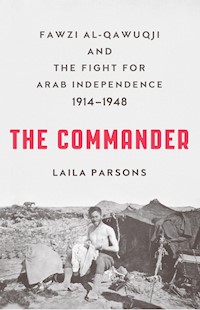
Revered by some as the Arab Garibaldi, maligned by others as an intriguer and opportunist, Fawzi al-Qawuqji manned the ramparts of Arab history for four decades. As a young officer in the Ottoman Army, he fought the British in World War I and won an Iron Cross. In the 1920s, he mastered the art of insurgency and helped lead a massive uprising against the French authorities in Syria. A decade later, he reappeared in Palestine, where he helped direct the Arab Revolt of 1936. When an effort to overthrow the British rulers of Iraq failed, he moved to Germany, where he spent much of World War II battling his fellow exile, the Mufti of Jerusalem, who had accused him of being a British spy. In 1947, Qawuqji made a daring escape from Allied-occupied Berlin, and sought once again to shape his region's history. In his most famous role, he would command the Arab Liberation Army in the Arab-Israeli War of 1948. In this well-crafted, definitive biography, Laila Parsons tells Qawuqji's dramatic story and sets it in the full context of his turbulent times. Following Israel's decisive victory, Qawuqji was widely faulted as a poor leader with possibly dubious motives.The Commander shows us that the truth was more complex: although he doubtless made some strategic mistakes, he never gave up fighting for Arab independence and unity, even as those ideals were undermined by powers inside and outside the Arab world. In Qawuqji's life story we find the origins of today's turmoil in the Arab Middle East.
Das E-Book können Sie in Legimi-Apps oder einer beliebigen App lesen, die das folgende Format unterstützen:
Veröffentlichungsjahr: 2017
Ähnliche



















ALSO BY LAILA PARSONS
The Druze Between Palestine and Israel, 1947–49
THECOMMANDER
Published 2017 in Great Britain by Saqi Books
Copyright © Laila Parsons 2016
All rights reserved.
Laila Parsons has asserted her right under the Copyright, Designs and Patents Act, 1988, to be identified as the author of this work.
This book is sold subject to the condition that it shall not, by way of trade or otherwise, be lent, resold, hired out, or otherwise circulated without the publisher’s prior consent in any form of binding or cover other than that in which it is published and without a similar condition including this condition being imposed on the subsequent purchaser.
ISBN 978-0-86356-166-5eISBN 978-0-86356-176-4
A full CIP record for this book is available from the British Library.
Printed and bound by CPI, Mackays, Chatham, me5 8td
Saqi Books26 Westbourne GroveLondon W2 5RHwww.saqibooks.com
FOR ROB
CONTENTS
List of Illustrations
Preface
1 Ottoman Officer
2 Syria in Revolt
3 Palestine 1936
4 Baghdad to Berlin
5 Palestine 1948
Epilogue
Notes on Sources
Acknowledgments
Index
LIST OF ILLUSTRATIONS
FIGURE 1: Inside view of the dining hall at the Imperial Military Academy soon after it was built, between 1890 and 1893. Library of Congress, Prints and Photographs Division, Abdul Hamid II Collection, Phébus (Studio). (LC-USZ62-80871)
FIGURE 2: The cavalry students from three classes at the Imperial Military Academy, in uniform, between 1880 and 1893. Library of Congress, Prints and Photographs Division, Abdul Hamid II Collection, Abdullah Frères. (LC-USZ62-82201)
FIGURE 3: View of the new bridge and Galata area from Istanbul, between 1880 and 1893. Library of Congress, Prints and Photographs Division, Abdul Hamid II Collection, Abdullah Frères. (LC-USZ62-81746)
FIGURE 4: Iraq, Mosul, general view with tall minaret in center of picture, 1932. Library of Congress, Prints and Photographs Division, G. Eric and Edith Matson Photograph Collection, American Colony (Jerusalem) Photo Department. (LC-DIG-matpc-16200)
FIGURE 5: General view of Beersheba, 1917. Library of Congress, Prints and Photographs Division, G. Eric and Edith Matson Photograph Collection, American Colony (Jerusalem) Photo Department. (LC-DIG-ppmsca-13709-00135)
FIGURE 6: Fawzi al-Qawuqji with his medals on display, undated. Public domain.
FIGURE 7: Sir Edmund Allenby entering the Holy City of Jerusalem on foot, 1917. Public domain.
FIGURE 8: Hanging of Arab nationalists in Damascus, 1916. Public domain.
FIGURE 9: Map showing the capture of Damascus, 1918. C. Falls and A. F. Becke, Public domain.
FIGURE 10: Map of the British and French Mandates, from George Antonius (1891–1941), The Arab Awakening: The Story of the Arab National Movement, London: Hamish Hamilton, 1938.
FIGURE 11: King Faysal being welcomed in Aleppo, 1918. Public domain.
FIGURE 12: Fawzi al-Qawuqji’s military identity card, 1920. Courtesy of the Center for Historical Documents in Damascus.
FIGURE 13: General Henri Joseph Eugene Gouraud, July 23, 1923. Library of Congress, Prints and Photographs Division, National Photo Company Collection. (LC-DIG-npcc-09013)
FIGURE 14: Coronation of Prince Faysal as King of Iraq, August 1921. Public domain.
FIGURE 15: Hama, between 1898 and 1946. Library of Congress, Prints and Photographs Division, G. Eric and Edith Matson Photograph Collection, photograph by the American Colony Photo Department or its successor the Matson Photo Service. (LC-DIG-matpc-07192)
FIGURE 16: Sheikh Sultan el-Atrash, leader of Druze revolt, ca. 1926. Library of Congress, Prints and Photographs Division, G. Eric and Edith Matson Photograph Collection, American Colony (Jerusalem) Photo Department. (LC-DIG-matpc-06444)
FIGURE 17: Fawzi al-Qawuqji wounded, 1926. Public domain.
FIGURE 18: Exiled Syrian rebels in Wadi Sirhan, 1929. Public domain.
FIGURE 19: Harry St. John Bridger Philby (1885–1960), 1930s. Public domain.
FIGURE 20: King Faysal I of Iraq funeral, 1933. Courtesy of the Institute for Palestine Studies.
FIGURE 21: Group from boys school with Mufti of Jerusalem and notable visitors at the mosque, “The Noble Sanctuary,” Jerusalem, between 1921 and 1937. Library of Congress, Prints and Photographs Division, G. Eric and Edith Matson Photograph Collection, American Colony (Jerusalem) Photo Department. (LC-DIG-matpc-08280)
FIGURE 22: Fawzi al-Qawuqji outside his tent, ca. 1936. Courtesy of Mr. Hassan Eltaher (www.eltaher.org).
FIGURE 23: Fawzi al-Qawuqji with leaders of the rebel army, 1936. Courtesy of the Institute for Palestine Studies.
FIGURE 24: Palestine disturbances during summer 1936, Jaffa, edge of the dynamited area close to the shore street, 1936. Library of Congress, Prints and Photographs Division, G. Eric and Edith Matson Photograph Collection, American Colony (Jerusalem) Photo Department. (LC-DIG-matpc-18038)
FIGURE 25: I.P.C. [i.e., Iraq Petroleum Company], welding pipes together, on Esdraelon stretch, between 1934 and 1939. Library of Congress, Prints and Photographs Division, G. Eric and Edith Matson Photograph Collection, American Colony (Jerusalem) Photo Department. (LC-DIG-matpc-16862)
FIGURE 26:The Salt Lake Tribune, March 7, 1937. Courtesy of The Salt Lake Tribune.
FIGURE 27: The fort at Rutbah, Iraq, under attack from Bristol Blenheim Mark IVs of No. 84 Squadron RAF Detachment, based at H4 landing ground in Transjordan, 1941. The Imperial War Museum, the United Kingdom, Royal Air Force official photographer: Hensser H. © IWM. (CM 822)
FIGURE 28: Dayr al-Zur bridge. Courtesy of Mr. Fareed Abou Haidar from the collection of his father, Dr.Adib Abou Haidar. 168
FIGURE 29: Haus Vaterland, Berlin, Potsdamer Platz, January 1, 1940. Photograph by Ullstein Bild / Getty Images.
FIGURE 30: German citizens walking along Hermann Goering Strasse past destroyed military vehicles amid rubble piled outside walls of the home of German Minister of Propaganda Joseph Goebbels following the fall of the city to Allied troops, July 1, 1945. Photograph by William Vandivert / The LIFE Picture Collection / Getty Images.
FIGURE 31: A view of Cairo from roof of Semiramis Hotel, looking east, Continental Savoy entrance, between 1934 and 1939. Library of Congress, Prints and Photographs Division, G. Eric and Edith Matson Photograph Collection, American Colony (Jerusalem) Photo Department. (LC-DIG-matpc-17897)
FIGURE 32: Aley, Lebanon. Courtesy of Mr.Fareed Abou Haidar from the collection of his father, Dr.Adib Abou Haidar.
FIGURE 33: Map of UN Partition Plan for Palestine, 1947. Public domain.
FIGURE 34: Fawzi al-Qawuqji inspecting the men in Jab‘a, 1948. Courtesy of the Institute for Palestine Studies.
FIGURE 35: Men of Emir Mohamed Saleh in their camp listening to latest news from Palestine, March 31, 1948. Photograph by John Phillips / The LIFE Picture Collection / Getty Images.
FIGURE 36: Group of soldiers smiling and posing for photograph, June 1, 1948. Photograph by Frank Scherschel / The LIFE Picture Collection / Getty Images.
FIGURE 37: Fawzi Kawkji smoking a cigarette, March 1, 1948. Photograph by John Phillips / The LIFE Picture Collection / Getty Images.
FIGURE 38: View of Kibbutz Mishmar Haemek, June 30, 1933. Photograph by Kluger Zoltan. Public domain.
FIGURE 39: Landing place, Jaffa, between 1898 and 1914. Library of Congress, Prints and Photographs Division, G. Eric and Edith Matson Photo graph Collection, American Colony (Jerusalem) Photo Department. (LC-DIG-matpc-11349)
FIGURE 40: Nahr al-Barid camp in Tripoli, Lebanon, 1951. UNRWA Photo Archive, S. Madver.
FIGURE 41: Fawzi al-Qawuqji at a banquet in Cairo, 1950s. Courtesy of Mr.Hassan Eltaher (www.eltaher.org).
PREFACE
The windswept town of Rutba lies in the far western desert of Iraq, just a few miles from the Syrian border to the north, the Saudi Arabian border to the south, and the Jordanian border to the west. The Damascus to Baghdad road runs east through Rutba toward the Euphrates River and the city of Ramadi. At Ramadi it crosses the Euphrates and then heads southeast through Falluja, through the suburb of Abu Ghrayb, and finally into the metropolis of Baghdad. On May 9, 1941, around the old fort in Rutba, fighting erupted between Arab nationalist rebels and the British army. Just over one month earlier, a group of officers in the Iraqi Army had mounted a successful coup against the British-controlled Iraqi government and laid siege to the British air force base at Habaniyya, west of Baghdad. The British landed troops at Basra in southern Iraq and sent a force of two thousand men and five hundred vehicles into Iraq from Transjordan in the west through the town of Rutba. The British air force and infantry troops took only a few weeks to quell the rebellion. The rebel leaders fled the country, and the former pro-British regime was reinstalled.
Fawzi al-Qawuqji, the commander of the Arab force charged with the task of defending the Rutba fort from the British advance, retreated east with two hundred men toward the town of Hit on the Euphrates, just north of Ramadi. From there Qawuqji continued to undertake guerrilla operations against British forces, even though the rebellion had been almost entirely crushed. One of his goals was to sabotage the oil pipeline that ran from the oil fields of Kirkuk through the town of Haditha and west out into the desert, ending up in another Middle Eastern city then under British control, the port of Haifa, which lay on the green hills of the eastern Mediterranean. Qawuqji appears briefly in the flurry of British telegrams about the revolt and its possible consequences for British interests in the region. His attempt to disrupt the flow of oil, so crucial for the war then being fought in France, Italy, and North Africa, grabbed the attention of British officials, who described Qawuqji as a “scallywag of particular cunning” and recommended that he be “liquidated.” By contrast, the men who fought alongside Qawuqji praised him as an Arab nationalist hero who fought on despite overwhelming British military force.
By 1941 Qawuqji was an old hand at confronting colonial armies. He fought as a young officer in the Ottoman army against the British advance into Palestine in the fall of 1917, he played a central role in the mass rebellion against French colonial rule in Syria in 1925, and he was one of the leading rebels in the revolt in Palestine against British occupation in 1936. After 1941 he went on to lead the Arab Liberation Army in the Arab-Israeli War of 1948. This book tells Qawuqji’s story in an effort to open up his world and describe the Arab Middle East in the first half of the twentieth century from the inside out.
Qawuqji’s world was dominated by the disintegration of the Ottoman Empire in the wake of British and French military conquest; the drawing of new borders—by men in Paris and London—of the new states of Syria, Palestine, Jordan, Lebanon, and Iraq; the imposition of British and French colonial rule over those newly created states under the League of Nations mandate and protectorate system; the emergence of armed resistance by Arab men (and a few women) against that rule; and the creation of the state of Israel in 1948. British and French soldiers and politicians in this period made decisions that entirely determined the futures of people in the Middle East; these include Mark Sykes, Georges Picot, Lord Balfour, Henri Gouraud, John Bagot Glubb, Alec Kirkbride, and Percy Cox. Few in the West remember these individuals now, but their names resonate in Beirut, Damascus, Baghdad, Ramallah, and Amman. So too do the names of the Arab fighters who resisted the British and French occupying armies: Yusuf al-‘Azma, Sa‘id al-‘As, Sultan al-Atrash, ‘Abd al-Qadir al-Husayni, ‘Izz al-Din al-Qassam, Adib Shishakli, Ramadan Shallash, Ibrahim Hananu, and Fawzi al-Qawuqji.
Fawzi al-Qawuqji’s life was the story of one individual, not the history of a nation. He found himself in particular places, made particular choices, and even fought particular battles, largely as a result of personal circumstances. But his story is also part of a larger narrative of Arab resistance against British and French colonial rule in the first half of the twentieth century. The events of Qawuqji’s life are recognizable to most Arabs, for whom Western colonialism and its responses, Arab nationalism and Islamism, form the political backdrop of their daily existence. Al-Jazeera talk shows, newspaper editorials, popular books, and dramatized TV series continue to depict the legacy of colonialism. Many people have their own stories of grandfathers and great-grandfathers killed in the fight against colonial forces. The history of colonialism in the region is held on to with such tenacity because most Arabs feel that little has changed. When the United States invaded Iraq in 2003, the Westerners fighting around Rutba were no longer the British soldiers of 1941 but the American soldiers of the First Marine Expeditionary Force from Camp Pendleton, in California. The arrival in Iraq’s western desert of these British and American uniformed men from Newcastle and San Diego appears as a continuum of foreign invasion and occupation.
Qawuqji’s story is not a simple one of heroic resistance against colonial armies. It is complex and full of contradictions. We find him fighting with colonial forces rather than against them. We find him committed to the old Ottoman Turkish order in the region, rather than to the Arab Revolt against the Ottomans. He detested European control over Arab lands, yet he was a Germanophile, spending the latter years of World War II in Berlin hoping that a German victory in the Middle East would bring the end of British and French colonial rule and the beginning of true Arab independence. He succeeded to the highest military ranks in his struggle against foreign occupation yet failed to push colonial troops out of Arab land. Because of this failure, many people in the Middle East regard Qawuqji and others like him as harbingers of an era of fruitless military adventures stretching from 1948 until today. For others, particularly those of an older generation, Qawuqji retains the status of a Garibaldi, struggling on against all odds in the fight for Arab independence.
Some of the contradictions in Qawuqji’s life story reflect larger historical trends: the wrenching transformation of the Arab peoples from Ottoman subjects to colonial citizens in the 1920s and 1930s; the co-opting of many Arabs into the ranks of their colonizers; the persistence of Germany as a counterbalance to British and French military power; and the emergence of Palestine as a central symbol of Arab nationalism. These broad historical themes—Ottomans into Arabs, European colonialism versus Arab nationalism, Germany in the Middle East, Palestine—form the backdrop of Qawuqji’s life. Although this book narrates the main events of his professional life, it is not a conventional biography. Instead, the goal has been to evoke, through a detailed description of the experiences of one individual, the historical landscape of the early- twentieth-century Arab Middle East. My hope is that I have done this in a way that will be easily recognizable to the majority of people living there today.
AUTHOR’S NOTE
I have used a wide range of original sources to construct the narrative in this book. A detailed account of these sources can be found at the end of the book, under the section entitled “Notes on Sources.”
THECOMMANDER
1
■
OTTOMAN OFFICER
An Arab cadet in Istanbul—Posting in Mosul—From the Iraqi front to the Palestinian front—Reconnaissance and the Iron Cross—German officers and Jamal Pasha—The Arab Revolt—Retreat and famine
“I opened my eyes to the world and found myself in the Ottoman military school system.” This sentence opens Fawzi al-Qawuqji’s memoirs. Childhood games with his brothers, Qadri, Zafir, Yumni, and Bahjat, and his sisters, Fawziyya and Badriyya, in the alley outside his home; the smells of his mother’s cooking; visits to the family’s orchard of orange and lemon trees; glimpses of the small religious college where his great-grandfather the scholar Abu al-Muhassin al-Qawuqji used to teach; eating special sweets with his father on a trip to Libya: none of these memories is mentioned in his self-narrative. He saw himself as the product of Ottoman military education.
This was understandable. Qawuqji’s father, ‘Abd al-Majid al-Qawuqji, had served in the Ottoman Army, as did some of Qawuqji’s brothers, including his younger brother Yumni, with whom Qawuqji was particularly close. ‘Abd al-Majid and his wife, Fatima al-Rifa‘i, raised their children in a simple house on a small alley in the Attarin district of the Arab port city of Tripoli, in today’s Lebanon. They did not have the means to send their sons to the elite Ottoman civil school system. That system was reserved for the children of landowners or important merchant families. The military school system was free, and families with little income saw it as a practical way to ensure that their sons were educated and provided with a profession. The Qawuqjis were typical of military families in the late-nineteenth-century Ottoman Empire: neither wealthy nor poor, they were part of a respectable lower-middle-class Arab Sunni community in Tripoli.
AN ARAB CADET IN ISTANBUL
Qawuqji underwent officer training at the War College in Istanbul in the early 1900s. The Ottoman government had introduced the new military school system decades earlier, in the mid-nineteenth century. By the early 1900s thousands of boys from all over the Ottoman Empire had attended their local military school for free, and a select few, like Qawuqji, went on to train as officers in the War College itself. The military schools were expanded by the Ottoman sultan Abdul Hamid II, who saw them as a crucial element in his plan to modernize the institutions of the Ottoman state. In the 1890s, during a state visit to Washington, D.C., Sultan Abdul Hamid presented the American government with a gift, a series of albums containing photographs of the Ottoman Empire. The albums highlighted the Ottoman government’s modernization drive, with photographs of new hospitals, factories, mines, harbors, railway stations, and government buildings. The albums also contained hundreds of photographs of the military schools. Some were exterior shots of the school buildings, which were nearly all neoclassical in style. Others showed cadets at drill practice on the training grounds of the schools, officer instructors in their classrooms, and dining tables laid for dinner ().
Lesen Sie weiter in der vollständigen Ausgabe!
Lesen Sie weiter in der vollständigen Ausgabe!
Lesen Sie weiter in der vollständigen Ausgabe!
Lesen Sie weiter in der vollständigen Ausgabe!
Lesen Sie weiter in der vollständigen Ausgabe!
Lesen Sie weiter in der vollständigen Ausgabe!
Lesen Sie weiter in der vollständigen Ausgabe!
Lesen Sie weiter in der vollständigen Ausgabe!
Lesen Sie weiter in der vollständigen Ausgabe!




