


Erhalten Sie Zugang zu diesem und mehr als 300000 Büchern ab EUR 5,99 monatlich.
- Herausgeber: Jonathan Ball
- Kategorie: Sachliteratur, Reportagen, Biografien
- Sprache: Englisch
Everyone said it couldn't be done; even internationally renowned sports scientists such as Dr. Tim Noakes. Certainly no-one had done it before, though many had tried: to run the Great Wall of China, end to end, non-stop. The journey would start in the Gobi Desert, cross the jagged Taihang Shan range, and end at the Bo Sea. It would involve blood boiling heat and mummifying sandstorms, soul-numbing mountain nights, incidents with bandits and draconian officials, pig's-hean soup and witnessing large-scale environmental devastation. But on-one had counted on teh tenacity of South African nature-lover Braam Malherbe. In runningthe main intact section of the Grat Wall, 4 500 kilometres end to end, Braam and his running partner David Grier set a world first. But Braam would have to call on reserves far deeper - physically and emotionally - than even he realised he had. China was never going to let him off lightly; then again, it would not leave a worthy traveller unmoved or unchanged. What began as a running-away, from long-buried childhood trauma, family suffering and loss, as well as hurt felf for the state of the planet, would eventually become a journey towards inner peace and understanding. The book concludes with the writer running into a new vision of healing the planet, step by small step, one person at a time.
Sie lesen das E-Book in den Legimi-Apps auf:
Seitenzahl: 381
Veröffentlichungsjahr: 2010
Das E-Book (TTS) können Sie hören im Abo „Legimi Premium” in Legimi-Apps auf:
Ähnliche



















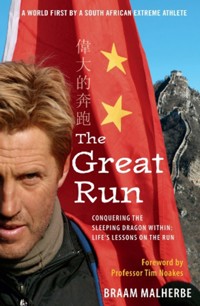
The Great Run
Conquering the sleeping dragon within: Life’s lessons on the run
Braam Malherbe
Foreword by Professor Tim Noakes
Sunbird Publishers
To Benjamin, who showed me the meaning of unconditional love.
May your journey be wonderful, wild and free. May your spirit soar and love be always in your heart.
Foreword
By Professor Tim Noakes
Between 24 August and 15 December 2006, Braam Malherbe and his close friend David Grier became the first humans on record to run the full extent of the Great Wall of China. They measured its distance at 3,515 kilometres – although they covered a distance of 4,218 kilometres due to having to leave the wall to find their support crew for replenishments on many occasions. After the pair had completed their run, the Chinese government declared the Wall off-limits to any future runs. Thus their achievement is unique and perhaps forever. What are we to make of those who are driven by ambitions that most of us cannot even begin to comprehend? In this book Braam offers some personal answers.
At 12, inspired by the stories of Tom Sawyer and Huckleberry Finn from another continent, he undertook his first solo ‘boy’s adventure’ spending some nights on the slopes of Devil’s Peak before returning home to his relieved parents, who must have thought that they had lost their errant son forever. On the mountain, alone and close to nature, he had discovered his childlike passion. Five years later, as a 17-year-old sometime runner who had yet to run more than 10 kilometres in a single run, he covered 532 kilometres in 11 days from Plettenberg Bay to Cape Town. His goal was to raise money for a study to determine the environmental impact of a proposed solid jetty in the environmentally sensitive Langebaan lagoon on the Cape West Coast.
When told the run was impossible, he reasoned that the fact that something had not been done did not mean that it could not be completed successfully. As a result of his triumphant teenage intervention, a more appropriate jetty was constructed in the Langebaan lagoon without negative environmental consequences. Then, at age 31, he ran 620 kilometres from the Tsitsikamma National Park to the Table Mountain National Park to raise awareness and collect money for the purchase of equipment to be used against poaching in the national game parks.
Thus the twin themes of Braam’s life are clear – a passionate desire to educate others of the need to protect the environment, and the capacity to perform physical feats that others have deemed impossible. Which brings us to the focus of this book, his run with David along the Great Wall of China.
At the start of this century there were two places on Earth that had yet to be reached by humans – the South Pole, first reached by the Norwegian team of Roald Amundsen in 1911, and the summit of Mount Everest, reached by Tenzing Norgay and Edmund Hillary in 1953, six years before Braam was born. Thereafter all that remained was the moon, which was first visited in 1969, when Braam was 11. To have been young in the 1960s was special, for it was a time of great optimism and self-belief. Humans really did believe that, given the willpower, we could achieve the impossible. To achieve a landing on the moon with the use of less computing power than is present in the most humble modern laptop computer was a quite remarkable feat. But, short of walking around the moon, there were not many remaining physical adventures on our planetary system that had not already been completed. Except the Great Wall of China.
When Braam first spoke to me about his desire to run the length of the Great Wall, it is true I told him it was improbable, perhaps impossible. I had assumed it would not be possible to run 42 kilometres a day, six days a week, on an uneven surface for more than 17 weeks without suffering a significant injury. And this did not even begin to consider the risks imposed by the environment, the risk of significant illness, the isolation, the altitude, the heat and the cold. It is also true I spoke about the failed British expedition to the South Pole in 1911, on which Captain Robert Scott and his polar team had man-hauled their provisions 10 hours a day for 159 days across the barren ice, covering just 16 kilometres a day. To achieve this they had expended more than 900,000 kcal of energy. But they had not survived. At a cost of 100 kcal a kilometre, Braam and David would have to expend more than half the total energy used by Scott’s party and nearly three times as much energy as that used by cyclists in the modern Tour de France. So I had good reason to tell Braam that to complete the run across the Great Wall of China in the manner he proposed was as close to an impossible undertaking as I could imagine.
This book explains why I was proved to be wrong. The physical challenge in an event like this is not where the outcome is decided. For the body is merely a slave to the mind. And if the mind can be convinced of the value of the task, there is little that is impossible. But the full scope of the brain’s seemingly limitless actions is constrained by the character of its owner.
Braam is driven by a character that is powered by honesty, passion and tenacity. His honesty is based on a complete understanding and acceptance of himself. Without that honesty, the run would have fallen apart at the first significant challenge. His honesty explains Braam’s transparency that shines through his every pore. His passion is for the environment and for those less fortunate. So the ultimate beneficiaries of his and David’s selfless run were the children born with facial deformities, now correctable within a few hours by appropriate surgical intervention – the Cipla Miles for Smiles campaign. His tenacity is such that he will not consider stopping until the task he has set himself is done.
This book is an inspirational testament of what can be achieved when good character and the prepared mind confront the ultimate challenge. Perhaps the greater question is why such human achievements are so astonishingly rare.
For the reality is that the world and the environment need many, many more Braam Malherbes and David Griers.
Professor Tim Noakes, OMS Discovery Health Professor of Exercise and Sports Science at the University of Cape Town and the Sports Science Institute of South Africa
.
Map of northern China
Introduction: Lessons from the Great Wall of China
The Great Wall is represented as a sleeping dragon in Chinese folklore. When I stood on a lonely plain of the Gobi desert and issued my challenge, like a latter-day knight, or Don Quixote perhaps, it awoke and raised itself to face the affront. In all its years, centuries and millennia of existence, it had not yet been beaten.
In 2005 Cape Town chef David Grier had hatched a foolhardy scheme, to run the main intact length of the Great Wall of China (3,515 kilometres) in one go. If completed as planned it would be a world first. I knew it would be forbiddingly tough – near impossible. But what I didn’t know was how my journey along that monument to human endeavour, and indeed through that haunting land itself, would change my life and influence my outlook on just about everything.
During those long months in China I was to discover that the Great Wall is a metaphor for life: like the Chinese, we all build walls around us to protect us from perceived fears and dangers. All too often these walls, initially constructed to safeguard, become prisons to our imagination and prevent us from reaching our fullest potential. We bury ourselves beneath painstakingly contrived masks and personas and so forget our true selves. Conquering the Great Wall of China forced me, step by tortuous step, to deconstruct my own walls. It also made me question many of my deep-seated and ingrained beliefs.
Feeling exhausted and seriously cold towards the end of a tough day. I had to dig deep and constantly remind myself of the big dream.
More than once I stood at that razor’s edge between giving up and carrying on, between death and life. One of the things my journey along the Wall confirmed was my belief that we hold the key to our future in our hands. The outcome is determined by the decisions we make throughout our lives.
It is ironic that many people awaken to the gift of life only after staring death in the face, after something dramatic or painful reveals the fragile and fleeting nature of their existence. Only in our most dire situations, whether in war, or alone in some seemingly Godforsaken place, can we grasp the value of the gift we’ve been given on this Earth and that we should use it to the best of our ability, and maybe even aim beyond that.
Running the Great Wall end to end – we eventually clocked 4,218 kilometres – gave me the rare opportunity, in those many weeks and months of silence, to reflect, learn and grow. It was a huge and intense physical challenge, but it was just as much of a mental challenge.
A Wild Child is Born
I often like to think I represent the average outdoor, nature-loving guy, but with experience I have also come to realise (slow as it has been to penetrate my obstinate and determined head) that I have made choices that set me on a different and singular course. From my earliest memories I had crazy ideas. All kids do, but I seemed to act on mine more than others, to always push myself just that little bit further, testing myself and the patience of those around me.
Like other children with access to a bit of veld, I spent hours and hours watching bugs, birds and animals and seemed to perceive some unifying truths about the universe. In my case those feelings never left me and the need to be at one with nature only grew stronger as I searched further. I guess I was, and have always been, a wild child.
At the age of 12 I didn’t just think about running away from home, go to the end of the road and then remember it was time for dinner and head back. I took off for a week on my first foray ‘to the mountain’ to gain wisdom. Later, when I was at high school, I embarked on an ultra-marathon run with a friend during the September break – 532 kilometres in all – running after a conservation dream. I had not done anything remotely like it before and it made me believe that anything was possible if my dreams were big enough. It was the first time I realised that the difference between success and failure was all about mental attitude.
Even at that stage, if I’d had the self-knowledge that came later, I might have realised that I had chosen – always chose whenever I got half a chance – the path of most resistance and maximum adventure. Not just adventure for the sake of adrenaline that seems to be in fashion, but a path that would lead me to greater personal wisdom, as well as a greater understanding of the issues facing us as the custodians of this fragile planet.
As I grew up and moved away from my family base, I realised I would never be able to come to terms with who I was until I managed to unravel the complicated relationships within my family. Running the Great Wall gave me both the time – endless days, weeks and months of putting one foot in front of the other in a haze of pain and monotony – and insight that maybe only an extreme pursuit like this can give a person.
Tortured events, failures, losses, seemed to unfold in my mind and resolve themselves one by one. I came back from China a different person ... or at least a changed one from the bundle of ego and energy that ran off into the Gobi desert, in the blistering heat of an alien land, that day back in July 2006.
Keeping Promises
The Great Wall turned my life around, and yet again reminded me of what’s really important in life: family, loved ones, and safeguarding our natural environment, as these are the things that ultimately sustain us.
Subsequently, my task is to make good on all the promises I made to myself about my relationships with the people I care about, and using whatever time and resources I can muster to help preserve the beauty of this unique planet. Not just for our sake, but for all life and the many generations still to to come after us.
This amazing adventure on the Great Wall of China led me through a magic door in my life that otherwise I would have never even known was there, to a place of greater consciousness. I have gained so much understanding of myself, my place in the world, and the legacy I want to leave behind.
So this is my story. I hope you enjoy the journey.
Braam Malherbe Appleton Camp, Signal Hill Cape Town February 2010
The Recce
Meeting the Sleeping Dragon
Alone
Hot, shimmering, orange mirages of desert landscape stretching out as far as I can see. Sometimes flat, often undulating hills of powder sand or ancient broken stone – the vastness of the Gobi desert is daunting.
I am standing at 39° 48' 073" N and 98° 12' 85" E. This is the extreme western terminus of the Great Wall of China. The first lonely mud watchtower stands on the precipitous edge of a cliff with the Great White River some 200 metres below. The only flowing river in a vast, parched and lifeless land; its flood cycles have carved a natural barrier that in times past prevented the hostile, invading Mongol hordes entering China from the north-west. The Great Wall is a man-made double front, lying like a giant sleeping dragon across the country’s northern frontier. It stretches from Jiayuguan in the west to Shanhaiguan at the Bo Hai (Sea) in the east. The vigilant, guarding dragon lies quietly for an estimated 3,500 kilometres.
Date: 24 August 2006; time: 13h00. Although it is autumn in the Gobi, the temperature is still in the high 30s. Standing here with my long-time friend David Grier, we are both silent. With every breath the hot air scorches the inside of my nostrils; my throat is dry and the sun feels like it is burning holes into the back of my cap. Each of us is holding a silk flag. Me, the flag of my country, South Africa, its bright rainbow colours shining in the sunlight, bringing a vibrancy to the dry and barren landscape. David holds high the red flag of China with its gold stars in acknowledgement of what we are about to begin.
Holding up the South African and Chinese flags.
We are going to attempt what many had said was impossible: to journey the entire length of the Great Wall on foot, in a single attempt, running (or crawling if it came to that) an average of 42 kilometres – or a full marathon – a day, six days a week, allowing for one rest day each week for recovery. We would be crossing some of the harshest terrain on the planet: from vast deserts with temperatures in the high 30s, through eroded lunar-like landscapes to high, snow-covered mountains where temperatures would be in the minus 20s. We wanted to travel the line of the Wall as closely as possible in order to measure its actual length by Garmin GPS. If completed as planned it would be a world first.
For a project of this kind to be really successful, careful planning is critical. First comes the dream, then the plan, only then the action. David’s dream of running the Great Wall of China had been born some three years earlier, although I instinctively felt the idea of something like it had been in me since I was a young boy. It’s a dream I think is in many children: the dream that we are superheroes, adventurers and explorers, and that we are invincible. That the Earth is a giant playground, rich with treasures waiting to be discovered. Now, standing in the barren desert, a frighteningly alien land, I vividly recall how it all started....
David phoned and said he wanted to meet to discuss what he called ‘a crazy idea’. Over the course of a long afternoon involving many cups of coffee we exchanged ideas. I told him about my unerring determination to show children that nothing is impossible if you just believe in yourself enough.
He in turn spoke of his fascination with the Great Wall since he was a boy. He mentioned a documentary he had watched on the late Sir Edmund Hillary, the first man to summit Mount Everest. It was a tribute to the man some 50 years later. Hillary recounted how, on revisiting base camp, he had been disgusted at the litter of discarded oxygen cylinders, the crowds, human faeces and rubbish. The great mountaineer spoke out in anger and pain for what he saw happening to the sacred mountain.
‘This was my Everest,’ he said. ‘Go and find your own Everest.’
David and I discussed the so-called impossible challenges of the world, those natural obstacles that tease the psyches of adventurous spirits – the obstacles that invite us to test ourselves and our abilities against the majesty of the natural world. As the first step towards ‘finding our own Everest’ we counted off the great challenges: the poles had been reached, by various methods; Everest had been climbed; the Earth had been circumnavigated this way and that; the Atlantic paddled. And here was one of the great challenges of the world standing before us, as yet unclaimed.
We began investigating the feasibility of running the full length of the Great Wall of China from start to finish in one go. The Great Wall, in the minds of many, and certainly in mine, is the greatest engineering feat in human history. The mighty pyramids of Giza pale into insignificance by comparison. It is said the bricks of the Great Wall could circle the Earth at the equator in a wall a metre thick and 1.5 metres high.
The idea thrilled me. I felt that familiar tension in my gut; the excitement I feel when something great or special challenges me, when I climb a difficult rock face, or am about to hurl myself out of an aeroplane.... The drone of the aircraft engines is the only thing I hear and my pumping heart is the only thing I feel. Then I leap into space. As I fall, I remember my Ouma (or Granny) when I asked her, at the age of about six, when I would be able to fly. I remember her saying, ‘My engel, mens kannie vlieg nie, ons het nie vlerke’ (my angel, humans can’t fly, we don’t have wings).
But there I am, falling at 220 kilometres an hour from 25,000 feet. I push my right arm outwards while keeping my left arm tucked in tight, arcing across the sky without wings.
Going beyond the limits of ordinary human abilities and imagination seems to have been my calling from the womb. We are all awed by great achievements. They excite us and take our breath away when we realise the ability to confront them is inside each of us: all we have to do is to say ‘yes’ and take the first step. It’s right there; it’s real and tangible. We all have the potential for greatness and the desire to excel is in our blood. We just don’t all seem to have the will.
As far as I’ve always been concerned, it doesn’t make sense to play at being small. We deny ourselves our destiny in doing so. It is when we step outside our comfort zone that the excitement wells up and we know we are on a road to greater things. Well, that’s the way I feel it, for sure.
I felt the Great Wall could be my great challenge, to prove to myself and others that nothing is impossible, even after many knowledgeable people had said it couldn’t be done. It had not yet been done. But in order to make it happen I had to dream it vividly and often: I needed to add colour, material form and substance to my dream. I knew also that many people and situations would try to prevent me from achieving my dream. These would include the obstructive beliefs of people who subscribe to negativity as part of a habitual lifestyle, as well as the normal day-to-day pressures of feeding body and soul and also of caring for others close to me. I knew that in order to reach my goal, I would need to make the dream a part of me, a part of my everyday life, to let it burn like an inextinguishable flame and to not allow one breath of doubt to enter my sacred place.
The Great Wall
William
So why had the Great Wall never been traversed from one end to the other in a single attempt? Why had no-one run it as we intended to do? Many had tried, none had succeeded.
‘But why?’ I kept asking myself, trying to untangle a bird’s nest of circular reasoning and doubt.
I found my answer not while exploring the Wall and the extreme terrain it crosses, but in researching the climate. You cannot run in the Gobi desert in summer when temperatures reach into the high 40s and the area is scoured by murderous dust storms. Almost yearly, people there get trapped in these storms and perish. They die of suffocation as the fine wind-driven powder mixes with their saliva and clogs their throats and noses.
What I didn’t know was just how much of a taste of this I was going to get about a year later.
Equally, you cannot run in the high mountains when the Siberian winter approaches, when the temperatures dive into the minus 30s before the mountains bend down to the Bo Sea. Nothing survives for very long in those extremes of climate and temperature.
I knew what that meant: a time frame of some four months and being exceptionally fit. The old cliché of survival of the fittest would be tested to a fine degree. To cover the Wall’s 3,500 kilometres in the time available, we would need to move at a rate of around a full marathon a day, for close on four months. I also knew that the Wall did not exactly present ideal running terrain. We would have to run wherever we could, and walk, crawl, clamber and climb where we couldn’t. But we would need to cover the necessary distance every day as planned if we wanted to survive and succeed in our quest. I also knew we would be moving from days with up to 11 hours of daylight in the Gobi desert, to very short and icy winter days in the high mountains with only six hours of daylight. Any injury could mean not only failure, but also possible death in the remote reaches of the Wall, where no-one would be able to come to our rescue.
Still, the more I learned and the longer I dreamed, the more tangible it all became. I could almost taste it. It was frightening and maddeningly exciting at the same time. The idea began to haunt me in my dreams and my waking hours. The bug had bitten hard, but first we had to plan well – logistically, mentally, physically and, for me, spiritually. David had sourced a book written by a man who had journeyed the Great Wall some 20 years earlier. William Lindesay had travelled the length of the Wall in various stages over a period of a year or so. He had been deported, but had returned. He had suffered dysentery, but returned. He seemed tenacious and, from what I read, I liked his attitude. William had met and married a local woman, and settled in Beijing with her and their two children. He had founded the International Friends of the Great Wall and is director of the organisation. He clearly had a deep knowledge, respect and passion for the Wall and its long history.
‘Perfect,’ I said. ‘He’s our man!’
Now it was just a matter of getting him to reply to our many e-mails. Where was the ever-elusive William? I had read his book, found out so much about him and the Wall, but William seemed to be a ghost. For agonising weeks we just couldn’t track him down.
Then one day, some three frustrating months and countless e-mails later, a reply arrived. The ghost had finally materialised!
‘I get inundated with people wanting to visit the Wall. Most have no idea what they’re in for, but you chaps are certainly persistent. You appear to be serious about this. Perhaps you need to come to China and see for yourselves what you’re getting into?’ He was testing our commitment.
It took another three months of e-mails and phone calls before things gelled and William agreed to meet with us in Beijing to ‘discuss things’. We planned a trip to meet him, to recce the Wall at various points and put the whole thing into perspective.
David and I arrived in Beijing in March 2005. It was summer and it was hot and muggy. My first view of the Wall was on a massive mural as I exited customs at Beijing airport. It looked picturesque, surreal, like something out of a Lord of the Rings movie. It certainly felt inviting, which maybe was a good sign, but I knew that perceptions could be very misleading.
Great Wall mural at Beijing airport.
We had booked into the Great Wall Sheraton, a lavish luxury hotel in central Beijing. The Great Wall was everywhere – murals, bank notes, on my visa, even the make of a vehicle. But, just like William, the real Wall remained frustratingly elusive.
William’s driver collected us early the next morning for a three-hour drive, heading north of Beijing where we were due to meet William at his farmhouse in the mountains. Never in my life had I seen such an integration of First and Third World living. Silver-mirrored skyscrapers stood out like gigantic crystals in the grey hazy smog. The freeways were congested with traffic, from modern sedans to lumbering trucks and then, in a lane dedicated to slower traffic, bicycles and tricycles, some motorised, others being pedalled or pushed, with their huge, disproportionate loads of vegetables, scrap metal or massive oil drums balancing precariously. And everyone hooted! It was standard practice to hoot. Indicators were an occasional added extra. Traffic circles were a nightmare – just get in first and keep moving. I was baffled. There seemed to be no logical system in place. Even pedestrians would step off the sidewalk and head into the sea of heaving, hooting hysteria. But somehow it worked. People swerved and hooted. No-one swore and no-one crashed.
All around Beijing lines of trees were growing. This is meant to bring more oxygen to the gasping city and relieve pollution. The bases of most trees were painted white for about a metre above the ground. It’s a poison to keep the ants and other invading insects at bay. I wondered who the real invaders were, because the masses of people reminded me of nothing so much as giant insects. In the shadows among the trees were many conical sand heaps, each surrounded by a ring of stones. Occasionally, at the top of the cone was a fist-sized rock or two. I discovered they were graves. Later, I was to see many more of them in the desert.
The grey haze stayed with us some 100 kilometres further as we wound our way into the hilly land beyond the city. I peered through the sad, oppressive metal-grey gloom and saw a fine line tracing the far ridges of the high mountains. Was this my first glimpse of the real Great Wall? I couldn’t be sure.
Snaking along narrow dirt roads, weaving between slow, yoked oxen heaving their cumbersome burdens of wood, we entered what appeared to be an ancient village. The only real signs of modernity were the electric wires linking the homes like scattered spaghetti.
When the car could go no further we gathered our packs and wound our way up a narrow footpath, passing an old woman grinding maize on a large, obviously ancient mill stone. She smiled politely as I passed, acknowledging my presence in silence.
At the top of a gentle slope, an open gate made of plaited sticks was the humble entrance to a farmhouse. And there stood the elusive William!
He was a tall man, around six foot two inches (two metres), with a mop of silver-grey hair, excited, shining eyes and a broad smile. He loped across the courtyard and shook my hand in a warm welcome: the beginning of a special relationship. Over dinner that evening, which consisted of the tastiest fresh trout cooked by William’s cook Lilly (who was to be our expedition cook more than a year later), I listened to William as he shared his knowledge of the Wall. He was so passionate that I grew more excited by the minute. I wanted to see it now, touch it, smell it ... I wanted to take a bite of my dream.
Meeting the elusive William Lindesay was a definitive moment, for without him, I’m not certain whether this journey would have come to fruition.
An early night was necessary as we would be up at 04h00 for a quick breakfast of farm eggs and toast before commencing our hike to finally make acquaintance with – what mountaineers call rubbing noses with – the ever-distant Wall. The door to my room was painted bright red. The ornate lock in the latch had a beautifully embroidered tassel hanging from it. The door was half open and it was dark inside. I paused for a moment to ponder the significance of this: red representing danger, yet the lock and the door being open, inviting anyone who was curious and maybe foolish enough to enter. What a metaphor for this mad journey we were planning. I took a deep breath and stepped inside, just as I committed to our plan of running the wall. Now that we were here, having made the long and expensive trip from Africa, there was no going back.
The ornate lock on my door at William’s farmhouse.
I lay on my thin mattress on the raised communal cement bed. These beds are common throughout rural China, probably originally made from clay. They are hollow underneath with a small opening on the outside of the building. This allows for a fire to be made under the bed, which warms the cement slab in the freezing winter. I lay in the dark contemplating my future and the changes that might occur. Looking back now, I realise I had no idea how these first steps towards my dream were going to alter the course of my life. I felt a little like a child first finding that it could walk, taking uncertain tottering steps, yet feeling great excitement at the new and wonderful discovery. I drifted into a restless sleep.
I got up at 03h30 and went outside to take a pee. The northern stars were still dazzlingly bright and so different from my familiar constellations back home. Everything I sensed was new and I was filled with a deep, craving fascination. Even the trees and grasses were different. Everything was a discovery. After putting on my running gear I hastily packed some basics into my day pack: camera, binoculars, compass, note pad and pen, some health bars and water.
In the greyness of dawn the three of us walked towards the mountains, our silence mirroring that of the land around us. Following William through green forest with dappled light as the predawn turned to dawn and dawn to day, sunlight at times flashing in my face, we wound what seemed like forever upwards.
Our first steps in search of the Great Wall.
Rounding a bend, with the sun fully up, suddenly, there, through a small clearing, less than a kilometre away – the Wall, majestic and ancient.
Seeing the Wall for the first time, through dense bush. The trees would be lifeless when we returned here in the winter more than a year later. It was still some two kilometres away.
I had goose bumps and couldn’t speak as I walked over broken bricks piled around the base and onto the Great Wall of China for the first time. It seemed so long ago that I had dreamed of this moment. I leaned with my face and naked chest embracing the wall. I removed my running shoes and walked barefoot for the rest of the day. I wanted to really feel the connection. Seeking out the pain underfoot so I could get a feel for what things might be like day after day, week after week, month after month when we returned for real. That’s when and why William gave me the name of the White Bushman.
Being on the Wall for the first time was an extremely emotional moment. I did 25 kilometres barefoot to really get to feel what I was going to be in for a year later. William called me the white bushman.
To say the defensive barrier is impressive would be an understatement. The granite foundation blocks are, on average, about a metre long by half a metre wide and slightly less than that in height, weighing nearly a ton each. These blocks were hand chiselled in the valleys some 2,000 metres below and hauled up near-vertical cliffs using pulley systems. The smaller bricks that make up the higher sections of the Wall, the ramparts, walkways and watchtowers, were baked in village ovens as construction advanced across the country. They were carried manually on wooden L-shaped rucksack-type frames, up the steep slopes to the construction site. During the Ming dynasty (1368–1644) something like 90 per cent of China’s population was contracted – mostly by force – to work on the construction.
It is estimated that one builder died for every metre of wall built.
The cement, too, was made in the valleys below. Glutinous rice porridge was boiled in huge pots, powdered limestone added and, incredibly, this paste still holds much of the Wall together today. The stark stone and brick watchtowers with their magnificent barrel vaults were cool and haunting. Standing in the silence, I imagined the long-gone soldiers talking, joking and laughing over a meal. I imagined a Mongol invasion – fires and columns of smoke, signalling from tower to tower across the rugged mountain tops that battle was at hand. I could hear the clatter of armour; see the oil being heated in cauldrons ready to be poured on the enemy below; arrows being carefully aimed through the specially designed window slots in the parapets; and, on occasion, the explosion from a hand-hurled bomb in the valley below (earlier in the morning I had seen shrapnel fragments of these bombs on the path leading to the Wall), and all the while the soldiers shouting in the heat of battle.
There were endless stories locked into the silent, cool mass of the Wall, so many memories of stories of so long ago, now only to be imagined. What an incredible feat of human imagination and engineering. A real tribute to visionary and tenacious (if tyrannical) leaders who held a nation together with a common goal, from dynasty to dynasty over the many centuries. This kind of steely, far-sighted resolve can be seen in much of what outsiders view as the contradictions of this amazing, if mysterious, country.
The shadows lengthened and it was time to leave the Wall and descend into the darkening valley. I had covered about 25 kilometres of extreme gradients and my feet were really hurting.
‘Will I feel this pain each day when I come back?’ I asked myself. I hoped not but feared I would. As I walked in silence, reflecting on the day, I felt a sudden tightening in my gut. There was sadness here. I stopped suddenly. David asked me what was wrong.
‘Listen,’ I said, ‘just listen.’
‘What?’ he replied, ‘I can’t hear anything.’
‘Exactly,’ I answered.
In this beautiful forest, high in the mountains, at a time of day when the birds should be calling to each other, there was not a note. No bird, or even insect, signalled its presence. I realised I’d not seen any animal tracks on the paths either. Apart from the trees and us, there was no sign of life at all. I gasped at the sterility, while contemplating the obvious: pretty much anything that could be caught and eaten had been. The natural order was out of balance here. Again, I was harshly reminded that there are just too many people to be provided for, and how much more intensely you can see this in China – the world’s most populous nation.
I arrived back at the farmhouse with mixed feelings. There was excitement and exhilaration at my first encounter with the Wall. My dream was tangible at last, but there was also a harsh realisation of how severe the damage already was that people had inflicted on nature in so many places. I was tired and emotional as we shared our feelings over another superb ‘Lilly’ dinner in the dark valley. As I drifted into sleep on my hard bed, images of the lonely, cold Wall high on the ridges above me swirled in my mind, morphing into fantastic shapes and evil dragons that were set to come back and haunt me.
An Egg and the Earth
I woke in the dark from pain. My feet were throbbing. I had been dreaming about the first long run I had done as a kid. I remembered how my feet had hurt so badly I swore I would never subject my body to pain like that ever again. I had a slightly convulsive feeling akin to nausea and felt afraid. Pain is a real leveller and, with the vividness of my dream, I wondered what I was getting myself into – again!
On the long, winding drive back to Beijing, I reminisced on why I had done that long run all those years ago. I remembered clearly that it had been a strong conviction to protect innocent animals and nature from human carelessness that had carried me through those painful kilometres and set me apart from other young boys of that age.
In physical form I’m your average middle-aged man, if a bit lighter and somewhat fitter than most men of my age and place. I come from an outwardly pretty average family who lived in a middle-class suburban environment. Acquaintances would probably say I’m more hyperactive than most, but I still see myself as a pretty normal guy. So why is it that I seem to be drawn to do things that your average person would dismiss as crazy?
I am the eldest of five siblings and was taught to be responsible from a young age. As a child, I often had to look after my younger brothers and sister, having to make up for the inadequacies of my parents, who tended to be too caught up in their own problems to really worry or care. Among other things, I believe it was this forced independence that caused me to question the actions of adults and other authorities and measure things on my own moral compass. I felt extremely protective of my younger siblings, which later translated into a strong passion to protect all things dear to my heart.
When I was 16 years old I was fortunate and privileged enough to have been sponsored to attend a Wilderness Leadership School in the Umfolozi game reserve (now part of the Hluhluwe Imfolozi Park) in Zululand, a particularly wild and lovely, lush tract of subtropical bushveld in South Africa. This experience had a deep and profound impact on me.
Sitting in the shade of an acacia tree on a hot day deep in the Umfolozi wilderness area, which is totally devoid of any human structure, our ranger and guide Colin Johnson handed each of us boys our lunch ration. It consisted of a sandwich and a hard-boiled egg.
Colin asked us not to break the egg, but just to hold it and look at it.
He held up an egg and asked us the question: ‘If this egg is our Earth, what part of it would be the air that surrounds us?’
We all said ‘the shell’.
He was silent for a moment, before cracking the egg on his head. He carefully and slowly peeled the shell away, exposing the thin, delicate membrane that lay beneath. Lifting a piece of the opaque skin away from the egg, he held it to the light.
‘This is how fragile our planet is,’ he said slowly. ‘This thin membrane is the only thing protecting us from whatever lies beyond. This is our thin layer of atmosphere and we must protect it at all costs.’ He was silent for at least a minute and so were we. There was such stillness in that wilderness, with the occasional, mournful call of a green-spotted wood dove. Even then, so long ago, I felt frightened at the vulnerability of our planet. The memory is still vivid to me.
After the silence Colin asked a simple question, a question that changed my life: ‘You are privileged to be here,’ he said calmly, ‘on this course and on this Earth. What are you going to do to make a positive difference to our Earth, when you get back to school?’
He did not say ‘when you finish school’, or ‘when you retire one day’ but ‘when you get back to school.’ He was not giving me the escape that so many people use: ‘one day, when I have time’. He meant now!
I did feel privileged. I had grown up with all the amenities and comforts a person could possibly ask for, and taken the resources our fragile ecosystems provided me with every day just as much for granted as everyone else around me. I realised then that if we didn’t take care of and protect the Earth, we would be doomed.
And so it was, through the challenge issued to me by Colin in 1974, that I consciously began my journey towards discovering my true calling. He had challenged me to be a champion and protector of nature, which deeply resonated with the love and awe I had felt all my life for all things natural and pristine, as well as my protective personality.
I was also a junior member of the Wildlife and Environment Society of South Africa at the time. Through the society I was made aware of the large concrete jetty being built into the beautiful Langebaan lagoon at Saldanha Bay on the south-west coast of South Africa. This was to be the terminal point of the Sishen-Saldanha railway line that would bring iron ore from the Sishen open-cast mine in the arid region of the Northern Cape, to be loaded onto vessels for export to the East.
The loading jetty, if built as a solid structure out into the lagoon as proposed by the task-focussed engineers, would significantly alter the flow of currents in the lagoon, with potentially catastrophic results for the flora and fauna endemic to the lagoon – a major wildlife and conservation area, especially for breeding colonies of sea birds. Some of them, like the Cape gannet, bank cormorant and black oystercatcher were already on the endangered list.
I was shocked at the blatant disregard for the voiceless plight of nature, with only the Wildlife Society seeming to care. I chose to do something to prevent the potential destruction: it was less than a year since Colin had issued his challenge to me and the other boys in that Zululand wilderness.
I approached a school friend, James Siddle, and outlined my plan: I wanted to run an impressively long distance to raise awareness – and money – so that an environmental impact assessment (EIA) could be carried out and a possible disaster prevented. EIAs were a new thing then and viewed by engineers and planners as something of a tree-hugging nuisance in those days. In fact, it has been proved that a properly conducted EIA will not only reduce negative impacts and increase the positive ones of any large development, but they save the developer money too by taking into account many variables that a strictly engineering point of view never would.
James was his usual keen self: ‘We could run from my folks’ holiday home in Plettenberg Bay back to Cape Town,’ he offered enthusiastically.
‘Cool,’ I replied, ‘how far is it?’
‘Ah, around 500 kays,’ was his casual reply.




