


6,99 €
Mehr erfahren.
- Herausgeber: Schreibstark-Verlag
- Kategorie: Lebensstil
- Sprache: Englisch
In this book we offer a collection of texts by various people, each attempting to describe their experiences of learning Kung Fu with their Sifu. We are happy to be able to offer reports from those learning within other branches of Kung Fu. The book is enriched by stories and anecdotes from former pupils of Yip Man, relating to the time they spent training in his school. Furthermore we discuss the various training methods, training equipment und techniques.
Das E-Book können Sie in Legimi-Apps oder einer beliebigen App lesen, die das folgende Format unterstützen:
Veröffentlichungsjahr: 2020
Ähnliche




Inhaltsverzeichnis
Foreword
Tuition with Lo Man Kam: the nephew of the last Great Master Yip Man.
My Training with Sifu Lo Man Kam
Wing Chun in my life
Master Lo Man Kam’s United Nations of Kung-Fu
Tuition with Lo Man Kam
My teacher, Sifu Lo Man Kam
Wing Chun Kung Fu, by a pupil of Marc Debus
A selection of interviews
An Interview with Sifu Gorden Lu
An Interview with Sifu Lo Man Kam
Memories of former times
My path to Sifu Wong Shun Leung
Training equipment and aids
The stick as training aid in the Lo Man Kam Wing Chun System
The spring-arm – traditional training equipment?
The tripod in Wing Chun Kung Fu
Training of forms in the Wing Chun system
Cham Kiu (1st Section), demonstrated by Marc Debus
First Section of the Wooden Dummy demonstrated by Sigung Lo Man Kam
Technique series
Sifu Philipp Mueggler demonstrate a Chi Sao Technique
Sigung Lo Man Kam and Sifu Philipp Mueggler show a Chi Sao attack sequence
Leverage techniques with Sigung Lo Man Kam
Defending a straight punch/ Sigung Lo Man Kam and Sifu Marc Debus
Defending a straight punch / Sigung Lo Man Kam and Sifu Marc Debus
Chi Sao Technique with Sigung Lo Man Kam and Andreas Zerndt
Chi Sao Technique with Sigung Lo Man Kam and Clarissa Muzammil
The Lo Man Kam Wing Chun System around the world
Greetings
Thanks
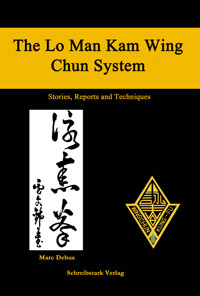
The Lo Man Kam Wing Chun System - Stories, Reports and Techniques
Stories and experiences of
Wing Chun Kung Fu
Marc Debus and others
Schreibstark-Verlag
Saalburgstr. 30
61267 Neu Anspach
„Wing Chun Kuen“
Calligraphy by Sifu Lo Man Kam
Foreword
In this book we offer a collection of texts by various people, each attempting to describe their experiences of learning Kung Fu with their Sifu. We are happy to be able to offer reports from those learning within other branches of Kung Fu. The book is enriched by stories and anecdotes from former pupils of Yip Man, relating to the time they spent training in his school. Furthermore we discuss the various training methods, training equipment und techniques.
I have tried to motivate as many people as possible who practice Wing Chun Kung Fu to write a report of their experiences for this book. This is aimed at illustrating the differing training ideologies, perceptions and individuality of Lo Man Kam’s pupils, without however trying to make any comparison.
Frequently there is discussion of the differences in methodology between various Wing Chun Schools: the historical reasoning behind particular training methods is explored, or assumptions are made about the combat effectiveness of a particular system. Unfortunately it tends to be entirely forgotten that most Wing Chun systems worldwide spring from the same root, namely that of the Great Master Yip Man. Various interviews have shown that Yip Man himself altered his training methods frequently over the course of his teaching career, and that methodological differences developed as they were passed on from pupil to pupil.
For example, during a talk with Sifu Wang Kiu I learned that in the early days of Sigung Yip Man’s teaching career, they had no wooden dummy available in the school and that therefore the Wooden Dummy Form was taught either without a dummy or using one of the pupils as a dummy. As a result of this experience Sifu Wang Kiu developed a training method which he called „Living Dummy“, where the Wooden Dummy Form is practiced with a partner.
This method of training is frequently called into question: however the historical facts as reported to me by Sifu Wang Kiu show that this training process actually existed in Yip Man’s school. And furthermore Sifu Wang Kiu puts forward a very positive argument for this particular training variation: „All the pupils of any Wing Chun school can practice the Wooden Dummy Form at the same time with this method, as most schools have only one wooden dummy available“.
This story and the resulting practices have proved to me that it is mistaken to believe that one cannot learn from other Wing Chun systems. Their experiences can benefit one’s own training methods and bring advantage to the development of one’s personal teaching style. The Masters and teachers who have practiced this art for many years have developed many useful theories as to how one can coach pupils in particular techniques and movements, thereby helping them in the learning process.
Our basic aim is to produce pupils who can master the art of combat and to encourage them to teach it to others, so that our chosen combat style does not die out. A teacher should be proud to see his pupil improving in the art of combat, and perhaps eventually outstripping the performance of his teacher. A good pupil is the result of a good teacher. The essence of the art of combat is never to give up the fight, and to win. This is the basic ideology which every combatant follows. The well-known saying of a famous fighter applies equally to the Wing Chun System: „Hasta la victoria sempre – Onward to victory!
Tuition with Lo Man Kam: the nephew of the last Great Master Yip Man.
-Training in Taiwan 2004-
What is it like, to train in a school run by a long-term pupil of the famous Great Master Yip Man? Surely many martial arts experts have asked themselves this question. Lo Man Kam not only enjoyed many years of training with Yip Man; he is also the nephew of the last Great Master. His first impressions and experiences of Wing Chun Kung Fu took place in Foshan (central China), when he was still very young, and before Yip Man lived in Hong Kong. At this time Lo Man Kam lived with his mother and his uncle in this province. Later he studied with Sigung Yip Man at one of his schools in Hong Kong for ten years.
Sifu Lo Man Kam sometimes talks about his experiences of training with his uncle, or as he explains a technique he relates what his uncle would have said about it at the time. Marc Debus and Dr. Frank Kuhnecke from the German Lo Man Kam Wing Chun Association went to train in Taipeh in the summer of 2004 and a short report of their first-hand experiences will give an impression of the realities of training in Sifu Lo Man Kam’s school.
Sifu Lo in Taiwan in the 70ties
It was not the first training trip to their Sifus school. Marc Debus and Frank Kuhnecke had already visited the Master’s school in both the preceding two years, while for one visitor it was the first experience of training with Sifu Lo Man Kam in Taipeh after getting to know him during his last two annual visits to Germany. Pupils from many other lands also travel regularly to Taiwan for training purposes, including Philipp Mueggler and Horst Uecker from Switzerland, and John Kang und Bradley Temple from America.
At the Sifus school, training sessions are divided into two blocks. The „Morning class“ takes place from 10am to midday, and is generally not as well attended as the „Evening class“ von 8.00 until 10.00pm. This later class tends to concentrate on Chi Sao training, and on practicing Forms and combat techniques together. Foreign students usually stay in the Sifus house with him, and therefore in the afternoons Sifu often gives them additional tuition in order to maximise the training potential of their stay. He puts emphasis on the perfect execution of the ‚Forms’ and corrects details of technique so that his Kung Fu style can be taught in the finest detail in schools outside Taiwan.
M. Debus in Taipeh
During the training classes the Sifu pays attention to all his pupils. He walks around the class to keep everyone under observation, and constantly corrects his pupils. He repeats these revisions tirelessly if he believes he can improve one’s technique. Some pupils are given special exercises in order to help them to rectify a mistake. This can be difficult, since Sifu Lo Man Kam will only allow a progression to the next exercise when he can see that the previous one has been fully understood and is now being correctly implemented.
Taifun in Taipeh
The climatic conditions demand particular effort: the temperature can often be between 38 and 40 degrees Celsius. The majority of foreign pupils are not used to training in such high temperatures. One must drink a lot of water in order to make up for fluid loss. Furthermore the air humidity level is extremely high and the temperature barely drops even at night. During 2004, Marc Debus and Frank Kuhnecke experienced a violent typhoon in Taipeh which almost prevented their journey home. One day the storm was so severe that it was impossible to continue training on the roof, where the training usually takes place. Instead a small group of five pupils trained in the living room of Sifu Lo Man Kam’s apartment.
My Training with Sifu Lo Man Kam
-by Marc Debus-
I began to be interested in martial arts in the middle of the eighties. At that time I trained a great deal with fellow students who had themselves been practicing various types of martial arts for several years. The problem with the training was that we were not able to have regular sessions, nor did we have a particular location for our training.
Sifu Lo Man Kam with Marc Debus 1996
I decided to attend a school of martial arts, so that I could have regular training sessions. And so I found a Wing Chun Kung Fu School in the city in which I was studying, and registered there and began my training. I quickly became fascinated by the combat style and therefore began a training programme to teach it myself. My teacher at the time soon encouraged me to open my own school. After a year of preparation I opened my own school in North Rhine-Westphalia with a colleague, and we ran it successfully together for three years.




