


Erhalten Sie Zugang zu diesem und mehr als 300000 Büchern ab EUR 5,99 monatlich.
- Herausgeber: THP Ireland
- Kategorie: Sachliteratur, Reportagen, Biografien
- Sprache: Englisch
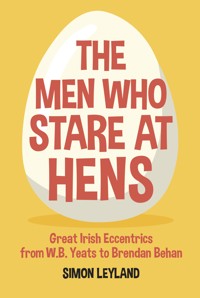
Have you heard of Frederick Hervey, the atheist Bishop of Derry who hated church bells? What about Samuel Boyce, the poet who couldn't afford trousers? Not even Mary Monckton, who once stole a live hedgehog from a dinner party? The Men Who Stare at Hens is a gentle meander down the byways and highways of Irish history, remembering the wonderful array of eccentrics that made their mark on their times.
Sie lesen das E-Book in den Legimi-Apps auf:
Seitenzahl: 183
Veröffentlichungsjahr: 2019
Das E-Book (TTS) können Sie hören im Abo „Legimi Premium” in Legimi-Apps auf:
Ähnliche


















For my Mother and Father
Non procul a proprio stipite poma cadunt
First published 2019
The History Press
The Mill, Brimscome Port
Stroud, Gloucestershire
GL5 2QG
www.thehistorypress.ie
© Simon Leyland, 2019
The right of Simon Leyland to be identified as the Author of this work has been asserted in accordance with the Copyright, Designs and Patents Act 1988.
All rights reserved. No part of this book may be reprinted or reproduced or utilised in any form or by any electronic, mechanical or other means, now known or hereafter invented, including photocopying and recording, or in any information storage or retrieval system, without the permission in writing from the Publishers.
British Library Cataloguing in Publication Data.
A catalogue record for this book is available from the British Library.
ISBN 978 0 7509 8975 6
Typesetting and origination by The History Press
Printed in Great Britain
eBook converted by Geethik Technologies
ACKNOWLEDGEMENTS
My thanks go to the wonderful Ronan Colgan of The History Press Ireland for his exceptionally good taste in deciding to publish this book.
A doff of the hat goes to Lauren Newby, Project Editor, and a firm hand shake to Katie Beard, Designer, for her delightful book cover.
I would also like to acknowledge the Letterfrack Council of Elders, who individually and collectively gave me the idea of writing a book on eccentrics, and the management and staff of the Veldons Seafarer Bar for allowing me to use their premises as an office.
Finally, my enduring thanks to the fragrant one for typing out endless drafts and being nice to me.
ABOUT THE AUTHOR
Simon Leyland has been living in Connemara since 2008. In a previous life he was a City trader and as a result has always been interested in the strange and absurd.
He has had three volumes of poetry published: Ramblings of an Unkempt Man (Erbacce Press, 2010), The Language of Exile (Erbacce Press, 2011) and Codes for Living Quietly (Erbacce Press, 2012). He has also written A Curious Guide to London (Bantam Press, 2014) and was shortlisted for the Hennessey Prize.
When behind on the rent he writes articles about cricket and horse racing for various magazines.
A blog exists at simonleyland.net.
INTRODUCTION
John Stuart Mill once said that ‘Eccentricity has always abounded when and where strength of character has abounded. And the amount of eccentricity in a society has been proportional to the amount of genius, mental vigour and moral courage it contained.’
Wise words, for we all have our own queer little quirks, odd habits and weird idiosyncrasies. Eccentricity is perhaps merely the amplification of this behaviour and madness is a leap in the dark. It is no crime to be an individual – especially in these times of suffocating bureaucracy, where people are reduced to just numbers or, worse still, ciphers.
Eccentrics, at least for my purposes, are also funny. They deviate from the norm in ways so odd and quirky that one wonders what made them think of it, not to mention what drove them to act out their ideas.
Quite recently there has been some serious research into eccentricity. According to the psychologist David Weeks, it appears that eccentrics are more cheerful than normal people. He goes on to contend that it is easy to distinguish between eccentrics and the mentally ill: the eccentrics are happy.
Like everything else, eccentricity has fashions and behaviour that go unnoticed in one age, but seem bizarre in another. The eccentricities of the Cork-born vegetarian ‘Linen’ Cook may have seemed outrageous in his time, but today he would have been viewed as a relatively normal, Guardian-reading, card-carrying Greenpeace activist.
You will no doubt notice that some of the entrants in this homage to eccentricity are not, strictly speaking, Irish. I therefore refer you to the late, great Conor Cruise O’Brien who said that ‘Irishness is not primarily a question of birth or blood or language; it is the condition of being involved in the Irish situation, and usually of being mauled by it.’
This book is a panegyric to all the strange scientists, magnificent misers, unhinged politicians, ritual compulsives, barmy builders, bizarre adventurers, brilliant iconoclasts, crackpot visionaries and the touchingly deluded.
I therefore propose to make 1 April, National Eccentrics Day. When the day arrives, do something different: wear your clothes back to front, invent something that no one will want, pay your mortgage with vegetables, or go to work in a wheelbarrow pulled by sheep. Perhaps you already do. Congratulations. We really do need our eccentrics.
♦ ♦ ♦ ♦ ♦ ♦ ♦ ♦ ♦ ♦ ♦ ♦ ♦ ♦ ♦ ♦ ♦ ♦ ♦
RICHARD WHATLEY (1787–1863)
One of the strangest clerics Dublin had ever seen was the wonderfully hyperactive Archbishop of Dublin, Richard Whatley.
A man of many odd interests, including boomerang-throwing and climbing trees, he believed that an outdoor life was the cure for all ills. If he ever had a headache, he would go out in his shirtsleeves, whatever the weather, and chop down a tree; the problem was that it could be any tree that took his fancy. He also objected to wasting money, but his congregation felt that he was taking it too far when he started to use worn-out church vestments for gardening.
His inability to sit still struck terror into the hearts of hostesses, as anyone who invited Whatley into their homes could expect to be left with broken tables and chairs. This was due to his uncontrollable habit of twitching, rocking violently and kicking out at anything in range whilst sitting down. His record seems to have been six chairs during an evening with Lord Burghley, who then had a chair specially built for Whatley’s next visit with legs ‘like the balustrade of Dublin castle’. Lady Anglesey, however, banned him from ever visiting again after he broke her best china when he managed to kick over a cabinet.
One day the Chief Justice was sitting next to Whatley at a Privy Council meeting and, feeling a sneeze coming on, put his hand in his pocket for his handkerchief – only to find the Archbishop’s foot already there. Large crowds would turn up for Whatley’s sermons, not to hear him preach but to see what he would do. One member of his congregation recorded that he ‘worked his leg about to such an extent that it glided over the edge of the pulpit and hung there until he had finished’. He would give lectures to his students while lying flat on a sofa with his legs dangling over the arm. Sometimes they were invited to accompany him on walks, which usually involved climbing trees.
He was totally disinterested in social chit-chat: whilst dining in company, he would take out a pair of scissors and trim his nails, or make miniature boomerangs out of his visiting cards and send them flying around the room.
Another example of his peculiar outlook on life was when a notoriously lazy clergyman asked Whatley for permission to go to New Zealand for his health. He replied, ‘By all means go to New Zealand – you are so lean that no Maori could eat you without loathing.’
He was also keen on phrenology, the once fashionable science of determining a person’s character traits by the size and shape of their head. He created a phrenological test of his own, namely: ‘Take a handful of peas and drop them on the head of a patient, the amount of the man’s dishonesty will depend on the number which remain there. If a large number remain, kindly tell your butler to lock up the silver.’
BASIL MACLEAR (1881–1915)
Sport and fashion have always been strange bedfellows. The sight of David Beckham cavorting around in a sarong is still enough to put you off your breakfast, and now it appears that even Conor McGregor is getting on in the act with his ridiculous suits.
There was one man, however, who managed to carry it off with great aplomb. He was a rugby player called Basil Maclear and he played eleven times for Ireland between 1905 and 1907. Having a reputation as a man about town, he was also well known for his sharp dress sense, which he brought with him onto the rugby pitch. Maclear would start the game with a pair of beautifully cut white calfskin gloves which he would then replace with another pair at half time. He surpassed himself during a match against Wales when he scored two tries wearing his customary white calfskin gloves plus a pair of ‘blancoed’ military putees.
The South African rugby historian AC Parker described Maclear’s try aginst South Africa in 1905 as ‘one of the greatest individual efforts ever achieved at international level’.
Sadly our elegant friend died of his wounds in 1915 after the Battle of Ypres.
BEAUCHAMP BAGENAL (1741–1802)
Beauchamp Bagenal’s behaviour on the Grand Tour both appalled and astonished his contemporaries. Jonah Barrington, the lawyer, politician and memoirist of Abbeyleix, included an account of the adventures of Beauchamp Bagenal in his memoirs. He wrote that Bagenal ‘fought a prince, jilted a princess, intoxicated the Doge of Venice, carried off a duchess from Madrid, scaled the walls of a convent in Lisbon and fought a duel in Paris’.
The jilted princess, Princess Charlotte of Mecklenburgh-Strelitz, you will no doubt be relieved to hear, consoled herself by marrying George III.
At home in Dunleckney, County Carlow, ‘King’ Bagenal (as he was known) entertained a never-ending procession of guests and spongers on a grand scale. They repaid him by obedience to his whims, not always a simple task.
Meals at Dunleckney were meals in name only; they were first and foremost drinking contests. Sitting in his favourite chair at the head of the table, Bagenal kept a couple of fully loaded pistols by his side. One was used to shoot the top off the cask(s) of claret that were inevitably drunk at each sitting, and the other, combined with a baleful glare, was a not so gentle reminder that all glasses must be emptied. If that was not bad enough, worse was to follow. He would then insist on his guests performing feats of strength and making them wrestle against each other, whilst more claret flowed.
One poor guest, a clergyman, who quickly realised that he would not be able to keep up, actually ran off and climbed up a tree rather than be obliged to take part. He later described the scene the next morning, when ‘such of the company as were still able to walk’ piled the bodies of their insensible companions onto a cart and delivered them to their respective homes.
In an age of obsessive duelling, Beauchamp Bagenall adored the prospect of a good fight. As a Mr Neill O’Daunt put it, ‘he had a tender affection for pistols. He was eager to pass his wisdom on to the younger generation, and derived great delight from encouraging the young men who frequented his house to hunt, drink, and solve points of honour at twelve paces.’
He even provoked his godson, Beauchamp Bagenal Harvey, to a duel. Harvey shot first and missed, whereupon Bagenal, immensely pleased, exclaimed, ‘Damn you, you young rascal! Do you know that you had like to kill your godfather? Go back to Dunleckney, you dog, and have a good breakfast got ready for us. I only wanted to see if you were stout.’
When Bagenal became lame due to an unwanted souvenir from an old skirmish, he preferred to lean against a tombstone when fighting a duel. However for his very last duel, he decided to rewrite the rules: he would fight it from his chair. This came about after a neighbour’s pig had strayed on to his land and the obviously delighted Bagenal, now with cause to pick an argument, sent a provocative letter to his neighbour to demand satisfaction. Bagenal was well into his sixties by this time and gout ridden. On the day of the duel, a chair was carried out to the site of the duel and Bagenal sat and waited. On the appointed hour, after they both exchanged shots, the neighbour was severely wounded. Apart from the arm of his chair being blown off, the mighty Bagenal was unharmed.
He appears to have died from a fit on the evening of 1 May 1802 after drinking three bottles of claret and a bottle of port with his dinner.
W.B. YEATS (1825–1939)
William Butler Yeats was fascinated by the occult and was a member of a rather odd sect known as the Hermetic Order of the Golden Dawn. A fervent believer in ghosts, he joined something called ‘The Ghost Club’ as well.
An astrological chart drawn up through the Golden Dawn told Yeats that October 1917 was the most auspicious time to get married and get married he did, to the 25-year-old Georgie Hyde-Lees in October 1917. Shortly afterwards he developed a habit of writing while in a trance like state, which he called ‘spirit writing’. It appeared to work best when he was moving, so any time he was on a bus or a train he would go into a ‘compositional trance’, which involved staring straight ahead, humming to himself and beating time with his hands to the sound of wheels going round. People would often come up to him and ask him if he was all right.
He could not spell, but in this he was in good company as Hemingway, Einstein, Keats and Churchill were also notoriously bad spellers. But he had to wait until he was in his fifties before he was recognised as a truly great poet, and this caused him some anxiety, as he now found himself surrounded by adoring young women. The resulting distractions caused him to suffer from both impotence and writer’s block.
His creative muse having fled and being unable to ‘get it up’, he took matters into his own hands (figuratively speaking) by experimenting with various cures to achieve what was known in polite society of the time as ‘rejuvenation’. In 1934 he went to a (subsequently discredited) Viennese doctor called Eugene Steinach for a type of vasectomy, a procedure known as ‘Steinaching’. Just to be on the safe side he also injected himself with monkey glands. It obviously did the trick, as a few months later he was escorting a beautiful young actress, Margot Ruddock, forty years his junior, after which the Irish press called him ‘The Gland Old Man of Letters’.
Yeats called these years his second puberty, and when he was not chasing young women or writing poetry he was also in the habit of hypnotising hens.
MARY MONCKTON (1746–1840)
Described as ‘very short, very fat but handsome, splendidly and fantastically dressed’, Mary Monckton, the wife of the seventh Earl of Cork was a popular society figure, well known for her parties and her friendships with the leading lights of the day. Lord Byron, Dr Johnson and the Prince of Wales were just a few of the famous people who attended her soirées.
She was still playing the hostess well into her 90s, and maintained some rather strange idiosyncracies, which Charles Dickens would later use when describing some of the peculiarities of Mrs Hunter in The Pickwick Papers. One of which was the rather odd way her drawing rooms were arranged. There were no tables, just rows upon rows of armchairs, all with their backs facing the wall. And if you think that was slightly odd, all the chairs had also been screwed to the floor so they were impossible to move.
Despite being a wonderful hostess, her party invitations were rarely reciprocated. This was due to another of her odd traits: she was a kleptomaniac. When Lady Cork went shopping, shop keepers would never allow their goods to be taken to her carriage for approval, as was the custom with people of wealth and position. They always insisted that she went into the shop and, once there, an assistant was appointed to follow her whilst she was browsing. On the increasingly rare occasions she was invited to other peoples homes, the servants were instructed to remove all of their finest silver and replace them with pewter or tin. This seemed to have no effect on our light-fingered aristocrat, as she would nonchalantly pick them up and secrete them in her muff as she left. Upon her return home her servants (well used to her proclivities) would gather up the booty and send it back to the owners with an apology. She once took a fancy to another guest’s carriage and instructed her driver to make off with it. The owner eventually turned up after a couple of days to reclaim his carriage and no doubt expecting to receive an explanation and apology. Instead he was subjected to a litany of complaints from Lady Cork: the seats were uncomfortable and the steps of the carriage were too high for her short legs.
And of course there is the famous story of when she was so obviously unimpressed with the quality of silver on offer that she decided to liberate a live hedgehog, which she popped in her handbag whilst she was saying goodbye to her hosts.
MOSS KEANE (1948–2010)
Maurice Ignatius Keane was a giant of Irish rugby between 1974 and 1984, during which time he played in fifty-one Internationals. He was a tireless forward, and, as the late rugby commentator Bill McClaren once memorably said before a game against England, he was ‘eighteen and a half stone of prime Irish beef on the hoof. I don’t know about the opposition but he frightens the living daylights out of me.’
There is a lovely story involving the mighty All Blacks, when they came to Landsdowne Road in 1978. Struggling to stay in the match, the Irish were consistently second best in the line-outs and realised that their only chance of success was to try and confuse the New Zealanders with an extremely complex series of line-out calls. However, the visitors received help from an unexpected source, when, following one very long line-out call from the Irish hooker, they heard Keane shout ‘Oh, God, not to me again!’
A man well known for his wit, he had a fund of stories (sadly most of them unprintable). But there is one story worthy of mention. A few days before the match against Wales, anxious to build his strength up, he went to the butchers and asked for a pig’s head. When the butcher asked where he should cut it, Keane replied, ‘As close to the arse as possible.’
EDWARD EYRE (1753–98)
The delightfully dotty Ned Eyre lived in Carrick-on-Suir in County Waterford with his ‘daughters and heiresses’, Miss Dapper and Miss Kitsey, who were two spotted Labradors.
He was very particular about his appearance. He would wear the brightest coloured silks and satins, always with a fur lining. His shoes would be in a matching satin with large silver buckles. To top off his ensemble he would carry a fan or a muff (depending on the weather) and would apply so much makeup that he resembled an eighteenth-century Boy George. His cousin, Dorothea Herbert, recalled one occasion in 1782 when he attended the races wearing a pink suit covered in diamanté buttons and what appeared to be a calfskin codpiece.
He kept very odd hours, rarely coming downstairs before noon, and he seemed to subsist solely on tea, sweetmeats and pickles. No doubt due to his love affair with his wardrobe, he eventually ended up in debt and died in 1798. He was also prone to outbursts of great generosity: he would sometimes invite ‘all the beggars of Galway’ to his house for hot tea, toast and chocolate.
He had a cousin, a Colonel Giles Eyre, who also managed to run through a great fortune, but in a slightly more conventional manner. He was a great sportsman and kept fifty horses and over seventy dogs, but he too had a touch of eccentricity: he would leave coins in a big copper bowl outside his house so that beggars could help themselves.
In 1811, he decided to stand for Parliament in Galway. His opponent was a man called Richard Martin, a man of short temper and propensity for duelling who was also known as ‘Hair Trigger Dick’. He offered not to oppose him if Eyre would simply sign some papers, but Eyre refused, as he was illiterate. So Eyre went to the polls. Despite having spent over £80,000, he still managed to lose the election. It was later discovered that the papers that Martin wanted him to sign were bills of sale for some properties that he had his eye on. Giles Eyre is commemorated in Charles Lever’s ballad ‘The Man from Galway’, the chorus of which is ‘With debts galore, but fun far more / Oh, that’s the man from Galway’.
Lord Eyre from Eyrescourt, from whom Giles had inherited his fortune, was equally odd. He lived in a castle with windows that did not open, doors that would not close, and a vast library with no books; he burnt them all to keep warm. Another late riser, he would be found seated at his favourite table from early afternoon to late evening, working his way through vast amounts of meat and claret. The food, which never varied, was presented in such a manner to discourage guests: a slaughtered ox was hung up whole and diners were expected to help themselves.
BRENDAN BEHAN (1923–64)
The greatest Irish writer of his generation, who wrote the critically acclaimed Borstal Boy and The Quare Fellow, famously described himself as ‘a drinker with a writing problem’.
He was raised on whiskey by his maternal grandmother because ‘it was good for the worms’. This was also the same grandmother who, Behan claimed, would only get out of bed to go to funerals.
He achieved national notoriety with a series of drunken appearances on television, most memorably on a 1956 episode of BBC’s Panorama when after mumbling through an interview he suddenly got up, stating, ‘I have to take a leak’, and did not return. He reprised this a few years later when he was a guest with the American actor Jackie Gleason on an American chat show, during which he didn’t manage a single comprehensible word. Gleason described the incident by saying: ‘It wasn’t an act of God, it was an act of Guinness.’




