


9,99 €
Mehr erfahren.
- Herausgeber: The History Press
- Kategorie: Sachliteratur, Reportagen, Biografien
- Sprache: Englisch
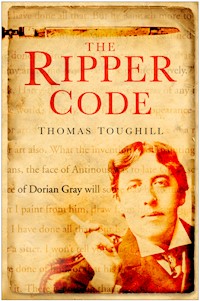
Was Jack the Ripper an artist called Frank Miles? Toughill suggests that this former 'friend' of Oscar Wilde was indeed the killer, and that Wilde dropped hints about this in several of his works, most notably The Picture of Dorian Gray, which Wilde wrote in 1889, the year after the Ripper murders took place. In fascinating detail, the author argues that Wilde's story, that of a privileged man whose life of vice in the East End of London turns him into a murderer, is in fact a coded message about the Ripper's identity. However, The Ripper Code is not just a fascinating voyage through the writings of Oscar Wilde and others. It is also a striking example of original detective work. Here, as in his previous books, Toughill unveils stunning evidence from a hitherto untapped source and uses it to devastating effect in arguing his case. The result is a book which is as original as it is enthralling.
Das E-Book können Sie in Legimi-Apps oder einer beliebigen App lesen, die das folgende Format unterstützen:
Veröffentlichungsjahr: 2012
Ähnliche


















THE
RIPPER
CODE
THE
RIPPER
CODE
THOMAS TOUGHILL
First published 2008 This edition published 2009
The History Press The Mill, Brimscombe Port Stroud, Gloucestershire, GL5 2QGwww.thehistorypress.co.uk
This ebook edition first published in 2012
All rights reserved
© Thomas Toughill, 2008, 2009, 2012
The right of Thomas Toughill, to be identified as the Author of this work has been asserted in accordance with the Copyrights, Designs and Patents Act 1988.
This ebook is copyright material and must not be copied, reproduced, transferred, distributed, leased, licensed or publicly performed or used in any way except as specifically permitted in writing by the publishers, as allowed under the terms and conditions under which it was purchased or as strictly permitted by applicable copyright law. Any unauthorised distribution or use of this text may be a direct infringement of the author’s and publisher’s rights, and those responsible may be liable in law accordingly.
EPUB ISBN 978 0 7524 8717 5
MOBI ISBN 978 0 7524 8716 8
Original typesetting by The History Press
‘Lover and friend has thou put from me and mine acquaintance into darkness.’
An extract from the 88th Psalm quoted on the frontispiece of that most famous of books on the Ripper murders, The Lodger, by Marie Belloc Lowndes, a confidante of Oscar Wilde.
‘Wilde told me how he had saved (Frank) Miles’s bacon but never referred to him again.’
A statement attributed to Robert Sherard, Oscar Wilde’s intimate friend and biographer.
CONTENTS
Acknowledgements
Foreword by Robin Odell
THE SETTING
THE MURDERS
THE EVIDENCE
THE SUSPECTS
THE QUEST
Notes
Select Bibliography
ACKNOWLEDGEMENTS
I owe a special debt of gratitude to Robin Odell and Non for the help and encouragement they have given me in this project. My thanks go also to Colin Wilson for his support and enthusiasm.
I am grateful to the following people who have assisted me in my research over the years: Graeme C. Hall, Archivist of the Oxford Union; Jennifer Thorp, Archivist of New College, Oxford; Dr Robin Darwall-Smith, Archivist, Magdalen College, Oxford; Claire Hopkins, Archivist, Trinity College, Oxford; Marcus Risdell of the Garrick Club; Mrs Hatfield, Archivist of Eton College; John Bidwell of the William Andrews Clark Memorial Library, University of California; Paul Davidson, Works of Art Department, Philips of Bond Street; Robert Bowman of Sotheby’s; J.S. Williams, Archivist, City of Bristol; Ronald Parkinson, Assistant of Paintings, Victoria & Albert Museum; Paul Goldman, Research Assistant, The British Museum; J.P. Filedt Kok, Curator of Prints, Rijks Museum, Amsterdam; P.K. Escreet, Keeper of Special Collections, Glasgow University Library; Camilla Vignoles, Information Department, Tate Gallery; David Clarke, Department of Fine Arts, University of Hong Kong; Clarissa Schoening Morrison, University of Victoria, British Columbia; Sheila Cooke of the Local Studies Library, Nottingham; and Ralph Gee, Chief Librarian, Evening Post, Nottingham.
I wish to express my gratitude to the staff of the following: the Oxfordshire Record Office; the Nottinghamshire County Record Office; the Public Record Office; the British Library; the Greater London Record Office and History Library; the Royal Academy of Arts; the Printmakers Council; the Mitchell Library, Glasgow; and the Department of English Literature, University of Glasgow.
PAPERBACK EDITION
I would like to thank the following who helped me in the writing of this paperback edition: Graeme C. Hall, Archivist, the Oxford Union; Mrs Elizabeth Boardman, Archivist, Brasenose College, Oxford; Geoffrey Bourne-Taylor, Secretary, Apollo University Lodge no 357, Oxford; Emma Butterfield, Picture Librarian, National Portrait Gallery; Philip Rood, Media Relations Manager, VT Group PLC; P. Hatfield, Eton College; and Hugh McCormick, President, Vincent’s Club, Oxford.
Once again, I owe a special debt to Robin Odell and Non. Robin’s generosity of spirit and gentlemanly behaviour are rare commodities indeed.
LIST OF PLATES
FOREWORD
This book is the culmination of a project that has evolved and taken shape over two decades. Thomas Toughill first mentioned his ideas to me in the late 1980s and he has been content to let them mature while he acquired further components for his intriguing matrix.
In the intervening years, he has done many things; served as a Special Branch police officer, taught history and written other books. Like any good researcher, he has frequented libraries, archives and hunted down all manner of sources to garner information and supporting detail. The Ripper Code, therefore, is not a hurriedly written account intended to capitalise on sensational claims. It is a considered, thoughtful thesis which the author presents to his readers. And it has been worth the wait.
Many books about the Ripper have appeared during this interlude, some airing new suspects, others presenting familiar names in a different guise. A few authors have even aspired to claims of finality with variations on the theme that their theories have allowed the ‘case to be closed’. Such claims lack substantiation, but hyperbole has been a strong theme in the history of Ripper literature. Fortunately, this has been balanced to some extent by reliable works of reference which have established a respectable corpus of knowledge and a basis for future research.
Thomas Toughill makes no exaggerated claims for his views; he writes only of having undertaken a quest. He takes a refreshing look at the murders themselves, examining new angles and perspectives and analysing the way events have been interpreted. There is none of the tired old re-hashing of overcooked theories and fiction posing as something more substantial. Of course, he retells the story of the crimes as they unfolded but in a way that establishes them as necessary coordinates for the reader. He avoids any temptation, so prevalent in books on this subject, to swamp the reader with detail.
He takes a new look at some of the touchstones of the Ripper story such as Sir Melville Macnaghten’s notes, the murderer’s modus operandi and police politics. There are also insights into the nineteenth century world of art and literature which dovetail into his thesis. The author gives the reader sufficient information with which to navigate, while moving the narrative forward in a measured fashion towards its conclusion. This is a skill drawn partly from his background as an historian but also from his instinct as a writer seeking to engage with his reader. As a result, The Ripper Code contains no contrived persuasion and no attempts to seduce with shrill, overblown arguments. The style is robust, measured and engagingly matter-of-fact.
Thomas Toughill has constructed a beguiling matrix into which he places the individual he believes to have been Jack the Ripper. Is it the end of the quest to identify the killer whose name has eluded legions of theorists for over a hundred years? Only the reader can judge, but the journey of discovery is certainly worthwhile.
Robin Odell Author of Ripperology: A Study of the World’s First Serial Killer and a Literary Phenomenon.
THE SETTING
. . . No one who was living in London that autumn will forget the terror created by these murders. Even now I can recall the foggy evenings, and hear again the raucous cries of the newspaper boys: ‘Another horrible murder, murder, mutilation, Whitechapel!’ Such was the burden of their ghastly song; and, when the double murder of 30th September took place the exasperation of the public at the non-discovery of the perpetrator knew no bounds, and no servant-maid deemed her life safe if she ventured out to post a letter after ten o’clock at night. And yet this panic was quite unreasonable. The victims, without exception, belonged to the lowest dregs of female humanity, who avoid the police and exercise every ingenuity in order to remain in the darkest corners of the most deserted alleys.
This is how Melville Leslie Macnaghten recalled the autumn of 1888 when Jack the Ripper, the most infamous and mysterious murderer in British history, carried out his brief but terrible vendetta against the female sex. Near panic there certainly was. ‘Horror ran through the land’, proclaimed one contemporary account. Yet in that year, Macnaghten, who as a senior Metropolitan Police officer was destined to play a major role in the Ripper case, lived in Chelsea in the West End of London, some six safe miles from Whitechapel, the squalid slum-ridden area the murderer chose as his hunting ground.
Whitechapel, named after the parish church of St Mary Matfellon which was painted white in the Middle Ages, stands to the east of the ancient City of London. Traditionally a home for hard working emigrants, the district prospered for many years under foreign influence and industry. When the Jews were allowed to re-enter England by Oliver Cromwell in the 1650s, after a ban of several centuries, many of them settled there, as did later the exiled Huguenots, the skilled and well-educated French Protestants. Over the years many of the people who came to Britain to enjoy its religious and political tolerance took up residence in Whitechapel, thus giving the area a strong cosmopolitan appearance. However, the industrial revolution and the immense growth in the population of London in the early nineteenth century had a profound and lasting effect on the district. By the 1880s, the once proud name of Whitechapel had long become a byword for poverty, disease, prostitution, and crime. It was, according to local clergyman, Samuel Barnett, ‘the evil square mile’, inhabited by, in the words of writer Jack London, ‘the people of the abyss.’
When Mrs Barnett moved with her husband to St Jude’s, Whitechapel in 1873, she had difficulty in believing what she found there; a dark crowded maze of filthy evil-smelling alleys and courts; an environment so unhealthy that more than half the local children died before their fifth birthday; a district so deprived that over a third of the population was classed as living in poverty or want and where great numbers of women were forced to sell themselves openly for a few pence or a loaf of bread; an atmosphere so denuded of hope that drink represented for many the only escape from an unbearable reality, and senseless violence accepted as a part of daily life; and an area so dangerous and crime-ridden that the police routinely patrolled it in pairs.
At the bottom of the heap were ‘the dossers’, the homeless who were forced to sleep rough in the streets, churchyards, or parks, unless they had the 4d it cost to hire a bed for the night in one of the 233 common lodging houses in the area. Jack London observed a group of these down and outs in Christchurch Garden, otherwise known as ‘Itchy Park’:
A chill raw wind was blowing, and these creatures huddled there in their rags, sleeping for the most part, or trying to sleep. Here were a dozen women, ranging in age from twenty years to seventy. Next a babe, possibly of nine months, lying asleep, flat on the hard bench, with neither pillow nor covering, nor with anyone looking after it. Next half-a-dozen men, sleeping bolt upright or leaning against one another in their sleep. In one place a family group, a child asleep in its sleeping mother’s arms, and the husband (or male mate) clumsily mending a dilapidated shoe. On another bench a woman trimming the frayed strips of her rags with a knife, and another woman, with thread and needle sewing up rents. Adjoining, a man holding a sleeping woman in his arms. Farther on, a man, his clothing caked with gutter mud, asleep, with head in the lap of a woman, not more than twenty five years old, and also asleep.
It was from women of this class that the Ripper selected his victims. Why he restricted himself to Whitechapel is not known. In 1888 there were several other parts of London where low class prostitutes were to be had, but the Ripper chose not to operate there, perhaps because, as one newspaper said, Whitechapel provided favourable opportunities for ‘both perpetration and escape’.
If the murders were restricted to the East End, the fear they engendered was not, as Melville Macnaghten makes clear. In fact, the Ripper scare extended well beyond the West End of London and indeed the shores of the United Kingdom. Stories spread that the Ripper had moved to America or the Continent. The reason for all of this was the unprecedented nature of the case itself. The murder of five East End whores was in itself a matter of little public concern; after all violent death in that area was almost commonplace. The Ripper killings however represented a new and, to contemporary minds, a deeply disturbing form of murder. Killing for revenge or gain was one thing, but that a man should kill prostitutes for the opportunity to cut open their bodies, tear out their innards and run off with ‘certain parts of their anatomy’ was something which the Victorian mind could not easily grasp.
In short, the Ripper murders constituted an open, and almost certainly deliberate, challenge to the solidity and hypocrisy of Victorian society. The Ripper did not try to conceal his victims; on the contrary he left them butchered in a public place for all the world to see. True, he killed his last victim in a room, but only because the streets had become too dangerous for him to work in. And by way of compensation, he used the privacy to indulge his satanic urges to the full and leave the woman barely recognisable as a human being.
In a sense, the Ripper is reminiscent of Sawney Bean, the fifteenth century Scottish cannibal who lived with his incestuous family in a cave from which they emerged to rob, kill, and eventually eat anyone unfortunate enough to pass by. When these crimes were uncovered (because one would-be victim escaped) the whole of Scotland was so shocked that the King himself led the hunt which culminated in Bean’s arrest and execution. Closer to the Ripper in time and character is Jean Lacenaire, the early nineteenth-century French murderer. He was not a serial killer; in fact he was a rather unsuccessful petty criminal. But, as he made clear in his Memoirs which he wrote while awaiting execution, he was a loner and a rebel who regarded his activities as a calculated assault on the society which produced him and which he had grown to hate. There is of course one important difference between Lacenaire and the Ripper; the Frenchman was caught, whereas the Ripper was not. His name remains a mystery, hence the need for this book.
Over the years a great deal has been written about the identity of Jack the Ripper. However, as shall be seen, practically all of it can be safely dismissed. Moreover, many, if not most, students of the case seem to believe that the Ripper was a deranged East Ender, a man who lived his life in obscurity, save for his brief notoriety in the autumn of 1888.
The fact remains though that the prime suspect in the Ripper files is a Montague John Druitt, an Oxford educated barrister, who had attended Winchester, one of the most exclusive Public schools in England. What makes this particularly meaningful, given the rigid class structure of Victorian England, is that the police officer who accused Druitt was Melville Macnaghten, himself an Old Etonion.
At first glance, it appears that Macnaghten snatched Druitt’s name out of the ether. There is no known police file on Druitt, who committed suicide in early December 1888, and no other police officer refers to him. However, it is clear that Macnaghten must have had a very good reason for listing Druitt as his prime suspect and in particular for including the following sentence in an official document which was meant for the eyes of his political masters:
(Druitt) was sexually insane and from private information I have little doubt but that his own family believed him to have been the murderer.
If Macnaghten’s report, which has become known as the ‘Macnaghten Memorandum’, is the most important document in the Ripper files, then that sentence is the most important in the memorandum itself. What exactly did Macnaghten mean by ‘sexually insane’ and who was the source of his ‘private information’? The way forward in this case is to answer these questions, for therein lies the path to the Ripper’s identity, be that Druitt or someone else.
That Macnaghten should accuse another Public schoolboy is not as surprising as it at first seems. If the Ripper was a ‘new’ type of murderer, one who had the imagination and the sheer gall to use murder as a means of avenging himself on society, then it is indeed likely that he was an educated man from a privileged background who knew the East End well from his frequent visits there (probably in disguise) in pursuit of sex and drugs.
The logic here is the Ripper murders stemmed from the corrupting power of vice, the unrestrained pursuit of physical pleasure and carnal gratification by someone from an Establishment background who, as a result of the gross inequalities in Victorian society, was able to find what he craved easily, cheaply, and anonymously in the brothels, opium dens and slums of the East End. The Ripper then, far from being a deranged local, is more likely to have been a ‘toff’ from outside, a man who regarded Whitechapel as his hunting ground, for that, in another form, is what the district had been to him before his addiction pushed him into madness.
The Ripper killings must be seen in their proper historical context if they are to be understood. Here, it is necessary to mention the Cleveland Street Scandal of 1889, the year after the Ripper struck. In that year, the police learned that certain upper class gentlemen, aristocrats, politicians and the like, were frequenting a house in London’s Cleveland Street for the purpose of having sex with low class rent boys. The police though were apparently prevented by the government from arresting the guilty parties, the most prominent of whom were allowed to leave the country. Indeed the only person to receive a lengthy prison sentence was a journalist who tried to bring out the truth about the case only to be punished for his efforts with 12 months’ imprisonment for criminal libel. Recently released government files indicate that the reason for the cover up in this scandal was the involvement of Queen Victoria’s grandson, the Duke of Clarence, who was apparently named as a frequenter of the male brothel. Here was a raw display of what power and justice meant in late Victorian Britain. (Clarence has been named as a Ripper suspect himself. The charge is absurd, but, given the argument presented here, it is important to note that the accusation was made.)
When Oscar Wilde published the first edition of his only novel, The Picture of Dorian Gray in 1890, he was savaged in the press for producing a book which was suitable for ‘none but outlawed noblemen and perverted telegraph boys’, a clear reference to the Cleveland Street Scandal, in which many believed Wilde had been involved, although no evidence to that effect has ever been found.
The press though did have a point. Dorian Gray’s relationship with his friends and the general atmosphere of decadence which pervades the novel are strongly redolent of the Cleveland Street Scandal. It is surprising therefore that, until now, no one has studied The Picture of Dorian Gray more deeply and seen the similarities therein with another case which had shocked Victorian Britain much more profoundly, the Ripper murders.
Central to the theory put forward here is the claim that the Ripper murders inspired Wilde’s novel which is essentially the story of a wealthy man whose life of vice in the stews of the East End turns him into a murderer. Naturally, there is no suggestion whatsoever that Wilde had anything to do with the murders themselves, merely that he came to learn that the killer was a former lover of his and that he dropped clear hints about this in his novel. In addition, this author suggests that, as appears to have happened in the Cleveland Street Scandal, the truth about Jack the Ripper was suppressed in order to protect a member of the Royal family.
As for Montague John Druitt, this author has carried out original research which enables him to provide convincing answers to the vital questions cited above. Simply put, these are that Oscar Wilde, who spent two years at Oxford with Druitt, was one source of Macnaghten’s ‘private information’ and that by ‘sexually insane’, a phrase Wilde used to describe the urges which led to his own imprisonment in 1895 for gross indecency with young men, Macnaghten, quoting medical opinion, meant that Druitt was a vice-driven 'boy-worshipper.' Druitt, it is now clear, was the sort of man who would have been involved in the Cleveland Street Scandal, had he still been alive, which would explain why he worked not just as a barrister, but as a teacher in a boarding school for boys, and why one of his legal colleagues, a solicitor called Edward Henslow Bedford, played a leading role in securing the prosecution of the journalist who tried to reveal the truth about the case.
However, Druitt was not, it seems, the Ripper. As will be argued in due course, that mantle belongs to another vice-driven ‘friend’ of Oscar Wilde, which returns us full circle to Melville Macnaghten for, if the following theory is correct, he and Jack the Ripper lived in the same street.
THE MURDERS
PRELUDE
‘Now the Whitechapel murderer had five victims and five victims only.’ So wrote Sir Melville Macnaghten, who joined the Metropolitan Police as an Assistant Chief Constable in 1889, several months after the last of those murders, that of Mary Jane Kelly, which took place on 9 November 1888. Not all students of the Ripper case agree with this figure. Some, like Dr Forbes Winslow, an amateur detective who played an active role in the hunt for the killer, have suggested that the first murder took place not in the second half of 1888 but on 26 December 1887.
This victim is unidentified other than by the fanciful name ‘Fairy Fay’. In listing the Ripper killings, The Scotsman said on 10 November 1888, ‘Last Christmas week, an unknown woman found murdered near Osborne and Wentworth Street, Whitechapel.’ According to Tom Cullen in his The Crimes and Times of Jack the Ripper, ‘“Fairy Fay” lost her life as a result of a wrong decision; she decided to take a short cut home when the pub in Mitre Square where she had been drinking all evening closed after midnight, and in the dim warrens behind Commercial Road she was struck down and carved up by an unknown assassin.’
A contemporary broadsheet entitled An Account of the Fearful Atrocities contains some details on this killing:
The first of this series of horrible murders which are believed to be the work of the same man, was committed so far back as last Christmas, when the body of a woman was found with a stick or iron instrument thrust into her body. In this case the woman was never identified and no particular sensation was caused, the death being generally assumed to be the result of a drunken freak on the part of the nameless ruffians who swarm about Whitechapel.
The killing of Emma Smith, a common prostitute, on 3 April 1888 must be dismissed as a Ripper murder. Smith was taken alive to the London Hospital where she stated before expiring that she had been attacked by four men. Moreover no attempt had been made to cut her throat, the Ripper’s hallmark. She died in fact from peritonitis which developed as a result of having a foreign object, not a knife, rammed into her vagina.
Martha Turner (or Tabrams), a married prostitute, is unlikely to have been a victim of the Ripper. Turner’s body, which was found on a staircase in George Yard Buildings at 3 a.m. on Tuesday 7 August, had not been mutilated, another of the Ripper’s hallmarks, and, as in the Smith case, her throat had not been cut. Her body had been pierced thirty-nine times, probably by a bayonet, and possibly, according to the examining doctor, by two weapons, a theory which is the foundation of the belief that the Ripper was ambidextrous. Turner had been seen earlier that night in the company of two soldiers and another prostitute. Macnaghten was emphatic about what ensued. ‘These men were arrested, but the second prostitute failed, or refused, to identify, and the soldiers were accordingly discharged.’ The inquest into Turner’s death, which opened on 10 August, returned a verdict of murder against a person or persons unknown.
Commenting on the above three crimes, Colin Wilson, who has probably had more to say about the Ripper case than any other writer, finds it worth noting that ‘the murders of ‘Fairy Fay’, Emma Smith, and Martha Turner occurred on holidays – Boxing Day, Easter Monday and August Bank Holiday, when many murders took place in London.’ If then these killings were not the work of the Ripper – and for want of evidence, that of ‘Fairy Fay’ must remain an open question – they at least set the scene for the terror that was to engulf the East End of London in the autumn of 1888.
MARY ANN NICHOLS
Mary Ann, or Polly, Nichols was a typical Whitechapel whore, a gin-sodden derelict who routinely sold her body in any convenient staircase, alley or court for the price of a night’s lodging. At the age of 42 in 1888, she stood 5ft 2in tall and had most of her front teeth missing. She had been married for over twenty years and had five children, but she was separated from her family. Her husband, William Nichols, a printer’s machinist, had got fed up with her drinking habits and left her eight years before, taking the children with him. He initially made financial provision for his estranged wife, but discontinued this when he found out that she had taken to prostitution. For several years Nichols drifted from one London workhouse to another. In early 1888, she was staying in the Lambeth Workhouse in south London. She took a job as a servant in a house on Wordsworth Common, but any hopes she may have had of finding long term security there vanished when, after only a few months, she was dismissed for stealing £3, apparently to buy drink. After this she slipped back to the stews of Whitechapel where by August she was sharing a room with three women in a common lodging house at No. 18 Thrawl Street.
Nichols was last seen alive by a friend, Emily Holland, who bumped into her at 2.30 a.m. on Friday 31 August at the corner of Osborne Street and Whitechapel Road. Holland was sure of the time because as she spoke to Nichols, the clock of the Whitechapel Church struck. Nichols was the worse for drink and penniless. She declared that she had had her lodging money three times that day and spent it. Holland wanted her to come back with him, but she declined and headed off towards Whitechapel. As she did so she said, ‘It won’t be long before I’ll be back. See what a jolly bonnet I’ve got now,’ implying that this adornment would help her find custom. Unfortunately for her, it did.
Bucks Row was a better than average East End street. It was a fairly wide thoroughfare with a warehouse on one side and on the other a row of terraced houses which were occupied for the most part by relatively well off tradesmen. It was however badly lit, with only one gas lamp servicing the whole street. Between the house and a board school there was a closed gateway to some stables. Some time within an hour of leaving her friend, Nichols picked up a man and went with him to this suitably dark and secluded spot to earn the 4d she needed for her lodging.
Nichols’ body was discovered between 3.30 a.m. and 3.45 a.m. by Charles Cross, a market porter, on his way to work. So bad was the lighting that he at first mistook her crumpled form for a piece of tarpaulin which had fallen from a cart. On discovering that this was a woman, he sought assistance from another porter, John Paul, who happened to pass by at that moment. The two men argued over what to do, and eventually concluded that the woman had been raped and that she may still be alive. After pulling down her disarranged clothing, they set off in search of a policeman.
A few moments after the porters left the scene, PC Neil of J Division came across Nichols’ supine body and with the aid of his lamp saw immediately what Cross and Paul had missed – the woman’s throat had been cut from ear to ear. He also saw that, disturbingly, her eyes were wide open. Her bonnet lay close to her left hand. Neil felt her arms and found them quite warm from the joints up. Seeing another constable pass in the next street, Neil called him over and asked him to summon Dr Llewellyn, the police surgeon, who lived nearby. The doctor arrived within a quarter of an hour and after a cursory examination, pronounced Nichols dead and gave instructions for her body to be taken to the mortuary.
Nichols’ clothes had soaked up most of the blood which had leaked from her wounds, but a little had drained onto the ground. This was promptly washed away with a bucket of water and by daylight the only signs of where the murder had taken place were faint dark stains between the paving stones.
Mortuary is too grand a word for the place to which Nichols’ body, in its official iron shell, was taken. Described by The Daily Telegraph as ‘a disgraceful hole and corner hovel’ which provided surgeons ‘with the most incomplete appliances for carrying out their delicate and difficult duty’, it was simply a shed behind the Old Montague Street workhouse. Nichols’ body lay in the yard outside this shed until the two workhouse inmates, Robert Mann and James Hatfield, had their breakfast. Then and only then did the undressing and washing of the corpse take place. It is not clear whether this was started under police supervision, as should have been the case, but around 7 a.m. Inspector Spratling, who was taking an inventory of Nichols’ clothing, lifted up the woman’s skirt and made the shocking discovery that this was no ordinary murder. Nichols' stomach had been ripped open.
On being called to the mortuary in the wake of this news, Dr Llewellyn immediately carried out a full post-mortem, or at least as full as was possible given the lack of facilities and equipment. His findings, which he gave in evidence at the inquest into Nichols’ death, are reproduced below. It was this testimony which gave birth to two contentious points about the Ripper – whether he was left-handed and whether he possessed any anatomical knowledge:
On the right side of the face there was a recent and strongly marked bruise . . . caused by a blow from a fist or the pressure of a thumb. On the left side a circular bruise might have been produced by the pressure of the fingers. There were two cuts in the throat, one four inches long, the other eight. The large vessels of the neck on both sides were severed. The incisions also completely severed all the tissues down to the vertebrae which had also been penetrated . . . There were several incisions running across the abdomen. On the right side there were also three or four similar cuts running downwards. . . As far as the throat is concerned the weapon appeared to have been held in the left hand of the person who used it. Similarly the wounds in the abdomen ran from left to right and might have been done by a left handed person. The murderer must also have had some rough anatomical knowledge. He seems to have attacked all the vital parts. . . I would say that the murder might have occupied four or five minutes.
As for the weapon itself, the doctor reckoned that it was stout-backed and pointed, like a cork cutter’s or cobbler’s, with a blade six to eight inches long.
The police had initial difficulty in identifying the body, the only clue being the mark of the Lambeth workhouse on Nichols’ petticoats. The matron of the workhouse though failed to recognise either the body or the clothes. However as word of the murder spread, some occupants of Nichols’ lodging house came forward. Their identification of the body was corroborated by an inmate of the Lambeth workhouse some days later and formally at the inquest by Nichols’ father, Edward Walker, a smith from Camberwell. He recognised his daughter by a missing tooth and a mark on her forehead. He produced a letter which she had sent to him the previous Easter from Wandsworth where she was working as a servant. This read, ‘You will be glad to know I am settled in a new place. My people went out yesterday and have not returned, so I am left in charge. They are teetotallers and are very nice people and I have not much to do.’ Walker conceded that his daughter was fond of drink but maintained that her only fault was that she was too good to others and not to herself. Her husband did not agree; while staring down at her in her coffin, he is said to have melodramatically forgiven her for the life she had led him.
In 1888 there was no proper coroner’s court in the East End of London and inquests were usually held in any suitable location that was available, which in practice usually meant a public house. However the committee of the Working Lads’ Institute, displaying a fine sense of the historical moment, offered the use of their premises in Whitechapel Road and it was there on Saturday 1 September that the inquest into the death of Mary Nichols began, presided over by Mr Wynne Baxter, the Coroner for the South Eastern Division of Middlesex County.
Wynne Baxter was destined to play a major role in the Ripper case, not as a sleuth but as a penetrating critic of police methods and official attitudes towards the East End. He handled the first three Ripper inquests which fell within the Metropolitan area and by rights he should have been responsible for the fourth and last. But as shall be seen, it would appear that the authorities, smarting from his earlier comments, thought otherwise.
Baxter started as he intended to continue. He clearly disbelieved the police account of the treatment of Nichols’ body in the mortuary and closely questioned the attendants, Mann and Hatfield, with a view to revealing discrepancies between the two versions:




