


7,19 €
Mehr erfahren.
- Herausgeber: New Island
- Kategorie: Sachliteratur, Reportagen, Biografien
- Sprache: Englisch
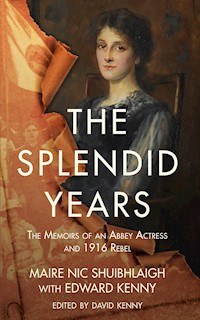
Maire Nic Shiubhlaigh was a founder actress of the Abbey Theatre and its first leading lady on its opening in 1904, when she played the title role in W. B. Yeats's Kathleen Ni Houlihan. On that night, five members of her family were acting and working in the theatre. Her beauty and talent captivated audiences and critics at home and abroad. Portrait artists queued up to paint her. Revolutionaries and poets wrote plays for her. The Pearse brothers, AE, Countess Markievicz, Maud Gonne, J. M. Synge and John B. Yeats counted among her admirers. The Splendid Years – with a foreword by Padraic Colum – is Maire's first-hand account of some of the momentous events that shaped Irish history: including the establishment of the Abbey Theatre and her role as leader of the Cumann na mBan 'girls' in Jacob's Biscuit Factory during the Rising. Withdrawn from print just weeks after its initial publication in the 1950s, the story of this remarkable and inspiring Irishwoman is available again, with new and never-before-seen material. Here we have Pearse imitating Yeats onstage; J. M. Synge rolling cigarettes for his actors; Maire's aged father printing the War News in 1916; her marriage to Major General Bob Price, and a lost portion of her story, detailing her childhood in Carlow before her rebellious, Parnellite family was run out of town by the clergy.
Das E-Book können Sie in Legimi-Apps oder einer beliebigen App lesen, die das folgende Format unterstützen:
Veröffentlichungsjahr: 2016
Ähnliche

















The Splendid Years
The Splendid Years
The Memoirs of an Abbey Actress and 1916 Rebel
Maire Nic Shiubhlaigh with Edward Kenny
Edited By David Kenny
THE SPLENDID YEARS
First published in 1955 by James Duffy.
This edition published in 2016 by
New Island Books 16 Priory Hall Office Park Stillorgan County Dublin Republic of Ireland.
www.newisland.ie
Copyright © David Kenny, 2016.
David Kenny has asserted his moral rights.
PRINT ISBN: 978-1-84840-509-7
EPUB ISBN: 978-1-84840-510-3
MOBI ISBN: 978-1-84840-511-0
All rights reserved. The material in this publication is protected by copyright law. Except as may be permitted by law, no part of the material may be reproduced (including by storage in a retrieval system) or transmitted in any form or by any means; adapted; rented or lent without the written permission of the copyright owner.
British Library Cataloguing Data.
A CIP catalogue record for this book is available from the British Library.
In memory of my father,
Edward ‘Ted’ Kenny,
and my friend Paul Drury.
The two greatest journalists I have known.
– D.K. (2016)
‘I have squandered the splendid years that the Lord God gave to my youth … Lord, if I had the years, I would squander them over again.’
— ‘The Fool’, P. H. Pearse
Contents
Introduction by David Kenny
Foreword by Padraic Colum
Preface by Edward Kenny
PART ONE – THE IRISH NATIONAL THEATRE SOCIETY
Chapter One: 1900–1901, The Curtain Stirs
Chapter Two: 1901–1902, Enter Kathleen, Stage Left
Chapter Three: 1902–1903 ‘The Sowing of the Seed’
Chapter Four: 1903, Beyond the Pale with Synge
Chapter Five: 1903–1904, Annie Horniman
Chapter Six: 1904–1905, The Abbey Opens
Chapter Seven: 1905, Farewell to Camden Street
Chapter Eight: 1905–1906, Walking out of the Abbey
PART TWO – THE THEATRE OF IRELAND
Chapter Nine: 1906, A New Beginning
Chapter Ten: 1907, The Playboy
Chapter Eleven: 1908, Fays Depart, and the Cracks Appear
Chapter Twelve: 1909–1910, Gipsy and the Countess
PART THREE – THE ABBEY IN AMERICA
Chapter Thirteen: 1911, The Western World Goes Wild for Playboy
Chapter Fourteen: 1911, Roosevelt to the Rescue
Chapter Fifteen: 1912, Under Arrest in Philadelphia
PART FOUR – THE RISING
Chapter Sixteen: 1912–1913, Setting the Stage for Pearse’s Passion Play
Chapter Seventeen: 1914–1915, The Irish Theatre, Tom MacDonagh and Joe Plunkett
Chapter Eighteen: 1916, The Eve of the Rising at the Ceannt Household
Chapter Nineteen: Inside the Jacob’s Garrison
APPENDICES
Appendix I: The Irish Literary Theatre
Appendix II: W. G. Fay’s Irish National Dramatic Company
Appendix III: Two Opinions of the Camden Street Theatre
Appendix IV: London Visit, May 1903
Appendix V: The Abbey Theatre
Appendix VI: Irish National Theatre Society Productions, 1902–1905, at The Antient Concert Rooms, Dublin
Appendix VII: Theatre of Ireland Productions, 1906–1912
Appendix VIII: ‘Irish Theatre’ Productions, 1914–1916
Acknowledgements
Introduction
by David Kenny
I
THE FOLLOWING is a story about the Abbey and Yeats that has never been told before.
It’s a cold, crisp December afternoon in the fourth year of the new century, and the curtain has just fallen on Kathleen Ni Houlihan (not literally). Yeats’s silver mane trails like a will-o’-the-wisp up the aisle towards the bar area. A member of the Walker/Nic Shiubhlaigh family spots him and points him out to his companion. ‘Get up there and say hello,’ the companion orders. ‘He’ll be glad to meet you.’
The Yeats who is being observed is Michael Yeats—son of W. B.—and the Walker is me. My mother, Gráinne Kenny, in between rib-nudges, has pointed out that Yeats and I are the only two people at the centenary celebrations who have blood ties to the founding of the Abbey Theatre. Five members of my father’s family were either on the stage or working behind the scenes on its opening night in 1904. My grand-aunt, Maire Nic Shiubhlaigh, was the first leading lady, playing Kathleen; grand-uncle Frank was the young man in On Baile’s Strand; great-grandmother Mary Anne was the wardrobe mistress; and my grandmother ‘Gipsy’ and grand-aunt Annie were selling programmes. The latter were also actresses, appearing under the names ‘Betty King’ and ‘Eileen O’Doherty’.
It is entirely probable too that my great grandfather, Matthew, printed the bills and programmes. He was a master printer and had his own publishing company, the Tower Press. He also printed the War News for Pearse and the 1917 edition of the Proclamation.
Michael Yeats only had his father there on the opening night, so I outnumbered him in terms of ghosts of thespians past. I tried to focus on this utterly ridiculous piece of logic as I nervously followed him through the bar, past the John B. Yeats portrait of my grandaunt … and into the gents.
I waited by the door, my cheeks glowing redder than a Sellafield fish. I have never been in the habit of hanging around toilet doors. I collared Mr Yeats as he left. He was in his eighties and the spitting image of his father, whose poetry I have always loved. I said something along the lines of: ‘Mr Yeats … portrait … bar area … grand-aunt … mumble … mumble.’
He stared at me, relatively benignly for a man being accosted in a public toilet.
‘I beg your pardon?’
I composed myself, remembering that, according to my dad, John B. Yeats was in love with Maire and had proposed to her with the words: ‘How would you like to be the stepmother of an internationally famous poet?’ I made a mental note not to repeat those uncorroborated words to Michael Yeats.
‘Your grandad, John B. Yeats, was very good friends with my grand-aunt, Maire Nic Shiubhlaigh.’
If octogenarian eyes can dance, his did a rumba.
‘Maire was your grand-aunt? Beautiful woman. I have a sketch of her in my hallway at home in Dalkey.’
I couldn’t have been more nervous if I had been speaking to Willie Yeats himself. My brain crashed, and I heard myself saying: ‘I live in Dalkey too.’
His subsequent look reflected the idiocy of this pointless statement. He must have felt sorry for me, as he ignored it and continued.
‘Maire and my father had a dreadful row,’ he said. I was stunned. History concertinaed. Here was Yeats’s son describing the schism at the heart of the Abbey in 1905 over professionalism versus patriotism that led to my grand-aunt walking out, with several other leading players. It wasn’t just a ‘row’: it rocked the Abbey to its foundations, and led to the founding of the Theatre of Ireland with MacDonagh and Plunkett among other 1916 notables. Again, I was stuck for words.
‘Oh well,’ I stammered, ‘that’s water under the bridge now.’
Before he had time to reflect on the astonishing banality of this comment, the toilet door was thrown open by a large rustic gentleman in desperate need of the loo. In my memory’s half-blind eye I can see Michael Yeats being flung across the floor by the force of the blow.
He wasn’t of course, but it seemed like a natural end to our conversation. As he rubbed his shoulder, I mumbled ‘bye’ and legged it. While I in no way advocate violence (intentional or otherwise) against the elderly, I like to think that this was Maire giving Yeats a dead arm, by proxy, from the beyond the grave.
Willie Yeats richly deserved it, certainly in the eyes of my father. He spent his entire life raging against the misconception that Yeats alone had ‘founded’ our national theatre.
The above anecdote may seem like an odd way to open an introduction to my grand-aunt’s personal recollections of the Abbey’s foundation and the fight in Jacob’s. It is certainly a bit crude, but that’s the way it happened. Life is seldom ‘neat’. The call I received from Michael Yeats a few months later was equally embarrassing. I was in work at the Herald and thought the voice on the other end of the phone was my publisher, Ed Higel, playing a trick on me. I used some choice Dublin expletives, joining in on the ‘joke’. Michael Yeats must have thought I was an utter fruitcake. Again, he was polite and told me he hadn’t any new information for me about the Abbey spat. I still cringe thinking about that call.
Both encounters illustrate, for me, how close we still are to the pivotal events in Irish history. Michael Yeats remembered the Abbey ‘split’ of 1905 as a ‘terrible row’ between his father and my grand-aunt. It was as though we were discussing a recent family spat.
History is all around us. It’s still tangible. Walk through the GPO and you are retracing the steps of Pearse and Connolly. There are still Irish people alive who were children during the Civil War. The over-forties in Ireland remember the Troubles that were brought about by the partitioning of our island—a direct result of the actions of the brave people who rose up against the British Empire between 1916 and 1922. Search your attic and you may find a letter or a medal or a mildewed souvenir kept by a dead relative. These may lead you back to the Repeal Movement or the Parnell era or the cultural revival or 1916. Talk to someone in their late seventies or eighties and you may be rewarded with childhood memories of their aunts or uncles who played a part in securing freedom for the greater part of this island.
That is how close 1916 and the War of Independence are. They are two generations, or less, away.
Michael Yeats grew up in the shadow of our greatest poet. My father, who wrote this book, grew up in the shadow of the Abbey and 1916. I grew up in the shadow of my father, knowing, in broad terms, that our family had been involved in some of the most momentous events in Irish history, and knowing also that he had written a book when he was in his late teens. The book had not been available to the wider public since 1955 because he had taken it out of print soon after its publication. He was unhappy with his publishers, James Duffy, for omissions and stylistic oversights. I also knew that Ted was working on a much bigger narrative incorporating The Splendid Years. He intended it to be an Irish Roots (Alex Haley’s book was enjoying huge success at the time).
And that is just about the sum of what I knew. Dad and I spoke, but we didn’t always communicate. I listened, but only half-listened. I was young and I loved him, but he carried his family’s sense of injustice, of being forgotten, on his shoulders all his life. This made communication about the subject with him quite difficult for me. He was a product of his upbringing: raised by his widowed mother, his 1916-veteran aunt and her husband, who was a former Director of Intelligence of the IRA.
When dad died in 1999, aged seventy-two, he took his store of family lore and memories with him — or so I believed. I thought that I would never corroborate any of the outlandish tales that managed to get through to me: the story of how one of his forebears had split with his Ascendancy family, converted and married a nun; how my great-grandad had been a firm friend of Parnell’s, and had walked the eight miles, from Glasthule, into the GPO on Easter Monday (at the age of seventy) to fight for Ireland; how his auntie Maire had co-founded the Abbey Theatre; and how much of a pretentious tosspot W. B. Yeats really was.
Twelve years after his death, I finally began sifting through his remaining papers and the mildewed ‘junk’ in his office at my mother’s house. He had given the most important papers and memorabilia to the National Library and Northwest University Illinois in 1966. What I found was considered ‘ephemera’ fifty years ago. There was an old battered sea chest stuffed with torn and bruised fragments: a masonic passport dated 1811, love letters to my granny from a dead poet, Victorian photographs taken in Vance’s on Stephen’s Green, small circular headshots of the 1916 signatories, printed samples of Pearse’s handwriting, Cuala prints….
There was a copy of a nicotine-dyed portrait of Maire as Lavarcham, painted by A.E., which hung in our sitting room when I was a child. It had spooked me and I always used to sit with my back to it while watching Zorro and Swap Shop on the black-and-white PYE TV. In my mother’s kitchen there was a blue steel tray that had been a wedding gift from an old friend of my granny’s. And, above all, there was dad’s treasured collection of dusty books, including two copies of The Splendid Years. Next to these was a signed edition of Tom Barry’s Guerilla Days in Ireland. The inscription read: ‘Major General Eamonn Price, IRA, Dublin. To Bob—my brother-in-law. As a token of friendship and as a reminder of the guerilla days when you served as one of the senior officers of the Army of the Republic. Tom Barry, Cork, 28.10.1949’.
Naturally, this grabbed my attention. I read Barry’s book before The Splendid Years, and was hooked on the period. The next book I picked up was Somewhere to the Sea by Kenneth Reddin (again, before The Splendid Years). It’s a love story set against the backdrop of the War of Independence. I nearly dropped it when Maire and Granny Gip appeared as talking characters on Bloody Sunday, and in the former’s case described as a 1916 veteran.
I wanted to know more. The fog of childhood memories condensed. I recalled our holiday home in Laytown where I spent the first ten summers of my life. On a bedroom wall there was a wedding photo showing Michael Collins as best man. In the annex there was a glass case of stuffed birds, a painted wardrobe and a pristine but ancient typewriter (said to have belonged to James Joyce). I slowly put the pieces together. Last century’s ephemera was pushing and prompting my curiosity. It was tugging at the hem of my conscience. I found a black-bordered letter addressed to Maire from a man called Rónán. He was asking her if he had ever lived up to the expectations of his mother, Áine. Was she disappointed that he had not become the man his father had been? He had cared for Áine all his life, and was clearly in a state of deep depression.
I found out who that man was, and wrote an article about him for the Irish Examiner in 2013. I’ll deviate briefly from this narrative now to share that story with you.
MAY 2013. My mother was watching us from the sink, through the steam rising from her potato pot. ‘Come in for your tea and bring my good blue tray with you.’ Her ‘good blue tray’ had been discarded and was leaning against the blackened anthracite bunker.
It was bearing up remarkably well, considering it had spent the morning being used as a sleigh. It was an expensive tray, bought as a wedding present in Switzer’s by a friend of my father’s family, the Walkers. A man named Rónán. He was a ‘sad figure’, my mother said.
I grew up surrounded by 1916 memorabilia. Not holsters or bayonets, but minutiae: buttons, photographs, books. A blue tray. History exists in both the heroic and the mundane. My dad’s family was steeped in 1916. My great-grandad, Matthew Walker, printed the Irish War News for Pearse and delivered his farewell letter to his mother. My Abbey actress grandmother (Gipsy Kenny) carried despatches for Charlie Burgess—you know him as Cathal Brugha. My grand-aunt, Maire nic Shiubhlaigh, led Cumann na mBan at Jacob’s during the Rising.
Seven years ago I was rustling through grand-aunt Maire’s papers when a letter fluttered to the floor. It was from a man who had lost his mother. It was signed, simply, ‘Rónán’. I had an inkling whom he might be, so I searched my father’s books and took down Piaras F. Mac Lochlainn’s Last Words: Letters and Statements of the Leaders Executed after the Rising at Easter 1916. I found the entry I was looking for and returned to the letter. I saw a ten-year-old boy holding a watch chain outside Kilmainham Gaol. The boy is Éamonn Ceannt’s son, Rónán. He is the man who gave us the blue tray. His mother is Áine Ceannt. Maire had spent the day before the Rising at their house.
The tragically modest tone of Rónán’s letter gives the impression of a man who feels that life has passed him by:
Maire, from time to time, for years past, I have wondered if mamy [sic] was, in a way, disappointed in me for not having shown myself to have been as fine a man as my father was.
I never had the courage to ask mamy, and she never gave me any special reason for my idea, but, yet, she may, deep down, have felt I was a bit of a failure. I’d rather know the answer to that question than be kept in ignorance, so if mamy ever spoke of the matter, will you please tell me what she said, even if it’s hard to hear? Please remember, I’m not just looking for words of praise and suchlike but just to be told the truth. Whilst I haven’t exactly got an ‘inferiority complex’, at the same time I have no great sense of my own importance, and it won’t do me any harm to know the truth.
Mamy loved my father until death parted them, and until she died she loved and honoured his memory and felt hurt when he appeared to be forgotten by those who owed him, equally with his companions, the freedom and good life which 1916 ushered in.
Therefore, it might have seemed to her that my lack of forcefulness etc. as compared with my father’s courage was a bit of a ‘let-down’, shall we say. Anyhow, tell me, if you know.
Rónán had never recovered from the death of his father. His words contrast starkly with Éamonn’s as he awaited his fate. He calmly bequeaths a watch chain to Rónán and writes that everyone is cheerful and resigned to their fates. ‘Tell Rónán to be a good boy and remember Easter 1916 forever.’
A few hours before dawn, at 2.30 a.m., Éamonn lets his emotional mask slip and writes to Áine:
Not wife but widow before these lines reach you. I am here without hope of this world […] My poor little sweetheart […] Ever my comforter […] What can I say? I die a noble death for Ireland. My sweetheart of the hawthorn hedges and Summer’s eves….
An hour later, he is blindfolded and put sitting on a soapbox before being executed. His son’s letter shows the tragic effect the executions of the 1916 leaders had on their families. Áine became an anti-Treaty ‘diehard’ during the Civil War, and suffered for it.
Rónán suffered too. Try to imagine being ten, knowing that your father is about to be shot. Try to imagine then living in the shadow of a colossus you could never hope to emulate. Ceannt’s death was no sterile ‘blood sacrifice’; it was a tragedy for his family. He was a man, not an icon. He was one of us.
As Éamonn was preparing to die, another comrade was penning his final words. Michael Mallin wrote to his baby son: ‘Joseph, my little man, be a priest if you can.’ Father Joseph is still alive today. That’s how near 1916 is.
Éamonn’s last words to his son were: ‘My little son, Rónán. Take care of your mother.’ Rónán fulfilled his father’s wishes. He never married, and looked after his mother until her death. He never realised it, but he too was a hero. He gave up his own life for the care of another. Éamonn and Rónán Ceannt showed that ordinary people are capable of extraordinary selflessness. That’s the true legacy of 1916. Revolutions are fought by ordinary people hoping to build an ordinary world.
Our Ireland needs heroes. We can draw on the memory of their courage to rebuild our country, post-Troika. We’re still the same race that produced men like Éamonn Ceannt. 1916 is only a fingernail’s breadth away. It’s in the mundane. It’s in an old letter. It’s in a tray skittering down a snow-clad garden. It’s in all of us.
II
My father must have felt the same way as Rónán to some extent. How could he ever hope to emulate the heroism of his aunt, uncle and mother? It is an extraordinary compliment to Maire that Rónán was so intimate with her, sharing his deep sense of self-doubt. Áine had been shunned, Maire had been ‘airbrushed’. They had that feeling of being forgotten in common.
I continued to look for more clues about the family with which Ted was so besotted. Every now and then I would receive emails from historians wanting to know more about Maire Nic Shiubhlaigh. I, in turn, learned snippets from these people. I didn’t put very much effort into it. As a veteran hack, I should have researched and written the family history in a matter of months, not years. Perhaps some psychologist can explain why I, and my father, dithered. Could it be something to do with not wanting to let go of the past?
The advent of 2016 finally prompted me to make my father’s corrections to The Splendid Years; to republish the book that meant so much to him as it wrote Maire back into the narrative of the Abbey’s history. Yeats had claimed the credit for founding the theatre and training the actors. In his Nobel speech he praised Sara Allgood, her acting ‘rival’, and didn’t mention Maire.
Dad would point out, on the rare occasions when we would talk about the Abbey, ‘Yeats founded the Irish Literary Theatre, which was a failure. The Fay brothers, my aunt and uncle and others, founded the national theatre. They were the visionaries who gave him bodies and voices to get his work across.’
That may sound simplistic, but the truth is that Yeats and Lady Gregory had been waiting for Irish actors to emerge and create a movement that would lead to the Abbey. Yeats and Gregory were generals without an army. The Fays and the Walkers were troops awaiting ammunition and leadership. Together they rebelled against the conventions of the day and created a new dramatic voice.
The Splendid Years recounts those early days from the perspective of Maire Nic Shiubhlaigh. It is not a biography; it is her personal recollections of two periods: the national theatre movement and 1916, as told to my father. It’s a modest account in many ways. She didn’t want to stoke up old rows, and underplays the sacrifices she and her family made for Irish nationalism.
Her personal writings in the National Library of Ireland are a little less discreet, and reveal her sense of humour. She raises the curtain just enough for us to see how she truly felt about certain individuals: poseur Yeats was horrible to her; Sara Allgood could be a bit of a monster; Pearse’s worship of Yeats was on one occasion ‘disgusting’. In The Splendid Years, however, she is kindness personified.
That is not to say that this is a PC account of a theatre’s birth and a rebellion. (How could any account of either of these things be bland?) It is far from it. It bristles and fizzes with vignettes and cameos from Joyce, Synge, Marcievicz…. Its pace and voice are contemporary. This is my father’s influence. He was a phenomenally gifted journalist.
So who was Maire Nic Shiubhlaigh?
Mary Elizabeth Walker was born on 8 May 1883 (died 9 November 1958) in Charlemont Street, Dublin, into a prominent nationalist Gaelgoiri family. Her father was Matthew Walker, who published a Parnellite paper in Carlow, the Vindicator, and was a member of the IRB. He printed the War News for Pearse in 1916 (and the 1917 version of the Proclamation, among other periodicals and seditious IRB material).
Maire started acting in her late teens and was a founder-member of the Abbey Theatre, and its first leading lady on its opening night in 1904 when she appeared as Kathleen Ni Houlihan. After splitting with the Abbey in 1905 in a row over W. B. Yeats’s move to make the theatre professional, she went on to help found the Theatre of Ireland, and led Cumann na mBan in Jacob’s in 1916.
That’s the overview. Maire did an awful lot more than that. She was always destined to do her bit for the cause of national freedom. To understand her nationalist idealism we must look at her family background, and in particular her extraordinary father, Matt.
While researching the Walker family history for this introduction, I stumbled across an old manuscript in my mother’s home. To my absolute astonishment and delight it was the skeleton of the ‘greater’ book my dad had been working on before his death. It’s called The Walkers and The Splendid Years. He was interspersing the family story with sections of Maire’s text from this book. It is unfinished, except for one part: the story of the Walkers’ life in Carlow during the last momentous period in Irish political life before the Rising: the Parnell split.
Without this, I would never have fully understood how Maire came to be such a committed nationalist. It is published here for the first time.
III
The Renegade Walkers
– by Edward Kenny
MARY ANNE WALKER was the well-dressed young matron who used to walk down Tullow Street in Carlow town in the early 1890s, performing her weekly shopping with an air that caused plenty of comment—and some hidden envy of the way she carried it off.
On these expeditions she would always be accompanied by at least two of her six children. Sometimes it would be the eldest boy, Frank, aged about thirteen, and the second boy, Charlie, both in immaculately cut sailor blouses and neat knickerbockers. Or it might be the eldest girl, Daisy, and the second girl, Maire—slender, with shoulder-length blondish hair and strange, attractive golden-brown eyes.
It was characteristic of Mary Anne that the girls were always dressed the same as her, apart from one or two minor technical differences. Their skirts would, of course, be folded elegantly five or six inches above their buttoned ankle-boots, and while Mary Anne always wore a large, well-endowed hat, they would sometimes go bare-headed or wear ribboned headgear on warm summer days.
Otherwise, their outfits would duplicate hers, down to the square-crocheted panel on their bosoms, their narrow, pinched-in waistlines, and sometimes even a knitted shawl or short cape in shiny, rustling material.
By all accounts, this weekly trip was quite a sight, moving from shop to shop behind Mary Anne, the cherries on her hat clinking defiantly when she nodded to acquaintances or tried to ignore those who pointedly passed her by. There was a constant undercurrent about these encounters. The public image she projected was of a well-organised, slightly dehumanised woman who knew what she wanted and minded her own business. On her shopping trips she seldom carried anything heavier than a pair of gloves, and she never brought her purchases home with her. The amount of food she bought was never particularly large, and it was surprising that she was never refused when she ordered that it be delivered to her door.
It would have been natural for her to avoid certain shops where the well-to-do did their business, and whose owners’ politics differed so violently from her husband’s. But she had the ability to invest everything she did with an air of elegant significance that made all her gestures, however small, seem important. When she went shopping with her little entourage, the comments would vary between ‘There’s the Dublin dressmaker from the Athy Road,’ to, more maliciously, ‘That Parnellite woman is ordering people around again.’
About five years later, when the time came for Mary Anne and her family to leave Carlow, she allowed herself the luxury of reflection as she locked up the little Walker home. One of her greatest attributes was her objectivity, and she was able to conclude, rightly, that she was leaving with a mixture of regret and relief. She had loved the town, with its heaving market days, narrow sloping streets and busy, barge-filled river. She would miss the friends she had made, but in her mind politics and Carlow would always go together. It was not so long ago that a stone had crashed through one of her upstairs windows, narrowly missing a sleeping child. She knew that old bitterness dies hard.
Essentially, Mary Anne Walker was a warm-hearted, impulsively generous woman, and the image she projected when she first went to Carlow was assumed. She called it her ‘armour’, and the fact that she felt she had to assume it was as good as any commentary on conditions in Ireland at the time, and the controversy in which she and her husband were involved.
In 1891, when Matt Walker went to Carlow with his young family, Parnell’s hitherto unassailable position as head of the Parliamentary Party was already badly eroded. His spectacular career was about to crash in even more sensational fashion. A whole era in Irish political history was ending, and the Walkers, typically, were caught up in the most unprofitable aspect of it.
Matt was an unsuccessful businessman. He was a printer, and his political affiliations had brought him back from Dublin to his native Carlow to manage an unprofitable local newspaper, the Parnellite Vindicator, at the height of the Irish Party split. The paper was new, vocal, and doomed to failure even before Matt arrived. Parnell, already involved in the O’Shea divorce suit, had not even tried to defend himself, had lost the case, and public opinion was outraged.
It was a time when past work was forgotten. Parnell’s rise to power and his extraordinary political achievements in less than ten years, and the personality and eloquence that had welded the diverse elements of the party together, dumbfounded Westminster and made Home Rule a probability. The final blow was the opposition of the Irish bishops. Its effect on a Catholic electorate ended Parnell’s chances of a return to political power. In Carlow it established Matt, Mary and their children, if not as apostates, then at least as Parnellite outsiders, which was nearly as bad.
In 1891, the biggest political controversy in decades was raging in Ireland. Carlow is a town about sixty miles from Dublin, in a region split, as everywhere was, on the Parnell issue. It would be unfair to assess its attitudes only through Mary Anne’s eyes. If the Walkers felt they were cold-shouldered by elements in the town, it was as much their own fault as anyone else’s: they were taking a rigid political stand. The effect of the Parnell–O’Shea scandal was devastating, and the bitterness that followed it was intense.
It isn’t easy at this distance in time to realise the effect produced by the divorce action without knowing the place Parnell had held in Irish minds. He was, or had been, a national idol. Someone had called him the Tribune of Ireland: the enigmatic political leader who forced his will and the Irish case on the blasé British Parliament. He had just emerged triumphantly from the Pigott forgeries scandal, making him even more popular. In London, The Times had published facsimiles of letters allegedly by Parnell condoning the murder in the Phoenix Park of the new Chief Secretary for Ireland, Lord Cavendish, and the permanent Undersecretary, Burke.
Pigott, who had forged the letters, confessed under cross-examination, escaped to Spain and shot himself. The effect on Parnell’s image was tremendous. British public opinion, outraged at the deception, swung violently in his favour. His prestige was never greater. In the Commons, his opponents had risen alongside his supporters to applaud his return after the forgeries were exposed. Into the middle of all this, the divorce petition by O’Shea, a former Parnellite, had dropped like a bomb. It certainly looked like another conspiracy, and the surprise that followed Parnell’s decision not to contest the charge threw the country into confusion. Incredibly, it seemed that he could not foresee the danger and believed that his political ability and his reputation as a leader would prevail over the moral issue. He also believed that his marriage to Kitty O’Shea after the divorce settlement would settle it once and for all.
However, outraged Catholic sensibilities, combined with the political implications of the situation after Gladstone virtually demanded Parnell’s removal, was enough to demolish his popularity irredeemably. The Irish Party split in two. The issue was swamped in a storm of recrimination, accusation and counter-accusation.
It was against this background of blind, sometimes bigoted, bickering, of disappointment and despair, that Walker and his younger brother, Ned, tried to publish a newspaper vindicating Parnell, and Mary Anne tried to rear a young family. Inevitably, the emotion that was to prevail among the Walker children was one of rigid self-sacrificial nationalism, and it was a feeling that was to persist in every member of the family for the rest of their lives.
The Vindicator, published weekly for a penny, stumbled out every Thursday, sustained by the Walkers’ hard work, the remains of the finance voted to it by the pro-Parnell elements in the Irish Party, and a lot of faith and hope, to say nothing of charity. It frequently ranted unreasonably, and just as frequently it sustained body blows from the clergy, who had a captive audience at Mass on Sundays.
Public opinion varied as the controversy continued, and there were breaks in both camps. One Vindicator employee left indignantly after a talk with his confessor, on the grounds that Parnellites were anti-Christs. On the other hand, two Catholic curates from a parish across the River Barrow in Kilkenny used to arrive on printing nights, muffled in topcoats, minus canonical leave and Roman collars, to take turns at winding the Wharfedale press that turned out the ever-diminishing copies.
The paper was an informative product of its time, but not for the general news that it carried, which was slight. Its editorial content varied between what its limited reporting staff could glean locally after coverage of pro-Parnell meetings in Carlow and elsewhere, and surprisingly close-to-the-bone police scandals lifted from the Dublin and English papers.
It was a four-page broadsheet. Its entire front page of advertisements reflected political affiliations pretty well in that part of south-east Leinster during the period; farmers, businessmen, craftsmen and professionals who were still in the National League stood by it financially. But it was significant that nearly a year after it was launched in early 1891, its biggest display ads were house ones: it could not have survived without a subsidy.
There was no subtlety about its editorial policy. The anti-Parnell elements in the Irish Party were traitors or worse. ‘Blatheration’ was the term most often applied to their comments when the paper bothered to publish them, and the same bias spilled over even into the area ‘Jottings’: ‘Well done, Parnellite Cricket Club of Mullinavat … unlike your Blatherationist Brothers, you carry the laurels of victory from your first field …’. Tim Healy, Parnell’s most vocal and vitriolic opponent within the Irish Party, got as good as he gave, and became ‘the ingrate groundling who fattened on Parnell’s bread and butter.’ Attacks on the anti-Parnellite clergy were obliquely aimed, sometimes appearing as letters to the editor, but obviously the product of the editorial pen:
If it was rashness to be a Fenian, it was also a sin. So the priests say […] is it rashness now to be a Parnellite? It was and always will be a sin to be an Irish patriot. […] Our priests will pray for the Queen and Royal family […] what right have they then to preach to me the politics I must profess?
The paper wasn’t above publishing letters that purported to show the political dishonesty of local personalities by throwing moral mud:
By denouncing Parnell as a ‘raskal’ and joining hands with the ‘clargy’ you imagine you are a saint […] but […] I know the story of poor Jeannie. I remember her innocence, her happy and stainless youth. I also know who it was that blighted her life and having blasted her future sent her off across the boundless ocean to sink beneath the weight of her own shame, into misery, into degradation—but God knows her end.
There was a call for religious unity too:
I long for the day when Catholics and Protestants will work side by side in the cause of Ireland. I hope I live to see them united like brothers. […] Surely the time has arrived when religious feuds should cease. If the Catholic priests continue to pursue their present line of action and constitute themselves the supreme authority on politics in this country, surely we cannot blame our Protestant fellow-countrymen for refusing to assist us in our attempt to get the management of our own affairs. […] Priests can boycott their barber, their tailor or their shoemaker for being opposed to them in politics, but the Pope says (vide his Rescript) that boycotting is unChristian and sinful. The seceders, many of them more immoral than himself, betrayed Parnell because Gladstone told them to do so.
Patriotic poetry was a great standby. The more emotional, the better:
If Ireland, cursed, beggared and slandered, Had nothing to show for her cause Save protests, remonstrances, wailings, Against England, her lash and her laws, The Nations might blush for our meanness, Or laugh at our eloquent might; The corpses below have redeemed us, They fought the good fight….
It is difficult to reconcile such emotionalism and outright propaganda with Matt and Ned Walker, who were quiet-spoken men, frock-coated, and gravely courteous, and who, despite the anti-clerical bias of the paper, insisted on their rights as Catholics to practise their religion in the cathedral, side by side with Parnell’s opponents. The situation was full of contradictions. ‘Nobody could keep us from Mass,’ said Mary Anne in later years. ‘But of course we always left before the sermon.’
At first, the family lived over the office and plant. In a whitewashed kitchen behind the little office area, the paper was hand-set by Matt and Ned, who were both compositors. On Friday nights, every member of the family folded the issues and counted them into orders. By eleven o’clock the job would usually be done, and the rolled-up papers, in dozens and half-dozens, piled the linoleum-covered office counter. The youngest children would already be in bed. The older ones would qualify for what Mary Anne called the ‘Friday-night feed’—fresh eggs and rashers and hard-fried bread, crisped in an iron pan over the kitchen range, accompanied by soda bread and yellow salted country butter. It was a regular family custom to sit beside the roaring range, ‘the heels of your bands ingrained with printer’s ink’ from the folding, and gorge the rich back rashers after midnight—the end of Friday, the weekly ‘fast day’.
As opposition to the paper grew, volunteer folders from outside of the family grew few. But the main problem was circulation.
Years later, Mary Anne said:
I was never Involved with politics […] I left that to Matt. He loved Mr Parnell and, God knows, he even looked and dressed like him […] the dark eyes, the beard and, of course, the gentlemanly manner. But nearly all Parnell’s supporters copied him at the time in one way or another. Matt always wore the same sort of three-quarter that Parnell had—not quite a ‘tall’, a velour, and much more expensive than we could afford.
He wore it in Kilkenny when he went with Parnell on one of the last campaigns. They threw lime in Parnell’s face. A man came out of the crowd, he was near to Matt, and he had the lime in some sort of parcel. All the men around Parnell drew in and protected him. Matt got the lime on his hat—he put it over Parnell’s face. Carlow used to be what was called a ‘McCarthyite region’. It was mostly against Parnellites.
That hat reappeared during the Abbey years. One evening in 1904, Matt arrived home to the family house and found Maire and Gipsy at the kitchen table making props. He chatted away to them and asked what they were making. ‘It’s a tramp’s costume,’ replied Maire, loosening the seams of an old jacket.
Gipsy chimed in: ‘We found this on top of your wardrobe. I hope you don’t mind us cutting it up.’
Matt stared at the crownless top hat in his daughter’s hands. It was the hat he held over Parnell’s eyes. The girls were distraught.
‘No, don’t apologise,’ he said calmly. ‘That hat played a part in Irish history twelve years ago. It’s playing its final act today.’
Matt had returned to Carlow late in the year before Parnell was to die. The great drama was already drawing to a pathetic close. The result of the divorce proceedings had been announced that November. It was rumoured that Parnell, disguised in a long coat and deerstalker hat with the ear-flaps down, had mingled, unknown, with the crowds awaiting the result outside the London law courts. Eight days later, the Irish Party had reaffirmed its belief in its leader and returned him. A week after that, at an emotional meeting in committee room fifteen of the House of Commons, the same leader was deposed.
Like most Parnellites, Matt had lived through the events amazed that they could have happened. There was bitterness and grief as the whole structure built by Parnell begun to crumble. Matt was out of Dublin when, incredibly, news came that Parnell had physically taken possession of the party’s weekly newspaper, United Ireland, in Abbey Street in case it changed its policy under editor William O’Brien, the MP now opposing him. Matt rushed to Dublin to see what could be done, and the next day, while he watched Parnell address a cheering crowd in Sackville Street, O’Brien’s supporters broke into the United Ireland office and scattered the type for an edition. Parnell led another skirmish and finally assumed control of the paper. It was an indication of the importance he came to lay, too late, in public opinion.
Later, there were conferences aimed at reconciliation, but they failed, and early in the same year Parnell sent a letter to be published in the Vindicator. It was addressed to O’Brien, and in it Parnell refused finally to resign the leadership ‘which I have accepted at the hands of our nation and our race.’
As event followed startling event, the Walkers in Carlow faced their worst opposition. Mary Anne found it increasingly difficult to shop just where she wanted, but kept up her weekly expeditions until the opposition finally gave way. There were one or two comments in the street and remarks were made to the children on their way to and from school. Stones were thrown through windows.
Mary Anne clashed with the clergy. When Daisy and Maire failed in a religious knowledge examination, she claimed the result was biased. On another, more spectacular, occasion, Mary Ann claimed she wasn’t being given room for herself and the children at Mass. To the horror of the congregation, she marched all the family up to the High Altar, where they stood, lined up inside the rails, until room was found in the body of the church. Carlow came to regard her somewhat warily.
Thereafter, she went pointedly to Mass and waited for the sermon. If it tended to be anti-Parnellite, she would walk with her entourage from the church in the middle of it.
Maire’s memories of the Parnell era are more idyllic than her mother’s. She remembered the first time Parnell came into her life, in Dublin: ‘I must have been about seven years of age when father took me to hear him speak in O’Connell Street. I know father loved Parnell.’
Despite the political unease, Maire loved her time in Carlow. She even remembered the move from Blessington Street. In September her mother packed up ‘our wee home, and all of our belongings went on a canal boat, a usual mode of travelling for furniture.’ The family went down to Carlow by train and were met by Matt. Maire never forgot the shock of seeing ‘how very bright was the little town of Carlow. So clean and so lovely. I didn’t know what it was. Years afterwards I heard it was electric lights.’ Carlow was the first town in Ireland that had electric lights.
Matt took a furnished flat on Dublin Street until their own place was ready. There was an electric streetlamp outside Maire’s window on the street, so they had no need to take lamps to bed. ‘It was so bright, and economical too.’
The Walkers were four and half years in Carlow. For about two of these they lived on the Athy Road, where they had ‘a lovely large orchard. I was always to be found on an apple tree—my own lovely sweet apples. I would go anywhere for an apple to this day.’
She recalled meeting the O’Hanrahan family in Carlow. ‘Michael, who was executed in 1916, was there. His father had a cork-cutting business in Tullow Street and his sisters went to school with me.’ She was very close to his eldest sister, Eileen. After returning to Dublin, Maire would travel to Carlow each summer and spend her holidays with the O’Hanrahan family, until they too came up to Dublin and got jobs. Harry and Michael joined the volunteers and Eileen joined Cumann na mBan.
Michael joined the IRB, and was frequently to be found in the Walker’s tobacco shop in High Street, which was always a hive of rebellious activity. In 1916, Harry O’Hanrahan recalled Maire’s kindness to the brothers at the Jacob’s garrison. Michael’s execution hit her very hard. After all, he was a childhood friend.
But Maire wasn’t dreaming of English firing squads as she sat in her apple tree in Carlow in 1891. It would be another twenty-five years before the curtain would raise on the greatest drama of her life.
They had known that Parnell was ailing, but the fight for vindication had gone on. In Cork, he declared in March of 1891—it was St Patrick’s Day—for the complete independence of Ireland. He denounced his former colleagues and his English allies. Earlier, Tim Healy had written of him and the Party that it ‘is a dreadful spectacle we present, with a lunatic trying to smash the great fabric that has been created under his authority.’
And then, impossibly, on 6 October, Parnell was dead. The last campaign was over.
Four days later, the Vindicator, all its columns framed in black, marked the event with words that showed it had no intention of leaving him forgotten:
Our once fond leader, our Chief, our Uncrowned King, is dead. His early grave is open to receive him, prematurely sent to rest—murdered by the people who he loved more dearly than life itself. […] The good men and true of Ireland will remember the slayers of Charles Stewart Parnell. They will treasure up in hatred the memory of the vile means by which he was done to death. […] Farewell, our Chief, our dear Chief. Farewell. Farewell!
Tim Healy wrote:
The funeral was a great affair. The crowd looked so resolute that Sir Garnet Wolseley [the Irish Commander in Chief] declared it was the only crowd he was ever afraid of.
Matt Walker’s nationalism was deep-rooted. Like printing, it was practically a Walker family tradition. The Catholic branch of the Walkers was at least two generations old when he was born. It originated colourfully enough (said Mary Ann) with a virtually penniless Walker arriving in Carlow, dispossessed for his politics, with only the tools of his gentleman’s hobby, bookbinding, in his bag. He set up business and plunged headlong from Ascendancy Presbyterianism into middle-class Catholicism by marrying a nun, who gave up her vows for him and lived happily ever.
Matt’s father, Francis, had a comfortable bookbinding business in Carlow when he was born in 1846. Francis died an exemplary Catholic, spending most of his declining years in church or the nearby Catholic Institute, where he was honorary librarian of a famous local book collection. This was known as ‘Dr Doyle’s Books’ because of its circulation among members of the Catholic Doctrine Society, founded by the famous and controversial churchman James Warren Doyle—‘J.K.L.’, an acronym for ‘James Kildare and Leighlin’—whose palace was in Carlow. Dr Doyle, the Bishop of Kildare and Leighlin, was a contemporary of Daniel O’Connell.
Matt, the eldest son, learned printing, and went to Dublin to work on the then pro-Parnell Freeman’s Journal. He was basically a quiet man, easily led in most matters, but fiercely rigid when it came to less profitable activities, like membership of the IRB, and championship of the hopeless Parnell cause in 1891. He was a man of great personal integrity with no practicality, and when he met Mary Ann Doherty in Dublin they were a well-balanced pair, for her practicality was undeniable.




