


Erhalten Sie Zugang zu diesem und mehr als 300000 Büchern ab EUR 5,99 monatlich.
- Herausgeber: The History Press
- Kategorie: Sachliteratur, Reportagen, Biografien
- Sprache: Englisch
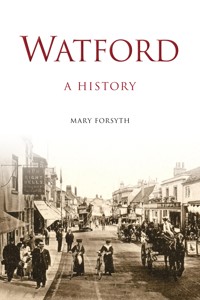
This volume explores the history of Watford from the earliest times to the 1970s. Set against a background of some of the major events in English history, it tells the story of how a small medieval settlement became the town we see today. Drawing on thirty years of research, Mary Forsyth provides a fascinating insight into the changing face of the town, the local characters who inspired and instigated its transformation, and the national events that shaped its development through the ages. Illustrated with selected images from Watford Museum and the author's own collection, it will interest newcomers and local residents alike, celebrating the history of this major Hertfordshire town.
Sie lesen das E-Book in den Legimi-Apps auf:
Seitenzahl: 283
Veröffentlichungsjahr: 2015
Das E-Book (TTS) können Sie hören im Abo „Legimi Premium” in Legimi-Apps auf:
Ähnliche



















ACKNOWLEDGEMENTS
This book could not have been completed if I had not had the help of friends. My knowledge, particularly of eighteenth-century Watford, has been supplemented by information generously provided by Gordon Cox, a fellow researcher. The map was drawn by another friend, Laurie Elvin. I also owe a deep debt of gratitude to my colleagues at Watford Museum, among whom are the manager, Sarah Priestley, who has supported me throughout, Sue Carter who has typed the whole of my handwritten script, and Christine Orchard who scanned all the images for me and who also created some of the line drawings which head the chapters. The illustrations come either from the museum’s collection or from my own. The following are from the museum: 1–6, 9, 13, 14, 16, 17, 19, 23, 26–29, 31, 32, 34–37, 39–56. Of these 16, 17, 19, 23, 26–29, 31, 41, 46, 47, 56 were taken by local photographer, Bob Nunn, whose widow gave them to the museum. The rest are my own.
Original drawing by Laurie Elvin Contains Ordnance Survey data © Crown Copyright and database right [2015]
CONTENTS
Title
Acknowledgements
List of Illustrations
Introduction
Chapter 1 From Prehistory to Domesday Book
Chapter 2 The Medieval Town
Chapter 3 The Town in the Time of the Tudors, 1485–1603
Chapter 4 The Town in the Time of the Stuarts, 1603–1714
Chapter 5 The Hanoverian Town, 1714–1815
Chapter 6 From Waterloo to the Great War, 1815–1914
Chapter 7 The Early Twentieth-Century Town, 1914–1945
Chapter 8 The Post-war Town, 1945–19748
Postscript
Bibliography
Copyright
LISTOF ILLUSTRATIONS
1. Bronze Age axe-heads.
2. Anglo-Saxon pennies.
3. Anglo-Saxon pennies.
4. Seventeenth-century trade token.
5. Seventeenth-century trade token
6. St Mary’s church, 1855.
7. St Mary’s church, early 1900s.
8. Lower High Street, early 1900s.
9. Lower High Street, early 1900s.
10. High Street, at King Street and Queens Road crossing, early 1900s.
11. High Street, south of the marketplace, before 1912.
12. Marketplace, early 1900s.
13. Marketplace, 1920s.
14. Marketplace, 1920s.
15. Marketplace, 1961.
16. Marketplace, with entry to Charter Place, 1986.
17. Charter Place.
18. High Street, looking to Clarendon Road, early 1930s.
19. High Street, corner of Clarendon Road.
20. The Parade, early 1900s.
21. The Parade, 1950s.
22. The Pond, early 1900s.
23. The Pond, 1960.
24. The Roundabout, 1930s.
25. The Roundabout, 1950s.
26. King Street, post-Second World War.
27. Queens Road, 1960s.
28. Clarendon Road, 1950.
29. Clarendon Road, 1949.
30. St Albans Road.
31. St Albans Road.
32. Bedford Almshouses, 1988.
33. Jackson’s, 1961.
34. Monmouth House, before 1927.
35. Little Cassiobury, 1922.
36. Frogmore House.
37. Benskin’s, 194 High Street.
38. Free School.
39. Watford Place.
40. One Crown public house, 1966.
41. One Bell public house.
42. Benskin’s Brewery.
43. Wells Brewery, 1966.
44. Ballard’s Buildings, early 1920s.
45. Harebreaks housing estate, 1920s
46. Clifford Street, 1983.
47. Estcourt conservation area.
48. Cassiobury House, front, 1922.
49. Cassiobury House, garden and elevation.
50. Watford Junction station, late nineteenth century.
51. Five Arches Railway Bridge.
52. High Street in the First World War.
53. First World War munitions workers.
54. Second World War: fitting gas masks.
55. Second World War: VI rocket damage, 1944.
56. View of Watford in the 1970s.
INTRODUCTION
Books have been written before about Watford, several of them, yet there is not available to the general reader a recent straightforward history of the town and its people.
This book seeks to provide that. It aims to remind long-term residents of the past which they have experienced, to show newcomers how the town has developed in the way that it has, and to provide a basis upon which future research can be developed.
All researchers draw on the work of their predecessors. And so it is that, in the search for Watford’s past, one needs to consider what others have written.
Amongst the earlier books are the histories of the whole County of Hertfordshire. Here Watford is mentioned only briefly, as just one among many market towns and not one of particular significance when compared, for example, with St Albans or Hertford, both of which have been boroughs much longer than Watford.
These early historians wrote of a county of woods and agriculture. They referred to its soil, to the underlying geology of the land, and to its rivers, but for the rest they were more interested in its ‘antiquities’ and in the pedigrees of the ‘gentry’ who lived in it and for whom they were writing.
The first of these early historians was Sir Henry Chauncy with his Historical Antiquities of Hertfordshire, published in 1700, towards the end of the reign of William III. On his title page he told his readers that he would be describing, amongst other features, ‘the several Honors, Mannors, Castles, Seats and Parks of the Nobility and Gentry’ and it was to these men, whether of the old established county families or the newcomers who were buying estates in the area, that he addressed himself.
In 1728, in the time of George II, Nathaniel Salmon published his History of Hertfordshire, in which he was, as he stated on his title page, ‘Describing the County and its Antient Monuments Particularly Roman with the Character of Those that have been the chief possessors of the Lands’. Like Chauncy, he dedicated his book to a member of the aristocracy, in his case the Earl of Hertford, and he listed the subscribers to his book, which included many of those ‘chief possessors of the Lands’.
Salmon drew on Chauncy’s research, both that published in the Historical Antiquities of Hertfordshire and some unpublished material that he acquired. Thus began a process, described by Stephen Doree in Hertfordshire in History, whereby historians transferred ‘the dead bones of the past from one grave to another: from the original depositories to their own notebooks’.
The next county historian was born and died in Watford. Robert Clutterbuck published the first volume of his History and Antiquities of the County of Hertford in 1815 and followed this with two more volumes in 1821 and 1827. A Fellow of the Society of Antiquaries, a local magistrate and trustee to several charities, his description of Watford appeared in his first volume; despite his association with the town, he did not give it any particular prominence.
Later in the century the last of the antiquarian county histories was published by J.E. Cussans; it was another multi-volume publication, with that containing Watford appearing in 1881. Cussans described it as ‘An Account of the descents of the various manors, Pedigrees of Families connected with the County; Antiquities, Local Customs, etc., etc.’
It was not until the twentieth century, with the publication of the Victoria County History of Hertfordshire, that a book appeared which both provided a substantial body of information about Watford and also showed where this information came from. The volume containing Watford was published in 1908; it included detail which had not previously been available in this format, though it too was particularly concerned with the history of various manors within the parish of Watford.
By this time, however, the first History of Watford had been published, in 1884, by another Watford resident, Henry Williams. Like Robert Clutterbuck, he was involved in town affairs, though at a different level. Born to a Watford family, he lived all his life in the town. He began as a photographer before turning to journalism, serving for a while as the local reporter for the Buckingham Advertiser. Later he worked for the local authority, at that time the Local Board of Health, first as a Water Inspector and later also as the Inspector of Nuisances, finishing his career as a Sanitary Inspector.
His History is a mixture of fact, legend and reminiscence; some of the stories he told were presumably picked up as he went about his daily business and he was lent some documents by acquaintances. In his Preface he offers his book to the public ‘as a plain exposition of matter which he believes will be interesting to the reader … with an earnest hope that it will be found not only amusing but containing much matter that will make it a guide to Watford and its institutions.’
Like his contemporaries, he was interested in the local nobility and he devoted the first part of his book to their exploits and their homes. He referred to earlier histories of the county and particularly to Clutterbuck whose son gave him permission to quote from History and Antiquities. He quoted from other acknowledged documents and included information about contemporary organisations and societies. He also spiced his writing with incidents and anecdotes that ‘have occurred to my mind or have reached me from the sources I have at my command’ – sometimes tales from the ‘oldest inhabitant’. He also included some of his own verses, all of which led to an amusing guide to Watford.
It was not until 1931 that another History of Watford appeared, written by W.R. Saunders. Though not born in Watford, he spent all his working life in the town, as a teacher. His history was published first in serial form in a local paper, the Watford Observer, between February and June 1931, and it then appeared in book form at the end of that year.
William Saunders stated in his Introduction that, ‘All the particulars given have been verified, as far as possible, by reference to authorities and actual documents at the British Museum; the Public Library, Watford; St Mary’s Church, Watford; and at Watford Place’. He did not include specific references in his text and it is a cause for regret that the transcriptions of documents which he deposited have not survived. Nevertheless, succeeding writers have drawn on his research.
In the last sixty years books about Watford have continued to be published, particularly those with selections of illustrations, and articles have appeared in magazines and society journals. Yet it is still difficult for the general reader to trace the way in which the town has grown and changed over the centuries; it is hoped that this book will make that possible.
CHAPTER 1
FROM PREHISTORYTODOMESDAY BOOK
The Watford to be considered is that in Hertfordshire, and the area involved is, for the most part, that of the parish of Watford as it was in the early nineteenth century. This is very similar to that now under the control of Watford Borough Council. In medieval times, however, the parish was much larger than it later became and, for the earliest periods of this history, this wider area will be considered.
Watford is not typical of the rest of Hertfordshire. Geologically this south-west corner of the county, with its mixture of London clay, flint, sand and gravel, is different from the areas to the north and east which lie predominantly on chalk. The river system too in the south-west is separated by hills from the rest of the county and flows into the Thames by a different route. These factors have influenced the way that the area has developed.
There is no evidence of settlement before the twelfth century in what later became, and still is, the centre of the town. Prehistoric peoples preferred to make use of the lighter, better drained soils in the surrounding areas and the heavier clays seem not to have been cultivated until after the Norman Conquest.
It is in the wider area surrounding the later town that evidence of the movement of successive waves of people has been found. The earliest settlers chose to make their temporary camps and later their more permanent homes close to water on the gravel soils to the west and north of it, along the valleys of the Colne and Gade rivers. The Historic Environment Record lists places at Hampermill and further west along the Colne at Tolpits Lane and Moor Park where flint handaxes and arrowheads from the Mesolithic (Middle Stone Age) period have been found, as well as areas where flints had been knapped.
Along the River Gade, excavation has revealed both temporary camps and more permanent Neolithic (New Stone Age) and Bronze Age settlements at The Grove, on the northern edge of Watford, and along the line of the Kings Langley and Berkhamsted bypasses, now the A41. Some of the earlier camps seem to have been occupied seasonally but later more permanent settlements were made in the same areas.
There is also evidence of late Bronze Age activity in west Watford, though without any apparent settlement associated with it. A remarkable find of a late Bronze Age hoard was made on the Holywell Industrial Estate in an area of land lying between the Gade and Colne rivers. Among more than forty manufactured items were several axe-heads and spearheads as well as swords, knives, a bowl and other fragments, plus a number of bronze ingots.1
Although the earliest settlers were nomadic, there is evidence that by the late Bronze Age some groups had started to settle permanently in the Watford area and to farm here. As succeeding generations began to use iron tools, the areas under cultivation could be extended and traces have been found of Iron Age occupation along the River Colne at Hampermill and further west at Moor Park, as well as to the north at The Grove.
It is known that by the late Iron Age south-west Hertfordshire was part of the territory of a tribe known as the Catuvellauni, with a concentration of activity at Wheathampstead and later at Prae Wood, St Albans. Even before the Romans invaded in AD 43, some local farmers had started to buy goods imported from across the Channel and Roman pottery has been found at some local Iron Age sites.2
The lack of evidence of military occupation in the area and the special status of the Roman town of Verulamium (St Albans) suggest that the transition from rule by tribal chiefs to a Roman imperial administration came about by assimilation rather than conquest. If the Catuvellaunian aristocracy continued to govern as ‘Roman’ magistrates under the new regime, the local people would have noticed little difference, at least at first.
Any surplus food that local farmers had to sell could be taken to the market near the River Ver where new buildings in the Roman style were replacing the buildings of the previous Iron Age settlement. News of the sacking of Verulamium and the burning of these new buildings by the Iceni tribe from Essex under their leader Boudicca, in AD 61, eighteen years after the Roman invasion, would have spread through south-west Hertfordshire. But the Roman Army quickly restored order; Verulamium was rebuilt and the seasonal routine would have continued.
Gradually, however, the influence of the Romanised way of life establishing itself in Verulamium seeped into the surrounding countryside. Some late Iron Age farms adopted only a few of the new ways. For example, at Hampermill some fine imported Roman Samian-ware pottery was in use alongside the coarse locally made ware, and pottery from the Roman period has been found nearby at Sandy Lodge. In time, the Iron Age style of building was replaced and new villas were built close to the river valleys around Watford, adjacent to or in some cases replacing the old farmsteads. At Moor Park the farmer built a Roman-style house in the second century and although the site was abandoned for a while, it was rebuilt in the fourth century and under-floor heating by a hypocaust was installed.
Particularly up the Gade valley, at Kings Langley, Gadebridge, Boxmoor and Northchurch, Roman building methods were used and in some cases Roman styles of interior decoration, with tessellated floors and painted wall plaster. On the other side of Watford, at Netherwild near Aldenham, a bath house has been excavated, though the villa that it would have served has been destroyed. There was also evidence here of pottery production, as well as nearby at Home Farm, Aldenham.
It therefore seems that some at least of the population in the Watford area adopted Roman ways but it is not clear how widespread this was nor how long it lasted. Some local villas showed signs of decline in the fourth century, before the Roman government withdrew. It seems unlikely that these Roman-style houses were occupied after about AD 400, though the land may still have been farmed, and there were signs of some activity at Verulamium in the fifth century.
For whatever reason – economic decline, a fall in population, the threat of foreign invaders – the Watford area, like the rest of the country, was, after 400 years of Roman rule, entering a period of change. The 600 years between the departure of the Roman Army and the arrival of William of Normandy have been called ‘the Dark Ages’. It is known that waves of invaders from the Continent, first Angles and Saxons and later Danes, caused havoc throughout large parts of the country, but there is little to show how this affected Hertfordshire.
In time, the invaders settled down and began to farm the land they had taken over. In other parts of the country recent excavation has revealed more about the lives of these people and the changes they introduced. But they have left few traces in the Watford area.
Yet ‘Watford’ is generally believed to be an Anglo-Saxon place name. The evidence for this comes from Anglo-Saxon charters. One, known as the Oxhey Charter, refers to a grant of land made in 1007 by the Saxon king Æthelred by which he gave land at ‘Oxengehaege’ (Oxhey) to St Albans Abbey. The boundaries of this land are defined in this charter and include mention of a place called ‘Watforda’ and what has been translated as ‘Colne Bridge’. This is assumed to refer to a crossing place on the River Colne near which the later settlement grew.3
An earlier Saxon charter is also thought to refer to the Watford area although it does not mention it by name. In 793 Offa, King of Mercia, established a monastery at St Albans and granted to it large tracts of land for its maintenance. This included an area known as ‘Caegesho’ (Cassio). From later evidence it seems likely that Cassio included what became the town of Watford.4
There are also two Saxon wills which mention Watford: one of the tenth century made by a lady called Æthelgifu and one of the eleventh century made by Edwin of Caddington. That of Æthelgifu is now generally believed to refer to Watford in Northamptonshire, though it seems likely that Edwin is referring to the Hertfordshire Watford.5 This, however, only gives the name with no further details, and because of the archaeological evidence, it is reasonable to suppose that the name of Watford throughout the Saxon period referred only to the river crossing.
There has been much debate over the meaning of the name. In Saxon and early medieval times it was spelt in various ways: Watforda, Wetford, Wathford(a), Watteford(e). Whereas there is no argument about ‘-ford’, various interpretations of the first syllable have been suggested, including ‘waed’, the Saxon word for ‘a place for wading’, or ‘wath’ meaning hunting, suggesting a ford used by hunters.
Archaeological evidence of Saxon infiltration and settlement in Hertfordshire in the early years after the invasions is sparse and particularly so in the south-west part of the county. Even later in the Saxon period, after the Danish invasions, when this part of the country came under the sway of the kings of Wessex and the administrative structure of ‘hundreds’ and counties was established, there is practically nothing to indicate the presence of Saxon settlers in the Watford area.
It was a surprise, therefore, when seven silver pennies from the tenth century were found in Whippendell Woods, to the west of the later town. They dated from the reigns of the Saxon king Edward the Elder (899–924) and his son Æthelstan (924–939). It has been calculated that they would have been enough to buy a sheep and so must have represented a considerable loss to their owner. Excavation of the site produced nothing else from this period and so it can be assumed that they were lost by a passer-by.6
Excavation at several sites in Watford High Street has failed to uncover even the slightest suggestion that there was a Saxon settlement here, and excavations on the periphery of the town have turned up practically nothing. An exception is the recent discovery of some timber-framed buildings and two burials at The Grove, which have been dated to the Saxon period. These were in an area which had seen settlement from the Bronze Age onwards.
It is not surprising that early settlers in the Watford area chose to establish themselves and their farms on the lighter gravelly soils round the edge of the later town rather than on the heavy clays in the more central part, particularly as the River Colne was prone to flooding there.
Even the Norman Conquest did not apparently bring any immediate changes to the area, at least none that have been revealed by excavation. Yet the farmers in the area must have been aware that something had happened that was likely to affect them all. The strenuous efforts of the last Saxon king, Harold, to hold back the Danes in the North of England and the Normans on the Sussex coast at Hastings may have passed without notice. But news of the passage of Duke William and his army as they moved northwards towards and across the Thames would have preceded them, with stories of the laying waste of the land through which they passed. William came up the River Gade to the Saxon settlement at Northchurch near Berkhamsted. There he received the submission of the Saxon nobles before moving to London where he was crowned in Westminster Abbey on Christmas Day 1066.
To have a marauding army so close must have been terrifying. In many areas, the invaders seized crops and livestock, burning what they could not carry with them.
Twenty years after the invasion, William took stock of the value of his conquest and his commissioners produced what came to be called Domesday Book. The return from each landholding showed the value in 1086, the value at the time of the Conquest and that before the Conquest; the pre-Conquest figure was the greatest of the three.7
Watford is not mentioned in Domesday Book; as a settlement it did not exist. It is assumed that then, as in Saxon times and for some time after the Norman Conquest, the ford across the Colne and the land around it was part of ‘Caissou’ (Cassio). The land still belonged to St Albans Abbey, though the Saxon abbot had been replaced by William’s nominee, the Norman Paul of Caen.
This does not mean that no one was living in the area at the time of Domesday. The survey lists fifty-two men in the manor of Cassio – a mixture of villeins, bordars and serfs who worked the land for the abbey, as well as three Frenchmen. There is no archaeological evidence of a settlement along the main road, not even any traces of individual dwellings or occupation debris from the eleventh century. It can be assumed, therefore, that these families lived in isolated clearings in the woodland.
The records of the abbey refer to clearance of woodland in the tenth and eleventh centuries as successive abbots sought to increase the productivity of their estates. Domesday Book states that there were twenty plough teams in use and four mills within the manor where grain from these arable fields could be ground. There was also pasture for grazing the livestock but still large areas of uncleared land: the survey refers to enough woodland for 1,000 pigs to forage. This was the yardstick used by the Domesday commissioners to gauge the amount of woodland, which was also important for the timber.
The value of the manor of Cassio was reckoned to be £28 in 1086, having dropped from an estimated £30 in Saxon times to only £24 after the Conquest. Now the abbot as landlord needed to improve the manor’s land. He needed provender for the monks and lay staff at the abbey and he had started an ambitious rebuilding programme which required craftsmen and labourers, all of whom had to be fed. And up the Gade valley at Berkhamsted, William’s half-brother Robert, Count of Mortain, had already started building a new castle to control passage along the valley, part of the route between London and the West Midlands, and he too needed provisioning.8
To increase the revenues from his estates, the abbot could continue the clearance of woodland and put more land to the plough; but another source of revenue was trade. He already had a market at St Albans. Now the area adjacent to the Colne crossing at Watford could be developed as another.
Notes
Most of the archaeological evidence for this chapter can be found in the Hertfordshire Historic Environment Record which is maintained by the Hertfordshire County Council and can be accessed at www.heritagegateway.org.uk. Each site listed in the HER has its own reference where further information can be found.
1 HER 634; the Bronze Age hoard can be seen at Watford Museum.
2 Branigan, K., & Niblett, R., Roman Chilterns; Williamson, T., Origins of Hertfordshire.
3 A translation of the text of the Oxhey Charter can be found in Cooling, C., & MacKay, I., Oxhey in Pictures.
4Victoria County History of Hertfordshire (VCH), vol. 2, p.451.
5Ibid.
6 HER 6281; the Anglo-Saxon coins were declared to be ‘Treasure Trove’ and were divided between the British Museum and Watford Museum. More information about the find is available at Watford Museum.
7 There are several translations of Domesday Book available of which that by J. Morris, published by Phillimore in 1976, is for Hertfordshire alone.
8 Birchnell, P.C., A Short History of Berkhamsted, p.13
CHAPTER 2
THE MEDIEVAL TOWN
Exactly when the first settlement was established at Watford is not known but it was probably during the twelfth century. Excavation within the town centre has produced no pottery before the twelfth century. Although a coin hoard was found in Oxhey in the early nineteenth century, which included coins from the reign of Henry I (1100–1135) onwards, the earliest coin found within the town centre was one of King John (c.1210/1215), found in association with late twelfth-century pottery when Nos 174–180 High Street was excavated before the modern ring road was laid through the site.
The core of the first part of the town was on the small hill that sloped gently up on the north side of the river crossing. Here a church was built and a market established.
What was believed to be twelfth-century stonework was found at St Mary’s church during extensive nineteenth-century repairs and the old font is considered to be of twelfth-century date.1 Further evidence for the establishment of the church by this period comes from a letter from the Pope to the Abbot of St Albans in 1188, which refers to the income from the church at Watford being used for the upkeep of the hospital at St Albans Abbey.2
The market too is believed to date from the twelfth century. There is, however, no direct evidence for the original grant of a charter from the king to the Abbot of St Albans allowing him to hold a market adjacent to the church. Without such a royal charter no one could hold a market and it was customary at this period for each king to confirm on his accession the charters granted by his predecessor. The original market charter has not survived and its existence is deduced from later confirmations. There is a difference of opinion about whether the first charter was granted by Henry I in the earlier years of the twelfth century or by Henry II in the second half of that century, after the disturbed years of civil war between the supporters of King Stephen and those of his cousin the Empress Matilda. What seems certain is that a market was established in Watford by the late twelfth century.3
It is significant that the market was granted to a place called Watford and not to Cassio. Until this time ‘Watford’ seems to have meant only the river crossing. But from the twelfth century it referred to the parish, the market and the town.
The choice of this particular site for the market was probably made because of its geographical position. At a time when most people remained where they had been born, the king and his retinue travelled widely throughout the country and Watford lay on the route that he might take as he came from London to his castle at Berkhamsted and later to the royal palace at Kings Langley on his way northwards.
What is not known is how this settlement began – whether it was a haphazard growth as people were attracted to the area because of the opportunities for trading at the roadside, or whether the church and the market were deliberately established here to provide the nucleus from which the town could grow. Some towns grew spontaneously along local or national routes; others were planted. The twelfth century saw the development of a number of ‘new towns’, set up to increase revenue from the land. A market charter was of great value because it gave its owner, whether a borough or, as in the case of Watford, the lord of the manor, the Abbot of St Albans, a way of raising revenue from market tolls and the transactions which took place in the market. The abbot would have considered a church a necessary part of this new settlement. It provided a meeting place for the inhabitants as well as a centre of religious and secular authority. The market might even have started in the churchyard before being moved to a position close by where the road widened to accommodate it.4
Essential to the life of the town was the mill. This was a watermill, taking water from the River Colne. Tradition has it that a mill-leet was cut in about 1100.5 This would put this innovation in the time of Abbot Robert and could have coincided with the development of the town. Like the market, the mill was a potential source of revenue for the lord of the manor and this would have justified the cost of the work.
The mill was the property of the abbot and to here, and nowhere else, the lord’s tenants would bring the grain which they had grown on his land. They were forbidden to grind it anywhere else or in any other way – for example, on hand mills or by a horse-mill – and had to pay the lord’s miller handsomely to do it for them. This obligation was often the cause of resentment, and disputes between the lord and his tenants were not uncommon. These could be about the extraction of water from the river as well as about the cost of milling. The abbey archives refer to a series of disputes between 1260 and 1290 and these occur later too, notably in the fourteenth century.6
For evidence of what the early medieval town looked like, it is necessary to turn to archaeological excavation: no domestic buildings of the period have survived and the church has been rebuilt. The evidence for early settlement along the main street comes from finds of broken pottery, household debris, animal bones and well-trodden earth floors. Dated pottery from the twelfth century has been found on both sides of the street from just above the river crossing to the marketplace and also in the garden of the house at the head of the marketplace (now 58 High Street). While evidence of development between the river and the marketplace was to be expected, recent excavations have shown that this continued further north as well: coarse local pottery, of mid-twelfth-century date, was found in a rubbish pit during excavation at 29–35 High Street.7
The only evidence of what the houses might have been like comes from the discovery during excavation of post holes, round patches of discoloured soil which are all that is left of the wooden posts that would have supported a simple timber-framed building. The earliest buildings of which traces have been found are from the late thirteenth century and they would have been very basic and flimsy. Little more than huts, they would have been roughly rectangular, with one room on the ground floor and perhaps a loft above, reached by a ladder. The spaces between the uprights would have been filled in to make walls, using wattle and daub – thin sticks covered in a mud mixture – and roofs would have been of thatch or turf, with a hole through which smoke from a central hearth could escape.
The few timber-framed houses from the medieval period, which have survived elsewhere in the country, are more substantial and from later periods. Built by the wealthy, they give a false impression of the condition in which most of the population lived. It is not surprising that it was the more elaborate and skilfully built houses from the later periods that are still standing. Although building techniques were refined over the centuries, change was slow. Even in the late fourteenth century, at the time of the Peasants’ Revolt, it was possible for the rioters to demolish the house of an abbey official one day and rebuild it later, also in a day.




