


Erhalten Sie Zugang zu diesem und mehr als 300000 Büchern ab EUR 5,99 monatlich.
- Herausgeber: Jonathan Ball
- Kategorie: Sachliteratur, Reportagen, Biografien
- Sprache: Englisch
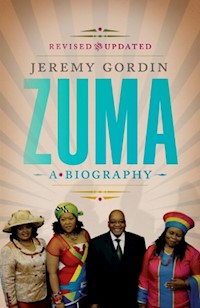
The first edition of Zuma, published in late 2008, concluded with Jacob Zuma's future balancing on a knife's edge. National elections loomed, but so did corruption charges and endless court battles. Since then Zuma's star has spectacularly risen - the corruption charges were dropped, he led the ANC to election victory and duly became President of South Africa, and his new cabinet and government appointments were generally well received. But he has also recently suffered a huge blow with revelations of another love-child, this time with the daughter of soccer supremo Irvine Khoza. Many of his supporters have distanced themselves from him, and Zuma is looking isolated. Pundits are once again wondering how long he'll survive as President. In this revised and updated edition, Jeremy Gordin takes the reader right up to present. He covers in detail the highs and lows of Zuma's past 18 months, including the final salvoes of his legal battles, as well as his first year as President. New material in this edition also includes the 'Pedro' document (a document Zuma wrote in 1986), and accurate information on his wives and children.
Sie lesen das E-Book in den Legimi-Apps auf:
Seitenzahl: 692
Veröffentlichungsjahr: 2010
Das E-Book (TTS) können Sie hören im Abo „Legimi Premium” in Legimi-Apps auf:
Ähnliche


















IN MEMORY OF
Miriam ‘Micky’ (Awerbuch) Gordin
1910–2002
mother, teacher, sceptic
AND FOR
Deborah, Jake and Nina Gordin
Jeremy Gordin
ZUMA
A Biography
Second edition
JONATHAN BALL PUBLISHERS
Johannesburg & Cape Town
David therefore departed thence, and escaped to the cave of Adullam: and when his brethren and all his father’s house heard it, they went down thither to him. And every one that was in distress, and every one that was in debt, and every one that was discontented, gathered themselves unto him; and he became captain over them …
First Samuel xxii.1-2.
The world is what it is; men who are nothing, who allow themselves to become nothing, have no place in it.
A Bend in the River, VS Naipaul.
One thing therefore History will do: pity them all; for it went hard with them all. Not even the Seagreen Incorruptible but shall have some pity, some human love, though it takes an effort. To the eye of equal brotherly pity, innumerable perversions dissipate themselves: exaggerations and execrations fall off, of their own accord.
The French Revolution, Thomas Carlyle.
Don’t be so anxious. Don’t peep so much into Freud. Look to the Zulu – and relax.
Letter from Elias Gordin to Jeremy Gordin, 1974.
The new president [Thabo Mbeki] appointed as deputy president Jacob Zuma, a loyal ANC member who had no formal education and posed no challenge to Mbeki’s leadership.
A History of South Africa (2001), Leonard Thompson.
‘Once upon a time,’ [Nikita] Khrushchev said, ‘there were three men in a prison: a social democrat, an anarchist and a humble little Jew – a half-educated fellow named Pinya. They decided to elect a cell leader to watch over distribution of food, tea and tobacco. The anarchist, a big burly fellow, was against such a lawful process as electing authority. To show his contempt for law and order, he proposed that the semi-educated Jew, Pinya, be elected. They elected Pinya.
‘Things went well, and they decided to escape. But they realized that the first man to go through the tunnel would be shot at by the guard. They all turned to the big brave anarchist, but he was afraid to go. Suddenly poor little Pinya drew himself up and said, “Comrades, you elected me by democratic process as your leader. Therefore, I will go first.”
‘The moral of the story is that no matter how humble a man’s beginning, he achieves the stature of the office to which he is elected.
‘That little Pinya – that’s me.’
Khrushchev: The Man, His Era, William Taubman.
Contents
Preface to the Second Edition
Preface and Acknowledgements
1. 1942–1959 Zulu boy
2. 1960–1963 Working-class warrior
3. 1963–1973 The Island
4. 1974–1990 Silence, exile and cunning
5. 1990–1994 The talking times
6. 1993–2003 The greasy levers of power
7. 1999–2004 Bring us our machine guns
8. 2003–2004 Hefer or: Hamlet without the prince
9. 2004–2005 Shaik goes down
10. 2005 Annus miserabilis
11. November 2005 Interlude in Zuma-land
12. 2006 Rape trial
13. 2006 Days of dirty laundry
14. 2006-2007 The Floating Opera
15. 2007 Siyaya Limpompo! (We are going to Limpopo!)
16. 2007–2008 The Zuma tsunami
17. 2008 ‘Let’s kill all the lawyers’
18. September 2008 Let’s fire Mbeki instead
19. November 2008 President-in-waiting
20. January-April 2009 Off the hook
21. April–December 2009 Siyanqoba! (We are victorius!)
22. January–March 2010 The honeymoon ends
Pictures
Appendix I The Pedro Document
Appendix II The Jacob Zuma family
Appendix III Operation Vula
Preface to the Second Edition
The first edition of this book ended as Judge Nicholson withdrew from Zuma’s mouth the sharp hook that had been lodged in it for about nine years by the National Prosecuting Authority. However, despite this enormous fillip, in December 2008 life did not look wonderfully rosy for him. Consider: it soon became obvious that the NPA would appeal as quickly as possible against the Nicholson judgment and probably win (this is indeed what happened). Then it would re-charge Zuma. Were this to happen (and it did), what would Zuma and the ANC do? Could a national election – due in April 2009 – be fought with him sitting in court? What if he were found guilty? A conviction and a sentence to a jail term of more than 12 months would have made Zuma ineligible for election to Parliament and therefore ineligible to serve as President of South Africa.
Then there occurred the most remarkable intervention: the decision by the acting National Director of Public Prosecutions to drop charges of racketeering, money laundering, corruption and fraud against Zuma – notwithstanding everything that had gone before.
On 6 May 2009, Parliament voted Zuma fourth president of a democratic South Africa, defeating the Congress of the People’s presidential candidate by 277--47 votes. Three days later, he was sworn in. As one of the talking heads on television remarked, it was ‘the greatest political comeback ever’ (certainly in South African politics).
What’s more, though he inherited a country wallowing in the doldrums, Zuma received a very good press, foreign and local – not only for his first 100 days but for the first eight months of his rule. He was featured on the cover of Time magazine on 7 December 2009, and the inside article was none too shoddy either. In addition, the political opposition, as much as ‘the people’, seemed disarmed by his brand of charm, his promises to eradicate corruption and create jobs, and his sweeping aside of Mbeki’s HIV/Aids denialism.
But on a balmy Sunday morning, 31 January 2010, the Sunday Times arrived – thump! – in the driveway, carrying incendiary matériel. Suddenly, Zuma was in trouble again; in the blink of an eye, he had again become the dirty rascal. Just when Zuma’s getting ahead in the game, he … well, he doesn’t shoot himself in the foot … but he does often commit a sexual misdemeanour. But more important than the brouhaha precipitated here and overseas by Zuma’s peccadilloes was the reaction of his allies in the ANC and the tripartite alliance. It was apparent from their lukewarm response that quite deep fissures existed in the party and the alliance. Zuma’s policy of governing by consensus had effectively meant perpetual compromise, and in such a process there can be little bold leadership.[1] By trying to be all things to all people, Zuma has clearly failed to satisfy most, if any, of the competing factions in his government.
This second edition of Zuma: A Biography contains three new chapters that incorporate all the new events that I have mentioned above – from October/November 2008 until the first weeks of March 2010 and the pomp and ceremony of his journey to London to see Queen Elizabeth II.
Much of the material in the three new chapters flows from articles I have written on politicsweb.co.za, where I have been a weekly contributor since about June 2009, and articles written for East London’s Daily Dispatch. My thanks and acknowledgements to James Myburgh and Alec Hogg of Politicsweb, for allowing me the space and giving me encouragement, and to Myburgh in particular for fruitful discussions and for letting me profit from his indefatigable questioning of the status quo and dislike of racist cant and political propaganda; and thanks and acknowledgements to Andrew Trench and Dawn Barkhuizen of the Dispatch for giving me an opportunity to write a monthly Zuma column.
In the first edition of this book, there were a number of instances where, without making proper acknowledgment, I used material directly from The Arms Deal in Your Pocket (Jonathan Ball Publishers, 2008) by Paul Holden. These omissions of acknowledgement have now been corrected; and I apologise to Holden. Some factual mistakes relating to Zuma’s family have also been repaired, and I apologise to Zuma as well.
Journalists David Beresford and Paul Trewhela had two similar ‘problems’ with this book. The first related to the way in which I dealt with – or, rather, failed to deal with – Zuma’s membership of the SA Communist Party, which membership had been clearly mentioned by Zuma himself in an autobiographical piece written on 2 May 1985 under the alias ‘Pedro’. The second related to my failure to damn Zuma sufficiently for his alleged complicity or culpability in the death of Thami Zulu. I deal with both these issues and reproduce the ‘Pedro’ document in a new appendix.
Besides again thanking the long-suffering Jeremy ‘where’s my copy?’ Boraine, publishing director of Jonathan Ball Publishers (JBP), and Frances Perryer, editor extraordinaire, I want also to thank Jonathan Ball for his support and friendship, and the rest of the JBP staff, especially Anika Ebrahim, JBP’s director of publicity. When I needed a proverbial pillar of strength on which to lean a little, Anika was there.
I also want to thank: Michael Hulley, Zuma’s attorney, for further assistance and friendship; Ajay Sooklal, formerly Thint’s attorney, also for further assistance and friendship; Justin Cartwright, for his unexpected encouragement and praise; my friend Benjamin Trisk for his continual, unbridled criticism of Zuma (if he let up, what would I have to think about?); Anthony Butler, head of Politics at Wits, for reminding me gently that it’s not the economy, stupid – it’s the politics, stupid; Anton Harber, my boss at Wits Journalism School, who didn’t look too hard to see where I was, though he knew that I generally wasn’t where I was supposed to be; and all the people, most of whose names I unfortunately do not know, who in the weeks immediately following publication in December 2008 came up to me in Cape Town, Durban, Johannesburg and East London, or wrote to me, to say they had enjoyed the book.
Finally, thank you to Jacob Zuma – a careful reader of those texts he must, or chooses to, read – who told me he enjoyed the book a great deal, notwithstanding ‘a few things that we need to discuss sometime’. I am delighted that Zuma’s note thanking me, inscribed on the title page of my copy of Zuma: A Biography, was written on 06/04/2009 – the evening on which he was celebrating the dropping of charges against himself.
Jeremy GordinPARKVIEW, JOHANNESBURG MARCH 2010
Notes
[1] See Allister Sparks’s eloquent article, ‘Obama, Zuma and a question of leadership,’ Business Day, 31 March 2010.
Preface and Acknowledgements
I once said to Jacob Gedleyihlekisa Zuma, aka ‘Msholozi’ (his praise name), that his life story seemed so fascinating, I was surprised no one had written about him.
‘Why should anyone write about me?’ Zuma asked. ‘I’m not an important person. I’m not from a politically famous or royal family. I’m not an influential businessman. I’m just an ordinary person.’
It was a vintage Zuma response because it was self-deprecatory, some might even say humble, yet at the same time quietly, almost obliquely, sarcastic about a number of South African leaders whom politically knowledgeable people would find it easy to identify. It was also inaccurate, at least insofar as he claimed to be unimportant, for his name and career are now inextricably parts of the history of South Africa in the late twentieth and early twenty-first centuries.
I need not discuss here why this is so – for the book that follows is about Zuma’s remarkable rise and fall and rise again, the consequent sacking of President Thabo Mbeki, as well as the possibility that Zuma’s road to presidential inauguration could still be blocked by corruption and racketeering charges. Zuma is also a highly controversial politician and person, and that’s putting it mildly. And, since being made president-in-waiting in December 2007, he has become the epicentre of the country’s political turmoil.
The aim of this book is to tell Zuma’s story in such as way as to offer some insight beyond the daily and weekly reporting in the media and to capture something of the man, his ambitions, and the political rollercoaster he has been on – his travails in his quest to be the next president of South Africa.
It’s a ‘pull-together’, as journalists say, with the necessary background and context; an ‘overview’ that tries to sew together all the elements of the story. The main focus remains on the last eight or nine years during which Zuma has been accused of corruption and during which he emerged as the spear of the Left in its ‘battle’ against Mbeki. But I also cover Zuma’s early life in rural KwaZulu-Natal, his 10 years on Robben Island, his adult life as a member of the ANC underground, and the transitional years of the 1990s.
It would be silly, however, to pretend that this short book is ‘definitive’. Doubtless there are many lines of investigation, facts, and events missing from it. Nor is this a ‘thesis’ book; I have no over-arching point to prove, or all-encompassing ‘explanation’ to offer, about Zuma.
The historian Eric Hobsbawm adapted a comment of Karl Marx’s as follows: ‘Men make their lives, but they do not make them just as they please, they do not make them under circumstances chosen by themselves, but under circumstances directly encountered, given and transmitted from the past, and by the world around them.’[1] This comment is particularly applicable to a person who was six years old when legal apartheid started being clamped like a vice on society, who spent 10 years jailed on Robben Island, whose life was devoted to political and underground struggle, and who is an ANC man through and through. The party is, literally, his life, and has been so for half a century. I have obviously therefore had to be careful not to ‘over-emphasise the role of the individual in shaping and determining events’ or to ‘ignore or play down the political context’ in which Zuma has operated.[2] To put it another way: Zuma’s story is also largely inseparable from the story of South African politics of the last decade and longer.
But, though they are the major factor when dealing with a politician, external circumstances are not everything. One must also deal with the person. Zuma’s actions and choices have not been due solely to environment and external occurrences. His story is also about his character. At the same time – in the same breath, so to speak – I am well aware, as an astute biographer remarked, that ‘none of us can enter into another person’s mind; to believe so is fiction. We can only know actual persons by observing their behaviour in a variety of different situations and through different perspectives.’[3]
This book, then, does not even try to be a so-called psychobiography. I have tried, rather, to base my interpretations of Zuma the person, such as they are, on observation and palpable evidence.
This book was not authorised by Zuma. I accepted a commission to write it from Jonathan Ball Publishers and then told Zuma about it. He did not, in other words, have any control over its content, nor did he try to have any. I suspect, too, that he was not deliriously overjoyed at the idea. Yet he cooperated graciously and patiently. Zuma is a busy person and became extremely busy once he was elected ANC president. Moreover, he prefers to talk face-to-face, which is time consuming. So I am especially grateful that he afforded me time whenever he could. He also took the trouble to answer questions that must have been annoying to hear. It can’t be much fun to have someone asking: ‘According to the National Prosecuting Authority, you are corrupt – what do you say to that?’
I can’t recall experiencing a failure of Zuma’s good humour or the disappearance of that infectious laugh of his, which seems to emanate from the core of his being and lights up his person. It has been an unexpected gift to have been able to meet and write about a person who, despite 10 years in prison, various other tribulations, and more than six decades among humankind, is still apparently enjoying himself. Zuma argued with me, but, significantly, this was mainly when he thought I was being derogatory or misguided about the ANC. The only complaint I am able to dredge up about my dealings with him is the lack of real coffee at his Forest Town home.
Various members of Zuma’s family were also kind and helpful: Nompumelelo Ntuli, Zuma’s fourth wife (or fifth, depending how one counts these things), who made me and photographer TJ Lemon feel at home at Nkandla; Zuma’s sons, Edward and Duduzani; and Zuma’s daughter, Duduzile, she of the smile that could launch a thousand ships.
This book is built, firstly, on and around the articles that I have written, sometimes with others, during the last six years or so, about Zuma or related events, and which appeared in the Sunday Independent, The Star, and other Independent Group newspapers. Unless necessary for reasons of context, I have not provided references to my own work or joint-work; it would have been tiresome for the reader. Nor have I provided references for information that is in the public domain. But I have tried hard to make acknowledgements where acknowledgements are due.
At Independent Newspapers, the following were generous with time, page space, advice, grunts, bellows, or assistance: Dave Hazelhurst and Moegsien Williams of The Star; Jovial Rantao, Andrew Walker and Alf Hayter of the Sunday Independent; Peter Fabricius, Independent Group foreign editor; Roslyn Kenny, formerly editorial assistant at the Independent News Network (INN); Alan Dunn, Philani Mgwaba, and Bruce ‘Shark’ Colly of the Sunday Tribune, though during the Hefer Commission and Schabir Shaik trial, Dunn was INN editor and Mgwaba editor of the Pretoria News; Denis Pather and Deon Delport, then of the Daily News; Ivan Fynn, former editor of The Argus; Diana Powell, Martine Barker, and Robyn Leary, also of The Argus; Brendan Seery, formerly executive editor of the Saturday Star; and Kevin Ritchie, now managing editor of the Saturday Star and, when I was acting editor of INN, my irrepressible deputy and the best shabbes goy a Jew could ever hope for. TJ Lemon of the Sunday Independent, photographer extraordinaire, and I went on some memorable Zuma expeditions. And when I had missed my deadline and was in deep trouble with the publisher, Walker, Rantao, and Williams arranged for me to take leave not due to me and added some extra time to boot.
I’m grateful to Walker, my boss at the Sunday Independent, for reminding me at strategic times – in his own, inimitable phraseology – of Lord Northcliffe’s words: ‘News is what somebody somewhere wants to suppress; all the rest is advertising.’ And Walker not only kept me on the straight and narrow in terms of hard news values, steering me away (as best he could) from bias and partisanship, he was also supportive in other ways, above and beyond the call of duty. As Zuma would say: I thank you, my brother.
My thanks also to those with whom I worked at different times on different parts of the story: Estelle Ellis, formerly of The Star; Nalisha Kalideen; Karyn Maughan and Gill Gifford of The Star; Ingrid Oellerman, formerly of The Mercury; Caroline Hooper-Box, formerly of the Sunday Independent; Angela Quintal, formerly the group’s political editor; and a couple of colleagues from rival publications, who I’m certain would prefer not to be named. I also thank the management of Independent Newspapers; if they had not paid for air tickets and accommodation in various places, I could not have covered much of the story.
The book is based, secondly, on interviews with Zuma and others, whose names are mentioned unless they asked to remain anonymous. As a result of my coverage of Zuma and Zuma-related stories since 2003, I have won a number of awards, including in April 2008 the Mondi Shanduka South African Journalist of 2007. But, though the accolades were pleasing, and the money that went with some of them equally (if not more) so, of greater importance to me were the people whom I came to know and to like, while on the Zuma trail.
They were (and are): Kessie Naidu SC, who was evidence leader at the Hefer Commission, acted at various times for Zuma and Thint, then left the Zuma arena; Ajay Sooklal, Thint’s attorney; Michael Hulley, Zuma’s attorney; Ranjeni Munusamy, Zuma’s sometime aide-de-camp and friend; Moe and Yunis Shaik, former members of the ANC underground, brothers of Schabir Shaik, and much more than that; and Mac Maharaj, underground leader and minister in the Nelson Mandela government, and his wife, Zarina, both of whom I had met prior to 2003 but came to know better during and after the Hefer Commission. For me, all these people were, and are, in their different styles, people of warmth and humanity. I value highly the relationships I formed with them and still have with most of them.
I have also profited, personally as well as professionally, and I am not talking about money, from getting more than merely the time of day from Kemp J Kemp SC, Zuma’s lead counsel; Jerome Brauns, Kemp’s junior during Zuma’s rape trial; Anton Steynberg, Deputy Director of Public Prosecutions in KZN; Jeremy Gauntlett SC; Wim Trengove SC, who acted, and continues to act, for the state in various matters; Neil Tuchtin SC, who acted for Zuma from time to time; Gilbert Marcus SC; Judge Denis Davis; Reeves Parsee, Schabir Shaik’s attorney; and Pierre Moynot, chief executive of Thint, and his wife, Bijou. My respect for the human intellect and the judiciary was refreshed by listening to and reading the judgments of judges Joos Hefer, Hilary Squires, Willem van der Merwe, Herbert Q Msimang and Chris Nicholson.
Ebrahim Ismail ‘Ibie’ Ebrahim, ANC stalwart and Robben Island veteran, Blade Nzimande, General Secretary of the Communist Party, and Jeremy Cronin, Deputy General Secretary of the Communist Party, have been generous with their time and thoughts, as have Chippy and Schabir Shaik. Janet ‘armed and dangerous’ Love, previously a member of Operation Vula, now a member of the ANC’s National Executive Committee, and mother of the more famous Thandi, gave me good advice when she had time. Stephen Laufer was a valuable sounding board, as was veteran political journalist Patrick Laurence, ever helpful and a mine of information.
My views are, of course, not necessarily held by any of the people just mentioned.
Thirdly, I have drawn for this book on other people’s writings, either in articles or books. All the written material I have used or poked my cerebral nose into is listed in the chapter notes.
As far as South African history and the history of the Zulu people are concerned, I have leaned very heavily on the scholarship of Jeff Guy and Dan Wylie. Their work should be compulsory reading in our schools and universities. I could not have written this book without having at my elbow books by Allister Sparks, Patti Waldmeir, and Luli Callinicos, as well as the majestic The Dream Deferred: Thabo Mbeki (2007) by Mark Gevisser, Shades of Difference: Mac Maharaj and the Struggle for South Africa (2007) by Padraig O’Malley, and Cyril Ramaphosa by Anthony Butler (2007). Despite its daunting title, ‘The Rape of a Trial: Jacob Zuma, AIDS, Conspiracy, and Tribalism in Neo-liberal Post-Apartheid South Africa’, written in April 2007 by Elizabeth Skeen as a thesis for Princeton University, was a boon. Paul Holden’s The Arms Deal in Your Pocket (2008) in which he has culled and collected the newspaper and Internet coverage of the Arms Deal and related matters, including stories of mine, was a useful reference tool.
In 1936 an irritable Sigmund Freud threw down the gauntlet to biographers: ‘Whoever turns biographer commits himself to lies, to concealment, to hypocrisy, to embellishments, and even to hiding his own lack of understanding, for biographical truth is not to be had, and, even if it were, one could not use it.’[4]
In this book, though not conscious of any hypocrisy, I am aware of some concealment (to avoid identifying certain people) and some embellishment, and I daresay I must be guilty at times of a lack of understanding. A larger problem, however, when it comes to me having ‘turned biographer’ of Zuma, is determining whether I am capable of dealing with Zuma objectively: without the distortion caused by personal feelings, prejudices, or unfounded interpretations.
This issue requires some unravelling because I have been accused of being a ‘Zuma spokesman’ or ‘Zuma apologist’. In the view of some (perhaps many) people, mainly journalists, I have been unprofessionally biased in favour of Zuma. Here is a small and relatively tame sample. In the 4 February 2008 issue of Empire, a Johannesburg-based arts and media magazine, Chris Vick, a professional ‘public relations’ person one of whose clients is (or was) businessman Tokyo Sexwale, wrote the following about the media fall-out that he foresaw would happen after the Polokwane conference: ‘Keep an eye out for Zuma’s pre-emptive media missile, journalist Jeremy Gordin, who uses Independent Media’s editorial space to ensure strategically timed leaks that advance Zuma’s cause and ensure his side of the story is well told.’
That comment would not be too unkind – it could perhaps even be read as a back-handed compliment – were it not for the toxic little barbs, ‘who uses Independent Media’s editorial space’ and ‘pre-emptive’. Vick was saying that I have ‘an agenda’ and that I am or have been part of, or party to, a considered Zuma media strategy (which assumes, erroneously, that Zuma has a media strategy).
This kind of ‘accusation’ began with, or picked up real momentum from, the lead story I wrote in the Sunday Independent on 13 November 2005, about the woman who accused Zuma of raping her. At the end of Zuma’s rape trial, the judge, who had acquitted Zuma, ruled that the woman should not be identified. So I shall call her what she was called during the trial by her supporters: Khwezi.
Khwezi had in fact laid a charge of rape against Zuma, but in my story vehemently denied that she had done so. The story came out on the same morning that the Sunday Times wrote unequivocally and correctly that such a charge had been laid. What happened was simple. Khwezi lied to me. In chapter 11, I will deal with the reasons for Khwezi lying: her frame of mind, the behind-the-scenes manoeuvring related to ‘compensation’ for her, and so on. Suffice it to say for the moment that she lied; that I believed her (I had no reason not to – she was the person who had allegedly been raped or, according to her then, not raped!); and that, once the Sunday Times story and mine came out, each directly contradicting the other, a hullabaloo ensued. I was accused of being a spin doctor, a propagandist, a purveyor of misinformation, of ‘putting the Zuma line out there’, and the rest.
Following this incident, it also was generally thought and said, at least by some people, that I was ‘embedded’ in the Zuma camp; that I knew and consorted (horrors!) with some of the people who gathered in Zuma’s parlour of an evening, and even had been in his parlour myself.
Notwithstanding Admiral Jackie Fisher’s famous dictum – ‘never contradict, never explain, never apologise’ – let me try to set the record straight: I was successfully manipulated by the Zuma camp as far as Khwezi was concerned. At that point it suited Zuma and his advisers, on the one hand, and Khwezi and her mother, on the other, to keep the existence of the rape charge a secret. And I was ‘used’ to deny its existence. And there have probably been other occasions, though I cannot now pinpoint any particular one, when I have been manipulated by the Zuma camp.
As for being embedded: the reasons I came to enjoy better access at certain times to Zuma and the Zuma camp would seem, like most things in life, to be a mixture. One reason would have been that I was a reasonably credible media voice who was sympathetic to Zuma and therefore to some extent malleable. But there were other reasons. During the months and years when Zuma was mostly demonised by the media (from the end of 2005 until the end of 2007), I simply chose to heed the golden text, handed down from generation to generation to me: You shall not take up a false report nor shall you follow a multitude to do evil. I also took the trouble to form relationships with Zuma and those around him; tried to avoid bias and the usual clichés, of thought as much as of word; and (it seems) worked harder than many others at finding out Zuma’s side of the story.
For the record then: I am not a member of the Zuma camp or any allied sect, order or organisation, on earth or anywhere else. I have also never been offered or given a bribe or blandishment of any kind by Zuma or anyone associated with him.
I like Zuma a great deal (if I didn’t, there would little point in writing this book), and my approach to him has always, I hope, been one of ‘sympathy and understanding that is as free from denunciation as from apologetics’.[5] Trying to stand inside someone else’s shoes, as Bob Dylan put it, is not an apology; it’s an attempt to understand the other person and to try to feel things the way he does.
This does not necessarily mean that I approve of everything Zuma does, has done, will do, or thinks. When Samuel Johnson agreed that the commissioning publishers would have the right to choose the poets to be written about in what would become his famous Lives of the Poets, his biographer James Boswell rounded on him, asking caustically whether he, the great Johnson, would really write about ‘any dunce’s work’.
‘Yes, sir,’ replied Johnson, ‘and say he was a dunce.’[6]
Of course I also assume that I have the right, as presumably Johnson did, not to call someone a dunce if in my view he is not one. In any case, my approval or disapproval of Zuma is irrelevant, in general and in this book. At issue is what Jacob Zuma thinks or feels about certain issues, legal charges, and events. This book is about him.
This book would have taken even longer to complete than it has, if I had not been assisted by Laura Lopez, an American lychnobite of extraordinary energy. Obviously, errors, misrepresentations, pretentiousness, solecisms, polysyllabic words, and so on, should be blamed on me alone because I alone am responsible for this book.
In August 2006, Jeremy Boraine, the publishing director of Jonathan Ball Publishers, asked me to write a book about Zuma. In retrospect this was perhaps not such a good idea. But – as Eliphaz the Temanite mentioned to my ancestor Job, man is born unto trouble, as surely as the sparks fly upward – and I agreed. I quickly found out, however, that my employers expected me to do some work, other than on the book, if I wanted to be paid; that my children thought they occasionally merited some attention; that typing words according to the rules of grammar while applying one’s mind, such as it is, so that the words have some semblance of logical meaning, grows more difficult rather than easier with the passing of time; and that I have never managed to shuck my habit of paying close attention to everything under the sun except the main task.
Still, though I missed my deadline by some 11 months, Boraine remained understanding. I don’t know if there’s a publishers’ award for saintliness. If there is, I nominate him. I also nominate the unflappable Frances Perryer for whatever award there is for editors; she has indeed turned the proverbial sow’s ear into something less so.
It is a truth universally acknowledged that I am not the sweetest of human beings and that, when engaged in work that conflicts with my innate laziness, I change into a creature worse than a bear with a cluster headache. Thanks then are also due to my family: Deborah, Jake, and Nina. It could be argued that they don’t have much choice about putting up with me. Maybe; but I’d like to thank them anyway.
Despite knowing me for roughly 25 years and being married to me for about 15, Deborah was always supportive. ‘Of course you must go,’ was, without exception, her response when told that I had to go away to another commission or trial, leaving her with two relatively young children. (Maybe she was simply happy to have me out of the house; as a journalist, one must consider every option.)
Jake (Eli) is named after my niece, Jacqueline Yonat Gordin, who died in Israel in 1989, aged 20, and after my father, Elias, who also died in 1989. Nina is named after my sister, Lenina, who died in Pretoria in the late 1930s. Both Jake and Nina are thus named after my ‘significant dead’.[7] But both are very much members of my significant living. Jake helped refine my thinking – and of course succeeded in irritating me – when he occasionally came home from school and said with a twinkle, reminiscent of his grandfather: ‘Some of the children at school say that Zuma is a bad man – is this true or not?’ On days when the world, or my world, seemed irretrievably stalled, Nina’s smile always made it move again.
Jeremy Gordin
PARKVIEW, JOHANNESBURG
OCTOBER 2008
Notes
[1] Eric Hobsbawm, Interesting Times: A Twentieth-Century Life (London: Abacus, 2003, p xiii).
[2] Ian Kershaw, Hitler: 1889-1936: Hubris (London: Penguin, 1998, p xxi).
[3] Bernard Crick, George Orwell: A Life (Harmondsworth: Penguin, 1982, p 30).
[4] Letter to Arnold Zweig from S Freud, 31 May 1936, in Freud: A Life for Our Time by Peter Gay (New York: WW Norton, 1988, pp xv–xvi).
[5] Isaac Deutscher, The Prophet Armed: Trotsky: 1879-1921 (Oxford: Oxford University Press, 1970 (1954), p vii).
[6] Samuel Johnson, Lives of the English Poets, selected and edited by Robert Montagu (London: The Folio Society, 1965, p 7).
[7] ‘Out in Chicago Humboldt became one of my significant dead’, Saul Bellow, Humboldt’s Gift (Martin Secker & Warburg, 1975, p 9).
CHAPTER 1
1942–1959
Zulu boy
Kusempondozankomo:
THE MOMENT JUST BEFORE DAWN, WHEN THE HORNS OF THE CATTLE BECOME VISIBLE
On 12 April 1942 Jacob Gedleyihlekisa Zuma was born into the Zuma clan at Nkandla, the first son of Gcinamazwi Zuma and Nokubhekisisa. ‘Gedleyihlekisa’ is a shortened version of an isiZulu phrase his father constructed – ‘Ngeke ngithule umuntu engigedla engihlekisa’ – which translated means ‘I can’t keep quiet when someone pretends to love me with a deceitful smile.’
With its deep gorges and steep ridges, the rainy Nkandla forest has always been a place of mystery, legend and final refuge.[1] King Cetshwayo, defeated by Zibhebhu, spent his last days there; in Nkandla the people once successfully defended themselves against King Shaka; more recently the rebels of Bhambatha had taken refuge in its depths.
These days the forest is badly denuded. The area around it, and the people who live in it, are deeply impoverished, and were even more so when Zuma was born. For some, there is electricity and water, and there are roads too, though many of them are still not tarred and, if you travel there during the rainy season, it is wise to do so in a four-wheel-drive vehicle. The poverty in those days, however, was also a poverty of spirit – of a once wealthy and powerful kingdom brought to its knees.
Zuma is a Zulu, a member of a tribe – or, more precisely, a federation of clans – which a bare 190 years ago, under Shaka kaSenzangakhona, became what has been called ‘Africa’s Sparta’. As the historian Leonard Thompson put it:
[The Zulu kingdom under Shaka] was a militarized state, made and maintained by a conscript army of about 40 000 warriors. Instead of the initiation system, which had integrated young men into the discipline of their particular chiefdoms, men were removed from civil society at about the age of puberty and assigned to age regiments, living in barracks scattered throughout the country. During their period of service they were denied contact with women and subjected to intense discipline.
… To foster loyalty to the state, Shaka and his councillors drew on the customary Nguni festivals. They assembled the entire army at the royal barracks for the annual first-fruits ceremony and before and after major military expeditions, when they used spectacular displays and magical devices to instil a corporate morale. The traditions of the Zulu royal lineage became the traditions of the kingdom; the Zulu dialect became the language of the kingdom; and every inhabitant, whatever his origin, became a Zulu, owing allegiance to Shaka.[2]
But to talk about an African Sparta is to have a skewed picture of the Zulu kingdom. This is because it emphasises what Dan Wylie has called the ‘stereotypical imagery of massed warriors – extravagant feathers waving, short stabbing-spears rusted with blood – pouring down grassy hillsides … a specifically Zulu cult and culture of romanticised yet rigorous brutality’ at the expense of all the other aspects of Zulu society, as it developed from roughly the 1820s until – under King Cetshwayo – it was destroyed in the 1880s.[3] For destroyed it was. Thompson summed it up succinctly:
The Zulu had been subjected in four stages. First, the kingdom was conquered and its army was broken up. Secondly, the country was split into thirteen separate units. Thirdly, white magistrates supplanted the chiefs as the most powerful men in their districts. And fourthly, the land was partitioned, leaving only about a third of the former kingdom in Zulu hands. Before the war, Theophilus Shepstone had expressed the hope that Cetshwayo’s warriors would be ‘changed to labourers working for wages’. That process had begun by the end of the nineteenth century.[4]
In 1906, the colonial authorities put down with a great loss of life and cruelty an uprising known as the Bhambatha (or Maphumulo) Rebellion, a popular revolt against the payment of poll tax. One of the major incidents of carnage during the rebellion took place in the Mome Gorge below the Nkandla forest. It was here, on 10 June 1906, that 1 000 men were trapped in the gorge and ripped apart by artillery trained on them from the surrounding high ground. ‘The injured and those who had found a cave or crevice in which to hide, had been finished off by the colonial militia and the African levies that had moved in with small arms, bayonets and assegais.’[5]
This happened 36 years before Zuma was born and it is not melodramatic, I believe, to say that the Zulu people remember with powerful feelings demeaning events such as these as well as their former glories.
‘When I was a young boy, there were two very old people in the village,’ said Zuma. ‘One came from the Ndlovu clan, another from the Bhengu, and they had been in their teens when the Bhambatha Rebellion ended. They used to tell of their experiences. And that, more than anything else, is what made me appreciate the sufferings of Africans. It was then, for the first time, when I was little, that I came to understand and to be angry about colonial oppression.’
Zuma makes no claim to gentle birth – he was an impoverished son of the soil, from a family of peasants. Blade Nzimande, the General Secretary of the South African Communist Party, loves to start his speeches at Zuma rallies by singing the Communist Party song that goes: ‘My mother was a kitchen girl,/ My father was a garden boy,/ That’s why I am a comm-u-nist …’ There’s a good reason for Nzimande’s choice. Zuma’s mother was a domestic worker. He remembers nothing of his policeman father, who died when he was about four.
His mother had three sons with his father – Jacob is the eldest – and the ‘big mother’, his father’s first wife, had four daughters and three sons, so there were plenty of siblings about. But, soon after her husband’s death, Zuma’s mother returned with her children to her parents’ home at KwaMaphumulo.
‘I was supposed to start school there, I was about seven or eight years old, but my grandfather, whose herdboy had gone off somewhere, asked that I take care of his cattle. He was supposed to find another herdboy, but he never did. So, although I was supposed to go to school, I couldn’t. That was it,’ said Zuma.
‘Later, my mother came to take me back to Nkandla – the family asked us to return – but there was no school at Nkandla. I was told to tend to the cattle and goats. And my mother went off to work as a domestic servant in the Durban area.’
Zuma liked the life.
‘Oh yes, besides tending the cattle, we did many things. Nkandla looked much the same then as it does now, though there were more ploughed fields then. We used to hunt birds in the surrounding area and in the forest with a rudimentary catapult. We also used to hunt animals with small knobkerries. We used to kill snakes. Actually, I was terrified of snakes – and I remember being told that the best way to deal with the fear was to kill even more of them. But, well …’
The herdboys would also dig holes so as to get into the ground hives of bees and steal their honey. They were trained in stick fighting, at which Zuma excelled. ‘He was a hero among his stick-fighting peers because he used to beat the hell out of them. He had good tactics. Everybody among his peers respected him for that,’ said Mncikiselwa Shozi, who knew Zuma as a boy.[6] But he wanted to learn things – he really missed school.
‘The media always report that I learned to read and write on Robben Island. Maybe they think it’s romantic. And of course my literacy was improved there and, yes, Ibie Ebrahim who was in my cell used to lend me books, and Judson Kuzwayo, who was arrested with me, also used to assist. But in fact I taught myself as a boy in Nkandla and later in the Cato Manor area of Durban where my mother was working.’
Zuma said that he used to harass the other children who were attending school in the area and would come home at night or at weekends.
‘I used to ask if I could look at their books and their slates. I really wanted to know what it was all about. Then I organised a kind of a night school. There was a woman in Nkandla, her name was Maria, and she had done standard four but was staying at home and not doing much of anything. I asked my uncles whether I could go to her for help after I had put the cattle back in the kraal in the evenings.
‘I remember the answer still – it came from either my mother or one of my uncles: “If the cattle are at home and well, then, yes, do that.” Other boys joined me, even ones who had been to school, and she took us through the work. I arranged it all – we paid her two shillings and sixpence a month, I remember.’
In 1990, Zuma said in an interview with the Helen Suzman Foundation:
Part of the reason I talk about my self-education more these days, is that I am trying to encourage those whose circumstances also did not allow them to go to school. If you are determined to educate yourself, it is possible – I’ve done it. People without formal education are looked down upon and often feel shy. But I am one of the few exceptions. I have done everything the educated have done. Education is education, whether it is formal or not. I want to use my example as an inspiration to those who did not have the opportunity to go to school. Without education one is like a warrior without weapons. You can’t fight the battle to survive in life. You can’t defeat things. You get defeated all the time. Once you have an education you remove those obstacles.[7]
As Zuma moved into his teens, he would visit his mother more often. He wasn’t allowed to go to the home where she worked in Cato Manor, but he had a cousin living in the Greyville area and he would walk around the city and take whatever odd jobs came his way.
Those days – the early 1950s – were a time when apartheid was gathering momentum, probably not a good time, if there ever was one, to be a black person. Does he feel bitter about whites? Does he, in truth, dislike them?
‘I once went into a café in Umgeni Road. I used to wander around in those days in my bare feet. There was a particular sweet that I liked. And it was there on the counter so I picked it up. But the owner thought I was taking it away from the white boy who was in front of me – or maybe he thought I was stealing it, I don’t know. He gave me such a klap that I was reeling. I was so angry that I cried and cried. And I thought: “One day I’ll fix him.” But, you know, I came to understand that this attitude was not part of the general oppression. It was just one man’s stupidity.
‘And so, no, I am not bitter or biased. That stuff is just too petty for words. It’s just not my way.’
But what made him – a rural Zulu boy with precious little education, brought up in the patriarchal traditions of the Zulu – turn to the African National Congress? Why give his life to the ANC, which it has turned out that he has? Why go to jail for a decade if he could have gone on with his life, got a job, and, if he wanted to be involved in politics, joined the resurgent Zulu nationalist movement that would become the Inkatha Freedom Party?
Zuma says that the first big influence on his awareness was the stories he heard as a child about Bhambatha’s rebellion. But he was especially influenced by his ‘father’s first son’, Muthukabongwa Zuma.
‘He had fought in the Second World War and he was a member of the ANC and he was a trade unionist. He preached endlessly about colonial oppression and the working class, and had an enormous influence on me.
‘Thirdly, in the Cato Manor township, and in Greyville when I used to stay with my cousin, I used to see the ANC volunteers in their uniforms, and I used to go to ANC public meetings, and I listened and I learned.
‘I used to visit my mother in Durban a lot, especially in winter, when there wasn’t so much work in Nkandla. But in those days it was not so much apartheid per se that worked on my mind – it was the overall and unrelenting oppression that Africans had faced.’
This was a time of great challenges and opportunities for the ANC, which already had a long and proud history. Since 8 January 1912, when it was founded as the South African Native National Congress (SANNC), it had fought – patiently, moderately and modestly, in the words of its first Nobel Peace Prize winning leader[8] – for the rights of black South Africans.
From its inception the ANC (which is what the SANNC became in 1923) represented both traditional and modern elements, from tribal chiefs to church and community bodies and educated black professionals, though women were only admitted as affiliate members from 1931 and as full members in 1943. The conspicuous failure of its gentlemanly approach to win any concessions from the government prompted the formation in 1944 of the ANC Youth League, which expressed the desire of a new generation for non-violent mass action. In 1947, when Zuma was five, the ANC allied with the Natal Indian Congress and Transvaal Indian Congress, broadening the basis of its opposition to the government.
In 1948, when Zuma was six, the National Party won the whites-only election and DF Malan became prime minister. In 1949, the Prohibition of Mixed Marriages Act was passed and then, in 1950, a rash of apartheid legislation appeared on the body politic: the Group Areas Act (people were not allowed to live among people of a different colour), the Suppression of Communism Act (banning the SA Communist Party), the Population Registration Act (people had to be registered according to their colour), and the Immorality Act (people of different colours were forbidden to have sexual intercourse). Significantly, so-called coloureds who had the vote were removed from the electoral rolls.
In June 1952, the ANC joined with other anti-apartheid organisations in a Defiance Campaign against the restriction of political, labour and residential rights, during which protesters deliberately violated oppressive laws, following the example of Gandhi’s passive resistance (Satyagraha) in Natal and India. More than 8 500 people courted imprisonment for contravening pass laws and curfew regulations, orders segregating whites and non-whites in railway stations and post offices, and other so-called petty apartheid measures. The campaign led to the formation of the Coloured People’s Congress, the Congress of Democrats (white) and the Congress Alliance, formed across the race divide. Nelson Mandela, president of the ANC Youth League, was appointed volunteer-in-chief. But the campaign was called off in April 1953 after new laws prohibiting protest meetings were passed.
In 1953, the Bantu Education Act (black and white children had to be educated separately) and the Reservation of Separate Amenities Act (people of different colours were not allowed to enjoy social intercourse with one another) were passed.
In 1955, when Zuma was 13, the Freedom Charter, claiming ownership of the land for all South Africans, was adopted at the Congress of the People in Kliptown, Johannesburg. But the Nationalist government pressed on, and forced removals of black people settled in designated ‘white’ areas such as Sophiatown caused widespread suffering and discontent.
In 1956, 20 000 women marched to the Union Buildings in Pretoria in a mass demonstration against black people being forced to carry at all times an identification document known as a pass (or ‘dompas’) to justify their presence in white areas, and which effectively allowed the police to find, almost without fail, that they were in a given area ‘illegally’.
Also in 1956, the five-year-long Treason Trial began. The 156 accused, including Nelson Mandela, were charged with high treason. In 1957, the inhabitants of Alexandra Township on the edge of Johannesburg boycotted the buses in protest against an increase in fares. Thousands of residents walked 20 km to work and back. The Pound-a-Day national minimum wage campaign was launched as result of the boycott. Women also held anti-pass demonstrations throughout the country all year, as well as protesting against the beer hall system, in terms of which the home brewing of traditional beer was prohibited so that municipal beer halls could provide the major source of revenue for township administrations.[9]
In 1958, Dutch-born Hendrik Frensch Verwoerd, the so-called theoretician and one of the ‘hard men’ of separate development, became prime minister. In May a number of rural people in Sekhukhuniland revolted against the formation of homelands or Bantustans; the revolt was brutally put down, 16 people were executed, and there was a clampdown in Pondoland, Tembuland and Zululand. The ‘Farm Labour Scandal’ received wide publicity after first appearing in New Age. Ruth First and Joe Gqabi conducted an undercover investigation into the kidnapping and enslaving of workers on farms. Their revelations led to a successful potato boycott nationwide.
In 1959, after a schism in the ANC, Robert Sobukwe set up the Pan-Africanist Congress (PAC), an organisation that was more African nationalist in orientation than the ANC in its aims, and not for whites, though a few white people belonged to it over the years. The Promotion of Bantu Self-Government Act (the legislation mandating that black people would have to live in their own ‘homelands’ ruled by homeland leaders) and the Extension of University Education Act (non-whites should have their own universities) were passed. And as a result of tensions over the municipal beer hall system, together with looming forced removals, Cato Manor township, where Zuma’s mother worked, exploded into riots.
In 1959, at the age of 17, Zuma joined the African National Congress.
Notes
[1] As historian John Laband describes it in Rope of Sand (Johannesburg: Jonathan Ball Publishers, 1995).
[2] Leonard Thompson, A History of South Africa (Johannesburg: Jonathan Ball Publishers, 2007 (2001), pp 82-83).
[3] Dan Wylie, Myth of Iron: Shaka in History (Pietermaritzburg: University of KwaZulu-Natal Press, 2006, p xiii).
[4] Leonard Thompson, ‘The Subjection of the African Chiefdoms, 1870–1898’, pp 245-85, in The Oxford History of South Africa, Vol. 2, ed. Monica Wilson and Leonard Thompson (London: Oxford University Press, 1971, p 266).
[5] Jeff Guy, The Maphumulo Uprising (Pietermaritzburg: University of KwaZulu-Natal Press, 2005, p 1).
[6] Interviewed by Bongani Mthethwa of the Sunday Times, 19 June 2005. http://www.sundaytimes.co.za/articles/article.aspx?ID=ST6A126104
[7] In the Helen Suzman Foundation magazine. www.hsf.org.za/publications/kwazb/issue-11/interview-with-jacob-zuma
[8] Chief Albert Luthuli: ‘Who will deny that 30 years of my life have been spent knocking in vain, patiently, moderately and modestly at a closed and barred door? What have been the fruits of my many years of moderation? Has there been any reciprocal tolerance or moderation from the government be it Nationalist or United Party? No! On the contrary, the past 30 years have seen the greatest number of laws restricting our rights and progress until today we have reached a stage where we have almost no rights at all.’
[9] Since the days of Willem Adriaan van der Stel, the ‘naughty’ governor of the Cape, the control of liquor supply has been a major issue in South Africa – and no less so in the early conurbations and townships. Cf. ‘Randlords and Rotgut 1886–1903’, pp 44–102, in Studies in the Social and Economic History of the Witwatersrand 1886–1914, Vol 1: New Babylon, by Charles van Onselen (Johannesburg: Ravan, 1982); Rooiyard: A Sociological Survey of an Urban Native Slum Yard by Ellen Hellmann (Cape Town: Oxford University Press, 1948); and ‘The Illicit Sector’, pp 267-98, by Jeremy Gordin, in Conspiracy of Giants: The South African Liquor Industry by Michael Fridjhon and Andy Murray (Johannesburg: Divaris Stein Publishers, 1986).
CHAPTER 2
1960–1963
Working-class warrior
‘“Kaffir, hierdie is Pretoria. Dis nie Durban nie. Wat dink jy, kaffir? Hier gaan jy praat.”
‘Then he hit me. I don’t know how he hit me or if he hit me with something. I didn’t see it coming. He must have chopped the side of my neck because I was out. All I know is that I woke up later, with water dripping down my face. I must have been unconscious and they must have thrown water all over me.
‘The thing was that I couldn’t speak Afrikaans then. I had just come from Durban. I didn’t have the faintest idea of what he was saying. And also, I wasn’t watching him, the white policeman. He was the interrogator. But there was an interpreter, a black policeman. And he was the one who seemed to be getting agitated. I mean, I was young then, so I was cheeky. I hadn’t learnt yet how to deal with people like that. The interpreter was sort of moving around as though he was about to hit me. So I was watching him.’
Zuma was part of a group of about 50 comrades who in June 1963, under the aegis of Umkhonto weSizwe (MK), were planning to cross the border into Bechuanaland (Botswana) and go to Lobatse. From there they aimed to head for Zambia for military training. But their plan to join the ‘Freedom Train’ out of South Africa[1] had been revealed to the security police before it even started.
‘They nabbed us with ease because they knew about us. Two of our so-called leaders had sold us out. Besides that, serious torture by the police was relatively new then, people weren’t prepared for it, it was savage, and many of the people in the group also gave away the game.
‘In short, the police didn’t need anything from me. They had the case sewn up. They beat us a little. I suppose they did so because that is what they did. But after that they mostly left me alone.’
Zuma’s group was caught near Zeerust in the Groot Marico area. They had been travelling in five kombis back to Pretoria ‘to deliver some comrades’ when the police on the side of the road spotted them and realised they were part of a larger group about which they had been tipped off.
The keen new MK recruits – some of them elderly – were arrested and held under the new 90-day detention law. This effectively kept them incommunicado and allowed the police to do with them as they wished. They were imprisoned in the Marabastad jail, Pretoria Central Prison, Hercules Police Station near Pretoria, and other jails nearby.
Zuma found the 90 days of being held mostly in solitary, in Hercules Police Station, one of the most difficult times of his life – far more trying than his decade on Robben Island.
‘I remember being called out of my cell at some point for interrogation. There was something wrong with my eyes; I couldn’t focus them; it was strange. I think it was about sitting in that cell in the darkness, doing nothing but thinking, for weeks.’
All of those arrested were charged with conspiring to overthrow the government and sabotage.
‘Con … spiracy, con … spiring … to … overthrow … the … government.’ Zuma savoured the words in a recent interview.
‘I think, if I remember correctly, “conspiring with Russia against South Africa” was also included somewhere. Funny charges. I always get the funny charges in my life … conspiring to overthrow the government, racketeering …’
The trial was held in the Pretoria Old Synagogue, in which a number of major political trials have been held since the 1960s, and the presiding judicial officer was Judge Fritz Steyn.
‘I remember that courtroom and that trial. Everyone and everything was hostile. Steyn was notorious. If he put you away, he really put you away. But some of the older people got only five years.’
On 12 August 1963, 21-year-old Zuma was sentenced to 10 years’ jail for conspiring to overthrow the government. He was apparently better known than either he or recent history has acknowledged. The headlines on page 6 of the City Late edition of The Star read: ‘JACOB ZUMA JAILED’:
Jacob Zuma, a prominent member of the banned African National Congress and activist in the ANC’s military wing Umkhonto weSizwe, has been sentenced to an effective ten years’ imprisonment for conspiring to overthrow the government. He was arrested with a group of 45 recruits near Zeerust in the Western Transvaal. The 21-year-old Zuma, the son of a policeman from Nkandla in Natal, became involved in politics at a very early age and joined the ANC in 1959 when he was a mere 17. Zuma was one of the ANC




