


Erhalten Sie Zugang zu diesem und mehr als 300000 Büchern ab EUR 5,99 monatlich.
- Herausgeber: BoD - Books on Demand
- Kategorie: Geisteswissenschaft
- Sprache: Englisch
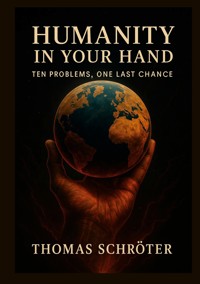
Our world is on the brink - but it's not too late. Thomas Schröter gets to the bottom of the biggest problems of our time: climate collapse, greed, alienation, loss of control. And he shows how we could act - if only we wanted to. A wake-up call for decision-makers, activists, and all people with hope.
Sie lesen das E-Book in den Legimi-Apps auf:
Seitenzahl: 68
Veröffentlichungsjahr: 2025
Das E-Book (TTS) können Sie hören im Abo „Legimi Premium” in Legimi-Apps auf:
Ähnliche



















Table of Contents
Foreword
Introduction: Why this book had to be written
Chapter 1: The Earth Burns – Climate Crisis and Environmental Destruction
Chapter 2: World Inequality – Wealth for the Few, Misery for the Many
Chapter 3: Machines Without Morals – Technological Dissolution of Boundaries
Chapter 4: Truth in the Fog – The Information Crisis One Screen, Many Realities
Chapter 5: The Collapse of Power – Political Instability and the Retreat of Democracy
Chapter 6: The Overexploitation of Life – Resource Scarcity and Ecological Exhaustion
Chapter 7: Empty Souls – Mental Crises and the Loss of Meaning
Chapter 8: Global Health at Risk – Illness in a Vulnerable World
Chapter 9: A Shrinking and Growing World – Demographic Extremes and Their Consequences
Chapter 10: The Final Risks – When Humanity Endangers Itself
Chapter 11: The Web of Crises – How Everything Is Connected
Chapter 12: The Beginning of Everything – Courage, Vision, Change
Global Instructions for Implementing a Future Worth Living
Foreword
What if we finally stopped talking about the symptoms of our time and started understanding the causes? What if we didn't just complain, but took consistent action? What if a book not only informed but also transformed? This book began with two simple yet radical questions I posed to an artificial intelligence: "What are the 10 biggest problems facing our civilization?" and "What solution do you have for them?" The answers were not only precise and comprehensive—they were, above all, systemic, holistic, and shockingly logical. No evasions. No excuses. No sugarcoating. The artificial intelligence was brutally honest. And at the same time, visionary. It showed not only where we stand as humanity—but where we could go if we had the courage. This book was born from these two questions. It addresses ten intertwined crises facing humanity – from climate catastrophe to social inequality and technological loss of control to emotional alienation, resource scarcity, and existential risks. But it doesn't stop at diagnosis. Each chapter develops concrete, well-thought-out, and feasible solutions: visionary in its ambition, realistic in its implementation. And what's more: Following Chapter 12, it contains a chapter with direct instructions for governments, organizations, associations, and clubs. Clear, unambiguous, and naming – without political considerations, without diplomatic platitudes. This book is not aimed at an elite. It is aimed at everyone: To those who despair. To those who hope. To those who ask themselves what they can do. It is not an academic work. Not a pamphlet. Not a party platform. It is a call to responsibility – and to renewal. When you hold this book in your hands, you are part of a movement that is greater than any individual. A movement of consciousness. A movement of connection. A movement for life. Spread this book. Don't read it alone. Discuss it. Give it away. Place it in libraries, schools, town halls. Talk about it with people who don't have enough time —and who therefore need this book. Because it's not too late. But it will be late if we continue to remain silent. The beginning lies in a decision. The future is in our hands. Thomas Schröter Writer, questioner, human being.
What are the 10 biggest problems of our civilization?
The ten greatest problems of our civilization can be classified into various categories—ecological, social, technological, economic, political, and existential. The following selection is based on a synthesis of scientific studies, geopolitical analyses, philosophical reflections, and systemic considerations. These are intertwined challenges whose solution requires a profound transformation of our global thinking and actions.
1. Climate Crisis and Environmental Destruction Global warming, the loss of biodiversity, ocean pollution, the destruction of rainforests, and species extinction threaten the ecological balance of our planet. The climate is changing faster than many societies can adapt. Extreme weather, droughts, floods, and rising sea levels lead to hunger, displacement, and conflict. The continued exploitation of natural resources is destroying the foundations of human existence. 2. Social Inequality and Distributional Injustice An ever-increasing wealth is concentrated in the hands of a few, while billions of people live in poverty. The gap between rich and poor is growing not only between countries but also within societies. Education, healthcare, housing, and social participation remain denied to many. This inequality is not only morally problematic but also endangers social peace and political stability. 3. Technological Dissolution and Loss of Control Artificial intelligence, surveillance technologies, neuroimplants, and biotechnology are developing faster than ethical or legal rules can take effect. Humanity faces the question of whether it will retain control over its own creations – or whether technologies will begin to dominate our scope for action, our freedom, and our thinking. The danger of digital authoritarianism, in which machines consolidate power structures, is growing. 4. Loss of Truth and Crisis of Trust In the "post-truth" era, it is becoming increasingly difficult to distinguish between facts and manipulation. Fake news, deepfakes, conspiracy theories, and propaganda are eroding trust in institutions, the media, and science. Democracies are being undermined from within, polarization is increasing, and public discourse is becoming more brutal. Without a common concept of truth, understanding becomes impossible. 5. Political Instability and Abuse of Power Corruption, nationalism, populism, and democratic deficits are undermining the legitimacy of political systems worldwide. Autocratic tendencies are increasing, international cooperation is being blocked, and multilateral institutions are losing influence. The global order is fragile, while geopolitical tensions are rising and a relapse into power politics is looming. 6. Resource Scarcity and Water Crisis Access to clean drinking water, fertile soil, clean air, and rare earths is increasingly becoming a source of conflict. Population growth, industrialization, and increased consumption are leading to overuse. Water scarcity already affects billions of people and is one of the greatest threats to peace, health, and food security. 7. Alienation and Loss of Meaning Many people feel alienated – from themselves, from others, from nature. In a world of constant acceleration and commodification of human relationships, the sense of belonging and meaning is lost. Loneliness, mental illness, and burnout are increasing. The question "What do we live for?" remains unanswered – yet is becoming the crucial question. 8. Pandemics and Global Health Risks The coronavirus crisis has shown how vulnerable our globalized world is to viruses. New pandemics, multi-resistant germs, and the misuse of biotechnology could pose future threats. At the same time, it is becoming clear that access to medical care is highly unequally distributed – with fatal consequences for global justice. 9. Population Explosion vs. Shrinkage While some regions (especially Africa) are experiencing exponential population growth, others (especially Europe and East Asia) are facing demographic collapse. Both developments pose enormous challenges: Overpopulation puts pressure on resources, infrastructure, and labor markets; population decline threatens pension systems, care, and the ability to innovate. 10. Existential Risks: Nuclear War, Supervolcanoes, Asteroids, AI Singularity Although statistically less likely, these dangers have the potential to wipe out civilization. Nuclear weapons are still on standby, and geopolitical conflicts could escalate. Researchers have also not ruled out the possibility of a supervolcano eruption, a globally catastrophic asteroid impact, or an out-of-control superintelligence. They demonstrate how fragile human civilization ultimately is. Conclusion: These ten problems are not isolated phenomena—they reinforce each other. The climate crisis fuels social inequality, technological loss of control undermines political systems, and a loss of meaning fosters extremism. A sustainable future therefore requires not a patchwork solution, but systemic change. Humans must relearn how to live in harmony with nature, technology, fellow human beings, and themselves. Otherwise, they endanger the Foundations of its own continued existence.
and what solution do you have for that?
Technology impact assessment before market launch (as with medications).
Democratic AI control: open source, citizen participation, ethics committees with veto power.
Digital fundamental rights: protection against surveillance, manipulation, and algorithmic discrimination.
Human-centered development: technology as a tool for developing human potential – not for control.
Ban on autonomous weapons systems, obligation to ensure transparency for algorithms.
4. Loss of truth → Solution: Enlightenment 2.0
Compulsory "digital media literacy" subject: in all schools from the age of 6.
Promote independent journalism: e.g., through foundation systems such as public research.
Platform regulation: algorithms must not be primarily focused on polarization and hate.




