


Erhalten Sie Zugang zu diesem und mehr als 300000 Büchern ab EUR 5,99 monatlich.
- Herausgeber: Publicacions de la Universitat de València
- Kategorie: Fremdsprachen
- Serie: English In The World Series
- Sprache: Englisch
The impact of digital storytelling all over the world cannot be disputed. It has become the perfect bridge between both traditional and new ways of engaging the creation and transmission of stories and has been successfully implemented across social and educational contexts. This volume brings together a selection of articles that explore such implementation in various educational fields and levels from kindergarten to university, and also in programmes of continuing education throughout the world. While presenting creative experiences and contributing practical advice, the articles also share a common methodological drive: they collect and appraise objective data to show how digital storytelling practices are a strong asset to the 21st century classroom. Each article critically explores the key role played by digital storytelling activities in the development and strengthening of multimodal literacies, cognitive engagement, creativity, research and information handling, communicative skills in a foreign language, self-confidence, and collaborative learning, among others. All in all, digital storytelling projects foster the creation of peer-assisted learning communities and also becomes a valuable resource to teachers seeking to revitalize their pedagogical practice.
Sie lesen das E-Book in den Legimi-Apps auf:
Seitenzahl: 348
Veröffentlichungsjahr: 2014
Das E-Book (TTS) können Sie hören im Abo „Legimi Premium” in Legimi-Apps auf:
Ähnliche





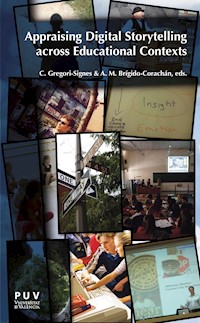
Appraising Digital Storytelling across Educational Contexts
Appraising Digital Storytelling across Educational Contexts
CARMEN GREGORI-SIGNES AND ANNA M. BRÍGIDO-CORACHÁN, EDS.
UNIVERSITATDEVALÈNCIA
2014
ENGLISH IN THE WORLD SERIES
GENERAL EDITOR
Antonia Sánchez Macarro Universitat de València, Spain
ADVISORY EDITORIAL BOARD
Professor Enrique Bernárdez Universidad Complutense de Madrid, Spain
Professor Anne Burns Macquarie University, Sydney, Australia
Professor Angela Downing Universidad Complutense de Madrid, Spain
Dr Martin Hewings University of Birmingham, Great Britain
Professor Ken Hyland City University of Hong Kong, China
Professor James Lantolf Penn State University, Pennsylvania, USA
Professor Michael McCarthy University of Nottingham, Great Britain
Professor Eija Ventola University of Helsinki, Findland
© The authors © 2014 by the Universitat de València
Design and typeset: Celso Hdez. de la FigueraCover design by Pere Fuster (Borràs i Talens Assessors SL)Cover Images by Anna M. Brígido-Corachán and Carmina Gregori-Signes
I S B N : 9 7 8 - 8 4 - 3 7 0 - 9 6 1 0 - 0
Notes on Contributors
ANNA M. BRÍGIDO-CORACHÁN (PhD New York University – University of Valencia) is a full-time lecturer at the University of Valencia and a member of the cross-disciplinary research group “Culture and Development”. Her academic interests include minority literatures and cultures in the Anglophone world, audiovisual languages and educational ICTs, with a special research focus on contemporary indigenous literature and history of the Americas and on digital storytelling.
MARK DUNFORD is an academic from the Faculty of Arts at the University of Brighton and a Director of Digitales, a research based company specialising in Digital Storytelling hosted at Goldsmiths College University of London. Digitales has overseen the successful delivery of many Digital Storytelling projects since it was first established in 2005. Mark is a Fellow of the Royal Society for the Arts.
CARMEN GREGORI-SIGNES is a full-time lecturer at the University of Valencia and a member of EDiSo (Studies in Discourse and Society). Her research fields include language learning, discourse analysis and corpus linguistics and more specifically the study of language use in fictional and non-fictional television discourse. Her current research focuses on computer assisted multimodal discourse analysis of fictional television series with the intention of delving into the complex relationships between media representations, society and our place in it.
KRISTIN HOLTE HAUG is associate professor at Oslo and Akershus University College of Applied Sciences, Faculty of Education and International Studies. She teaches pedagogy and ICT & learning at the Early Years Teacher Program. Her research topics are Workplace-based studies and ICT & learning, with a special interest in Digital Storytelling as a tool for documentation and reflection in higher education. She has published books and articles on these topics.
GRETE JAMISSEN is associate professor at the Multimedia Section of Oslo and Akershus University College of Applied Sciences. In 2006 she launched an interfaculty Digital Storytelling (DS) project resulting in a number of study programs implementing digital storytelling for learning and reflection. Other research topics are ICT and learning, experience based learning and action research. She coedited the first Norwegian book on Digital Storytelling and learning (2012).
JOE LAMBERT founded the Center for Digital Storytelling (formerly the San Francisco Digital Media Center) in 1994, with wife Nina Mullen and colleague Dana Atchley. Together they developed a unique computer training and arts program that today is known as the Standard Digital Storytelling Workshop. Since then, Joe has traveled the world to spread the practice of digital storytelling and has authored and produced curricula in many contexts, including the Digital Storytelling Cookbook, the principle manual for the workshop process, and Digital Storytelling: Capturing Lives, Creating Community.
LINA LEE (Ph.D. University of Texas, Austin) is professor of Spanish at the University of New Hampshire where she teaches courses in second language acquisition, foreign language methodology and applied linguistics. She has conducted research and published articles on language pedagogy, computer-mediated communication, online feedback and discourse analysis. She has also designed online activities to accompany Spanish language textbooks.
IRENA MAUREEN is a lecturer in the Educational Technology Department at State University of Surabaya, Indonesia. After being introduced to Digital Storytelling in a short course at the University of Sydney Australia in 2009, she started to implement it in her classes for her studies. She also keeps a blog about digital storytelling in Bahasa Indonesia and is in charge of EdCamp-Indonesia, a community discussion on Education. Her current research focuses on the uses of Digital storytelling in Higher Education.
SARA MCNEIL is an associate professor and program coordinator of the Learning, Design and Technology graduate program at the University of Houston. She teaches courses in instructional design, the collaborative design and development of multimedia and the visual representation of information. She researches, publishes and presents about emerging technologies in educational environments and is a consultant to schools concerning 21st century technologies.
ANH NGUYEN is currently an instructor at Cornerstone College, Vancouver. She is also collaborating with the Faculty of Education of Simon Fraser University, Canada in a four-year research on the effects of digital technology on the socio-emotional life of older adults. Anh Nguyen holds Master’s degrees in Education and Arts from the University of Sydney and Eastern Michigan University, as well as a doctorate in Education with an emphasis on Instructional Technology from the University of Houston. Her research interests include instructional technology, curriculum design, language teaching and digital literacy.
DOLORS PALAU SAMPIO is a full-time lecturer of Journalism in the Faculty of Philology, Translation and Communication at the University of Valencia. Her teaching and research deal with writing, journalistic styles and digital storytelling. She worked for nine years as a journalist at Levante-EMV, a regional newspaper, and has been a visiting scholar at universities in the UK, France, Germany and Chile.
MARGARITA RAMÍREZ LOYA is a full-time ESL instructor at Cochise College in Douglas, Arizona. Her passion for teaching in non-traditional settings has led her to create learning projects that are focused on community involvement and participation. To date, she has co-authored with her ESL students two books from the We Are Stories series that capture and preserve the stories of the Arizona-Sonora Borderlands community.
BERNARD ROBIN is an associate professor of Learning, Design and Technology at the University of Houston. He is an internationally recognized leader in the educational uses of digital storytelling and has been teaching courses, conducting workshops, writing articles, and supervising graduate student research on the educational uses of digital storytelling for over a decade.
JOSÉ LUIS RODRZÍGUEZ ILLERA is a professor in the Faculty of Pedagogy at the University of Barcelona. He has been working on the effects of digital technology in society for the last 30 years with a focus on new forms of digital literacies and narratives. He serves as editor of the journal Digital Education Review and supervises doctoral research.
ALISON ROOKE is a lecturer in the Sociology department and CoDirector of the Centre for Urban and Community Research, (CUCR), a well-established interdisciplinary research centre within Goldsmiths’ Department of Sociology (UK). At CUCR Alison works in partnership with a range of arts organisations and cultural and educational institutions and a range of partners at a national, European and international level.
SONER YILDIRIM is a professor of instructional technology at the Middle East Technical University in Ankara, Turkey. He received his M.A. in educational systems development from Michigan State University in 1993, and his PhD in instructional technology from the University of Southern California in 1997. His current research interests include pre and in-service teachers’ technology integration, learning objects, social media use in education and digital storytelling in education.
PELIN YUKSEL ARSLAN is a professor of instructional technology at Inonu University in Malatya, Turkey. She received her PhD in instructional technology from Middle East Technical University in 2011. Her research interests include digital storytelling, teacher education, technology integration in K-12 settings, qualitative research methods, and phenomenological research methods.
CONTENTS
Notes on Contributors
1Digital storytelling and its expansion across educational contexts
Anna M. Brígido-Corachán and Carmen Gregori-Signes
2Digital storytelling at a crossroads. Historical context for an ever-emerging genre
Joe Lambert
3Personal storytelling in the digital society
José Luis Rodríguez-Illera
4Atomisation of data versus storytelling. Renouncing the narrative voice in digital newspapers
Dolors Palau Sampio
5Using digital storytelling to create educational projects for diverse web audiences
Bernard Robin and Sara McNeil
6Towards the digital storytelling university
Grete Jamissen and Kristin Holte Haug
7Sharing the experience of creating a digital story: an inquiry into the knowledge community of digital storytellers and its educational implications
Anh Nguyen and Bernard Robin
8Empowering learners with digital news stories: an exploratory study of a college Spanish course
Lina Lee
9Digital storytelling beyond the ESL classroom
Margarita Ramírez Loya
10Exploring the collaborative learning possibilities in the use of digital storytelling in higher education
Irena Maureen
11Digital storytelling activities in a kindergarten
Pelin Yuksel, Bernard Robin and Soner Yildirim
12Extending creative practice
Mark Dunford and Alison Rooke
1
Digital storytelling and its expansion across educational contexts
ANNA M. BRÍGIDO-CORACHÁN AND CARMEN GREGORI-SIGNESUniversitat de València - IULMA
Abstract
This chapter briefly examines the history of digital storytelling as a genre and the place that educational digital storytelling holds within it as an empowering pedagogical practice that both students and teachers can strongly benefit from. By highlighting some of the theoretical frameworks and key findings that are explored in the accompanying chapters, we hope to further understand the potential advantages and challenges that implementing digital storytelling practices across a variety of educational contexts may bring to all practitioners and users.
Keywords: digital storytelling, education, learning styles, digital natives.
1Introduction: origins of digital storytelling as a genre
We imagine, experience, and endlessly recreate the world through stories. Storytelling is and has always been at the “core of human activity” (Lambert 2002: 19) and all individuals and societies have explored old and new ways to make such stories compelling, moving, empowering, and everlasting. One of the most recent manifestations of this narrative drive is Digital Storytelling, which started in the 1990s in the Centre for Digital Storytelling (CDS) in California. The novelty at the time was that the advances in technology would facilitate the work that the CDS had been doing until then, that is, help people tell their own story. The Center’s motto was, in fact, “everyone has a story to tell”. Now, digitalization would make the process more attractive and more challenging.
Following authors such as Barrett (2004), Lambert (2010), and Robin (2011), we can define digital stories as short narratives (between 2-5 minutes) that combine traditional modes of story narration with other multimedia tools, such as drawings and graphics, audio material, video extracts, animation and online publication –with one of its most noteworthy characteristics being that the author narrates the story with his/her own voice (cf. Barrett 2006).
The impact of digital storytelling (DS) all over the world cannot be disputed (cf. Harvey and Williams 2009). Although it has been implemented in several fields (history, health and medicine, social services, or culture and the arts), its strongest contribution has been in education, where DS activities have received a warm welcome on the part of both students and teachers (Alcantud-Díaz and GregoriSignes 2013). The implementation of digital storytelling in all educational levels from kidergarten to university and also in continuing education programmes and in non-institutional, social-oriented workshops has brought many advantages to the classroom and has played a key role in the development and strengthening of motivation, confidence, digital literacies, cognitive engagement, creativity, research and information handling, organization management, critical thinking, writing skills, and collaborative learning, among others (Barrett 2006, Robin 2006, Dogan and Robin 2008, Bou 2013, Brígido-Corachán 2013, Alcantud-Díaz et al. 2014, Gregori-Signes 2014). Tellingly, students born between 1980 and 2000 are already being referred to as digital natives, Millenials, the Net Generation, or Generation 2.0. The learning styles and social practices of this digital generation differ from those of other age groups and include an ability to multitask, heightened technological expertise, a preference for networked interactions, and for image and audio-based formats over textual platforms (Mason and Rennie 2008: 24-5). Such students build on these multi-literacy skills and also gain an awareness of social diversity, increase their self-confidence, and develop collective reflection through the process of creating digital stories (Brígido-Corachán 2013, cf. Lee, Nguyen and Robin, Yuksel et. al. and also Ramírez Loya in this volume).
As Lambert points out, “if children remember the stories of their own learning process and can readily apply their unique sets of strengths and intelligences, they will develop their own strategies for learning” (Lambert 2002: 99). Thus, because the late nineties and the early two thousands were and still are the era in which technology is paramount, DS has become a perfect bridge between both traditional and new ways of perceiving the transmission of stories (Gregori-Signes 2008).
2Theoretical frameworks and pedagogical settings of digital storytelling
This volume brings together a selection of articles that explore the implementation of digital storytelling across the curriculum in different educational fields and levels, from kindergarten to higher education. Together with a primary focus on pedagogy, storytelling, and technology, these articles share a common methodological drive, since they all scientifically appraise the successes and failures of digital storytelling in educational settings. That is, these articles are not mere descriptions of classroom experiences or case-studies but deploy a variety of measuring instruments and objective data to show how digital storytelling practices are a strong asset to the 21st century classroom.
The present volume includes three introductory articles that frame these pedagogical experiences by introducing readers to the historical context of the genre (Lambert), then moving to its potential as a vehicle for social reflection and personal introspection (Rodríguez Illera), and finally investigating the idiosyncratic features of the narrative voice in other related digital storytelling formats such as newspapers (Palau Sampio). The remaining articles more specifically delve into a variety of DS practices in different educational settings and fields of research, that is, they explore what is the core focus of this book, the pedagogical uses of digital storytelling, by applying an objective lense to the form’s merits and shortcomings. Robin and McNeil and Nguyen and Robin discuss various DS projects that have been implemented at the University of Houston, a pioneering institution in the field of educational digital storytelling, and give critical advice on how the collaborative process of creating a digital story should be organised to maximise its effectiveness. While Jamissen and Haug consider the challenges of using DS to improve professional competence in pre-service teachers, the articles of Lee, Maureen, and Ramírez Loya focus on the various uses of DS in foreign/second language learning. Finally, Yuksel et al., examine DS activities with younger practitioners in kindergarten, while Dundford and Rooke take us beyond the traditional classroom to describe the empowering experience of using DS in long-life learning programmes with older adult groups.
Finally, it is worth stressing that contributors to this volume are all socially-conscious educators who have often brought digital storytelling outside school boundaries, transferring the empowering, pedagogical benefits of digital storytelling to other collectives such as the elderly or to immigrant communities in their respective countries, through community-based projects, continuing education programmes, and social workshops of many kinds. Writing, telling, and listening to others’ stories help us become reflective, life-long learners and committed, participative citizens. The articles that follow ultimately teach us that classrooms have no walls.
The volume opens with a chapter by Joe Lambert on the history, core process, social, and educational advantages of DS for the individual user/storyteller, the role of the very active Center for Digital Storytelling (CDS) in the spread of DS around the world via its dynamic and inspiring workshops, and explores the future of digital stories in today’s increasingly digital society. In his article, “Digital Storytelling at a Crossroads. Historical Context for an Ever-Emerging Genre”, Joe Lambert, one of the driving forces at the CDS, describes the four phases of dissemination of their methods in digital storytelling: the Creative Phase (1993-1996), the Literacy Phase (1997-2001), the Methodological Phase (2002-2004), and the Ethos Phase (2005-2013). During the creative phase, the CDS considered the potential of digital video [and] “[…] was somewhat unique in suggesting that these very state-of-the-arts tools were about greatly expanding the literacy of people as media creators” (Lambert, in this volume). Lambert explains how the CDS organised workshops all over the United States to expand their method. The literacy phase (1997-2001) consolidated this expansion with the publication of their Digital Cookbook, which provided the public with a method that could be mimicked by creative educators who wanted to work with DS. Educators in the United States soon realised that this approach to storytelling implied a multimodal approach to communication and learning that would ultimately be replicated, later on, all over the world: “the Cookbook became a teaching text, and we developed the first Train-the-Trainer materials to assist educators in developing their own curriculum” (Lambert, in this volume). This growth, however, implied a change to the original first person narrative promoted by the CDS. As argued by Lambert “the challenge of scholastic demands and a general resistance to the idea of first person storytelling as appropriate for classroom contexts, meant that in many K-12 contexts, digital stories became illustrated essays, essentially taking the style of impersonal analytical exposition with pictures.” As for the methodological phase (2002-2004), during this period the CDS established itself as a global authority on the method for teaching DS with the publication of Digital Storytelling, Capturing Lives, Creating Community. The CDS and their method gained recognition at an international level, a fact that brought about a diversification of the practice of digital storytelling and forced the CDS to position themselves against the different emerging types of digital stories. The CDS chose to stay within his origins and, as Lambert explains, kept a “specifically affective approach to digital storytelling as a tool for emotional health and wellbeing.” Finally, during the Ethos phase, the CDS reconfigured their objectives and approach and concluded that DS can be used “in the processes of creative self-definition, emotional intelligence and social and emotional learning, as a core component of well-being and whole thinking for a 21st Century student.” Their work aims at spreading democratic values and civil participation, making sure that all minority groups, disenfranchised communities, and also individuals within those collectives, can raise their voice and have a vehicle and public space to tell their story. Lambert particularly emphasises the role of the Story Circle in the DS process since the CDS is a highly precise model of group facilitation.
The concept and context of the emergence of personal digital storytelling is explored by José Luis Rodriguez-Illera in his article “Personal Storytelling in the Digital Society”. Rodríguez-Illera dissects the two core components of DS, that is, “digital” and “storytelling,” considering each of them separately and in relation to one another. He focuses on the function rather than the form of personal digital storytelling and distinguishes between informative vs. expressive digital stories while admitting that they may overlap. He then proceeds to characterise more precisely the type of text generated by personal digital storytelling and the process through which such stories are produced. Rodriguez Illera argues that personal digital stories share features with autobiographical narratives, in particular with what Lejeune (1975, cited in Rodríguez-Illera in this volume) refers to as the “autobiographical pact”, in which the author, narrator, and character are one and the same, which differentiates it from other genres. Core characteristics of personal DS underlined by Rodriguez-Illera include its linearity, its short duration, and its autobiographical focus. Finally, the author concentrates on the reception of DS and its point of view indicating that: “what is truthful about the text is its internal credibility or, put another way, the relationship between the author and the degree of truth that he/she confers on what is narrated.” As for the relationship between reader and author and DS, the strategies identified by the author are of an external and internal nature. The external features are bound by the host website itself and by the markers that reveal the amateur nature of the storytellers. Internal characteristics would be, in large part, the voice and first person narration and the emotional nature of the story. Rodriguez-Illera concludes his article by positing that further studies should be devoted to DS and its generic hybridity.
The next article by Dolors Palau, “Atomisation of Data versus Storytelling”, draws attention to the current transformation of the narrative voice in digital newspapers. According to Palau Sampio, the narrative voice is a potentially powerful element of writing that is being neglected by media in the digital age. Palau examines the configuration of the narrative voice in over three hundred examples of the newspaper genre features (especiales) published by two Spanish newspapers with a large readership. Applying both quantitative and qualitative methods to her analyses, she concludes that contemporary digital news lean towards the suspension of traditional characteristics of narrative such as plot, voice, and internal coherence, and favour instead an atomisation of data and a disjointed presentation of separate elements in the featured story that enables authors to avoid responsibilities. For journalists, bloggers, reporters, and communicators of the digital age the challenge is no longer the knowledgeable use of media tools and ICTs but, as Palau points out, “the capacity to narrate, to tell a story, to give a full account of a complex reality in a multimedia, hypertextual, and interactive environment”, and to recover the interpretative and analytical standards of quality journalism. Moreover, by turning their reporting into mere of assemblages of data, contemporary journalists fail to fully explore the potential of multimodality in electronic media. Therefore, Palau advocates for the creation of complex multimedia stories through the reinforcement of traditional narrative features in concert with new technologies –both of which should play an integral part in the academic training of future media and communication professionals.
As we have seen, digital storytelling practices used in any field of knowledge and experience always have a strong pedagogical component. Whether autobiographical, historical, or news-based, the act of telling a story necessarily implies the use of narrative, technology, and other forms of literacy as a vehicle for reflection and enlightenment. The remaining articles in this volume specifically explore such pedagogical components more in depth, that is, the implementation of digital storytelling in educational settings. As argued by Gregori-Signes and Pennock-Speck (2012: 1) “educational digital stories are school-focused, produced and developed within the school context and as part of the academic curriculum which engage in formal schooling applications of DS” from kindergarten to pre-service teaching. In these educational settings, as expressed by McWilliam (2009: 152), DS is often seen as an empowering tool at the academic and personal/social levels as it “build[s] media literacy, narrative development and self-presentation skills, but also means engaging students who might otherwise be struggling socially and/or intellectually.”
One of the pioneers in the implementation of digital storytelling in educational contexts is Dr. Bernard Robin, who in Robin and Mc-Neil (2012) explains how he introduced DS and how it has become a major focus in the University of Houston where “[f]aculty members and graduate students in the Laboratory for Innovative Technology in Education (LITE) teach courses, deliver workshops, conduct research, write articles and share presentations at conferences on the many different aspects of how digital storytelling can be used in educational settings.” Most of their resources can be found on the website Educational Uses of Digital Storytelling (<http://digitalstorytelling.coe.uh.edu>) that was “originally created in 2004 by one of the authors (Robin, 2006) with the primary goal of informing educators and students about how digital storytelling could be integrated into a variety of educational activities” (Robin and Mc-Neil, in this volume)
Robin and McNeil’s chapter offers an overview of the large-scale-DS projects that students created at the University of Houston and explain how they broadened their DS activities so that digital storytelling practices now also include the design and/or compilation of a wide spectrum of related pedagogical materials to supplement and reinforce each production. Projects described include: James Surls, The Hoaxes!, War Experience, and Invenciones de la Inventiva. For the authors, the term project implies that the digital stories are “only part of a larger set of educational resources”. The interactive, public outcomes of these projects are, among others, the development of a digital submission system that allows external visitors to share their own stories about World War II, or the creation of a repository of cross-disciplinary materials that can be used by teachers across educational levels.
Robin and McNeil also establish a series of factors that should be considered in the implementation of educational DS practices, and give advice on how to handle each step and facilitate the task for the students. Core steps to be followed are: 1) defining the main topic; 2) identifying its intended audience; 3) organising the story; 4) addressing the challenges faced during the process; and 5) assessing student competence development through the use of questionnaires. Students were additionally asked to describe their own experience and also to evaluate the supplemental materials they had been provided with to elaborate the story. In their conclusions, the authors establish the importance of continuously reviewing the teaching and learning process they use in order to understand the multiple factors that students must deal with as they design, develop, and evaluate their digital storytelling projects.
Jamissen’s and Haug’s “Towards the Digital Storytelling University” is groundbreaking in that it appraises the benefits and effects of developing digital storytelling practices at a large scale, across a whole professional education programme in an institution of higher education: Oslo University College of Applied Science (HiOA), in Norway. Specifically, Jamissen and Haug discuss the effects of implementing DS at HiOA’s Bachelor Degree in Early Childhood Teacher Education, through a three-year period. Grounding their study in a methodology that blends action research and theory on learning organizations, they believe that DS can be effectively used to develop professional competence as it improves pre-service teachers’ “reflection on practice,” while strengthening their creativity and initiative.
Jamissen and Haug also address some of the logistics, and the technological and organisational decisions that must be taken into account when building a DS programme across a whole institution. These include “building sustainable structures”, curricular and administrative continuity, a consideration of instructors’ skills such as motivation, ability for innovation and leadership, and obtaining rooms and spaces that are appropriate for a project of such magnitude. Educators aiming to broadly implement DS across a whole institution of learning should also consider issues such as the general resistance of traditional colleagues to the use of ICTs as learning tools, as well as busy faculty schedules and heavy workloads. All in all, the authors suggest that implementing DS in professional education programmes is clearly beneficial to lessen practice shock, that is, to minimize the challenging disconnect between educational theory and professional practice, which creates anxiety and even withdrawal in teachers at the beginning of their pedagogical careers.
A productive way to further understand the benefits and challenges of digital storytelling in higher education is to explore the process that leads to the production of a digital story and to examine the knowledge community that emerges when digital storytellers collaborate with one another. In their article “Sharing the Experience of Creating a Digital Story” Nguyen and Robin argue that building a solid DS knowledge community, that is, a “circle of pre-service or in-service teachers sharing face-to-face their practical knowledge or narrative knowledge through stories” (Nguyen and Robin in this volume), in fact becomes a core component of the DS learning experience. Knowledge communities emerge and grow through negotiation and collaboration, and through the sharing of experiences, cultural perspectives, and final outcomes. According to Nguyen and Robin the concept of sharing in educational DS stretches even further and lays at the heart of its very process of creation as, in sharing these experiences, digital storytellers stir reflection on their own and on others’ progress.
To understand the inner workings of the type of sharing, reflection, and self-evaluation that takes place within DS knowledge communities in an educational setting, Nguyen and Robin specifically focus on the implementation of story circles. In their study, they monitor a series of storytellers’ interactions through online discussion forums stored in Moodle, and they also examine the consequences and challenges of sharing storytelling experiences when these are part of an institutionalized, educational curriculum. Following the methodological parameters of narrative inquiry (Connelly and Clandinin 1990) and based on data gathered by Anh Nguyen during the writing of her doctoral dissertation throughout an eight month period in a large university in Houston, Texas in 2010-2011, Nguyen and Robin conclude that educational DS processes become more effective and beneficial when students are able to build such communities of knowledge, that is, when they have an online forum at their disposal that works as a constructive learning environment where multidirectional interaction and sharing can take place. In this manner, students can not only actively learn from and reflect on each others’ errors and successes, but also practice self-evaluation. The benefits of implementing DS in the classroom thus lay mostly in the process of creation and not in its outcome.
One of the possible applications of DS, which needs to be further explored, is its use in foreign language teaching settings, where students not only create a story but also experiment with story building using a language that is not their own mother tongue (Reyes-Torres et al. 2012) and, what is more, facing the difficulty to produce a coherent multimodal digital story (cf. Bou-Franch 2012, Gregori-Signes 2014). Robin (2006) argues that DS helps students improve the following skills (cf. Lee in this volume): 1) Research Skills: Documenting the story, finding and analyzing pertinent information; 2) Writing Skills: Formulating a point of view and developing a script; 3) Organisation Skills: Managing the scope of the project, the materials used, and the time it takes to complete the task; 4) Technology Skills: learning to use a variety of tools, such as digital cameras, scanners, microphones and multimedia authoring software; 5) Presentation Skills: Deciding how to best present the story to an audience; 6) Interview Skills: Finding sources to interview and determining questions to ask; 7) Interpersonal Skills: Working within a group and determining individual roles for group members; 8) Problem-Solving Skills: Learning to make decisions and overcome obstacles at all stages of the project, from inception to completion; and 9) Assessment Skills: Gaining expertise critiquing their own work and the work of others.
In this volume, there are three articles that report on the use of DS in the foreign language classroom. First, Lina Lee examines the use of digital stories to build language learners’ content knowledge and oral skills. Her article is one of the few available which has used digital storytelling to foster the learning of Spanish as an L2. A group of university students used VoiceThread to create news digital stories about current events in Spanish-speaking countries with the intention of promoting authentic communication. The analysis includes both qualitative and quantitative data gathered from students’ digital news recordings, blog reflections, online surveys, and final interviews, which were utilised and analysed to report the findings. Lee designed the tasks with the purpose of helping students to “improve their pronunciation and oral skills by regularly creating voice recordings”. She also stresses the importance of addressing strategies to create digital stories prior to task execution, in order to avoid overwhelming the students with the demands of the task itself. As concluded by Lee (in this volume): “[t]he results show that digital news stories empowered students to use their own voices for self-expression and self-reflection. Through interactive exchanges, students collaboratively built knowledge”.
The contribution by Margarita Ramírez Loya, “Digital Storytelling beyond the ESL Classroom”, considers how two separate groups of non-English speaking university students enrolled in an English as a Second Language (ESL) classroom at Cochise College (Arizona) and used digital storytelling to improve their digital and linguistic skills in academic and non-academic settings. Combining foreign language learning with an oral history project, the students in the module were asked to produce digital narratives based on stories shared by members from the English-speaking community around them. This activity forced them to develop communication in a foreign language within a real social environment and with a specific purpose in mind: gathering oral stories and creating historical narratives aimed at commemorating the Arizona Centennial. In addition to improving linguistic practice in a foreign language, this experience also enabled non-English speaking students to establish meaningful connections with members of the community outside their educational institution, located near the borderlands between the states of Arizona (United States) and Sonora (Mexico).
Data obtained from focus group interviews and close monitoring of the students’ performance along the process indicate that, through the use of DS and through close interactions with the neighbouring community, these ESL students became more reflective learners and skillful communicators. Moreover, in addition to strengthening their linguistic skills in a foreign language, students developed collaborative learning, critical thinking, tolerance, and a more heightened awareness of social diversity.
The third article dealing with instruction in a foreign language is Maureen’s “Collaborative Learning Possibilities in the Use of Digital Storytelling in Higher Education”. In Maureen’s study, DS projects were used as a means to develop collaboration and critical thinking skills within a group of students that had fallen below their expected level of performance and who had neglected peer assistance. Maureen identifies a series of problems and anxieties that these students had during the first implementation of DS in the module, mainly, fears of failing the course, diffidence, and not being able to complete the task. These conceptual blockers, according to the author, were the reason that digital storytelling did not succeed the first time they took on the task.
The second time DS was implemented in the EFL classroom, it was specifically aimed at promoting collaborative learning. Maureen designed a project in which there were language-oriented activities and technology-oriented activities that could be carried out individually or in collaboration with other students. Student performance and results were monitored by means of pre- and post-task questionnaires, focus group discussions, and close observation during lectures. The analysis of this data shows that learning individually was mostly preferred when engaging language activities (m=70.3), while learning collaboratively was most frequently chosen when carrying out technology activities (m=64). However, once students were lectured on the benefits of collaboration when producing a digital story, students’ strongly leaned towards collaboration when engaging language activities as well. Collaboration helped students to make their thinking processes explicit, to productively interact and compete in an attempt to improve their story, and increased their awareness of social networks as useful tools where valuable peer-assistance could be obtained. All in all, DS proved to be a helpful activity suitable for improving language skills and for promoting creativity, critical thinking, and collaboration amongst peers.
Finally, although we can find a wide variety of studies describing the impact that implementing digital storytelling projects may have in higher levels of education, digital storytelling as a potentially useful tool in early childhood education has received surprisingly very little scholarly attention. In their article “Digital Storytelling Activities in a Kindergarten” Pelin Yuksel, Bernard Robin, and Soner Yildirim address this gap in the field and analyse the benefits and challenges of introducing DS in a kindergarten classroom in Ankara, Turkey. Grounding their pioneering study on in-depth teacher interviews and non-participant classroom observation of a preschool group, the authors posit that early educational levels may also benefit from digital storytelling projects. Study results indicate that DS activities can help kindergarten teachers overcome technological anxiety whilst strengthening younger learners’ self-confidence and media literacy through self-representation, depiction of tailor-made real life preoccupations, and collective reflection. Moreover, used as a creative, problem-solving approach to knowledge, digital storytelling may constitute an attractive way to introduce preschoolers to some of the educational advantages of already familiar household technologies (video cameras, photographs, computers) and also enable teachers to tackle core psychological and social issues faced by students at a young age by turning their personal challenges into stories which are both enlightening and empowering.
Outside the world of institutionalised education, from kindergarten to university and pre-service teaching, digital storytelling has often been deployed as a tool for self-representation and for social inclusion, especially within communities that have traditionally been left outside the digital sphere (Lundby 2008; Hancox 2011). Digital storytelling can encourage people of all ages, genders, and heritages to become participative citizens in 21st century online cultures (Jenkins 2006). Closing our volume, Mark Dunford’s and Alison Rooke’s article, “Extending Creative Practice,” (ECP) examines such ways in which digital storytelling can become an empowering tool for older adults in broader social/educational contexts. ECP is a pan-European project that integrates media, education, social services, and care in Slovenia, Romania, Finland, and in the United Kingdom, where it is also known as Digi-Tales. The project’s focus group is older adults, a collective that has traditionally been excluded from technology and the digital sphere. As stated in the article, 65% of European adults in the 65-74 age range had never used Internet in 2012, while this was only the case for 4% of European youngsters between 15-24 years of age. According to Dunford and Rooke (in this volume), digital storytelling can be an effective tool that increases the “range and amount of opportunities for autobiographical storytelling” within a collective that is rich in personal and social experience. This age group has lived through many historical transformations, yet often has fewest opportunities to share such knowledge in today’s e-society.
A series of DS workshops were therefore carried out with the aim of building creative digital practice through oral history and the arts. Although ECP’s main priority was to reduce the digital divide and so increase active ageing, workshop trainers soon expanded its focus of interest and addressed the rich pool of lived experiences that were being generated by project participants. Through content analysis of these oral histories and focus group feedback, Dunford and Rooke explore core features of elderly DS in a selection of narratives from the four participating countries, paying particular attention to the powerful role of photographs and images within DS. Their conclusion is that DS proves to be a user-friendly digital tool that enables e-inclusion because it works in combination with more traditional forms of autobiography and narrative that older collectives are familiar and comfortable with. DS workshops may thus contribute to bridge the technological gap for the elderly, increasing their independence, their access to public services, and their civil participation in the digital sphere.
3Conclusion
The benefits of implementing Digital Storytelling as an approach and tool in all levels of education and pedagogical settings are numerous and varied. For students, the practice of storying, that is, developing a stronger understanding of narrative structures and mental meaning construction (Hamilton and Weiss 2005 cf. Ramírez Loya, in this volume) becomes a fundamental resource in their repertoire of learning strategies, as both the process of listening and telling stories and also the process of sharing experiences and negotiating while the stories are being created strengthens communication, collective reflection, collaborative learning, social skills, emotional intelligence, and self-confidence (cf. Lambert, Robin and McNeil, Nguyen and Robin, Maureen in this volume).
From a teaching perspective, several contributors to this volume agree that implementing digital storytelling activities in the classroom creates more active, reflective, and innovative educators and can also alleviate both technological anxiety (cf. Yuksel et. al.) and the so-called practice shock, the stressful disconnect that creates an often unsurmountable gap between pedagogical theory and professional practice for teachers at the beginning of their careers (cf. Jamissen and Haug).
Within a broader social context, digital stories work as a form of knowledge-transmission, while bringing self-recognition, emotional and social empowerment to their creators. Given the fundamental characteristics of digital storytelling (short message, narrative coherence, authorial voice, and effective integration of multimodal elements, among others) we can affirm that implementing DS in all levels of education and pedagogical settings enables practitioners to become aware of the importance of core storytelling elements such as plot, narrative voice, structure, internal coherence, and a critical interpretation of information. Thus, they can transfer their understanding of narrative to other socio-political fields such as the press and other forms of electronic media, where, as Palau points out in this volume, we see an increasing abandonment of solid stories in favour of atomised, disjointed facts where information is incoherently singled out, while ethical commitment and civil responsibilities are left aside. Strengthening the story-telling aspects of DS may thus help us face the new narrative challenges of fragmented, hurried, ephemeral communication in the digital age. Beyond institutionalized education, digital storytelling is already becoming an empowering tool for self-representation and social inclusion within collectives such as older adults, who have traditionally been left outside the digital sphere (Hancox 2011, cf. Dunford and Rooke, in this volume).
Although still a challenge for many other collectives, the use of technology has become an available, familiar tool for an increasingly wide sector of the world population today. The “digital” now makes little difference, since the analog, as Lambert argues in this volume, “has essentially failed to exist”. However, enabling people to “increase depth and emotional power” in their stories, “to make them effective and memorable storytellers at all levels of literacy, becomes a continuing challenge for all practitioners […]” (cf. Lambert, in this volume) as does the achievement of multi-modal fluency. The focus must now turn from technology to narrative structure and voice again, to ideas, self-confidence, and creativity in these new multimodal literacies –to the core elements of human storytelling since its emergence.
References
Alcantud-Díaz, M. and Gregori-Signes, C. (eds.) (2013). Experiencing Digital Storytelling. JPM Ediciones.
Alcantud-Díaz, M., A. Ricart Vayá, and C. Gregori-Signes (2014). “‘Share your experience’. Digital Storytelling in English for Tourism”. Iberica, 27, 185-204.
Barrett, H.C. (2006). Digital Stories in ePortfolios: Multiple Purposes andTools. <http://electronicportfolios.com/digistory/index.html>. Accessed 04/01/2007.
Brígido-Corachán, A. M. (2013). “Cultural Digital Stories: Building Up Research through Hi-storytelling and Learning Object Design.” In Alcantud, M. and C. Gregori-Signes (eds.).




