


1,90 €
Mehr erfahren.
- Herausgeber: Lebooks Editora
- Kategorie: Geisteswissenschaft
- Serie: Ortega y Gasset Essential
- Sprache: Englisch
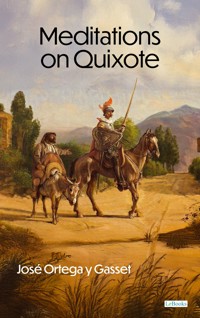
Meditations on Quixote, published in 1914, is the first major philosophical work by José Ortega y Gasset, and it marks the beginning of his distinctive intellectual path. Conceived as both a literary and philosophical essay, the book uses Cervantes's Don Quixote as a framework to explore fundamental questions about reality, art, and the human condition. Ortega does not offer a mere interpretation of the novel; rather, he turns it into a meditation on how individuals construct meaning within their circumstances and how culture emerges from the tension between imagination and reality. The work opens with Ortega's famous declaration that "I am I and my circumstance, and if I do not save it, I do not save myself." This phrase encapsulates his philosophy of vital reason, which asserts that human life cannot be understood apart from the concrete world in which it unfolds. Through Don Quixote, Ortega examines the relationship between idealism and reality: Don Quixote's adventures symbolize the human tendency to impose dreams and ideals upon a resistant world. Yet, rather than dismissing this idealism as folly, Ortega interprets it as a necessary expression of life's creative energy — the will to transcend one's condition while still being bound to it. In his meditations, Ortega also reflects on Spain's cultural identity, seeing in Don Quixote a mirror of the Spanish spirit: passionate, idealistic, and deeply introspective. He laments that Spain has often been unable to reconcile its poetic imagination with the demands of reason and progress. Thus, Meditations on Quixote becomes both a philosophical treatise and a cultural diagnosis — a call for Spain, and by extension humanity, to rediscover a balance between life, reason, and imagination. José Ortega y Gasset was a Spanish philosopher and essayist, widely regarded as one of the most influential intellectual figures of 20th-century Spain. His work is characterized by a profound reflection on culture, reason, and human life, proposing a vitalist philosophy that sought to renew European thought from a distinctly Hispanic perspective.
Das E-Book können Sie in Legimi-Apps oder einer beliebigen App lesen, die das folgende Format unterstützen:
Seitenzahl: 139
Veröffentlichungsjahr: 2025
Ähnliche















José Ortega y Gasset
MEDITATIONS ON QUIXOTE
Original Title:
“Meditaciones del Quijote”
First Edition
Contents
INTRODUCTION
PRELIMINARY MEDITATION
1 – The Forest
2 – Depth and Surface
3 – Streams and Orioles
4 – Worlds Beyond
5 – The Restoration and Erudition
6 – Mediterranean Culture
7 – What a Captain Said to Goethe
8 – The Panther, or on Sensism
9 – Things and Their Meaning
10 – The Concept
11 – Culture – Security
12 – Light as an Imperative
13 – Integration
14 – Parable
15 – Criticism as Patriotism
A SHORT TREATISE ON THE NOVEL
1 – Literary Genres
2 – Exemplary Novels
3 – The Epic
4 – Poetry of the Past
5 – The Bard
6 – Helen and Madame Bovary
7 – The Myth, Leaven of History
8 – Books of Chivalry
9 – Master Pedro’s Puppet Show
10 – Poetry and Reality
11 – Reality, Leaven of the Myth
12 – The Windmills
13 – Realistic Poetry
14 – Mime
15 – The Hero
16 – Intervention of Lyricism
17 – Tragedy
18 – Comedy
19 – Tragicomedy
20 – Flaubert, Cervantes, Darwin
INTRODUCTION
José Ortega y Gasset
1883–1955
José Ortega y Gasset was a Spanish philosopher and essayist, widely regarded as one of the most influential intellectual figures of 20th-century Spain. His work is characterized by a profound reflection on culture, reason, and human life, proposing a vitalist philosophy that sought to renew European thought from a distinctly Hispanic perspective.
Early Life and Education
Ortega y Gasset was born in Madrid into a family deeply connected to journalism and culture. He studied at the University of Deusto and the Central University of Madrid, later continuing his education in Germany, where he was influenced by neo-Kantianism and by thinkers such as Wilhelm Dilthey and Edmund Husserl. His exposure to German intellectual life played a decisive role in shaping his philosophical outlook.
Philosophy and Work
Ortega y Gasset developed a philosophy centered on the concept of vital reason, an approach that reconciles rational thought with the concrete realities of human existence. He rejected both idealism and materialism, proposing instead that “I am I and my circumstance,” one of his most famous statements, which expresses his view of the human being as inseparable from their environment and historical moment.
Among his most important works are Meditations on Quixote (1914), The Revolt of the Masses (1930), and Invertebrate Spain (1921). In The Revolt of the Masses, Ortega analyzes the rise of the “mass man,” a symbol of an age dominated by mediocrity and the decline of spiritual and cultural values, warning of the dangers this poses to civilization.
Influence and Legacy
Ortega was also a major renovator of Spanish cultural and political thought. As a professor at the University of Madrid and an active participant in Spain’s intellectual life, he became a central figure of liberal and Europeanist thought. His influence extended beyond Spain, reaching Latin America and key intellectual circles across Europe.
José Ortega y Gasset died in Madrid on October 18, 1955.
His thought—focused on the affirmation of life, culture, and individual freedom—remains a fundamental reference for understanding modernity and the existential challenges of contemporary humanity.
About the work
Meditations on Quixote, published in 1914, is the first major philosophical work by José Ortega y Gasset, and it marks the beginning of his distinctive intellectual path. Conceived as both a literary and philosophical essay, the book uses Cervantes’s Don Quixote as a framework to explore fundamental questions about reality, art, and the human condition. Ortega does not offer a mere interpretation of the novel; rather, he turns it into a meditation on how individuals construct meaning within their circumstances and how culture emerges from the tension between imagination and reality.
The work opens with Ortega’s famous declaration that “I am I and my circumstance, and if I do not save it, I do not save myself.” This phrase encapsulates his philosophy of vital reason, which asserts that human life cannot be understood apart from the concrete world in which it unfolds. Through Don Quixote, Ortega examines the relationship between idealism and reality: Don Quixote’s adventures symbolize the human tendency to impose dreams and ideals upon a resistant world. Yet, rather than dismissing this idealism as folly, Ortega interprets it as a necessary expression of life’s creative energy — the will to transcend one’s condition while still being bound to it.
In his meditations, Ortega also reflects on Spain’s cultural identity, seeing in Don Quixote a mirror of the Spanish spirit: passionate, idealistic, and deeply introspective. He laments that Spain has often been unable to reconcile its poetic imagination with the demands of reason and progress. Thus, Meditations on Quixote becomes both a philosophical treatise and a cultural diagnosis — a call for Spain, and by extension humanity, to rediscover a balance between life, reason, and imagination.
MEDITATIONS ON QUIXOTE
PRELIMINARY MEDITATION
The monastery of the Escorial rises on a hill. The south side of this hill slopes down under the covering of a grove of both oak and ash trees. The site is called “La Herreria,” the Smithy. The character of the superb gray mass of the building changes with the season, for the thick blanket of vegetation spread out at its feet is copper-hued in winter, golden in autumn and dark green in summer. Spring passes through here swiftly, instantaneously and exuberantly — like an erotic image through the steely soul of a monk. The trees are rapidly covered with luxuriant masses of leaves of a bright fresh green; the ground disappears under an emerald grass which, in its turn, is bedecked one day with the yellow of daisies, another day with the purple of lavender. There are places which enjoy a wonderful silence — which is never absolute silence. When all around is completely quiet, the noiseless void which remains must be occupied by something, and then we hear the pounding of our own hearts, the throbbing of the blood in our temples, the flow of air which floods into our lungs and then rushes out. All this is disturbing because it has too concrete a meaning. Each heartbeat sounds as if it were to be our last. The following beat which saves us always seems to come accidentally and does not guarantee the next one. That is why it is preferable to have a silence in which purely decorative, unidentifiable sounds are heard. This place is like that; it is crisscrossed by clear murmuring streams, and small birds sing amid its verdure — greenfinches, linnets, orioles, and an occasional sublime nightingale.
On one such afternoon of the fleeting spring, the following thoughts came to meet me in “La Herreria?’
1 – The Forest
How many trees make up a forest? How many houses a city? As the peasant from Poitiers sang.
La hauteur des maisons empeche de voir la ville, or, as the Germanic proverb goes, one cannot see the forest for the trees. Forest and city are two things essentially deep, and depth is fatally condemned to become a surface if it wants to be visible.
I have now around me as many as two dozen grave oaks and graceful ashes. Is this a forest? Certainly not. What I see here is some trees of the forest. The real forest is composed of the trees which I do not see. The forest is invisible nature — hence the halo of mystery its name preserves in all languages. I can now get up and take one of these blurred trails ahead of me, crisscrossed by the blackbirds. The trees which I saw before will be replaced by similar ones. The forest will be breaking up into a series of successively visible portions, but I shall never find it where I am. The forest flees from one’s eyes.
When we arrive at a small clearing in the verdure, it seems as if a man had been sitting there on a stone, with his elbows on his knees, his hands on his temples, and that just as we were arriving he had got up and left. We suspect that this man, taking a short roundabout course, has gone to take up the same position not far from us. If we yield to the desire to surprise him — to that power of attraction which the center of forests exerts on those who enter them, the scene will be repeated indefinitely.
The forest is always a little beyond where we are. It has just gone away from where we are and all that remains is its still fresh trace. The ancients, who projected their emotions into corporeal and living forms, peopled the forests with fugitive nymphs. Nothing could be more exact and expressive. As you walk along, glance quickly at a clearing in the bush and you will notice a quivering of the air as if it were hastening to fill the void left by the sudden departure of a slender, naked form.
From any spot within its borders the forest is just a possibility: a path along which we could proceed, a spring from which a gentle murmur is brought to us in the arms of silence and which we might discover a few steps away, snatches of songs sung in the distance by birds perched on branches under which we could pass. The forest is the aggregate of possible acts of ours which, when carried out, would lose their real value. The part of the forest immediately before us is a screen, as it were, behind which the rest of it lies hidden and aloof.
2 – Depth and Surface
When one repeats the sentence “one cannot see the forest for the trees,” its exact meaning is perhaps not understood. It may be that the intended joke turns its point against the speaker. The trees do not allow the forest to be seen, and it is due to this fact that the forest exists. The function of the visible trees is to make the rest of them latent, and only when we fully realize that the visible landscape is concealing other invisible landscapes do we feel that we are in a forest.
This invisibility, this being hidden, is not a merely negative quality, but a positive one which transforms the thing it hides, making a new thing of it. In this sense it is absurd to try to see the forest, as the aforementioned saying declares. The forest is the latent as such.
There is a good lesson here for those who do not see the multiplicity of individual destinies, all equally respectable and necessary, which the world contains. There are things which, when revealed openly, succumb or lose their value and, on the other hand, reach their fullness when they are hidden or overlooked. There are men who might reach complete self-fulfillment in a secondary position, but whose eagerness to occupy the forefront destroys all their worth. A contemporary novel presents a certain boy, not very intelligent but endowed with an exquisite moral sensibility, who consoles himself for being the last in his class by thinking: “After all, someone has to be the last!” This is a good remark, good enough to guide us. There may be as much nobility in being last as in being first, because the two positions are equally necessary in the world, the one to complement the other.
Some men refuse to recognize the depth of something because they demand that the profound should manifest itself in the same way as the superficial. Not accepting the fact that there may be several kinds of clarity, they pay exclusive attention to the clarity peculiar to surfaces. They do not realize that to be hidden beneath the surface, merely appearing through it, throbbing underneath it, is essential to depth.
To ignore the fact that each thing has a character of its own and not what we wish to demand of it, is in my opinion the real capital sin, which I call a sin of the heart because it derives its nature from lack of love. There is nothing so illicit as to dwarf the world by means of our manias and blindness, to minimize reality, to suppress mentally fragments of what exists. This happens when one demands that what is deep should appear in the same way as what is superficial. No, there are things which present only that part of themselves which is strictly necessary to enable us to realize that they lie concealed behind it. In order to find evidence of this, it is not necessary to mention anything very abstract. All deep things are similarly constituted. The material objects which we see and touch, for example, have a third dimension which constitutes their depth, their inwardness. However, we do not see or touch this third dimension. We find on their surfaces, it is true, suggestions of something which lies within; but what is within can never come forth and become visible in the same way as what is without. It will be useless for us to begin to break up the third dimension into superficial layers: no matter how thin the slices may be, the layers will always have some thickness, that is to say, some depth, some invisible, intangible inwardness. And if we succeed in obtaining layers so thin that our eyes can see through them, then we do not see either the depth or the surface, but a perfect transparency, or, what is the same thing, nothing. For just as depth needs a surface beneath which to be concealed, the surface or outer cover, in order to be so, needs something over which to spread, covering it.
This truth is all too obvious, but it is not completely useless, because there are still some people who demand that we make them see everything as clearly as they see an orange before their eyes. But actually, if seeing is understood as a merely sensorial function, neither they nor anyone else has ever seen an orange in their terms. The latter is a spherical body, therefore with an obverse and a reverse. Can anybody claim to have the obverse and the reverse of an orange in front of him at the same time? With our eyes we see one part of the orange, but the entire fruit is never presented to us in a perceptible form; the larger portion of the orange is concealed from our eyes.
There is no need, therefore, to have recourse to subtle and metaphysical matters to indicate that things have different ways of presenting themselves, but each one in its own way is equally clear. What is seen is not the only thing that is clear. The third dimension of a body is offered to us with as much clarity as the other two dimensions, and yet things or certain of their qualities would not exist for us if there were no other methods of seeing than the passive method of vision in the strict sense.
3 – Streams and Orioles
Our thought is now a dialectical faun pursuing the essence of the forest as if it were chasing a fleeing nymph. In contact with the naked body of an idea it experiences a sort of amorous delight. Having recognized as the fleeting nature of the forest, always absent, always concealed — an ensemble of possibilities — our idea of the forest is not yet complete. If the deep and latent is to exist for us it must manifest itself to us, and do so in such a form that it does not lose its depth or its latency. As I said before, depth suffers the inevitable fate of showing itself through superficial features. Let us see how it does so.
This water which is flowing at my feet complains gently as it strikes the pebbles and forms a curved arm of crystal around the root of this oak tree. Just now an oriole has entered the oak tree as a king’s daughter enters her palace. From the oriole’s throat comes a deep warble, so musical that it seems a note snatched from the nightingale’s song, a short sudden sound which fills the visible area of the forest completely for an instant, just as a pang of sorrow suddenly fills the area of our consciousness.




